The Four Tools of Influence
Sama, Dana, Bheda, Danda
Kautilya's famous Chaturnaya - the four methods of achieving goals - isn't a license for manipulation. It's a framework for using the right tool for the right situation, always exhausting peaceful means before escalating to force.
The Stubborn Feudatory
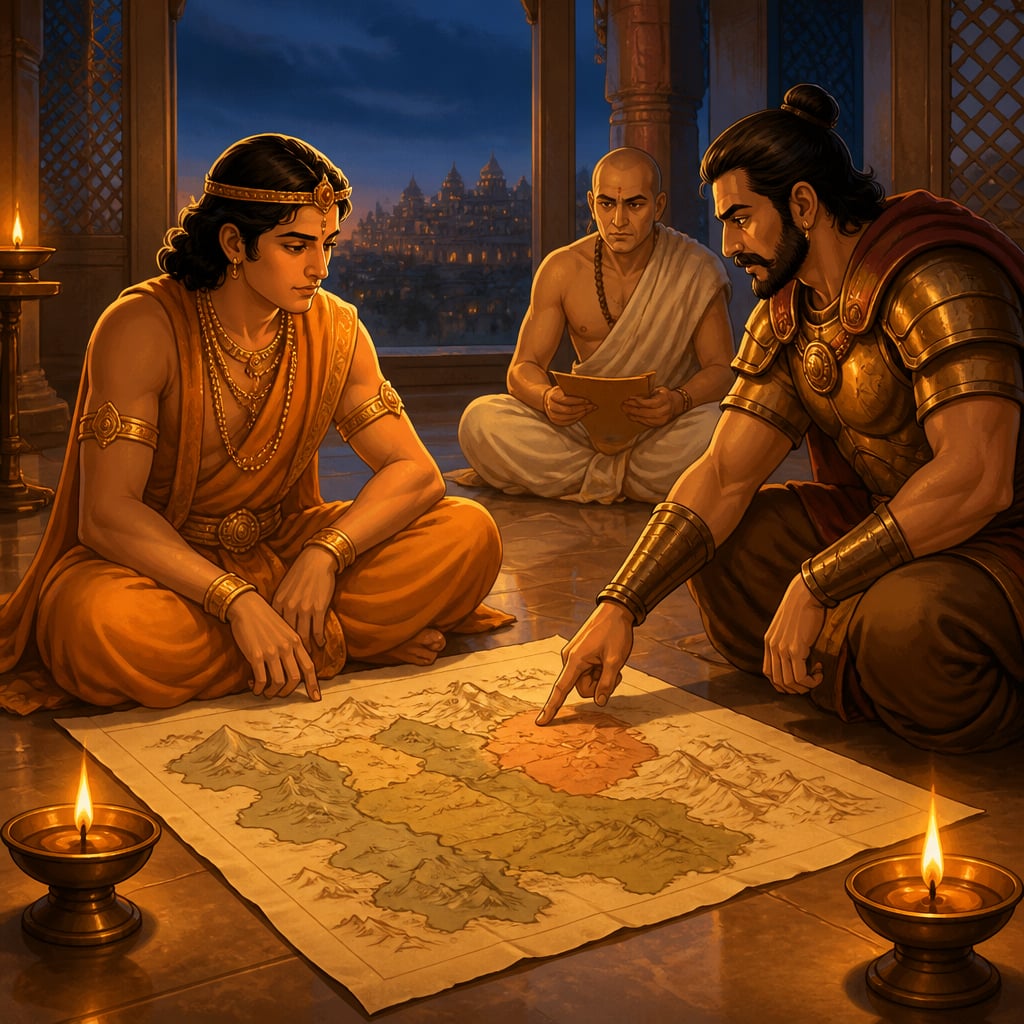
Chandragupta Maurya studied the map spread across the council chamber floor. One region refused to submit - a minor kingdom whose raja had fortified his capital and sworn never to bow to the Mauryas.
"We could crush them in a month," offered General Bhadrabahu. "Their walls are strong, but our siege engines are stronger."
Kautilya, seated in the corner, spoke quietly. "And how many of our soldiers would die taking those walls? How many fields would burn? How many widows would curse the Mauryan name?"
Chandragupta waited. He had learned to wait for his teacher's wisdom.
"There are four ways to achieve any goal," Kautilya continued. "A wise ruler knows all four - and knows which to use when."
This was the moment the Chaturnaya - the doctrine of the four upayas (methods) - entered the strategic education of India's greatest emperor.
The Four Methods
Kautilya's framework is elegant in its simplicity:
"सामादीनामुपायानां चतुर्णां प्रथमं समः" "Of the four methods beginning with Sama, conciliation is the first."
Sama (साम) - Conciliation, persuasion, negotiation. Appeal to reason, shared interests, mutual benefit.
Dana (दान) - Gifts, incentives, rewards. Offer something valuable to secure cooperation.
Bheda (भेद) - Division, creating dissension. Separate enemies from their allies. Exploit internal conflicts.
Danda (दण्ड) - Force, punishment, coercion. The last resort when all else fails.
The order matters. Kautilya insists that peaceful methods must be exhausted before escalation. This isn't idealism - it's hard-headed pragmatism. War is expensive. Coercion breeds resentment. The cooperation you win through persuasion is more durable than submission extracted by force.
Sama: The Art of Persuasion
Back to the stubborn feudatory. Kautilya sent an envoy - not with threats, but with an invitation.
"The Mauryan emperor respects your independence," the envoy told the raja. "He seeks alliance, not conquest. Join us, and your family will rule this land for generations under our protection. Trade routes will open. Your merchants will prosper. Your enemies will become our enemies."
Sama works by aligning interests. It answers the question: What does the other party actually want? Often, what looks like opposition is really fear - fear of loss, humiliation, or irrelevance. Address the fear, and resistance melts.

Modern parallel: When Warren Buffett acquires companies, he doesn't force hostile takeovers. He persuades owners that Berkshire Hathaway will preserve their legacy, keep their management, and let them do what they love - without the pressures of quarterly earnings. Sama in action.
Dana: Strategic Generosity
The feudatory was intrigued but suspicious. Generations of conflict had taught him to distrust powerful neighbors.
Kautilya's next move: send gifts. Not bribes - that would insult the raja's honor. Rather, genuine expressions of respect. Rare horses from the northwest. A master craftsman to repair the ancient temple in the raja's capital. A scholar to tutor his son.
"दानं वश्यकरं लोके" "Gifts bring people under one's influence."
Dana creates obligation and goodwill. It demonstrates capability ("We have resources to share") and intention ("We want to benefit you"). The gifts told the raja: alliance with the Mauryas brings tangible benefits.
Modern parallel: Singapore's diplomacy under Lee Kuan Yew used dana masterfully. A tiny nation surrounded by larger neighbors, Singapore offered training programs, scholarships, and technical assistance to build goodwill. Today, Singapore punches far above its weight in regional influence - not through threats, but through being genuinely useful.
Bheda: Strategic Division
The feudatory still hesitated. His chief minister whispered that the Mauryas would absorb them eventually. Better to resist now than submit to slow digestion.
Kautilya's intelligence network had identified this minister as the obstacle. He was ambitious, resentful of the raja's family. Kautilya's agents didn't attack him directly. Instead, they let slip to the raja that his minister had been in secret contact with a rival kingdom.
True or not, the seed of doubt was planted. The minister's influence waned. Other advisors, who favored alliance, gained the raja's ear.
Bheda doesn't always mean deception. Often it means identifying who truly opposes you and isolating them from their support. The feudatory's resistance wasn't monolithic - it was driven by specific individuals with specific interests. Neutralize those individuals, and resistance collapses.

Modern parallel: During the Cuban Missile Crisis, Kennedy's team used bheda against the Soviet leadership. Rather than treating the USSR as a monolith, they identified Khrushchev as someone who could be reasoned with - and gave him a face-saving exit that his hardliners couldn't block. The crisis was resolved not by force, but by driving a wedge between Soviet moderates and hawks.
Danda: The Last Resort
But what if all else fails?
Kautilya was clear: danda exists, and sometimes it must be used. The world contains genuine enemies who cannot be persuaded, bought, or divided. Against them, force is not just permitted - it's necessary to protect the innocent.
"दण्डः शास्ति प्रजाः सर्वाः दण्ड एवाभिरक्षति" "Danda governs all people; Danda alone protects them."
But - and this is crucial - danda used prematurely destroys your credibility for sama. If you're known as someone who jumps to force, no one will negotiate with you. They'll assume your offers are traps. Every future sama attempt will be viewed with suspicion.
The Mauryan empire grew not primarily through conquest, but through the credible threat of conquest combined with attractive offers of alliance. Most kingdoms joined voluntarily because the alternative was clear, but the first choice was always peace.
The Escalation Ladder
Kautilya's genius was recognizing that the four methods form an escalation ladder:
- Start with Sama - Always try persuasion first
- Add Dana - If persuasion alone fails, sweeten the offer
- Introduce Bheda - If incentives don't work, divide opposition
- Resort to Danda - Only when everything else has failed
This isn't weakness. It's wisdom. Each step preserves the option of returning to negotiation. Each step demonstrates good faith. Each step makes your eventual use of force (if necessary) more legitimate - because everyone can see you tried everything else first.
Your Turn
Think of a goal you're pursuing right now - at work, in your family, in your community. Someone stands in your way.
Before reaching for pressure tactics, ask:
Sama: Have you really understood what they want? Have you shown them how cooperation benefits them?
Dana: Have you offered anything valuable? Not bribes, but genuine help with their problems?
Bheda: Is your opposition truly unified, or are there allies waiting to be cultivated? Who actually drives the resistance?
Danda: If force becomes necessary, have you exhausted alternatives so thoroughly that everyone - including yourself - can see it was the last resort?
The stubborn feudatory, by the way, eventually joined the Mauryan alliance voluntarily. His treasury grew. His borders became secure. His grandson married into the imperial family. Sometimes the best victories are the ones where no one loses.
Modern conflict theory emphasizes 'escalation ladders' and the importance of giving opponents face-saving exits. Game theorists note that rushing to punishment destroys future cooperation possibilities.
Kautilya integrates this insight into a complete doctrine. He doesn't just say 'try negotiation' - he provides four distinct tools and specifies their sequence. The framework is actionable, not just advisory.
The Mauryan empire's expansion was primarily diplomatic. Most kingdoms joined through alliance (sama/dana) rather than conquest (danda). This created a more stable empire than pure military conquest would have.
Robert Cialdini's research on influence confirms reciprocity as one of the most powerful persuasion principles. People feel obligated to return favors. Soft power theorists (Joseph Nye) emphasize attraction over coercion.
Kautilya specifies dana as the second method - to be used when sama alone isn't sufficient. This prevents both premature gift-giving (which seems manipulative) and skipping straight to pressure (which misses opportunities).
Singapore's diplomacy under Lee Kuan Yew used dana masterfully - offering training, scholarships, and technical assistance to neighbors. A tiny nation became disproportionately influential through genuine helpfulness.
Negotiation theorists emphasize 'going behind the table' - understanding the internal dynamics of the opposing party. Coalition warfare strategy focuses on separating enemies from allies rather than fighting united fronts.
Kautilya provides specific guidance on identifying which opponents can be divided and how. He analyzes different types of allies and their vulnerabilities. The framework is diagnostic, not just prescriptive.
Kennedy's handling of the Cuban Missile Crisis involved treating the Soviet leadership not as a monolith but as containing moderates (Khrushchev) and hawks. The resolution came by giving the moderates a face-saving exit the hawks couldn't block.
Verses
सामादीनामुपायानां चतुर्णां प्रथमं समः
sāmādīnām upāyānāṃ caturṇāṃ prathamaṃ samaḥ
Of the four methods beginning with Sama, conciliation is the first.
The sequence matters morally and practically. Kautilya doesn't list the methods randomly - he insists peaceful persuasion must be the starting point.
Book 2, Chapter 10, Verse 47 (R.P. Kangle)
दानं वश्यकरं लोके दानेन वश्यते जगत्
dānaṃ vaśyakaraṃ loke dānena vaśyate jagat
Gifts bring people under influence; by giving, the world is won over.
Dana isn't bribery - it's strategic generosity that creates reciprocal obligations and demonstrates goodwill. Kautilya understood that people respond to genuine benefit, not just rational argument.
Book 9, Chapter 6, Verse 56-58 (L.N. Rangarajan)
दण्डः शास्ति प्रजाः सर्वाः दण्ड एवाभिरक्षति
daṇḍaḥ śāsti prajāḥ sarvāḥ daṇḍa evābhirakṣati
Danda governs all people; Danda alone protects them.
Force exists and sometimes must be used. Kautilya was no pacifist - he recognized that the world contains genuine threats that cannot be persuaded or bought.
Book 1, Chapter 4, Verse 3 (R. Shamasastry)
Case studies
The Cuban Missile Crisis
In October 1962, the US discovered Soviet nuclear missiles in Cuba. President Kennedy faced a choice: air strikes (danda), which risked nuclear war, or some combination of other methods. The world came closer to nuclear annihilation than ever before or since.
Kennedy used all four methods in combination. Sama: private letters to Khrushchev establishing dialogue. Dana: offering to remove US missiles from Turkey. Bheda: identifying Soviet moderates and giving them a face-saving exit. Danda: naval quarantine and credible threat of invasion - but not immediate attack.
Khrushchev withdrew the missiles. Nuclear war was averted. The crisis led to the hotline between Washington and Moscow - institutionalizing sama for future conflicts.
Even at nuclear stakes, the chaturnaya framework applies. Kennedy's restraint - using danda as credible threat rather than immediate action - gave diplomacy time to work. Skipping to force would have been catastrophic.
The 2015 Iran nuclear deal (JCPOA) followed the same graduated approach: economic pressure (bheda through sanctions), diplomatic engagement (sama through negotiations), and military threat held in reserve (danda as backdrop). Its partial success and later collapse illustrate both the power and fragility of multi-method strategy.
The Cuban Missile Crisis lasted 13 days in October 1962. Soviet missiles in Cuba were 90 miles from the U.S. coast with a flight time of under 5 minutes. Kennedy's naval blockade involved 180 ships monitoring a 500-mile arc.
Historical context
c. 4th century BCE
India in Kautilya's time was fragmented into competing kingdoms. The Nanda dynasty ruled Magadha through brute force and heavy taxation. Alexander's invasion had just demonstrated that even powerful kingdoms could fall to superior strategy. In this environment, Kautilya developed his framework for building a stable empire through intelligent combination of methods.
The chaturnaya doctrine emerged from the chaos of competing kingdoms and demonstrated that strategic sophistication - not just military power - determines success. Kautilya's insight that peaceful methods should be exhausted first reflects his belief that governance serves the people, not the ruler's ego.
Living traditions
Kautilya's four methods are taught in business schools worldwide under names like 'negotiation strategy' and 'stakeholder management.' The Indian Foreign Service training includes study of the chaturnaya. Management consultants reference the escalation ladder in conflict resolution frameworks. The principle that peaceful methods should precede coercion is now embedded in international law and diplomatic protocol.
- Diplomatic Protocol: Modern diplomacy's escalation from dialogue to sanctions to military options mirrors Kautilya's sama-dana-bheda-danda sequence
- Kumrahar Archaeological Site: Remains of the Mauryan assembly hall where Chandragupta and Kautilya likely discussed strategy. The pillared hall hosted debates on governance.
- Patna Museum: Houses Mauryan-era artifacts including the famous Didarganj Yakshi, providing context for the period when Kautilya's strategies shaped an empire
Reflection
- Think of a current goal where someone stands in your way. Have you genuinely tried sama - understanding their perspective and finding mutual benefit?
- Why do you think Kautilya insisted on sequencing - sama first, then dana, then bheda, then danda? What is lost when we skip steps?
- How does the chaturnaya framework differ from Machiavellian 'by any means necessary'? What ethical principle underlies Kautilya's sequencing?