Dana: Strategic Generosity
Building Influence Through Giving
The second method - dana - isn't bribery. It's the sophisticated art of creating genuine value for others while advancing shared goals. Kautilya understood that strategic generosity builds durable influence, while transactional exchange creates only temporary compliance.
The Gift That Changed History
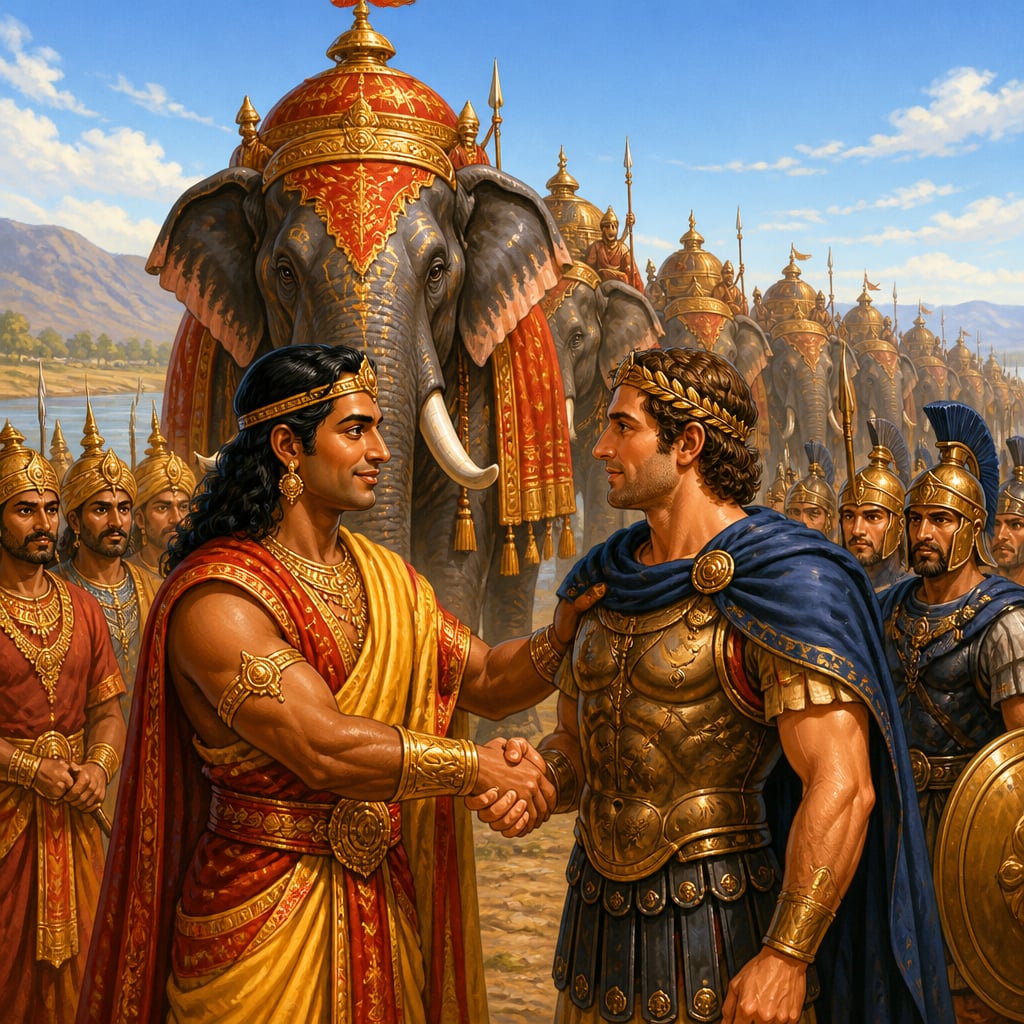
Seleucus Nicator had marched east with sixty thousand men. The successor to Alexander's eastern empire, he intended to reclaim the territories his predecessor had conquered. India would bow again.
But Chandragupta Maurya's armies were larger, better organized, and fighting on home ground. After two years of inconclusive warfare, Seleucus faced a choice: continue bleeding his forces in an unwinnable war, or negotiate.
The treaty that followed was masterstroke of dana.
Chandragupta didn't just demand territory. He offered Seleucus something valuable: five hundred war elephants - the ancient world's most devastating military asset. In exchange, Seleucus ceded the eastern provinces and gave his daughter in marriage.
"दानं हि बलवत् लोके" "Giving is powerful in this world."
Those elephants helped Seleucus win the Battle of Ipsus, securing his western domains. The marriage created lasting friendship. What began as confrontation became alliance - not through Mauryan force, but through Mauryan generosity.
Watching from Pataliputra, Kautilya smiled. This was dana at its finest.
Dana Beyond Bribery
Dana is often mistranslated as "gifts" or even "bribery." This misses the point.
Kautilya distinguishes between:
Utkoca (bribery) - Paying someone to act against their duty or interests. Corrupting.
Dana (strategic generosity) - Giving something valuable to align interests and create goodwill. Strengthening.
The difference isn't just moral - it's practical. Bribery creates dependence and resentment. The bribed official serves you only as long as you keep paying, and secretly despises the relationship. Dana creates genuine gratitude and partnership. The recipient benefits, and the relationship becomes self-sustaining.
The Five Types of Dana
Kautilya catalogued different forms of strategic giving:
Material gifts - Money, land, goods. Tangible value that demonstrates capability and intention.
Honors and titles - Recognition, status, praise. Meeting the need for respect and acknowledgment.
Positions and offices - Giving meaningful work that serves their ambition while advancing your goals.
Assistance in trouble - Helping when they're vulnerable. Creating bonds of profound gratitude.
Sharing information - Intelligence, opportunities, connections. Demonstrating trust and enabling their success.
The master of dana reads what each person values and gives accordingly. Some want wealth; others crave recognition; still others seek opportunity. The same gift may delight one person and insult another.
The Reciprocity Principle
Dana works because of a deep human truth: we feel obligated to those who help us.
Robert Cialdini's research on influence identifies reciprocity as one of the most powerful psychological forces. Gifts create an "debt" that people feel compelled to repay - not transactionally, but through ongoing goodwill and cooperation.
Kautilya understood this intuitively. His dana wasn't charity - it was investment in relationships that would pay dividends for generations.

Ratan Tata's philanthropy follows this pattern. Tata companies have given billions to education, healthcare, and community development. The result isn't just goodwill - it's a deep reservoir of trust that protects the brand through crises and enables business in communities across India.
Dana as Capability Signal
Generous giving sends important messages:
"We have resources" - Only the strong can afford to give. Dana demonstrates surplus and capability.
"We choose to help you" - The gift is voluntary, not coerced. This implies genuine goodwill.
"We see long-term relationship" - Short-term thinkers don't invest in others. Dana signals commitment to ongoing partnership.
"We understand your needs" - A well-chosen gift shows you've paid attention to what they value.
When Singapore offers training programs to its neighbors, it's not just generosity - it's a demonstration of capability and commitment that builds influence far beyond the program's direct impact.
The Gift That Backfires
Not all giving works. Kautilya warned against dana that:
Insults the recipient - Giving to someone who doesn't need it or in a way that implies they're inferior.
Creates suspicion - Excessive or unexpected generosity makes people wonder about your motives.
Enables bad behavior - Giving to those who will use it against you or others.
Depletes your resources - Dana requires surplus. Giving what you can't afford weakens you.
The story of Dhana Nanda illustrates failed dana. He tried to buy loyalty from officials who despised him, showering gifts on those who were already plotting betrayal. His giving came from weakness, not strength - and everyone knew it.
Modern Dana: Soft Power
Joseph Nye coined "soft power" - influence through attraction rather than coercion. Dana is soft power's ancient form.

Japan's development assistance transformed its image from wartime aggressor to generous partner. Japanese ODA built infrastructure across Asia, creating goodwill that supports Japanese business and diplomacy decades later.
The Gates Foundation spends billions on global health. The result: Bill Gates is one of the most trusted figures in global development, with influence far exceeding what money could buy directly.
Google's free products - Search, Gmail, YouTube - built a user base of billions before monetization. Strategic generosity created a platform that now generates $200 billion annually.
In each case, giving created influence that couldn't be purchased directly.
Dana in Negotiations
Kautilya used dana within the negotiation process:
Concession as gift - Giving up something the other party values shows good faith and creates reciprocal pressure.
Sweetening offers - When sama alone doesn't work, adding dana often tips the balance.
Demonstrating value - A small gift during negotiation shows what partnership could bring.
Breaking deadlocks - Sometimes a generous gesture shifts the emotional tenor from adversarial to collaborative.
The Chandragupta-Seleucus treaty worked because the elephant gift transformed the relationship. Seleucus wasn't just accepting terms - he was entering a partnership that would benefit him for years.
The Dana Mindset
Effective dana requires specific attitudes:
Genuine generosity - People sense when giving is manipulative. Dana works only when the benefit to the recipient is real.
Long-term thinking - The return on dana isn't immediate. You're investing in relationships, not buying transactions.
Abundance orientation - You must believe you have enough to share. Scarcity thinking poisons dana.
Strategic clarity - Random giving disperses resources. Effective dana is targeted at those whose goodwill matters.
Your Turn
Think about someone whose cooperation you need - a colleague, client, family member, neighbor.
What do they actually need? Not what you'd like to give, but what they'd value receiving.
What can you offer? Your time, expertise, connections, resources, recognition?
How can you give without strings? The power of dana comes from its unconditional nature. Give because giving is good, not because you expect immediate return.
What relationship do you want to build? Dana creates relationships, not transactions. What kind of ongoing partnership would serve both of you?
The five hundred elephants that Chandragupta sent west were never "repaid" in any transactional sense. But they created an alliance that lasted generations, kept the Mauryan western border secure, and demonstrated to the world that India's new empire was both powerful and generous. That's dana at its best.
Keith Ferrazzi's 'Never Eat Alone' teaches building relationships through generosity before you need them. Adam Grant's 'Give and Take' shows that 'givers' often outperform 'takers' in long-term success.
Kautilya integrates dana into a sequenced framework. It's not random generosity but strategic deployment - used when sama needs reinforcement, targeted at those whose goodwill matters most.
The Mauryan alliance network was built through proactive dana - helping smaller kingdoms before asking anything in return. When threats emerged, these allies supported Pataliputra not from obligation but from genuine friendship.
Marketing distinguishes between features (what you offer) and benefits (what they value). The same principle applies to dana - what matters is perceived value to the recipient, not your cost or effort.
Kautilya's five categories of dana (material, honors, positions, assistance, information) recognize that people value different things. The skilled practitioner reads what each counterpart needs.
Chandragupta didn't give Seleucus gold or territory - he gave war elephants, exactly what Seleucus needed to win his western battles. The gift was perfectly calibrated to the recipient's actual situation.
Political science distinguishes between legitimate influence (based on persuasion and mutual benefit) and corruption (based on payoffs). Both 'work' in the short term, but only the former is sustainable.
Kautilya explicitly distinguishes dana from utkoca (bribery). The distinction isn't moralistic - it's practical. Bribery creates relationships that collapse under pressure; dana creates relationships that strengthen over time.
Dhana Nanda tried to maintain power through utkoca - paying officials to stay loyal. They took his money and defected anyway. Chandragupta built loyalty through genuine partnership, and his officials remained steadfast through crisis.
Verses
अर्थस्य च प्रयोगः दानम्
arthasya ca prayogaḥ dānam
Dana is the application of wealth.
Wealth isn't just for hoarding or consumption - it's for strategic deployment. Dana is wealth put to work building relationships and influence.
Book 2, Chapter 10, Verse 50 (R.P. Kangle)
दानं हि बलवत् लोके दानेन सुहृदो भवेत्
dānaṃ hi balavat loke dānena suhṛdo bhavet
Giving is powerful in this world; through giving, one gains friends.
Dana creates suhrd - genuine well-wishers, not just transactional allies. This is stronger than sama alone because it creates emotional bonds alongside rational alignment.
Book 7, Chapter 6, Verse 24-25 (L.N. Rangarajan)
यस्य अर्थाः तस्य मित्राणि यस्य मित्राणि तस्य बलम्
yasya arthāḥ tasya mitrāṇi yasya mitrāṇi tasya balam
He who has resources has friends; he who has friends has power.
This sutra reveals the logic chain: resources enable dana, dana creates friends, friends constitute power. Wealth matters not as an end but as means to build relationships that amplify your influence far beyond what money alone could buy.
Book 9, Chapter 4, Verse 10-12 (R. Shamasastry)
Case studies
Japan's Post-War Development Assistance
After World War II, Japan faced deep hostility from Asian neighbors who had suffered under occupation. Rather than waiting for forgiveness, Japan embarked on massive development assistance programs across Asia - building infrastructure, providing technical training, and investing in education.
Japan used dana at national scale. The giving was genuinely valuable - roads, hospitals, schools that benefited recipients. It demonstrated capability (Japan had recovered), positive intention (choosing to help rather than hoard), and long-term commitment (ongoing programs, not one-time gifts).
Over decades, Japan transformed its regional reputation. Countries that had suffered under occupation became Japan's trading partners and diplomatic allies. Japanese soft power in Asia now exceeds that of much larger countries.
Strategic dana can transform even deeply damaged relationships. Japan's generosity wasn't charity - it was sophisticated relationship investment. The same principle works at any scale: genuine giving creates trust that no amount of persuasion or payment could buy directly.
China's Belt and Road Initiative follows a similar strategic logic, using infrastructure investment and development financing to build relationships across Asia, Africa, and Latin America. Whether it achieves Japan's success depends on whether recipient nations perceive genuine mutual benefit or extractive intent.
Japan's Official Development Assistance totaled over $390 billion (cumulative) from 1960 to 2020, making it the largest bilateral donor in Asia. By the 2010s, Japan's favorability rating in Southeast Asia exceeded 80%.
Historical context
c. 4th century BCE
The early Mauryan period saw strategic gift-giving become diplomatic policy. Chandragupta and Kautilya understood that India's emergence as a major power required building alliances across the known world. Dana was the primary tool for this international relationship-building.
The Mauryan-Seleucid alliance demonstrates dana's strategic power. What could have remained an adversarial relationship became a partnership that benefited both empires for generations. This model - turning enemies into friends through generous giving - remains relevant in diplomacy, business, and personal life.
Living traditions
Dana principles permeate modern philanthropy and soft power strategy. Bill Gates's approach to global health, Japan's development assistance, Singapore's neighborhood diplomacy - all echo Kautilyan insight that strategic generosity builds influence more durably than transaction or coercion. Corporate reputation increasingly depends on perceived generosity and social contribution.
- Corporate Social Responsibility: Modern CSR programs echo Kautilyan dana - strategic giving that builds goodwill, trust, and long-term relationships with communities and customers
- Tata Central Archives: Documents over a century of Tata philanthropy, demonstrating how systematic dana built one of India's most trusted business houses. Includes records of hospitals, universities, and research institutions founded through Tata generosity.
- Indian Institute of Science: Founded through Jamsetji Tata's vision and generosity, IISc exemplifies how dana creates lasting institutions. The campus itself is a testament to strategic philanthropy.
Reflection
- Think of your most valuable relationships. How many were built through your generosity versus theirs? What does this tell you about how influence is created?
- What distinguishes genuine dana from manipulative giving? How do you know when generosity is authentic versus calculated?
- Kautilya distinguishes dana from bribery (utkoca). Where is the ethical line? Can strategic generosity ever become corruption?