Sama: The Art of Persuasion

Winning Through Understanding

The first method - sama - isn't weakness or mere talking. It's the sophisticated art of finding common ground, addressing real concerns, and creating genuine alignment. Kautilya understood that persuasion achieved through understanding is more durable than any victory won through force.

The Ambassador's Gambit
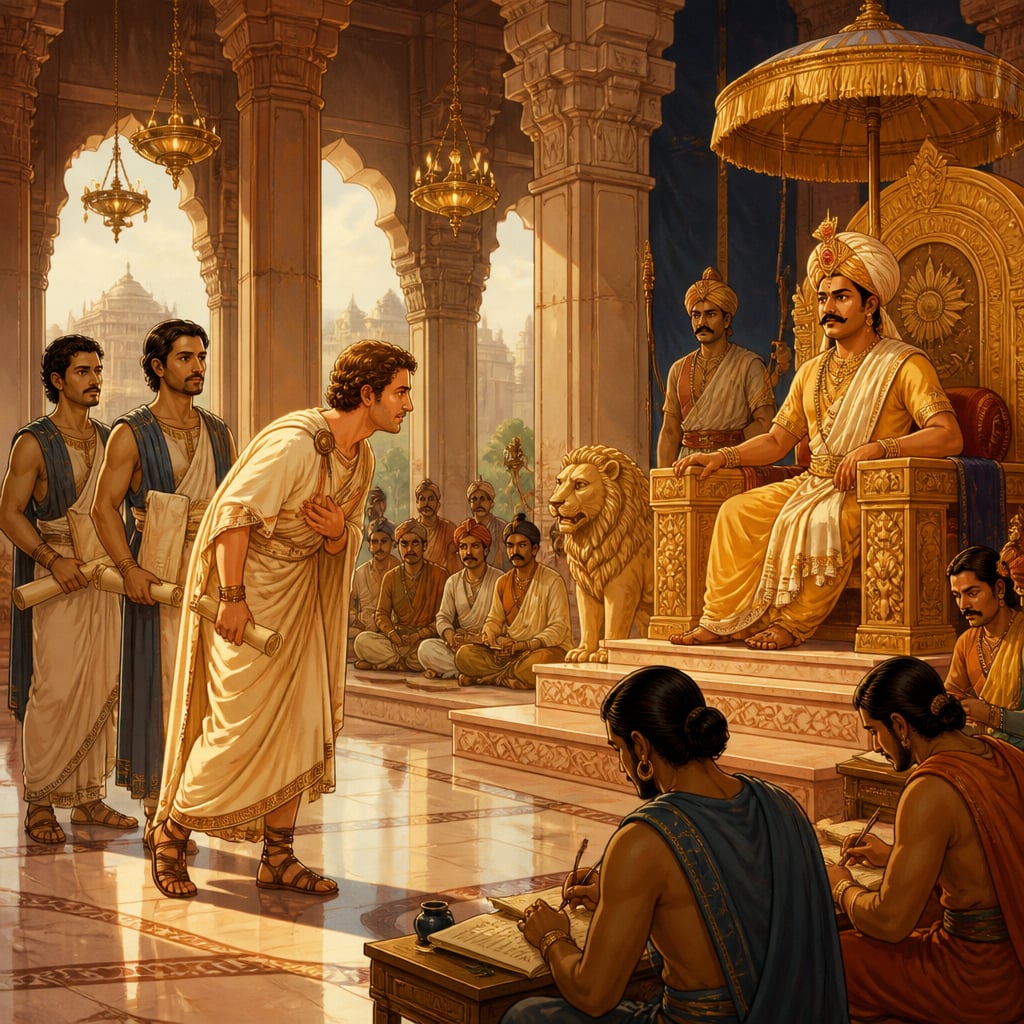
Megasthenes the Greek ambassador arriving at the Mauryan court at Pataliputra

Megasthenes, the Greek ambassador, arrived at Pataliputra expecting barbarians. What he found amazed him.

The Mauryan court operated with a sophistication that rivaled - perhaps exceeded - anything in the Hellenistic world. Ministers debated policy in structured councils. Judges applied written law. The emperor held daily public audiences where any citizen could bring grievances.

But what struck Megasthenes most was how the empire had grown. "They have expanded not primarily through conquest," he wrote, "but through the art of bringing others into willing alliance."

Watching from the shadows was an old man who had designed this system. Kautilya had made sama - conciliation, persuasion, diplomatic skill - the foundation of Mauryan statecraft. He knew something that emperors often forget: the easiest person to defeat is the one who never becomes your enemy.

What Sama Really Means

Sama is often translated as "conciliation" or "negotiation." These words miss its depth.

"समः समत्वात् साम्यं च समयो मित्रभावनम्" "Sama comes from sameness - creating equality, agreement, and the feeling of friendship."

The root sam means "together, equal, same." Sama isn't just talking - it's creating a state of psychological alignment where the other party genuinely feels their interests are understood and addressed.

Kautilya broke sama into specific techniques:

Praising virtues - Acknowledge what the other party does well Showing connection - Emphasize shared interests, history, values Indicating benefits - Explain how cooperation serves their goals Addressing fears - Identify and neutralize their concerns Creating face - Allow them dignity in agreeing

Notice what's missing: manipulation, deception, false promises. Sama works precisely because it's genuine.

The Kalinga Calculation

Before the famous Kalinga war that broke Ashoka's heart, Kautilya had advised a different approach.

Kalinga was wealthy, strategically located, and fiercely independent. Chandragupta wanted it. Kautilya counseled patience.
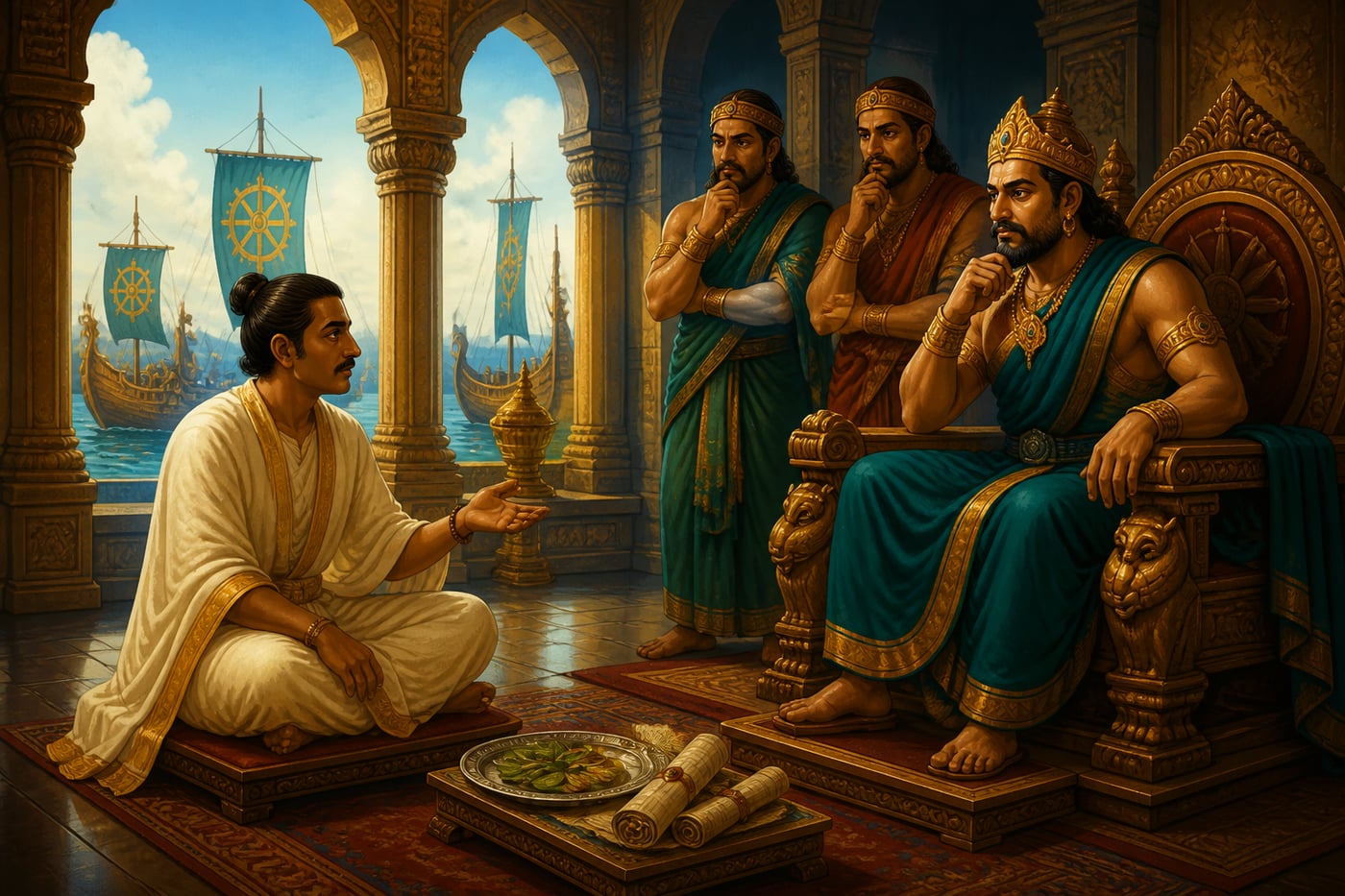
Mauryan envoy presenting a treaty proposal at the Kalinga royal court

"What does Kalinga's king actually want?" Kautilya asked. "He fears absorption. He values independence above all. So we offer what he values."

The proposal: Kalinga keeps its king, its laws, its identity. The Mauryas guarantee protection from common enemies. Trade routes open. Kalingan merchants prosper. In exchange, Kalinga coordinates foreign policy with Pataliputra and contributes troops during war.

"But we could conquer them," Chandragupta protested.

"And then rule an resentful population that remembers its independence. Every tax collector needs an armed guard. Every policy faces resistance. You win the land but lose the people."

Kalinga accepted. For a generation, it was a loyal ally - until Ashoka, ignoring his grandfather's wisdom, chose conquest over conciliation.

The Psychology of Sama

Kautilya understood something modern negotiators rediscovered: people don't resist proposals; they resist the feeling of being forced.

When someone feels:

The same agreement feels different when it's "imposed" versus "chosen." Sama creates the conditions for genuine choice.

Chris Voss, former FBI hostage negotiator, teaches the same principle: "Tactical empathy. Your counterpart wants to be understood. Give them that, and you've done 90% of the work."

The Three Levels of Sama

Kautilya recognized that sama operates at multiple levels:

Level 1: Rational Appeal Explain the logical benefits of cooperation. "If we ally, we both gain trade routes, security, and influence." This works when both parties are rational and information is clear.

Level 2: Emotional Connection Create bonds of affection, loyalty, shared identity. "Our peoples have traded for generations. Our temples honor the same gods. We are natural friends." This works when reason alone isn't sufficient.

Level 3: Identity Alignment Make cooperation part of who they are. "Joining the Mauryan alliance makes you part of the most prestigious power in the subcontinent. Your enemies will fear you. Your friends will respect you." This creates durable commitment that survives changing circumstances.

The master diplomat moves fluidly between levels, reading what each counterpart needs.

When Sama Fails

Sama doesn't always work. Kautilya was clear about its limits:

Genuine enemies - Some parties have interests fundamentally opposed to yours. No amount of understanding will change this.

Bad faith actors - Some will use negotiation as a delay tactic while preparing attack. Sama requires reciprocal good faith.

Zero-sum situations - When one party's gain necessarily means another's loss, no "common ground" exists to find.

Power imbalances - The weak cannot negotiate as equals with the strong. Sama works best between parties of roughly equal power.

Recognizing these limits is wisdom, not cynicism. Kautilya's genius was knowing when to try sama - and when to move to dana or bheda.

Modern Sama: Negotiation Science

Modern research confirms Kautilya's insights:

Harvard Negotiation Project - "Getting to Yes" teaches interest-based negotiation: focus on underlying interests, not stated positions. This is sama in academic language.

Fisher and Ury's principles:

Every principle maps to Kautilyan sama.

Satya Nadella leading a culture-change discussion at Microsoft Redmond

Satya Nadella transformed Microsoft from a culture of internal competition to collaboration. His method? Understanding what people actually wanted (impact, recognition, growth) and showing how cooperation delivered it better than competition. Sama at corporate scale.

The Sama Mindset

Sama requires a specific psychological orientation:

Curiosity over judgment - Ask "why do they want this?" before deciding they're wrong to want it.

Long-term over short-term - The relationship matters more than any single negotiation.

Abundance over scarcity - Look for ways to expand the pie, not just divide it.

Respect over contempt - Even difficult counterparts have legitimate interests worth understanding.

This mindset isn't naive. Kautilya paired it with clear-eyed analysis of when sama wouldn't work. But when it can work, it's always the preferred method.

Your Turn

Think of a relationship where you're currently in conflict - at work, in your family, with a neighbor.

Step 1: Map their interests - What do they actually want? Not their position ("I want X"), but their underlying interests ("I want to feel respected/secure/successful").

Step 2: Find common ground - Where do your interests overlap? What do you both want from this relationship?

Step 3: Address their fears - What are they afraid will happen if they cooperate with you? How can you genuinely address those concerns?

Step 4: Create face - How can they agree without feeling like they've lost or surrendered?

Megasthenes left India convinced that the Mauryas had discovered something valuable - a way of building power that didn't require constant warfare. The method was sama. The insight was that understanding your counterpart isn't weakness. It's the foundation of durable influence.

Harvard's 'Getting to Yes' framework distinguishes positions (what people say they want) from interests (why they want it). This distinction is central to modern negotiation theory.

Kautilya embeds this in a broader framework. Understanding interests isn't just a technique - it's the foundation of sama, which itself is the first method to be attempted. The sequencing makes clarity about interests structurally important.

The Kalinga negotiation: Kautilya understood that Kalinga's king valued independence, not isolation. By offering protection of autonomy within alliance, he addressed the real interest (security plus independence) rather than the stated position (no submission).

Negotiation research shows that even economically identical deals are rejected if they feel humiliating. 'Face' - dignity in the process - is a fundamental human need that transcends cultures.

Kautilya makes face-creation a formal technique (praising virtues, showing connection), not just a nice-to-have. It's part of sama's definition, not an afterthought.

Kennedy's handling of Khrushchev in the Cuban Missile Crisis: the public deal (US won't invade Cuba) gave the Soviets a face-saving exit. The private deal (removing US missiles from Turkey) addressed their real concern without humiliation.

Game theory distinguishes between 'games' where cooperation is possible and 'zero-sum games' where it isn't. The Prisoner's Dilemma shows how repeated interaction enables cooperation even between self-interested parties - but only if both can benefit.

Kautilya provides a framework for assessment: Is there genuine common ground? Is the counterpart acting in good faith? Do they have authority to commit? Only proceed with sama if these conditions exist.

Chamberlain's attempt at sama with Hitler at Munich failed because Hitler wasn't a 'yogya shatru' - a suitable enemy for persuasion. His interests were fundamentally expansionist, and any agreement was merely a delay tactic.

Verses

गुणसंकीर्तनं सम्बन्धोपदर्शनं चार्थोपदर्शनं च सामः

guṇa-saṃkīrtanaṃ sambandha-upadarśanaṃ ca artha-upadarśanaṃ ca sāmaḥ

Sama consists of praising virtues, showing connection, and indicating benefits.

Kautilya breaks sama into specific techniques. It's not vague 'being nice' - it's targeted communication that addresses the other party's need for recognition (praising virtues), belonging (showing connection), and self-interest (indicating benefits).

Book 2, Chapter 10, Verse 48-49 (R.P. Kangle)

सम्यक् पश्यन् परार्थं च स्वार्थं च कुशलो भवेत्

samyak paśyan parārthaṃ ca svārthaṃ ca kuśalo bhavet

One becomes skilled by correctly seeing both the other's interest and one's own.

Expertise in sama requires understanding both sides clearly. You can't find genuine common ground if you don't know what the other party actually wants.

Book 7, Chapter 2, Verse 1-2 (L.N. Rangarajan)

समेन साध्यं मन्येत योग्यं शत्रुं विचक्षणः

samena sādhyaṃ manyeta yogyaṃ śatruṃ vicakṣaṇaḥ

The discerning one should consider whether the enemy is suitable to be won over by sama.

Not everyone can be won through persuasion. Wisdom lies in recognizing which opponents are amenable to sama and which require other methods.

Book 7, Chapter 1, Verse 28 (R. Shamasastry)

Case studies

Microsoft's Cultural Transformation

When Satya Nadella became CEO in 2014, Microsoft was known for internal competition and 'stack ranking' that pitted employees against each other. The company was losing talent and innovation. Nadella needed to transform the culture without mass layoffs or authoritarian decree.

Nadella used sama at organizational scale. He understood what employees actually wanted: meaningful work, growth opportunities, collaboration. He showed how these interests aligned with a new vision. He praised Microsoft's genuine strengths while honestly naming what needed to change. He created face - employees weren't blamed for past culture; they were invited to build something better.

Microsoft's market value grew from $300 billion to over $2 trillion. The company became known for collaboration, cloud innovation, and employee satisfaction. The transformation happened without mass layoffs or coercive mandates - through genuine cultural sama.

Sama works at any scale. Nadella didn't command cultural change; he understood what people wanted and showed how a new culture delivered it better. This is the sama mindset: find genuine alignment, not forced compliance.

Nadella's approach has become the template for modern corporate turnarounds. When Bob Iger returned to Disney in 2022 or when new CEOs take over struggling companies, the first move is almost always cultural alignment before strategic change. The insight that people follow leaders who understand their aspirations, not just their KPIs, is now standard leadership doctrine.

Under Satya Nadella (2014-present), Microsoft's market capitalization grew from $300 billion to over $3 trillion, a 10x increase. Cloud revenue (Azure) grew from $4.4 billion in 2014 to over $110 billion by 2024.

Historical context

c. 4th century BCE

The Mauryan period saw systematic diplomacy emerge as statecraft. The empire maintained ambassadors across the known world - from the Seleucids in the west to Sri Lanka in the south. This network made sama practical at imperial scale.

The Mauryan diplomatic system demonstrated that a large empire could be held together through alliance and negotiation, not just military force. This model - sama as foundation, force as backup - proved more sustainable than empires built on conquest alone.

Living traditions

Negotiation training worldwide teaches principles Kautilya articulated: understand interests before positions, create face for agreement, assess whether persuasion is appropriate. The Harvard Negotiation Project's 'Getting to Yes' echoes Arthashastra wisdom. Corporate leaders like Satya Nadella demonstrate sama at organizational scale - transformation through understanding rather than force.

Reflection

More in Upaya: The Four Methods

All lessons in Upaya: The Four Methods · Arthashastra: Philosophy of Power course