Why Kings Exist
The Origin of Rulership
Who gave kings the right to rule? In most ancient traditions, the answer was 'the gods.' Kautilya's answer was revolutionary: the people. They created kingship to escape the chaos of matsya nyaya. This makes the king a servant, not a master - and gives the people the ultimate authority to judge their rulers.
Picture a village in ancient India, before kings, before law. A farmer clears land and plants crops. His harvest ripens. Then a stronger neighbor simply takes it - all of it. What can the farmer do? There are no courts, no police, no protector. The strong prey on the weak without consequence.

This was matsya nyaya - the law of the fish, where the big fish eat the small.
Now imagine this happening everywhere, constantly. No one invests in the future because anything valuable will be seized. No one builds because buildings can be burned. No one cooperates because there's no way to enforce agreements. Life becomes, as Hobbes would later describe it, "solitary, poor, nasty, brutish, and short."
The people were desperate. They approached Manu, the wise one, with an extraordinary proposal:
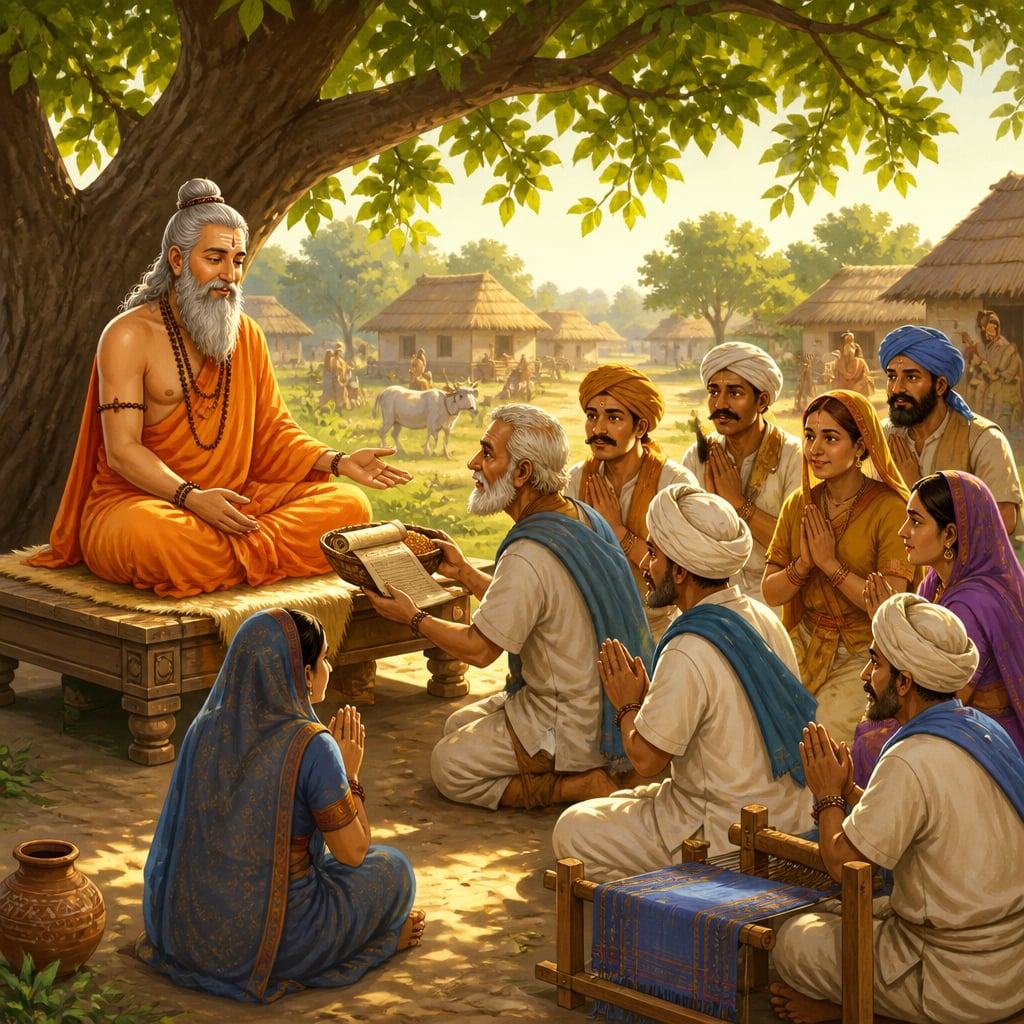
"We will give you one-sixth of our grain and one-tenth of our trade. In return, protect us from those who would harm us."
Manu agreed. He became the first king - not because gods appointed him, not because he conquered others, but because the people chose him to solve their problem.
This story from the Arthashastra contains a revolutionary idea: kingship is a human creation, born from the people's need for protection.
Consider what this means:
The people existed before the king. They created the institution of kingship to serve their needs. The king doesn't own the people - he works for them. His authority isn't divine gift but earned through service.
Kautilya captures this in the most famous sutra of the Arthashastra:
प्रजासुखे सुखं राज्ञः प्रजानां च हिते हितम् "In the happiness of the subjects lies the king's happiness; in their welfare, his welfare."
This isn't poetic sentiment. It's the logical consequence of the social contract. The king was created to serve the people. His success is measured by their flourishing.
This view was revolutionary for the ancient world. Most civilizations taught that kings ruled by divine right - chosen by gods, answerable only to heaven. To question the king was to question cosmic order itself.
Kautilya rejected this entirely. Kings exist because people needed them, and their authority depends on fulfilling that need.
The contract establishes clear terms:
What the people give: Taxes (one-sixth of agricultural produce, one-tenth of trade), obedience to lawful commands, service in defense when needed.
What the king gives: Protection from external enemies, prevention of crime and disorder, impartial justice, conditions for economic prosperity.
This is an exchange, not tribute. The king earns his support by fulfilling obligations - he doesn't simply demand it by right of birth or conquest.
What happens when a king breaks this contract? When he takes taxes but doesn't protect? When he preys on his people instead of serving them?
Kautilya's answer is radical: such a king has become what he was created to prevent. He has become the biggest fish in matsya nyaya. His authority is void.

Western political philosophy credits Hobbes, Locke, and Rousseau with inventing "social contract theory" in the 17th and 18th centuries. But Kautilya articulated the same insight two thousand years earlier:
- Life without government is chaotic and dangerous
- Government is a human solution to this problem
- Legitimate authority comes from serving the people's needs
- Rulers who betray this purpose lose their claim to obedience
The parallel isn't coincidental. Different thinkers, facing similar problems, arrived at similar insights. This suggests the social contract isn't a cultural invention but a discovery about how legitimate authority actually works.
Today, this principle is embedded in democratic governance: "government of the people, by the people, for the people." We take it for granted that rulers should serve citizens, not the reverse.
But in Kautilya's time, this was genuinely revolutionary. And the full implications - that bad rulers can be judged, that authority has limits, that the people's welfare is the ultimate measure - took millennia to work out.
Kautilya started that work. The Arthashastra doesn't just assert that kings should serve the people - it designs systems to ensure they actually do.
Verses
षष्ठांशेन फलं राज्ञः प्रजानां च हिते रतः
ṣaṣṭhāṃśena phalaṃ rājñaḥ prajānāṃ ca hite rataḥ
The king takes one-sixth of the produce as his share, being devoted to the welfare of his subjects.
This sutra captures the exchange nature of governance. The king's right to taxes is conditional on his devotion to the people's welfare.
Book 1, Chapter 13, Verse 5-7 (R.P. Kangle)
प्रजासुखे सुखं राज्ञः प्रजानां च हिते हितम्
prajā-sukhe sukhaṃ rājñaḥ prajānāṃ ca hite hitam
In the happiness of the subjects lies the king's happiness; in their welfare, his welfare.
This may be the most important sutra in the entire Arthashastra. It explicitly states that the king's interests are subordinate to the people's interests.
Book 1, Chapter 19, Verse 34 (L.N. Rangarajan)
नात्मप्रियं हितं राज्ञः प्रजानां तु प्रियं हितम्
nātma-priyaṃ hitaṃ rājñaḥ prajānāṃ tu priyaṃ hitam
What is pleasing to the king himself is not good for him; what is pleasing to the subjects is good for him.
This sutra is remarkable in its explicit rejection of royal self-interest. The king's personal desires are not the measure of good policy - the people's needs are.
Book 1, Chapter 19, Verse 35 (R. Shamasastry)
Case studies
The American Declaration of Independence
In 1776, American colonists declared independence from Britain. Their argument was explicitly based on social contract theory: governments derive their just powers from the consent of the governed, and when government becomes destructive of rights, the people may alter or abolish it.
The Declaration's logic mirrors Kautilya's framework: (1) Government exists to protect rights (like the king exists to protect from matsya nyaya), (2) This creates mutual obligations, (3) When government fails its obligations, its authority is void. The colonists weren't just rebelling - they were invoking an older idea of legitimate governance.
The American Revolution succeeded, creating a new nation explicitly founded on social contract principles. The Constitution became a written contract between government and people, with enumerated powers and protected rights.
Social contract theory isn't just philosophy - it has revolutionary implications. If authority comes from serving the people, then authority that harms the people can be legitimately opposed. Kautilya understood this; so did the American founders.
The social contract framework remains the dominant lens for evaluating government legitimacy worldwide. From protests in Iran and Myanmar to democratic transitions in Chile and Malaysia, citizens invoke the same principle: governments that fail to serve their people forfeit their right to rule.
The Declaration of Independence was signed by 56 delegates representing 13 colonies with a combined population of approximately 2.5 million. It explicitly invoked the right to dissolve a government that violates its social contract.
Historical context
c. 4th century BCE
The question of royal legitimacy was urgent in Kautilya's time. The Nanda dynasty had risen from humble origins and ruled through raw power rather than traditional legitimacy. Chandragupta himself was not of royal birth. Kautilya needed a theory of legitimacy that didn't depend on divine right or noble ancestry.
The social contract framework explains why Kautilya places so much emphasis on the king's duties and limitations. If the king's authority comes from serving the people, then a king who fails this duty has no legitimate claim to obedience. This is a radical check on royal power.
Reflection
- If you could design the 'contract' between government and citizens from scratch, what would each side owe the other? What would be the consequences for breaking the contract?
- Kautilya says the king's happiness lies in the subjects' happiness. But is this realistic? Don't rulers often prosper while their people suffer? Is Kautilya describing reality or an ideal?
- Think of a position of authority you hold - as a parent, manager, teacher, or community leader. What is the implicit 'contract' with those you lead? Are you fulfilling your side?