The People Choose Their Ruler

Consent and Legitimacy

If kings exist to serve the people, then the people must have a say in who rules them. Kautilya understood that legitimate authority requires consent - not just at the beginning, but continuously. A ruler who loses the people's confidence loses legitimacy, regardless of formal titles or military power.
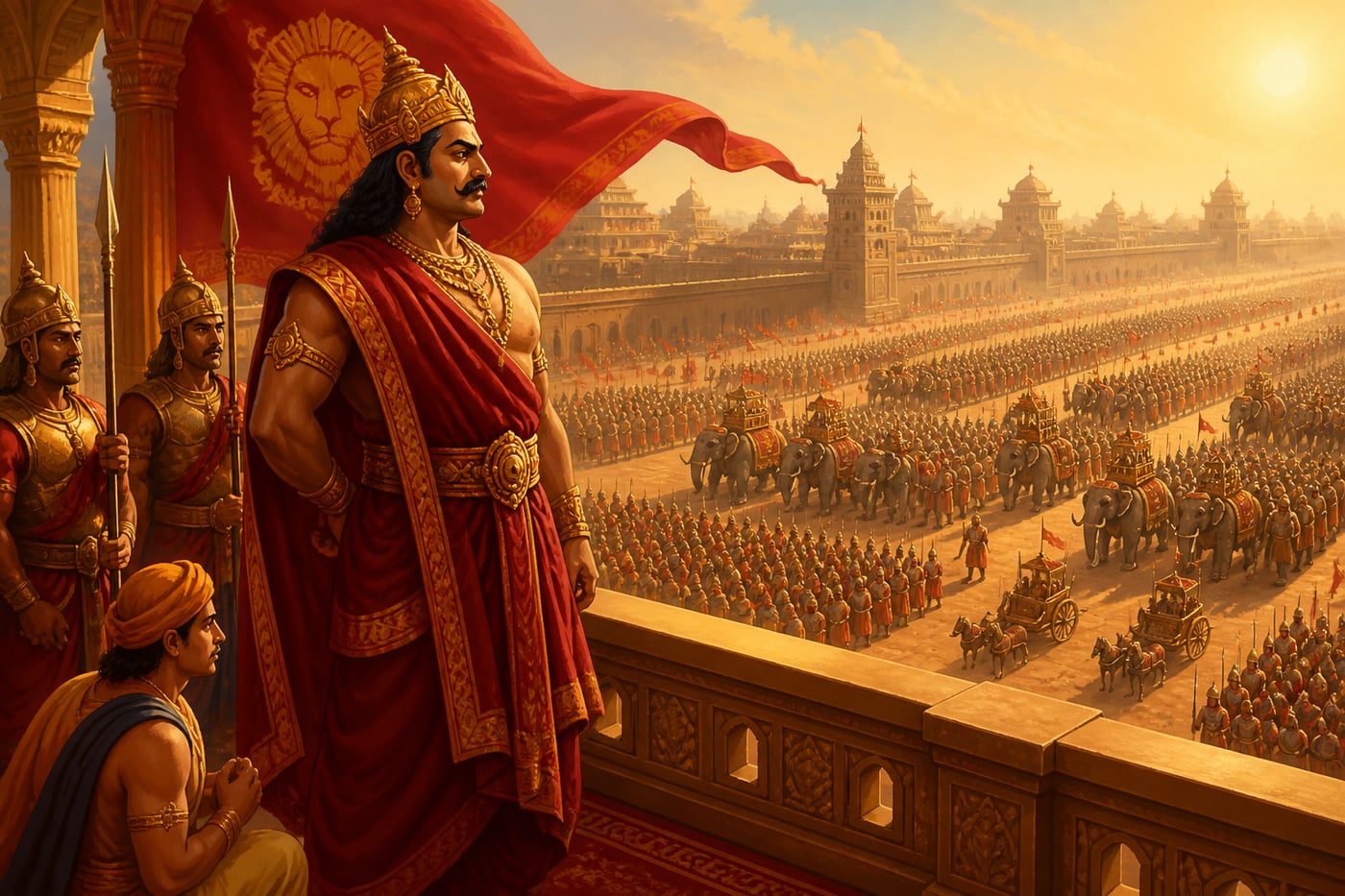
Mahapadma Nanda surveys his vast army from the palace balcony

The Nanda kings commanded the largest army in India. Their treasury overflowed with gold extracted through heavy taxation. By every measure of raw power, they were dominant.

Yet when Chandragupta Maurya challenged them - a young man with a fraction of their military strength - the Nanda empire crumbled within months.

Why?

Because the Nandas had power without legitimacy. They could compel obedience through force, but the people never accepted their authority as rightful. When an alternative appeared, support shifted overnight. Soldiers deserted. Officials defected. The vast Nanda army proved worthless because it was filled with conscripts who had no stake in their rulers' survival.

Kautilya understood something profound: power and legitimacy are different things. Power is the ability to compel. Legitimacy is the recognition that authority deserves to be obeyed.

The Arthashastra makes this distinction central to political thought. And the implications are revolutionary.

If legitimacy comes from the people's acceptance, then the people are ultimately sovereign. Their consent - not divine appointment, not hereditary right, not military conquest - is what transforms raw power into rightful authority.

But how is consent expressed? In Kautilya's time, there were no elections. The answer lies in observable behavior:

When people pay taxes willingly rather than requiring constant coercion, they're expressing consent. When they obey laws voluntarily rather than from fear alone, they're expressing consent. When they defend the kingdom against invaders rather than welcoming them as liberators, they're expressing consent. When they prosper and multiply rather than fleeing to better-governed regions, they're expressing consent.

These are the people's votes - cast through daily choices, not periodic ballots.

Kautilya captures this in a simple formula:

यावत् प्रजा सुखिता तावत् राजा सुखी "As long as the subjects are happy, the king is happy."

This creates a feedback loop. The king's security depends on the people's acceptance. Their acceptance depends on their welfare. Their welfare depends on good governance. So the king's self-interest, properly understood, aligns with serving the people.

But this also means consent is ongoing, not one-time. A king who earned legitimacy through good early rule can lose it through later tyranny. The contract must be continuously renewed through continued service.

Kautilya was deeply practical about this. He specified the qualities people should look for in rulers - not as abstract ideals, but as verifiable standards:

Self-discipline (indriya-jaya): Can this person master their own impulses? Someone who can't control themselves cannot be trusted to control a kingdom.

Knowledge (vijñāna): Does this person understand statecraft, economics, law? Ruling requires expertise, not just good intentions.

Good counsel (mitra-saṃpada): Does this person surround themselves with wise advisors? No ruler can know everything; the wisdom to seek advice is itself a qualification.

These qualities are observable. The people can judge whether their ruler has them. This makes legitimacy something earned through demonstrated capability, not claimed through birth or divine right.

The contrast with the Nandas is instructive. They had risen through military power, not traditional legitimacy. They taxed heavily and spent on armies rather than the people's welfare. They ruled through fear rather than acceptance.

So when Kautilya sought someone to replace them, he looked for qualities the Nandas lacked:

A young Chandragupta Maurya gathering early supporters in a forest clearing

Chandragupta was capable and ambitious, yes. But more importantly, he could offer what the people wanted - just rule, reasonable taxation, protection that served the people rather than exploiting them. His legitimacy came not from being stronger than the Nandas, but from being acceptable to the governed in ways they never were.

This principle - that authority requires consent - has profound implications:

Power without legitimacy is expensive. The Nandas needed vast armies and surveillance systems to maintain control. Every tax required enforcement. Every law required coercion. Resources that could have built prosperity went instead to suppressing resistance.

Legitimacy without power is vulnerable. A good ruler who can't defend the kingdom won't remain ruler for long. Kautilya never suggested that moral authority alone is sufficient.

The combination is sustainable. When people accept authority as rightful AND that authority can defend itself, you get stable governance. People obey voluntarily, defend willingly, and prosper together.

This is why Kautilya insisted that good governance is efficient governance. A legitimate ruler doesn't need massive enforcement apparatus - people comply because they recognize the system serves their interests. The savings can go to productive uses that make everyone better off.

George Washington refuses a crown offered by Continental Army officers

The idea that legitimate authority requires consent has become foundational to modern political thought. Democratic elections formalize the process - regular renewal of consent through voting. Constitutional limits prevent even popular rulers from violating fundamental rights. Separation of powers ensures no single person can accumulate unchecked authority.

These specific mechanisms would have surprised Kautilya. But the underlying principle - that rulers must earn and maintain the people's acceptance - would be entirely familiar. He articulated it 2,300 years before it became mainstream.

And he demonstrated it in action. The Mauryan Empire he helped create lasted generations precisely because it was built on legitimate authority, not just military power. When that legitimacy eventually eroded through later rulers' failures, the empire fell - proving once again that consent, not force, is the foundation of durable political order.

Verses

यावत् प्रजा सुखिता तावत् राजा सुखी

yāvat prajā sukhitā tāvat rājā sukhī

As long as the subjects are happy, the king is happy.

This creates a feedback loop: the king's legitimacy depends on the people's acceptance, which depends on their happiness, which depends on the king's governance. A king who makes his people miserable cannot maintain legitimate authority, only raw power.

Book 1, Chapter 7, Verse 1-2 (R.P. Kangle)

इन्द्रियजयः विज्ञानम् मित्रसंपदा च लोकयात्रा

indriyajayaḥ vijñānam mitrasaṃpadā ca lokayātrā

Self-discipline, knowledge, and good counsel - these three enable proper governance.

Legitimate rulership requires specific, verifiable qualities. A ruler must first master himself before attempting to rule others.

Book 6, Chapter 1, Verse 1 (L.N. Rangarajan)

राजा प्रजारञ्जको भवेत्

rājā prajārañjako bhavet

The king should be one who pleases his subjects.

This is remarkable for what it doesn't say. It doesn't say the king should be feared, or obeyed, or worshipped.

Book 1, Chapter 15, Verse 45-48 (Patrick Olivelle)

Case studies

The Fall of the Nanda Dynasty

The Nanda dynasty (c. 345-321 BCE) ruled much of northern India with one of the largest armies in the ancient world and a vast treasury accumulated through heavy taxation. By all measures of power, they were dominant. Yet when Chandragupta Maurya challenged them, with Kautilya's guidance, the Nandas fell quickly despite their military superiority.

The Nandas had shakti (power) but not manyata (legitimacy). They ruled through force and taxation, not service and consent. The people saw them as oppressors, not protectors. When Chandragupta offered an alternative - promising to rule justly and protect the people's welfare - support shifted rapidly. The Nandas' army, filled with conscripts who had no loyalty to their rulers, proved ineffective against smaller but motivated forces.

The Nanda dynasty was overthrown, and the Mauryan Empire established. Chandragupta's rule proved more stable precisely because it was more legitimate - he had the people's consent, not just their coerced obedience.

Legitimacy is more durable than power. An unpopular government with a huge army can fall to a popular movement with fewer resources. This is why Kautilya emphasizes that rulers must maintain popular support - without it, all the military might in the world won't save them.

The 2011 Arab Spring confirmed this dynamic across multiple countries simultaneously. Rulers with massive security forces fell when popular legitimacy evaporated. Tunisia, Egypt, and Libya demonstrated that no amount of military hardware can sustain a government its people have decisively rejected.

The Nanda military reportedly numbered over 200,000 soldiers, yet the dynasty was overthrown in approximately 321 BCE by popular revolt led by Chandragupta, whose initial force was significantly smaller but backed by public support.

George Washington's Refusal of a Crown

After the American Revolution, some officers proposed making George Washington king. He had the military power, personal prestige, and popular admiration to seize permanent authority. Instead, he refused, served two terms as elected president, and then voluntarily stepped down - setting a precedent that defined American governance.

Washington understood the difference between power and legitimacy. He could have taken power, but the American Revolution was fought on principles of consent and limited government. A monarchy would have contradicted those principles, delegitimizing the new nation. By respecting the social contract - that government derives authority from consent - Washington gave the new republic lasting legitimacy. His voluntary relinquishment of power actually increased his authority and the stability of the system.

The precedent of peaceful transfer of power became foundational to American democracy. Washington's reputation was enhanced, not diminished, by his restraint. The system he helped create has survived over two centuries.

True authority comes from respecting the principles that grant legitimacy, not from seizing maximum power. A leader who understands this - as Washington did, and as Kautilya taught - creates lasting institutions rather than personal dictatorships.

Nelson Mandela's decision to step down after one presidential term, despite overwhelming popularity, demonstrated the same principle in 1999. Leaders who voluntarily constrain their own power create institutional precedents that outlast any individual, exactly as Washington's example shaped American governance for centuries.

After the Revolutionary War, Washington voluntarily resigned his military commission on December 23, 1783. King George III called him the greatest man in the world for willingly giving up power.

Historical context

c. 4th century BCE

The question of political legitimacy was urgent in Kautilya's time. The Nanda kings lacked traditional legitimacy (humble origins) and had failed to earn popular legitimacy (oppressive rule). Chandragupta similarly lacked hereditary claims. Kautilya needed to articulate why Chandragupta's rule would be legitimate - and his answer was based on qualities and consent rather than birth or divine appointment.

Understanding that Kautilya saw legitimacy as essential, not optional, explains the elaborate institutional checks he designs. If legitimacy requires ongoing consent, then rulers must be constrained from abusing their power. The emphasis on royal duties, limits on taxation, and accountability mechanisms all flow from this understanding.

Reflection

More in The Social Contract

All lessons in The Social Contract · Arthashastra: Philosophy of Power course