Rights of the People

What Citizens Deserve

If the social contract creates duties for rulers, it also creates rights for the ruled. Kautilya's framework protects property, ensures justice, limits taxation, and even allows for resistance against tyranny. These aren't just ideals - they're enforceable claims that constrain royal power and protect individual freedom.
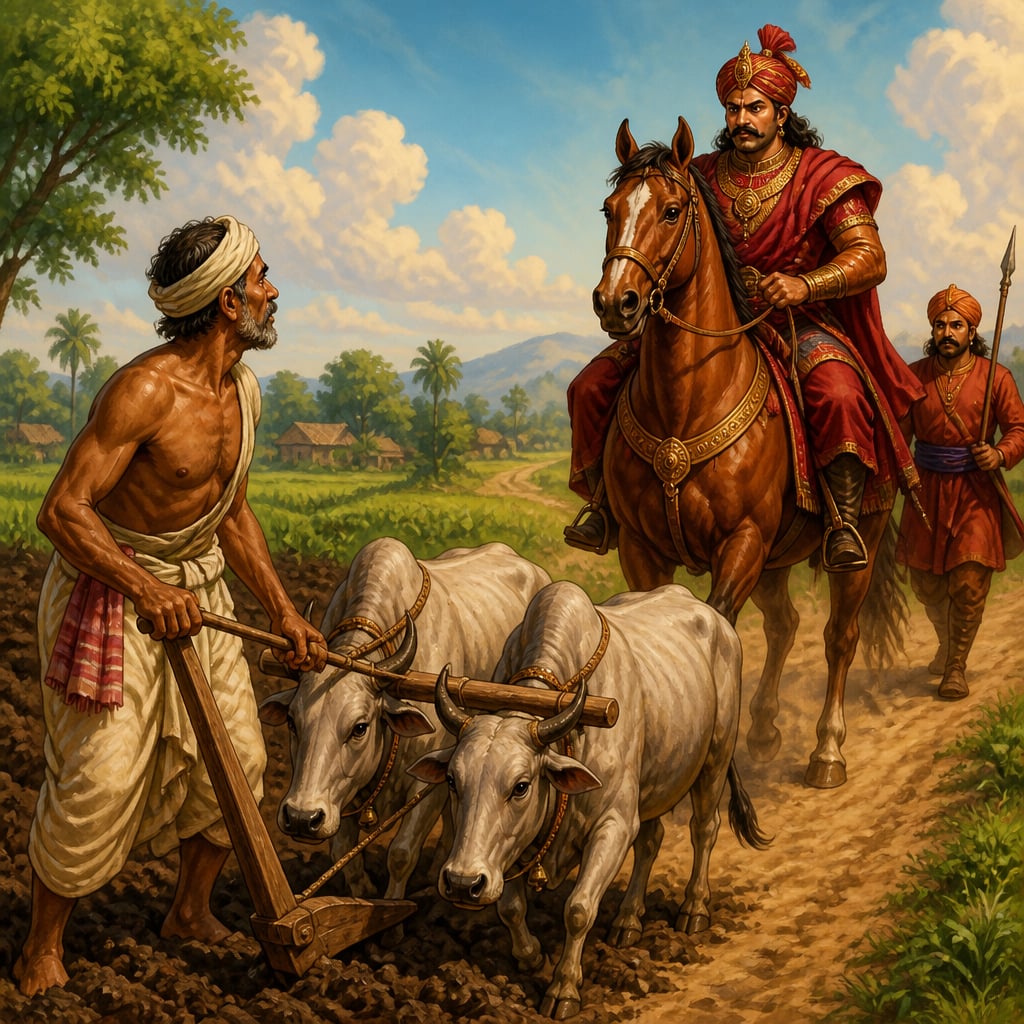
A farmer working his land as a powerful lord approaches on horseback

A farmer works a plot of land for decades. He clears it, irrigates it, builds soil fertility through patient labor. His children grow up knowing which field belongs to their family, which path leads to their home.

One day, a powerful lord rides through. He likes the land. He takes it. The farmer has no recourse - no court that will hear him, no law that protects him, no right that the powerful must respect.

This is what Kautilya sought to prevent. And he did it not just by describing the king's duties, but by articulating something radical for the ancient world: the rights of the people.

If the social contract creates duties for rulers, it simultaneously creates rights for the ruled. This is logical: if the king has a duty to protect property, then people have a right to property protection. If the king has a duty to provide justice, then people have a right to justice.

Kautilya states this with remarkable clarity:

स्वामिगामिकोऽर्थो न हर्तव्यः "Property belonging to the owner must not be seized."

This isn't advice to kings. It's a statement about what people can rightfully claim. The word svāmigāmika - "belonging to the owner" - implies that ownership exists prior to and independently of royal permission. The king doesn't grant property rights; he recognizes and protects them.

Property rights in Kautilya's framework are comprehensive. They include ownership (possessing and using what is yours), transfer (selling or giving it as you choose), exclusion (preventing others from taking it), contract (making enforceable agreements about it), and inheritance (passing it to your heirs).

Why does property matter so much? Because property creates freedom.

Without property, you depend entirely on those with power. You cannot say no to an employer, ruler, or mob if you own nothing. Property creates a zone of independence where you can make your own decisions about your own life.

Property also enables future planning. If you cannot be sure you'll keep what you earn or build, you won't invest effort in improvement. Who plants orchards when someone else will harvest the fruit?

And property limits government. If the king can seize property arbitrarily, there are no real limits on his power. Property rights constrain rulers - they cannot simply take what they want.

Kautilya specifies that even when property must be taken for public purposes, the king must have genuine public need (not personal desire), provide fair compensation, take only what's truly necessary, and follow proper procedure. Arbitrary seizure breaks the social contract.

Beyond property, Kautilya articulates a right to justice - fair, accessible courts that apply laws consistently. This includes knowing the charges against you, presenting evidence, confronting accusers, and receiving proportionate punishment. The king himself is bound by law; he cannot simply decide cases based on personal preference.

People have a right to limited taxation. The classical rate - one-sixth of agricultural produce - represents what Kautilya considers the boundary. Taxes must be moderate, predictable, proportionate to ability to pay, and used for legitimate public purposes. Excessive taxation is theft, even when done by kings.

There's a right to physical safety - not just from crime, but from the state itself. No arbitrary arrest, no torture, no punishment without proper trial. The institution created to provide security must not become a threat.

An ancient Indian marketplace operating under royal standardized weights

There's a right to economic opportunity - to choose your occupation, trade freely, enter into contracts, innovate. The king enables commerce; he doesn't control it.

And crucially, there's a right to exit. People can move freely, migrate to better-governed regions, leave oppressive situations. This right disciplines rulers: if people can leave, rulers must compete to keep them.

What happens when kings violate these rights? Kautilya is surprisingly radical:

धर्मे स्थितो धर्मस्थानीयो राजा "The king who stands in the law is worthy of his position as enforcer of law."

The implication is clear: a king who violates law loses his standing to enforce it. When rulers systematically seize property, deny justice, tax oppressively, and rule through terror, they have become tyrants. And tyrants have lost legitimate authority.

People respond. They withhold cooperation. They reduce productivity. They flee to better-governed regions. They provide only minimal compliance. A king who loses popular support, even if he retains military power, has lost what matters most.

This framework of individual rights - property, justice, limited taxation, safety, economic freedom, movement - represents a proto-libertarian philosophy articulated 2,300 years before such ideas became mainstream in Western thought.

King John seals the Magna Carta at Runnymede in June 1215

Modern constitutional democracies protect similar rights: against arbitrary seizure, for due process, to economic freedom, to limits on taxation, to free movement. Kautilya would recognize all these as implementing principles he described millennia earlier.

The rights create space for freedom - a zone where people can live their lives without constant interference or fear. This is ordered liberty: not anarchy, but government constrained by what people can rightfully claim.

The social contract creates kings to serve the people. Rights ensure that service remains genuine rather than becoming exploitation.

Verses

स्वामिगामिकोऽर्थो न हर्तव्यः

svāmigāmiko'rtho na hartavyaḥ

Property belonging to the owner must not be seized.

This sutra establishes property as a right, not a privilege granted by the king. The term 'svāmigāmika' - belonging to the owner - implies that ownership exists prior to and independently of royal permission.

Book 3, Chapter 16, Verse 30-32 (R.P. Kangle)

धर्मे स्थितो धर्मस्थानीयो राजा

dharme sthito dharmasthānīyo rājā

The king who stands in the law is worthy of his position as enforcer of law.

The king is not above the law - he stands *within* it. His authority to enforce law depends on his own submission to law.

Book 3, Chapter 1, Verse 40-41 (L.N. Rangarajan)

प्रजावृद्धिः करवृद्धिः

prajāvṛddhiḥ karavṛddhiḥ

Growth of the people (their prosperity and numbers) is the growth of revenue.

This elegant formula establishes that the king's interest (revenue) depends on the people's wellbeing. He cannot prosper by impoverishing them.

Book 2, Chapter 8, Verse 25-26 (Patrick Olivelle)

Case studies

Magna Carta: Forcing Rights Recognition

In 1215 CE, English barons forced King John to sign Magna Carta, a document limiting royal power and protecting certain rights. The king had been seizing property without cause, taxing arbitrarily, imprisoning nobles without trial, and generally ruling as if unconstrained by law. The barons rebelled and demanded written protections.

Magna Carta articulated many rights Kautilya described 1,500 years earlier: no seizure of property without lawful cause, no taxation without consent, right to fair trial, limitation on arbitrary imprisonment, requirement that the king himself obey law. Both Kautilya and Magna Carta recognized that rights must constrain power, not just describe ideals. The barons were asserting what Kautilya would call adhikara - rightful claims against their ruler.

Though King John tried to repudiate Magna Carta, it became foundational to English law and eventually influenced constitutions worldwide, including the U.S. Constitution. The principle that rulers are bound by law and people have enforceable rights became central to Western political thought.

Rights often must be fought for and formalized. Kautilya articulated them philosophically, but making them real requires institutional protections. Written rights, courts to enforce them, and people willing to resist violations are all necessary. Rights don't protect themselves.

The European Convention on Human Rights and the International Criminal Court represent modern extensions of this tradition. Rights must be codified, courts must enforce them, and citizens must be willing to defend them. Every successful rights framework follows this three-part pattern.

Magna Carta, signed on June 15, 1215, contained 63 clauses limiting royal authority. It has been cited in over 900 years of legal proceedings and directly influenced the U.S. Bill of Rights ratified in 1791.

Hong Kong: How Property Rights Drive Prosperity

Hong Kong was a poor fishing village when Britain acquired it in 1842. By focusing on strong property rights, rule of law, free trade, and minimal taxation, Hong Kong transformed into one of the world's wealthiest regions. Its success demonstrates how rights protections enable prosperity.

Hong Kong implemented Kautilyan principles: secure property rights (svamitva), accessible courts (nyaya), low taxes (moderate karamiti), economic freedom (varta), and generally staying out of people's way. The government focused on core duties - security, justice, infrastructure - while letting people pursue their own prosperity. The result validated Kautilya's insight: prajāvṛddhiḥ karavṛddhiḥ (people's prosperity is revenue prosperity).

Hong Kong achieved remarkable prosperity with limited natural resources. Its success was based almost entirely on human capital enabled by rights protections. However, as these protections have eroded under Chinese control post-1997, prosperity and freedom have both declined.

Rights aren't just moral ideals - they're practical prerequisites for prosperity. Protecting property, ensuring justice, limiting government, and freeing commerce enable human flourishing. Hong Kong's success, and its decline as rights eroded, proves that Kautilya was right about both the importance of rights and what happens when they're violated.

Recent changes to Hong Kong's legal framework after 2020 illustrate the inverse. When property rights, judicial independence, and rule of law weaken, capital flight and talent emigration follow rapidly. Thousands of businesses relocated to Singapore after Hong Kong's National Security Law altered the institutional environment.

Hong Kong's GDP per capita grew from approximately $4,000 in 1960 to over $49,000 by 2023. At its peak, it ranked in the top 10 globally for economic freedom with a Heritage Foundation score of 89.7/100.

Historical context

c. 4th century BCE

The Mauryan Empire's vast scale created urgent need for rights protections. Previous small kingdoms relied on informal constraints (personal relationships, community pressure). Governing millions required formal rights that would apply even when rulers didn't personally know subjects. Kautilya needed to articulate rights that would scale.

Understanding that Kautilya articulated individual rights 2,000+ years before Western rights theory challenges narratives that rights are uniquely Western concepts. Rights thinking has multiple independent origins. This should make us more confident that rights are genuine moral discoveries, not cultural artifacts.

Reflection

More in The Social Contract

All lessons in The Social Contract · Arthashastra: Philosophy of Power course