Duties of the Ruler
Obligations to the People
What does a ruler owe the people? Kautilya's answer is remarkably comprehensive: protection, justice, prosperity, infrastructure, and moral leadership. These aren't optional extras - they're the obligations that justify the king's authority. A ruler who fails these duties has broken the social contract and forfeited legitimacy.
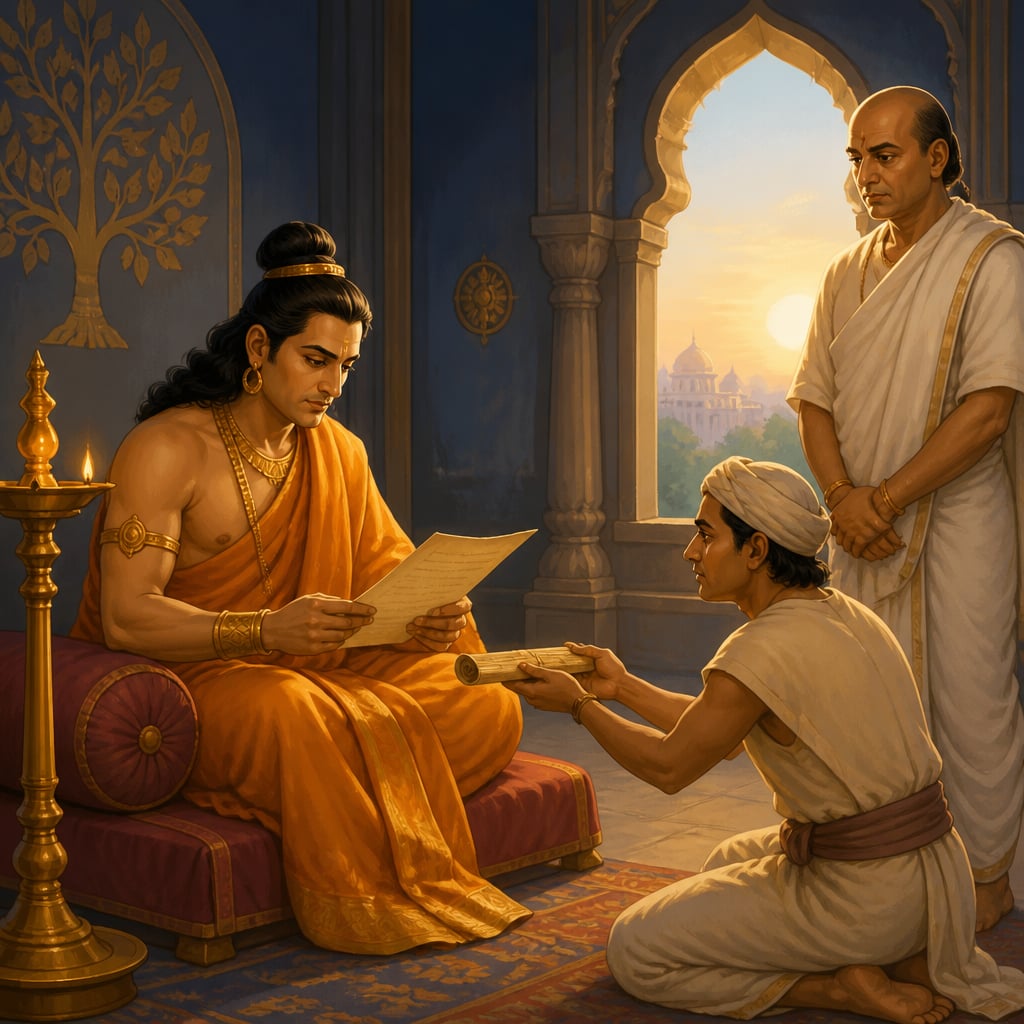
Consider a king's morning. Most rulers wake when they please, summon entertainment, indulge in leisure. Kautilya's king wakes before dawn.
In the first ninety minutes, he receives intelligence reports - what happened overnight, what threats emerged, what opportunities appeared. In the next period, he reviews financial accounts - where the treasury stands, what's been spent, what's owed. Then he holds open court where any subject can bring grievances. Then military reviews. Then consultations with ministers. Then inspection of infrastructure. And so on, period after period, until late at night when he finally allows himself brief rest before starting again.
This schedule, laid out in precise detail in the Arthashastra, makes a point: rulership is work, not privilege. The king who lounges in luxury while collecting taxes has stolen from his people.
But what specifically must a ruler accomplish through all this work? Kautilya provides an exhaustive catalog - not aspirational ideals, but concrete obligations that define whether a king has earned his authority.
The first and most fundamental duty is raksha - protection. This is why kingship exists. Without security, nothing else is possible.
Protection operates on multiple levels. The king must defend against external enemies - maintaining armies, building fortifications, forming alliances, gathering intelligence. But he must also maintain internal order - preventing crime, suppressing bandits, ensuring that the strong don't prey on the weak.
And crucially, he must protect property rights - preventing theft, enforcing contracts, protecting inheritance, never seizing property arbitrarily. Property protection isn't about wealth for its own sake. It's about enabling people to invest, build, and plan for the future. Without security of ownership, no one plants orchards or builds houses.
The second duty is nyaya - justice. The king must establish courts that are accessible to all, apply laws consistently, judge fairly without corruption, and punish proportionately. Kautilya is explicit: the king himself is bound by law. He cannot simply decide cases based on personal preference.
Justice must especially protect the vulnerable - women from violence, children from abuse, the elderly from abandonment, the poor from exploitation by the wealthy. The justice system cannot be neutral when the parties aren't equal. Power imbalances must be compensated for.
The third duty is yogakshema - welfare in the specific sense of helping people prosper and protecting what they've gained. Kautilya captures this with a vivid metaphor: the king should be like a gardener who takes fruit, not like a charcoal maker who uproots the tree.
This means creating conditions for economic flourishing - maintaining roads and irrigation, protecting trade routes, standardizing weights and currency, preventing monopolies. It means providing relief during famines and disasters, maintaining emergency reserves, supporting those who cannot support themselves.
And it means restraint in taxation. Kautilya recommends taking only one-sixth of agricultural produce - enough to fund governance, not so much as to impoverish producers. Taxes must be predictable, proportionate, and actually used for public purposes rather than royal luxury.
The fourth duty is vridhi - fostering growth and development. A kingdom should be better next year than this year. Population should grow (people vote with their feet - they move toward well-governed places). Infrastructure should expand. New lands should be settled, new industries developed, education and skills advanced.

But perhaps the most remarkable duty is what Kautilya calls indriya-jaya - self-mastery. The king must conquer his own senses before he can properly serve his people.
Why is personal discipline a public duty? Because an undisciplined king's vices become everyone's problems:
- An angry king executes innocents in rage
- A greedy king overtaxes and impoverishes
- A lustful king exploits subjects' daughters
- A fearful king makes cowardly decisions
- A lazy king neglects his obligations
- A proud king ignores wise counsel
Every personal weakness corrupts public policy. The king who cannot govern himself cannot govern others. Self-mastery isn't optional self-improvement - it's the foundation on which all other duties rest.

Kautilya's sutra captures the essence:
प्रजानां सुखे राज्ञः कार्यम् "The king's work is in the happiness of his subjects."
Not his own glory. Not military conquest. Not accumulation of wealth. The king's entire job description is the people's flourishing. Everything else is either means to this end or distraction from it.
This creates a demanding standard. When duties conflict - as they sometimes must - Kautilya provides a hierarchy: protection comes first, then justice, then prosperity, then growth. But neglecting any duty too long is dangerous. The king must somehow attend to all of them.
How do we ensure rulers actually fulfill these obligations? Kautilya's answers are pragmatic:
Results speak. The people can see whether the kingdom is safe, just, and prosperous. They don't need to read philosophy - they experience good or bad governance daily.
Institutions constrain. Ministers, courts, and administrators create checks on royal power. No one rules alone, and those who serve the king can slow or redirect harmful commands.
Reputation matters. A king who fails his duties loses the consent that makes authority legitimate. People withdraw cooperation, provide minimal compliance, look for alternatives.
And succession looms. A bad king may be overthrown by challengers. The threat disciplines rulers who might otherwise neglect their obligations.
The comprehensive nature of these duties reveals something important about Kautilya's political philosophy. The king exists to serve specific, limited purposes - protection, justice, enabling prosperity. Within these domains, his authority is strong and his duties demanding. Outside them, he has no legitimate claim on people's lives.
This is a framework of limited but effective government - strong enough to protect freedom, constrained enough not to threaten it. The king does what only government can do, and leaves the rest to individuals and voluntary associations.
Modern democracies still debate the proper scope of government duties. Kautilya's answer - focus on protection, justice, enabling conditions for prosperity, and restraint in everything else - remains remarkably relevant 2,300 years later.
Verses
प्रजानां सुखे राज्ञः कार्यम्
prajānāṃ sukhe rājñaḥ kāryam
The king's work is in the happiness of his subjects.
This sutra defines the entire purpose of kingship. The king's 'work' (karya) - his essential duty - is not conquest, glory, wealth, or power.
Book 1, Chapter 19, Verse 34 (R.P. Kangle)
राज्ञः प्रजाया योगक्षेमवहनम्
rājñaḥ prajāyāḥ yogakṣemavahanam
The king bears the burden of the subjects' welfare - both their acquisition and preservation of prosperity.
The term 'vahanam' means to carry or bear a burden - like an ox carries a cart. The king doesn't just passively allow prosperity; he actively works to create conditions for people to prosper (yoga) and to protect what they've gained (kshema).
Book 1, Chapter 13, Verse 8 (L.N. Rangarajan)
इन्द्रियाजयः सर्वस्य राज्ञः प्रथमं कर्तव्यम्
indriyājayaḥ sarvasya rājñaḥ prathamaṃ kartavyam
Self-discipline is the first duty of every king.
Before everything else - before building armies, administering justice, or developing the economy - the king must master himself. An undisciplined ruler will fail at all other duties because his personal weaknesses will corrupt his judgment.
Book 1, Chapter 7, Verse 6 (Patrick Olivelle)
Case studies
Ashoka's Transformation: From Conquest to Welfare
Emperor Ashoka, grandson of Chandragupta Maurya, initially followed the traditional path of military conquest, culminating in the brutal Kalinga War (c. 261 BCE) that killed over 100,000 people. Horrified by the carnage, Ashoka underwent a profound transformation, converting to Buddhism and reorienting his entire approach to kingship.
Ashoka's rock edicts after his conversion read like an implementation checklist of Kautilyan duties: he established hospitals for humans and animals, planted medicinal herbs, dug wells, planted trees along roads, appointed special officers to ensure justice for the vulnerable, made himself accessible to petitioners at all times, and emphasized dharma (righteous conduct). He shifted from viewing kingship as conquest to viewing it as service - precisely Kautilya's framework.
Ashoka's reign became one of the most stable and prosperous periods of the Mauryan Empire. His focus on welfare, justice, and moral leadership created lasting loyalty. His edicts, carved in stone across the empire, served as public accountability - anyone could read what the emperor claimed as his duties and judge whether he fulfilled them.
When rulers take their duties seriously - protection, justice, welfare, infrastructure, moral leadership - prosperity and stability follow. Ashoka's transformation shows that rulership as service isn't just idealistic; it's practically effective. His legacy outlasted conquerors who prioritized power over duty.
Modern welfare states in Scandinavia and East Asia demonstrate this duty-focused governance. Their governments prioritize healthcare, education, and infrastructure as core obligations rather than optional benefits, and they consistently rank among the world's most prosperous and stable nations.
Ashoka's Rock Edict XIII records that the Kalinga War killed over 100,000 people and deported 150,000 more. After this, Ashoka built hospitals, planted medicinal herbs, and dug wells across his empire spanning 33 edicts carved in stone.
Singapore: Effective Governance Through Clear Duties
When Singapore gained independence in 1965, it was poor, small, lacking natural resources, and surrounded by larger, potentially hostile neighbors. Lee Kuan Yew and his government focused relentlessly on core duties: security (building capable defense), justice (creating incorruptible courts), infrastructure (world-class ports and airports), education (heavy investment in human capital), and enabling commerce (business-friendly regulations, protection of property rights).
Singapore's approach closely mirrors Kautilya's framework of royal duties. The government focused on what only government can do - security, justice, infrastructure, education - while letting private enterprise drive economic growth. They maintained strict self-discipline (zero tolerance for corruption), prioritized long-term prosperity over short-term popularity, and measured success by citizen wellbeing (housing, employment, safety) rather than government power.
In two generations, Singapore transformed from a poor port city to one of the world's most prosperous nations, with high incomes, low crime, excellent infrastructure, and strong institutions. This success came from relentlessly focusing on core governmental duties rather than trying to control all aspects of society.
Kautilya's principle - focus on essential duties, enable private flourishing - works in modern contexts. Governments that try to do everything often fail at core functions. Those that master the basics (security, justice, infrastructure, enabling commerce) while letting people pursue their own goals tend to prosper.
The UAE's governance model explicitly follows this playbook. Government spending focuses on world-class infrastructure, healthcare, and education while maintaining low taxes and business-friendly regulation. The result is one of the fastest-developing regions in the world with consistently high citizen satisfaction.
Singapore's government spending on healthcare, education, and infrastructure averages 15-17% of GDP, yet it achieves outcomes that rival nations spending 35-45% of GDP, ranking 6th globally in the Human Development Index.
Historical context
c. 4th century BCE
The Mauryan Empire was the first attempt to govern most of the Indian subcontinent as a single political entity. This required moving beyond informal tribal leadership or small-kingdom governance. Kautilya needed to articulate what duties came with ruling such a vast territory - duties that would make this unprecedented power legitimate rather than oppressive.
Understanding the full scope of royal duties explains why Kautilya devotes so much of the Arthashastra to administrative details. He's not just describing how things work - he's showing kings how to fulfill their obligations. Every technical detail (how to build irrigation, manage forests, run courts, etc.) relates to a specific duty the king owes the people.
Reflection
- Kautilya says self-mastery is the king's first duty. Why do you think he puts this before all the external duties like defense, justice, and economic management? Is personal virtue really necessary for good governance?
- Kautilya's catalog of duties is extremely demanding - few rulers could fulfill all of them. Is this realistic, or is he setting an impossible standard? What's the value of an ideal that cannot be fully achieved?
- Think about a position of authority you hold - parent, manager, teacher, community leader. Using Kautilya's framework, what are your core duties? Are you fulfilling them? Where are you falling short?