Sangraha: Building and Protecting State Reserves
The Art of Filling the Treasury Without Draining the People
Kautilya's sophisticated revenue system balanced the imperative of state income against the danger of overtaxation. His 'honeybee principle', collect gently, widely, and predictably, anticipated modern tax theory by two millennia. From Mauryan tax collectors to GST, the challenge remains: how to fund the state without crushing the economy.
The Treasurer's Dilemma
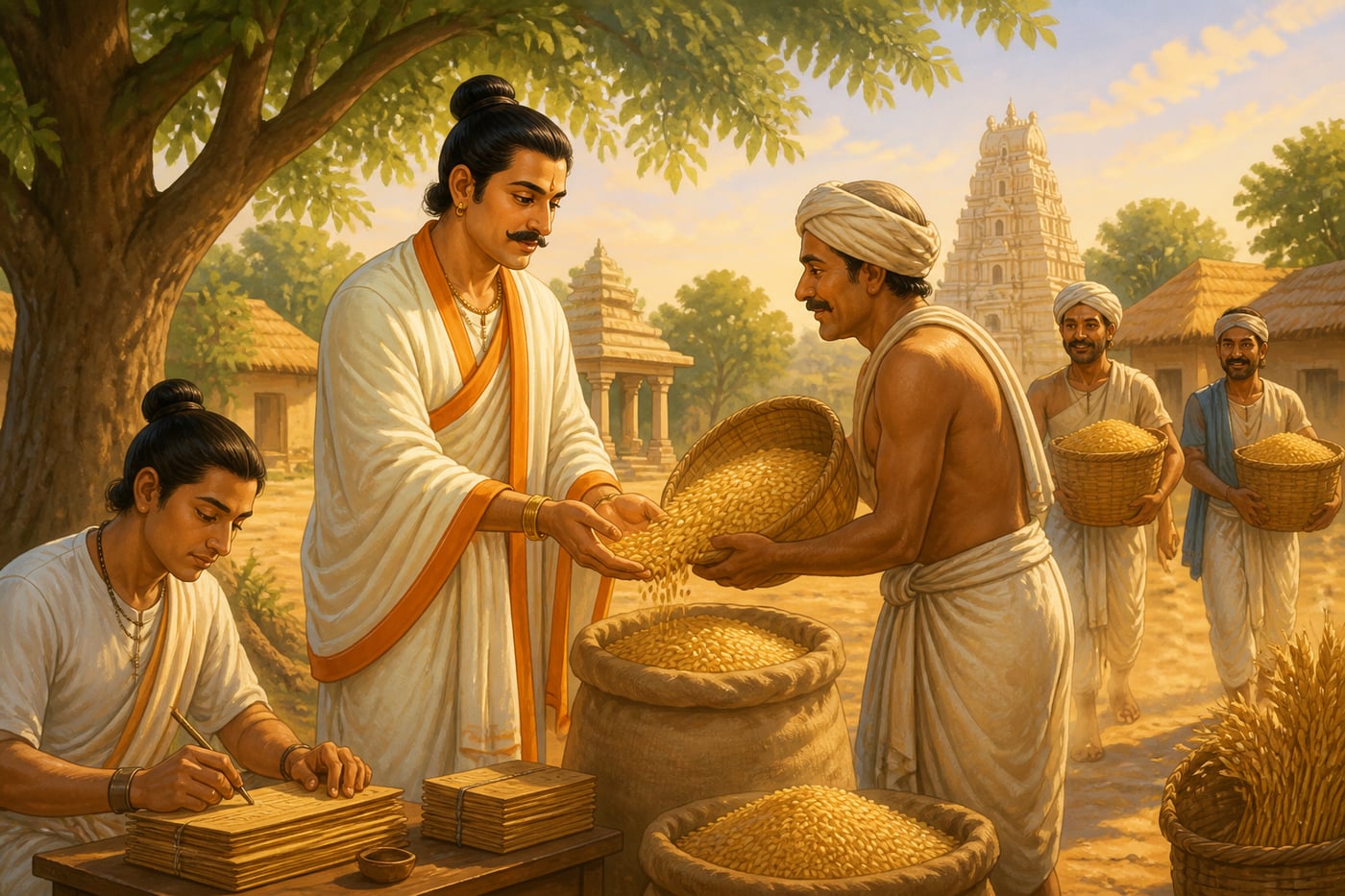
The Sannidhata, the Mauryan Chief Treasurer, faced an impossible job. Every morning, petitions arrived from across the empire: the army needed funds for the northwestern frontier; engineers demanded payment for the new irrigation canal in Kalinga; granaries required restocking before monsoon. And every evening, the king asked the same question: "Is the kosha full?"
Pushyamitra, one such Sannidhata in the reign of Ashoka's grandson, understood the trap. If he extracted too much revenue, merchants would flee to rival kingdoms, farmers would abandon fields, and the tax base itself would shrink. If he extracted too little, the treasury would empty, the army would weaken, and enemies would sense opportunity.
Kautilya had anticipated exactly this dilemma, and his solution was elegant.
The Honeybee Doctrine

In the Arthashastra, Kautilya offers one of history's most memorable metaphors for taxation:
"Yathā madhukaro puṣpāt rasam ādadyāt, tathā rājā dhanaṃ prajābhyaḥ"
"As the bee takes honey from the flower without injuring the flower, so should the king take wealth from his subjects."
This wasn't poetry, it was policy. Kautilya was articulating what modern economists call the Laffer Curve 2,300 years before Arthur Laffer drew it on a napkin. There's an optimal tax rate: too low and revenue suffers; too high and the economy contracts, ultimately reducing revenue anyway.
The genius was the metaphor's precision. The bee doesn't take all the nectar, it leaves enough for the flower to survive and produce more. The bee visits many flowers, not extracting heavily from a few. And the bee's collection is predictable, the flower knows what to expect.
Three principles encoded in one image:
- Moderation: Never tax so heavily that the source is destroyed
- Breadth: A broad tax base with moderate rates outperforms narrow taxes with high rates
- Predictability: Subjects must know what's expected; surprises destroy trust and planning
The Sangraha System: Revenue Architecture
The term sangraha means "collection" but also "holding together", revenue gathering that maintains social cohesion rather than tearing it apart. Kautilya designed an intricate system with multiple revenue streams:
Direct Taxes:
- Bhaga – the king's share of agricultural produce (typically 1/6th, adjustable by soil quality and irrigation)
- Bali – religious/customary contributions
- Kara – taxes on artisans, traders, and other professionals
Indirect Taxes:
- Shulka – customs duties on trade (carefully calibrated to encourage imports of needed goods, discourage luxuries)
- Vaidharana – road tolls funding the very infrastructure merchants used
State Enterprises:
- Mines, forests, and salt works operated directly by the state
- Royal monopolies on strategic goods
- State-owned manufacturing (armories, textile works)
Kautilya insisted on diversification: "A king dependent on a single revenue source is like a house on one pillar." If monsoon failed and agricultural revenue dropped, trade taxes might compensate. If war disrupted trade, mining revenue continued.
Global Perspectives on Revenue Collection
Adam Smith (1723–1790), writing in The Wealth of Nations, articulated four "canons of taxation" remarkably similar to Kautilyan principles:
- Equity: Taxes should be proportional to ability to pay
- Certainty: The amount, timing, and manner of payment must be clear
- Convenience: Taxes should be collected when and how most convenient for the payer
- Economy: Collection costs should be minimized
Smith was essentially rediscovering what Kautilya had systematized. The Arthashastra specifies collection schedules aligned with harvest times (convenience), published rates (certainty), graduated assessments by income (equity), and centralized accounting to reduce overhead (economy).
Jean-Baptiste Colbert (1619–1683), Finance Minister to Louis XIV, famously said: "The art of taxation consists in so plucking the goose as to obtain the largest possible amount of feathers with the smallest possible amount of hissing." This is the honeybee principle restated, maximum revenue with minimum resistance. Colbert implemented mercantilist policies that boosted French state revenue sixfold, but his heavy-handed methods eventually triggered revolts. Kautilya would have noted the failure of predictability.
Arthur Laffer (1940–present) drew his famous curve on a restaurant napkin in 1974, showing that at both 0% and 100% tax rates, government revenue is zero, and that somewhere in between lies an optimal rate. Laffer was celebrated as revolutionary, but Kautilya's honeybee doctrine contains the same insight: extract too aggressively and you kill the flower; extract nothing and you starve.
| Thinker | Key Insight | Kautilyan Parallel |
|---|---|---|
| Smith | Four canons of taxation | Arthashastra's collection principles |
| Colbert | Maximum extraction, minimum resistance | Honeybee doctrine (but Colbert violated predictability) |
| Laffer | Optimal tax rate below maximum | "Take honey without injuring the flower" |
The difference: Kautilya integrated all these insights into a comprehensive administrative system, not just theoretical principles.
The Budget as Dharmic Document
Kautilya required the Sannidhata to maintain detailed accounts, what we would call a budget. The Arthashastra specifies:
- Aya (income projections) – estimated revenue from each source
- Vyaya (expenditure allocations) – planned spending by category
- Shesha (surplus/deficit) – the balance requiring action
Critically, Kautilya demanded these projections be made in advance and publicly verified by auditors. This wasn't just accounting, it was accountability. A king who overspent would face questions; a treasurer who underestimated revenues would be investigated for possible corruption.
The budget itself became a governance document. By requiring officials to commit to projections, Kautilya created incentives for realistic planning rather than wishful thinking, a discipline many modern governments still struggle to achieve.
Modern Resonance: GST and the New Sangraha
For seven decades after independence, India's tax system violated nearly every Kautilyan principle. Multiple taxes (17 different levies!) created confusion. Rates varied arbitrarily between states. Collection was unpredictable. Cascading taxes meant businesses paid tax on tax. The system was, in Kautilya's terms, like a bee that stung flowers repeatedly, killing many and driving others to hide.

On July 1, 2017, at midnight, India implemented the Goods and Services Tax (GST), the most ambitious tax reform in independent India's history. Finance Minister Nirmala Sitharaman, who would later oversee its maturation, called it "a good and simple tax."
The parallels to Kautilyan sangraha are striking:
Breadth: GST brought millions of previously informal businesses into the tax net, not by raising rates, but by simplifying compliance. The honeybee now visited more flowers.
Predictability: One tax rate (with slabs) nationwide replaced the chaos of state-specific levies. Businesses could finally plan.
Moderation: Input tax credits eliminated cascading, businesses paid tax only on value added, not on accumulated taxes.
Results by 2024-25:
- Monthly GST collections crossed ₹1.87 lakh crore (December 2024)
- Tax base expanded from 6 million to 14+ million registered taxpayers
- Compliance costs fell by an estimated 30%
Sitharaman's observation echoes across millennia: "When compliance is easier, collections improve. When the system is fair, evasion falls." Kautilya would have nodded.
Your Turn
The sangraha principle applies beyond taxes. Consider: How do you "collect" in your own life?
If you're a manager, you extract effort from your team. Do you do it like Colbert, maximum feathers, maximum hissing? Or like Kautilya's honeybee, moderately, broadly, predictably?
If you're building a career, you're accumulating reputation, skills, and relationships. Are you extracting short-term gains that damage long-term prospects? Or investing in flowers that will keep producing?
The sangraha insight: sustainable collection requires caring for the source. Drain it today, lose it tomorrow. Nurture it, and it yields indefinitely.
In our next lesson, we'll examine who was responsible for tracking all this revenue, the ancient accountants and auditors who prevented the treasury from leaking.
Arthur Laffer demonstrated that tax revenue is maximized at some intermediate rate, not at the highest rate. Both extremes (0% and 100%) yield zero revenue. The 'optimal' point varies by context but the principle is universal.
Kautilya's metaphor captures not just the rate insight but the relational dimension, good taxation maintains trust and willingness to comply. Modern India's GST success relies partly on this: simpler compliance creates voluntary participation, not just coerced extraction.
India's GST registered taxpayer base grew from 6 million (2017) to 14+ million (2024), not through higher rates but through easier compliance. The honeybee visited more flowers by being gentler.
Modern Portfolio Theory (Markowitz, 1952) proved mathematically that diversified portfolios reduce risk without proportionally reducing returns. The insight is the same: multiple uncorrelated income streams provide stability.
Kautilya applied diversification not just to investments but to national fiscal architecture, a more sophisticated application. India's current tax structure (income tax, GST, customs, corporate tax) follows this principle exactly.
In FY 2023-24, India's gross tax revenue came from: GST (30%), Income Tax (27%), Corporate Tax (26%), Customs (8%), Others (9%), no single source dominates, providing fiscal resilience.
Key terms
- Saṅgraha
- Collection; the systematic gathering of revenue while maintaining social cohesion
- Bhāga
- The king's share; the primary agricultural tax representing a fraction of produce
- Śulka
- Customs duty; taxes on goods crossing borders or entering markets
- Sannidhātā
- The Chief Treasurer; the official responsible for custody and management of state finances
Verses
यथा मधुकरो पुष्पात् रसम् आदद्यात्, तथा राजा धनं प्रजाभ्यः
Yathā madhukaro puṣpāt rasam ādadyāt, tathā rājā dhanaṃ prajābhyaḥ
As the bee takes honey from the flower without harming it, so should the king take wealth from his people.
This anticipates the Laffer Curve by 2,300 years, the insight that maximum tax rates do not produce maximum revenue. Beyond a certain point, higher rates reduce economic activity and thus reduce collections. The 'flower' (economy) must remain healthy to keep producing.
Arthashastra, Book 5, Chapter 2 (R.P. Kangle critical edition)
एकस्तम्भे गृहं न तिष्ठति
Ekastambhe gṛhaṃ na tiṣṭhati
A house cannot stand on a single pillar.
This is portfolio theory applied to public finance, diversification reduces risk. Modern governments understand this: India's tax revenue comes from income tax, GST, customs, and corporate tax precisely because over-reliance on any single stream creates fiscal fragility.
Arthashastra, Book 2, Chapter 6 (L.N. Rangarajan edition)
आयव्ययशेषाश्च लेखयेत्
Āyavyayaśeṣāśca lekhāyet
Income, expenditure, and the balance, all must be recorded.
This is the earliest known prescription for government budgeting. The triple accounting of āya (revenue), vyaya (expense), and śeṣa (balance) maps directly to modern budget documents, income statements, expenditure plans, and fiscal balance calculations.
Arthashastra, Book 2, Chapter 7 (Patrick Olivelle (2013))
Key figures
Chandragupta Maurya
340–298 BCE
Nirmala Sitharaman
1959–present
Adam Smith
1723–1790
Case studies
GST: India's Honeybee Revolution (2017–2025)
Before July 1, 2017, India's indirect tax system was a labyrinth. Seventeen different taxes, central excise, service tax, VAT, entry tax, octroi, and more, created a compliance nightmare. Goods crossing state borders faced multiple taxation. Cascading taxes meant businesses paid tax on tax. Estimates suggested 30–40% of economic activity remained informal partly to escape this complexity. The problem wasn't just administrative, it violated every Kautilyan principle. Rates were unpredictable (varying by state). Collection was neither broad (informal economy escaped) nor moderate (cascading meant effective rates far exceeded nominal rates). The 'flower' was being stung repeatedly. **The GST Solution:** On July 1, 2017, India unified these taxes into a single Goods and Services Tax, the most ambitious tax reform in Indian history. The design echoed sangraha principles: - **One Tax, One Market**: Eliminated cascading; tax paid only on value added - **Technology-First**: GSTN platform enabled digital filing, reducing compliance friction - **Input Tax Credit**: Businesses recovered taxes paid on inputs, creating self-policing incentive - **Phased Implementation**: Started with higher thresholds, gradually expanding coverage Early months were chaotic, businesses struggled with new systems, rates were tweaked repeatedly, and skeptics predicted failure. By 2020, GST was called a 'disaster' by some critics.
Kautilya would have recognized both the design brilliance and implementation challenges of GST. The honeybee principle was embedded in the architecture, broader base, moderate rates, simplified compliance. The diversification principle was honored, multiple rate slabs rather than one-size-fits-all. The predictability principle was the weakness, frequent rate changes in early years damaged business planning. The dharmic dimension: GST aimed to bring informal businesses into the formal economy not through coercion but through incentive, input tax credits meant staying informal carried a cost. This is sangraha at its finest: collection that benefits the collector AND the payer. Critically, the government chose to prioritize base expansion over rate maximization, exactly what Kautilya prescribed. When compliance simplified, collections grew without rate increases.
**By 2024-25:** - Monthly GST collections routinely exceed ₹1.8 lakh crore (up from ₹0.9 lakh crore in Year 1) - Registered taxpayers grew from 6 million to 14+ million - E-way bill system reduced tax evasion on interstate trade - State GST revenues funding previously under-resourced local programs **The validation:** - December 2024: ₹1.77 lakh crore collected, strong despite economic headwinds - Compliance costs fell by an estimated 30% for businesses - India's tax-to-GDP ratio improved from 16.8% (2017) toward 18%+ target The honeybee found more flowers and extracted gently, and total honey collection increased.
GST proves Kautilya's counter-intuitive insight: lower friction and broader base beat higher rates and narrow base. The path to more revenue isn't squeezing existing taxpayers harder, it's making compliance so simple that evading seems irrational. When the bee is gentle, flowers willingly offer nectar.
India's GST trajectory validates the broader principle that compliance-friendly systems outperform enforcement-heavy ones. As more countries consider consumption tax reform, India's experience shows that digital infrastructure and simplified rates can grow revenue faster than rate increases.
GST collections grew 80% in seven years (₹1.0L cr → ₹1.8L cr monthly) while the top rate remained 28%, growth came from base expansion, not rate increases. The honeybee found more flowers.
Historical context
Mauryan Empire (322–185 BCE)
The Mauryan period saw India's first centralized fiscal administration spanning most of the subcontinent. Revenue collection was systematized with designated officials for each category, Samaharta for assessment, Sannidhata for custody. Tax rates were published and relatively standardized. The sophistication exceeded contemporary Mediterranean kingdoms and wouldn't be matched in Europe until much later.
Contemporary powers, the Ptolemaic kingdom in Egypt, the Seleucid empire, the early Roman Republic, all taxed, but none had the systematic approach Kautilya documented. Rome's tax farming system (selling collection rights to private contractors) invited the corruption Kautilya's direct administration was designed to prevent. Egypt's grain extraction was effective but narrow; Kautilya diversified across sources.
Greek sources estimate Chandragupta's annual revenue at approximately 50,000 talents of silver (roughly equivalent to $2-3 billion in modern purchasing power), making the Mauryan treasury among the richest in the ancient world.
The sangraha system proved that sophisticated revenue administration, fair rates, predictable collection, diversified sources, systematic accounting, could fund ambitious state programs without impoverishing subjects. This balance between fiscal capacity and economic sustainability remains the central challenge of public finance today.
Living traditions
Every GST return filed is sangraha in action, revenue collected systematically, recorded digitally, reconciled across states. The GSTN portal processes billions of transactions annually, but the underlying logic would be recognizable to a Mauryan Sannidhata: track income sources, verify collections, identify leakages, maintain records for audit.
- Kumrahar Archaeological Site, Patna
- National Museum, New Delhi - Mauryan Gallery
- Jantar Mantar Observatory: Built by Sawai Jai Singh II for astronomical calculations, this site near Parliament symbolizes the precision and measurement that Kautilya required for treasury management. Just as astronomical instruments enabled accurate calculation, systematic sangraha requires precise measurement of revenue and expenditure.
- Laxmi Narayan Temple (Birla Mandir): Dedicated to Lakshmi, goddess of wealth, this temple near central Delhi embodies the dharmic understanding of prosperity that informs sangraha. Wealth collected through righteous means (madhukara-nyaya) enables dharmic purposes, the temple itself was built through commercial wealth channeled to spiritual ends.
Reflection
- The honeybee principle suggests that sustainable extraction requires caring for the source. In what areas of your life do you 'extract' from others, time, energy, attention, money? Are you operating like a honeybee (sustainable, reciprocal) or like a parasite (extractive, depleting)?
- Kautilya insisted on diversified revenue streams. List your current income sources (salary, investments, side work, etc.). What percentage comes from your largest single source? If that pillar fell tomorrow, how long could the others sustain you? What's one step you could take this month to add a 'pillar'?