Koshakshaya: Preventing Treasury Depletion

When the Well Runs Dry

Kautilya knew that even the best-managed treasury could face crisis. His graduated emergency measures, from revenue optimization to desperate last resorts, provided a hierarchy of responses based on severity. From later Mauryan decline to Sri Lanka's 2022 collapse, history demonstrates: nations that deplete their kosha lose not just wealth but sovereignty.

The Empty Vault

Pushyamitra Shunga in Brihadratha's emptied throne hall

In 185 BCE, General Pushyamitra Shunga marched into the throne room of Brihadratha, the last Mauryan emperor, and ended the dynasty with a single sword stroke. But Brihadratha's real death had occurred years earlier, in the treasury.

The Mauryan kosha, once the richest in the ancient world, had been systematically depleted by a succession of weak kings. Where Chandragupta and Ashoka had accumulated reserves during prosperity, their descendants spent without restraint. Military pay fell into arrears. Infrastructure crumbled unmaintained. Provincial governors, unpaid for months, began acting as independent rulers. By the time Brihadratha inherited the throne, he ruled an empire in name only: no treasury, no loyal army, no functional administration.

Pushyamitra didn't overthrow a kingdom. He merely formalized a collapse that treasury depletion had already accomplished.

Kautilya had foreseen exactly this danger. His warnings about koshakshaya, treasury exhaustion, occupy some of the Arthashastra's most urgent pages.

The Koshakshaya Hierarchy: Graduated Emergency Response

Kautilya understood that fiscal distress comes in degrees. His response hierarchy recognized four stages, each requiring different measures:
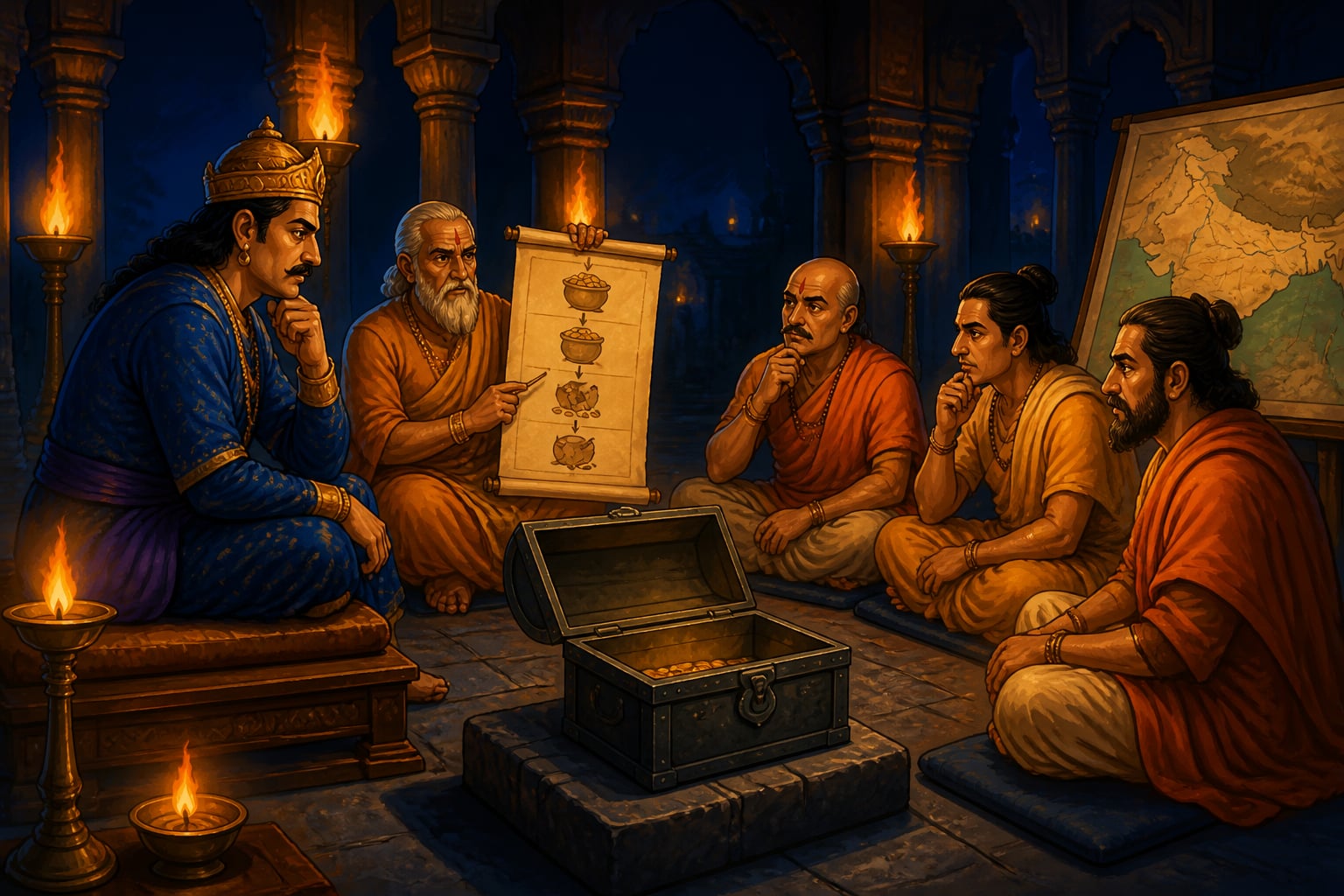
Mauryan finance council in emergency session

Stage 1: Temporary Shortfall (Minor Koshakshaya)

Stage 2: Serious Deficit (Moderate Koshakshaya)

Stage 3: Treasury Crisis (Severe Koshakshaya)

Stage 4: Existential Emergency (Critical Koshakshaya)

The crucial insight: each stage had boundaries. Moving to Stage 4 measures during Stage 2 distress would cause unnecessary harm. But clinging to Stage 1 responses during genuine crisis would ensure failure.

"The wise minister matches remedy to ailment; excess medicine kills as surely as neglected disease."

The Three Causes of Koshakshaya

Kautilya diagnosed treasury depletion to three root causes:

1. Ayahani (Revenue Failure) When income falls below projections, from drought, trade disruption, war, or economic contraction. This is external misfortune requiring adaptation.

2. Vyayavrddhi (Expenditure Excess) When spending exceeds revenue due to poor control, palace extravagance, unnecessary wars, corruption, or weak governance. This is internal failure requiring discipline.

3. Koshacchidra (Treasury Leakage) When revenue is collected but stolen, embezzlement, corruption, accounting fraud. This is systemic failure requiring institutional reform.

Effective response required correct diagnosis. Treating vyayavrddhi with emergency taxation (ayahani remedy) punishes subjects for government's failure. Treating ayahani with austerity alone ignores that reduced economic activity reduces future revenue. Treating koshacchidra with either, without fixing the leakage, merely provides more resources to steal.

Global Perspectives on Financial Crisis

Hyman Minsky (1919–1996) developed the Financial Instability Hypothesis: stability itself breeds instability. During good times, economic actors take on more risk; leverage increases; and what initially seemed prudent becomes reckless. Then comes the "Minsky Moment", when accumulated fragility suddenly unwinds into crisis.

Kautilya's insistence on maintaining reserves even during prosperity reflects the same insight. The king who spends all surplus during good times has no buffer when the Minsky Moment arrives. The discipline of counter-cyclical reserve accumulation is defense against the human tendency to assume good times last forever.

Kenneth Rogoff (1953–present), in "This Time Is Different" (with Carmen Reinhart), examined eight centuries of financial crises across sixty-six countries. The haunting conclusion: nations repeatedly convince themselves that accumulated knowledge prevents crisis, and repeatedly discover they were wrong. Sovereign debt crises follow patterns; warning signs are often ignored; and the phrase "this time is different" precedes almost every catastrophe.

Kautilya's koshakshaya warnings embody this historical wisdom. The later Mauryans believed their empire too large to fail. They were wrong. Every nation that exhausted its kosha discovered that treasury depletion creates cascading failures no administrative brilliance can prevent.

Paul Krugman (1953–present), Nobel laureate, has analyzed numerous emerging market crises. His key insight: currency and fiscal crises are often intertwined. When government deficits require printing money or external borrowing, currency depreciation follows; depreciation raises import costs and debt service; higher costs worsen the deficit; creating a vicious spiral.

This is precisely what happened to Sri Lanka in 2022 and what Kautilya prescribed avoiding. His graduated response hierarchy was designed to halt deterioration before spiral becomes irreversible.

Thinker Key Insight Kautilyan Parallel
Minsky Stability breeds instability Counter-cyclical reserves; discipline in prosperity
Rogoff Nations repeatedly believe 'this time is different' Koshakshaya warnings against complacency
Krugman Currency-fiscal spirals create vicious cycles Graduated response to halt deterioration early

The Emergency Revenue Measures

When all else failed, Kautilya specified emergency revenue options, but with strict conditions:

Benevolences (Voluntary Contributions)

"Let the wealthy be invited to contribute; let their contribution be recorded publicly; let honor be given in proportion."

The king could request voluntary donations from merchants, nobles, and temples. But coercion was forbidden, and contributors received public recognition. This preserved goodwill for future needs.

Advance Taxation Taxes could be collected ahead of schedule, but only with commitment to reduce future obligations proportionally. Subjects paying early weren't paying extra, they were lending to the state.

Asset Monetization State-owned enterprises, surplus land, and non-strategic assets could be sold. But not fortifications, not strategic mines, not anything whose loss would weaken the state permanently.

Debased Coinage (Last Resort) Kautilya acknowledged that currency debasement (reducing precious metal content) was possible, but warned it was "drinking poison." The temporary relief from expanded money supply would be followed by inflation and loss of trust. Modern economists call this "inflation tax."

Modern Resonance: Sri Lanka's Collapse (2022)

Colombo fuel queue in April 2022

In April 2022, Sri Lanka became the first Asian nation in two decades to default on sovereign debt. The world watched in disbelief as a middle-income country ran out of fuel, medicine, and food. President Gotabaya Rajapaksa fled the country as protestors stormed his residence.

The collapse was a textbook demonstration of every Kautilyan warning violated:

Vyayavrddhi (Expenditure Excess):

Ayahani (Revenue Failure):

Koshacchidra (Treasury Leakage):

The Spiral: By 2021, forex reserves fell below $3 billion, enough for barely one month of imports. Rather than seeking IMF assistance (which would require reforms), the government printed money. Rupee collapsed 80%. Import costs soared. Fuel became unavailable. Power cuts reached 12 hours daily. Medicine stocks depleted. Food prices doubled.

The social contract shattered. A nation that had successfully managed economic development for decades found itself unable to function. The treasury's depletion didn't just reduce government services, it destroyed the state's capacity to govern.

India's Contrast: Meanwhile, neighboring India, facing the same COVID shock, maintained forex reserves exceeding $600 billion. The difference wasn't luck; it was decades of reserve accumulation following the 1991 crisis. When COVID struck, India had buffers; Sri Lanka didn't. Policy choices across thirty years determined which nation survived the identical shock.

India's Post-2014 Crisis Navigation

India's fiscal management during recent crises demonstrates Kautilyan principles in modern practice:

COVID-19 Response (2020-2021): When COVID struck, the government faced impossible choices: massive spending required, revenues collapsing. The response combined:

Critically, India didn't deplete strategic reserves. Even at COVID's peak, forex reserves remained above $500 billion. The Atmanirbhar Bharat package (approximately 10% of GDP including credit guarantees) was structured to leverage existing buffers rather than create new obligations the treasury couldn't sustain.

2018 Rupee Crisis: When emerging market currencies collapsed globally in 2018, the rupee fell 13% against the dollar. Rather than depleting reserves to defend an unsustainable exchange rate, the RBI allowed gradual depreciation while maintaining reserves for genuine crisis. This preserved the kosha for the COVID shock two years later.

These responses reflected Kautilyan graduated hierarchy: using appropriate measures for the severity of distress, preserving reserves for genuine emergency, and avoiding the desperation measures that transform manageable problems into existential crises.

Your Turn

Koshakshaya principles apply to personal finance:

What's your emergency hierarchy? When income drops, what gets cut first? Most people have no plan, they make desperate decisions under pressure. Create your hierarchy now, when you're calm.

Do you have reserves for each stage?

Have you diagnosed your risks correctly? Are you facing ayahani (income problem), vyayavrddhi (spending problem), or koshacchidra (leakage problem)? The remedy differs for each.

The individual who plans for crisis before crisis arrives has options. The individual who waits until desperation has only desperation's options.

In our next lesson, we'll examine the broader principle of fiscal discipline at the national level, how Kautilya conceived of the state's economic responsibility to its subjects.

Modern central banks have similar hierarchies: first, communication (forward guidance); then, conventional policy (rate changes); then, unconventional tools (QE); then, emergency measures (direct lending). The principle: match intervention to severity.

Kautilya's hierarchy is more comprehensive, covering fiscal, administrative, and social measures, not just monetary. His framework integrates responses across government functions, not just one policy domain.

India's COVID response used multiple stages: conventional fiscal measures first, then special liquidity facilities, then emergency guarantees, but never depleted strategic reserves. Sri Lanka jumped to desperate measures too quickly, then had nothing left when they failed.

The 'original sin' hypothesis (Eichengreen & Hausmann) notes that emerging markets borrowing in foreign currency face amplified risk: currency depreciation increases debt burden precisely when repayment capacity falls. Rogoff's research shows high debt levels correlate with lower growth.

Kautilya's moral framing, debt as poison, captures the psychological dimension modern economics often misses. The person comfortable with debt accumulates more than the person who views it as dangerous. The framing shapes behavior.

Sri Lanka's foreign debt was 60% of GDP before collapse, not extreme by global standards. But when rupee collapsed 80%, debt service in rupee terms multiplied. The debt taken in prosperity became unpayable in crisis.

Key terms

Kośakṣaya
Treasury depletion; the exhaustion of state financial reserves
Āyahāni
Revenue failure; decline in state income due to external factors
Vyayavṛddhi
Expenditure excess; spending growth beyond sustainable levels
Ṛṇa
Debt; obligation to repay borrowed resources

Verses

कोशक्षये राज्यक्षयः, राज्यक्षये राजक्षयः

Kośakṣaye rājyakṣayaḥ, rājyakṣaye rājakṣayaḥ

When the treasury depletes, the kingdom declines; when the kingdom declines, the king is destroyed.

This anticipates the 'debt-deflation' spiral modern economists recognize: fiscal weakness causes reduced capacity, which causes further fiscal weakness. Sri Lanka's 2022 collapse followed this exact pattern, treasury depletion → service collapse → political collapse → loss of sovereignty.

Arthashastra, Book 5, Chapter 2 (R.P. Kangle critical edition)

औषधं व्याधिमात्रेण, अत्यौषधं विषं भवेत्

Auṣadhaṃ vyādhimātreṇa, atyauṣadhaṃ viṣaṃ bhavet

Let medicine match the disease; excess medicine becomes poison.

This is the principle of proportionate response in crisis management. Austerity during recession (excessive medicine for demand problem) worsens the disease. But stimulus during structural crisis (insufficient medicine for supply problem) wastes resources without healing. Correct diagnosis precedes correct treatment.

Arthashastra, Book 5, Chapter 3 (Patrick Olivelle (2013))

ऋणं विषम्, ऋणं बन्धः, ऋणं मरणम् आपदि

Ṛṇaṃ viṣam, ṛṇaṃ bandhaḥ, ṛṇam maraṇam āpadi

Debt is poison; debt is bondage; in calamity, debt is death.

This anticipates the 'original sin' problem in emerging market economics, debt accumulated in good times becomes lethal in crisis. Sri Lanka's dollar-denominated debt, manageable when rupee was stable, became unpayable when currency collapsed. The debt taken in prosperity became death in calamity.

Arthashastra, Book 2, Chapter 8 (L.N. Rangarajan edition)

Key figures

Brihadratha Maurya

c. 187–185 BCE

India's COVID Fiscal Response (2020-2021)

2020–2021

Hyman Minsky

1919–1996

Case studies

Sri Lanka 2022: The Complete Collapse

In March 2022, Sri Lankans began queueing for fuel. By April, they were queueing for everything, cooking gas, medicine, food. In July, protestors stormed the Presidential Palace. President Gotabaya Rajapaksa fled the country. A middle-income nation with strong human development indicators had experienced complete economic collapse. **The Path to Collapse:** **2009-2019: The Accumulation** - Post-civil war growth masked structural problems - Foreign debt financed infrastructure megaprojects: Hambantota Port (subsequently leased to China for 99 years), Mattala Airport ('world's emptiest'), Lotus Tower, cricket stadiums - Debt-to-GDP rose from 70% (2012) to 87% (2019) - Reserves remained low relative to obligations **2019: The Catalyst** - Massive tax cuts promised during election campaign - VAT reduced from 15% to 8%; corporate taxes cut - Revenue fell 30% almost overnight - Warning: this was vyayavrddhi creating future āyahāni **2020-2021: The External Shock** - COVID devastated tourism (10% of GDP) - Remittances fell - Export earnings declined - Reserves fell below $3 billion **2022: The Spiral** - Government printed money to cover deficits - Currency collapsed 80% - Import costs exploded - Fuel unavailable → transport stopped → economy stopped - Medicine shortages → hospitals unable to function - Power cuts reached 12 hours daily - Food prices doubled - Social order collapsed

Sri Lanka's collapse demonstrates every Kautilyan warning: **Kośakṣaye rājyakṣayaḥ**: Treasury depletion led to kingdom's decline. Without reserves, the government couldn't import essentials. Without essentials, the economy stopped. Without functioning economy, the state lost legitimacy. **Ṛṇaṃ viṣam**: Debt accumulated slowly (poison), constrained choices (bondage), and killed when crisis struck (death in calamity). Dollar-denominated debt, manageable at stable exchange rates, became lethal when currency collapsed. **Diagnosis failure**: Sri Lanka faced all three causes simultaneously, āyahāni (COVID revenue loss), vyayavrddhi (tax cuts, spending), and koshacchidra (corruption, waste). Rather than correct diagnosis and graduated response, leadership denied problems until too late. The dharmic dimension: Sri Lanka's leaders violated their fiduciary duty to citizens. Resources were squandered on prestige projects while reserves depleted. When crisis came, it wasn't leaders who suffered first, it was ordinary citizens queueing for fuel while children went without medicine. Koshakshaya's burden falls on the vulnerable.

**Immediate:** - Sovereign default (first in Sri Lanka's history) - President fled; Prime Minister resigned - IMF bailout required ($2.9 billion) - Inflation exceeded 70% - Economy contracted 7.8% (2022) **Human cost:** - Malnutrition increased among children - Thousands of medical professionals emigrated - Fuel rationing limited economic activity for months - School year disrupted by power cuts **Recovery path:** - IMF program with strict conditions - Debt restructuring negotiations ongoing - Tax increases reversing 2019 cuts - Painful austerity after painless profligacy **Contrast with India:** Same COVID shock, similar economic structures, geographic neighbors. India maintained reserves; Sri Lanka depleted them. India survived; Sri Lanka collapsed. The difference: decades of post-1991 fiscal prudence versus post-2009 fiscal fantasy.

Treasury depletion doesn't just reduce government services, it destroys the state's ability to function. When reserves vanish, even basic imports become impossible. When imports stop, the economy stops. When the economy stops, political authority collapses. Kautilya's warning, koshakshaya leads to rajyakshaya leads to rajakshaya, played out exactly as predicted, 2,300 years later, on global television.

Sri Lanka's 2022 collapse is now studied alongside Venezuela and Zimbabwe as a modern example of treasury depletion cascading into state failure. For South Asian economies, the warning is specific: vanity projects funded by external borrowing, combined with populist tax cuts, create a fiscal trap that ends in sovereign default.

Sri Lanka's forex reserves fell from $7.5 billion (2019) to $1.7 billion (March 2022), barely three weeks of imports. India's reserves during the same period: $600+ billion (10+ months of imports). Same storm, different ships.

Historical context

Late Mauryan Period (232–185 BCE)

The Mauryan decline offers India's earliest documented case of koshakshaya leading to state collapse. The dynasty that created the world's first empire-scale fiscal administration demonstrated what happens when fiscal discipline fails across generations. Later Indian political theorists studied the Mauryan collapse specifically to understand how treasury management determines state survival.

Contemporary states faced similar challenges. The Seleucid Empire fragmented partly due to fiscal overextension. The Roman Republic entered its crisis period (starting c. 133 BCE) with treasury disputes central to political conflict. But the Mauryan collapse is better documented and more clearly attributable to treasury depletion than these contemporaneous cases.

Successive Mauryan rulers after Ashoka reigned an average of only 7-8 years, compared to Chandragupta (24 years), Bindusara (25 years), and Ashoka (36 years). The shortened reigns correlate with weakening central authority as treasury depleted.

The Mauryan collapse proves that Kautilya's warnings weren't theoretical, his own state fell when his fiscal principles were abandoned. This gives the Arthashastra's koshakshaya warnings unique authority: the author described a failure mode that subsequently destroyed the very state he helped build. History validated the text.

Living traditions

Every Finance Ministry budget discussion implicitly references koshakshaya. When officials debate 'fiscal space' and 'debt sustainability,' they're assessing how far from treasury depletion current policy stands. When RBI Governors defend reserve levels against critics calling them 'excessive,' they're applying Kautilya's logic: reserves seem unnecessary until crisis proves them essential. India's post-1991 fiscal architecture represents explicit institutional response to koshakshaya risk.

Reflection

More in Treasury & Financial Management

All lessons in Treasury & Financial Management · Arthashastra: Economic Principles course