Kosha: The Science of Treasury Management

Why Cash Reserves Matter More Than Armies

Kautilya's revolutionary insight that a full treasury (kosha) is the foundation of state power, ranking it above even the army. From Mauryan gold vaults to India's $600 billion forex reserves, the principle endures: wealth stored wisely is strength multiplied.

The Weight of Gold
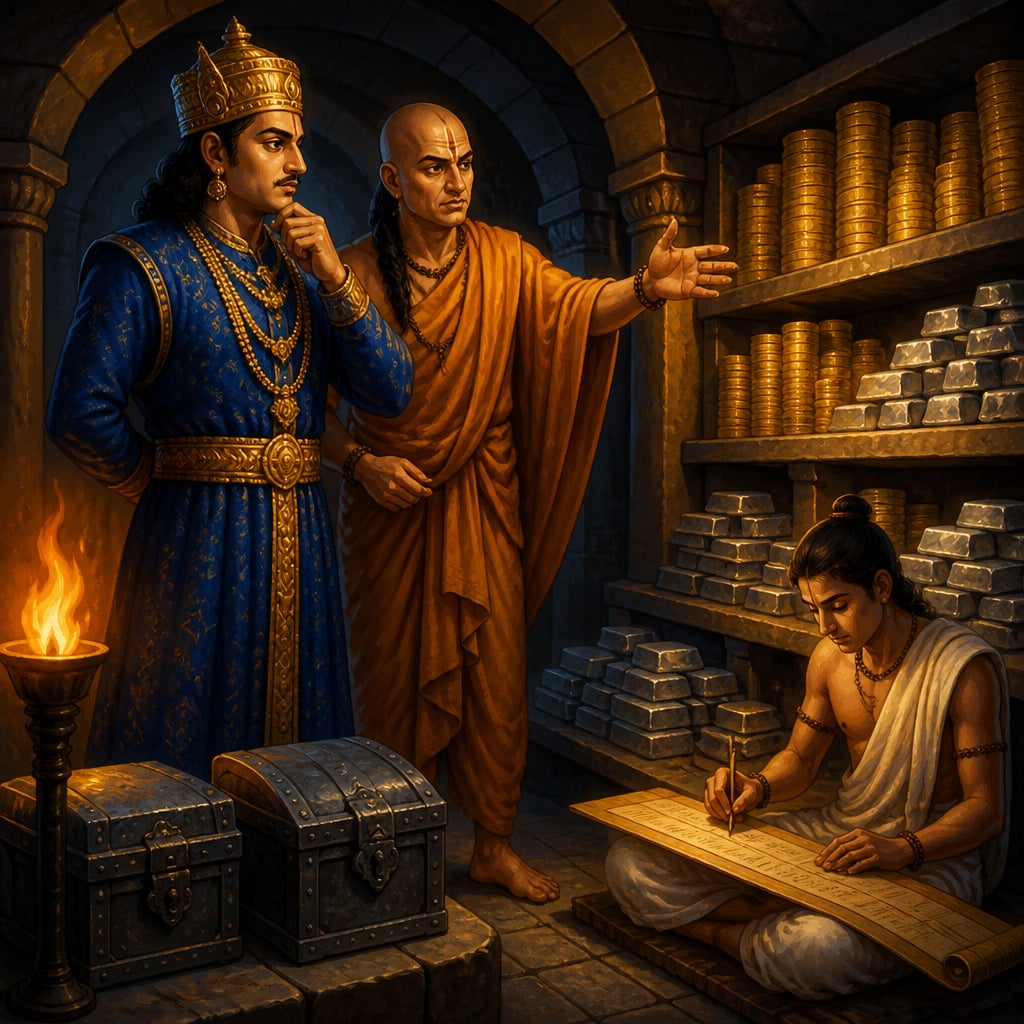
Chandragupta and Kautilya inside the Mauryan vault

The year was 321 BCE. Chandragupta Maurya stood in the treasury vault beneath his palace in Pataliputra, torchlight dancing across stacks of gold coins, silver ingots, and precious gems. His teacher Kautilya had insisted he come here, not to the armory, not to review his legendary war elephants, but here, to this silent room of accumulated wealth.

"You have conquered Magadha," Kautilya said quietly. "But this room will determine whether your dynasty survives a hundred years or a thousand."

Chandragupta was puzzled. He had the finest army in the subcontinent. Greek historians would later estimate his forces at 600,000 infantry, 30,000 cavalry, and 9,000 war elephants. Why would his teacher prioritize a vault of metal over such overwhelming military power?

The answer would become one of the most influential economic principles in human history.

The Revolutionary Ranking

In the Arthashastra, Kautilya presents the Saptanga theory, the seven limbs of the state: the king (svami), ministers (amatya), territory (janapada), fortified capital (durga), treasury (kosha), army (danda), and allies (mitra). What shocked ancient commentators was Kautilya's ranking.

"Koshāt prabhavati danda, dandāt prabhavati bhūmih"

"From the treasury comes the army, from the army comes the land."

This was radical. Every king instinctively believed military strength came first. Kautilya inverted the logic: the treasury is the source from which all other powers flow. An army without pay becomes a mob. Fortifications without maintenance crumble. Allies without gifts drift away. Even the most brilliant king, without a full treasury, rules nothing but dust.

Kautilya devoted an extraordinary 35 chapters of the Arthashastra to treasury management, more than to diplomacy, warfare, or even espionage. He wasn't writing philosophy; he was writing a survival manual.

The Kosha Principle: Reserves as Resilience

Sheathed sword resting on reserve-ratio palm leaves

The Sanskrit word kosha means more than "treasury." Its root suggests a sheath, a protective covering, like the scabbard that protects a sword. Kautilya's insight was that wealth stored isn't wealth idle; it's potential energy waiting to become kinetic power.

He prescribed specific reserve ratios:

"The king should accumulate wealth during times of prosperity, for the treasury accumulated in good times rescues in calamity." , Arthashastra 5.2.1

This wasn't arbitrary frugality. Kautilya had witnessed the chaos when kingdoms ran out of gold, soldiers deserting, administrators defecting, enemies sensing weakness. He calculated that a kingdom should maintain reserves sufficient to sustain the state for three to seven years without any revenue, a buffer against drought, war, or epidemic.

Consider the precision: he wasn't saying "save money." He was quantifying exactly how much safety required.

Global Perspectives on Treasury Reserves

Kautilya's insights weren't rediscovered in the West until much later, but parallel thinking eventually emerged:

Alexander Hamilton (1755–1804), America's first Treasury Secretary, understood this instinctively. When he established the First Bank of the United States in 1791, he argued that national creditworthiness, the ability to borrow because you've demonstrated the ability to save, was the foundation of sovereignty. "A national debt, if not excessive, will be a national blessing," he wrote, but only if backed by visible reserves and reliable revenue. Hamilton's system of federal assumption of state debts and creation of a sinking fund echoed Kautilya's principle: accumulate in prosperity to deploy in crisis.

John Maynard Keynes (1883–1946) formalized what Kautilya intuited about counter-cyclical reserves. His General Theory argued that governments should run surpluses during boom times and deficits during busts, essentially building a kosha when times are good, then deploying it when the economy falters. The insight that austerity during a recession is precisely backwards mirrors Kautilya's warning against depleting reserves at the worst possible moment.

Milton Friedman (1912–2006) approached reserves from a different angle, monetary stability. His argument that predictable money supply prevents economic chaos led to the modern consensus that central banks must maintain sufficient reserves to defend currency stability. When Friedman visited India in 1955, he advised building foreign exchange buffers, advice that would prove prophetic four decades later.

Thinker Core Insight Kautilyan Parallel
Hamilton National credit requires demonstrated reserves Kosha enables state capacity
Keynes Counter-cyclical fiscal policy Accumulate in prosperity for calamity
Friedman Monetary reserves ensure stability Treasury protects against external shocks

The difference? Kautilya synthesized all three, fiscal reserves, emergency buffers, and monetary stability, into a single integrated framework, 2,300 years before any of them were born.

Modern Resonance: Greece vs. India, 2008–2020

In September 2008, Lehman Brothers collapsed, triggering the worst global financial crisis since the Great Depression. The world's economies faced an identical shock simultaneously, a perfect natural experiment for Kautilya's thesis.

Greece entered the crisis with government debt at 109% of GDP and minimal foreign exchange reserves. When credit markets froze, Greece couldn't borrow. When the economy contracted, tax revenues collapsed. By 2010, Greece required a €110 billion bailout. Unemployment would peak at 27%. The economy shrank by 25%, a depression comparable to the American 1930s.

India entered the same crisis differently. Under RBI Governor Y.V. Reddy, India had accumulated forex reserves of $310 billion by 2008, despite criticism from economists who called such accumulation "excessive" and "economically inefficient." Reddy's response? "Reserves are not for economists to calculate optimal levels. They are for governors to have options when crisis strikes."

Calm RBI banker reviewing forex reserves at dusk

When the 2008 crisis hit, India could defend its currency, maintain liquidity, and avoid the IMF. GDP growth slowed from 9% to 6%, painful, but not catastrophic. No bailout. No sovereignty surrendered.

The contrast became even starker during COVID-19. By 2020, Shaktikanta Das, then RBI Governor, had built India's reserves to over $600 billion. When the pandemic struck, the RBI cut interest rates by 115 basis points, injected liquidity equal to 8.7% of GDP, and provided loan moratoriums, all without triggering a currency crisis. Das received the "Central Banker of the Year" award from The Banker magazine in 2020 and "Governor of the Year" from Central Banking in 2023.

His explanation echoed Kautilya across millennia: "Emerging market economies have to build their own buffers, their own safety nets. A strong foreign exchange reserve is the best safety net against global spillovers."

Your Turn

Kautilya's principle scales from empires to individuals. Ask yourself: Do you have a kosha, an emergency fund, a buffer against job loss or medical crisis? Financial planners today recommend 6–12 months of expenses saved. Kautilya recommended 3–7 years for states. The principle is identical: stored wealth isn't idle; it's insurance against uncertainty.

The next time you're tempted to spend everything you earn, remember Chandragupta in that torchlit vault. His treasury didn't make him powerful. It made his power durable.

In our next lesson, we'll explore how the Mauryans actually built that treasury, the sophisticated system of sangraha (revenue collection) that funded an empire.

Liquidity buffers and the precautionary motive for holding cash

Keynes identified the 'precautionary motive' for holding money, reserves against uncertainty. Modern central banks maintain capital adequacy ratios and liquidity coverage ratios following this logic.

Kautilya's framework is more comprehensive, he integrated fiscal buffers (treasury), monetary reserves (gold/silver), and strategic reserves (grain stores) into a single framework, while modern economics often treats these separately.

India's forex reserves of $600+ billion (2024) represent approximately 10 months of import cover, within the 'buffer zone' Kautilya would have recommended.

Friedman argued that holding excessive reserves imposes opportunity costs, the foregone returns on productive investment. Larry Summers has criticized China's $3+ trillion forex reserves as 'dead money.'

Kautilya's framework anticipates this critique by emphasizing purpose: reserves exist to enable decisive action during crises, not as ends in themselves. The test is whether reserves can be deployed effectively when needed.

Key terms

Kosha
Treasury; the accumulated wealth and financial reserves of the state
Saptāṅga
The seven limbs or constituent elements of the state in Kautilyan political theory
Daṇḍa
The rod of authority; specifically, the army and coercive power of the state
Āpad
Calamity, distress, emergency; unforeseen crisis requiring exceptional response

Verses

कोशात् प्रभवति दण्डः, दण्डात् प्रभवति भूमिः

Koshāt prabhavati daṇḍaḥ, daṇḍāt prabhavati bhūmiḥ

From the treasury springs the army; from the army springs dominion over land.

This is essentially an ancient statement of fiscal primacy, that economic capacity determines geopolitical capacity. Modern defense economists recognize this principle: military budgets depend on GDP, and sustained military operations require sustained funding. The U.S. defense establishment's unofficial motto, 'Amateurs study tactics, professionals study logistics', echoes Kautilya's insight.

Arthashastra, Book 8, Chapter 1, Verse 43 (R.P. Kangle critical edition)

सुभिक्षे कोशं सञ्चिनुयात्, कोशः सञ्चितः आपदि त्रायते

Subhikṣe kośaṁ sañcinuyāt, kośaḥ sañcitaḥ āpadi trāyate

In times of plenty, fill the treasury; the treasury filled shall rescue you in calamity.

This is the principle behind sovereign wealth funds, foreign exchange reserves, and fiscal buffers. India's accumulation of $600+ billion in forex reserves follows this exact logic, building reserves during the growth years of 2003-2008 and 2010-2019 enabled crisis response in 2008 and 2020 without external dependence.

Arthashastra, Book 5, Chapter 2, Verse 1 (Patrick Olivelle (2013))

आयमुखम् उदयः व्ययमुखं नयः तयोः अन्तरम् आगमः।

āya-mukham udayaḥ vyaya-mukhaṃ nayaḥ tayoḥ antaram āgamaḥ |

What rises is income; what departs is outgo. The difference between them, that is true gain.

Book 2 chapter 12 is Kautilya's treatise on the treasurer's duties. This sutra establishes the fundamental metric: a ruler who watches only inflow (udaya) and not net (āgama) will be surprised by an empty treasury.

Book 2, Chapter 12, Verse 37 (R.P. Kangle)

Key figures

Kautilya (Chanakya)

4th century BCE

Shaktikanta Das

1957–present

Alexander Hamilton

1755–1804

Case studies

Tale of Two Crises: Greece vs. India (2008–2020)

In September 2008, Lehman Brothers' collapse triggered a synchronized global crisis. Both Greece and India faced the same external shock, frozen credit markets, capital flight risk, and collapsing demand. Yet their outcomes diverged dramatically. **Greece** entered 2008 with government debt at 109% of GDP, negligible foreign exchange reserves, and membership in the Eurozone (meaning no independent monetary policy). When crisis hit, Greece couldn't devalue its currency, couldn't print money, and couldn't borrow affordably. By 2010, it required a €110 billion EU/IMF bailout, surrendering fiscal sovereignty to the 'troika.' Unemployment peaked at 27.5% in 2013. GDP contracted by 25% from peak to trough. Recovery wouldn't begin until 2017. **India** entered 2008 with forex reserves of $310 billion (built under RBI Governor Y.V. Reddy despite economist criticism), manageable government debt, and monetary policy independence. The RBI cut rates aggressively, injected liquidity, and defended the rupee without depleting reserves. GDP growth slowed from 9.3% to 6.7%, painful but not catastrophic. No bailout. No external conditionality. Sovereignty intact. The contrast repeated during COVID-19. Greece, still recovering from the previous crisis, required additional EU support. India, with reserves now exceeding $600 billion under Governor Shaktikanta Das, implemented massive fiscal and monetary support (8.7% of GDP in liquidity injection alone) without triggering debt distress or currency crisis.

Kautilya's framework diagnoses both outcomes precisely. Greece violated the fundamental kosha principle, entering prosperity without building reserves, accumulating debt instead of buffers, and surrendering monetary sovereignty to external authority. India followed Kautilyan logic: accumulate in prosperity (building reserves during 2003-2008 growth), maintain policy independence (avoiding eurozone-style constraints), and deploy reserves decisively when crisis strikes. The dharmic dimension: Greece's creditors imposed 'austerity', cutting spending during depression, precisely what Kautilya warned against. India could afford stimulus because it had accumulated the reserves to fund it. Prudence before the crisis enabled compassion during the crisis.

**Greece**: 10+ years of economic depression. Youth unemployment reached 60%. 'Brain drain' as educated Greeks emigrated. Debt-to-GDP ratio actually worsened despite austerity. Political instability and rise of extremist parties. **India**: V-shaped recovery after both 2008 and 2020 shocks. Forex reserves grew from $310B (2008) to $600B+ (2024). Maintained investment-grade credit rating throughout. No external bailouts in modern history despite multiple global crises. The divergence isn't about size, geography, or luck, it's about the kosha principle: reserves accumulated in prosperity rescue during calamity.

Nations without reserves face impossible choices during crises, austerity that deepens depression, or bailouts that surrender sovereignty. Nations with reserves have options. Kautilya's 2,300-year-old principle remains the foundational truth of sovereign economics: build your kosha before you need it, because when you need it, it's too late to build.

The Greece-India divergence is now a standard comparison in sovereign finance courses. For developing nations building reserves, the lesson is unambiguous: fiscal buffers built during good times are the only protection against impossible choices during bad times.

Greece's economy contracted 25% (2008-2013); India's grew 41% over the same period. Both faced the same global shock. The difference was reserves.

Historical context

Mauryan Empire (322–185 BCE)

The Mauryan Empire represented India's first successful attempt at subcontinental unification. Pataliputra (modern Patna) became one of the ancient world's largest cities, population estimates range from 150,000 to 400,000. The treasury at its peak may have collected revenues equivalent to 25% of total economic output, a fiscal extraction rate not matched in India until the 20th century.

Contemporaneous empires, Seleucid Persia, Ptolemaic Egypt, early Roman Republic, all struggled with treasury management. Rome's repeated currency debasements demonstrate the consequences of ignoring Kautilyan principles. China's Qin dynasty (221–206 BCE) achieved similar centralization but collapsed within fifteen years; the Mauryans lasted 137 years, partly due to superior fiscal foundations.

Megasthenes, Greek ambassador to the Mauryan court, reported that the royal treasury employed hundreds of specialized accountants tracking revenues from 'agriculture, mines, forests, herds, trade, and manufactures', an early example of systematic public finance.

The Mauryan treasury system, documented in the Arthashastra, represents humanity's first comprehensive fiscal management framework. Its principles influenced the Gupta Empire, Mughal administration, and even British colonial revenue systems. Understanding Kautilya's treasury management illuminates both ancient sophistication and enduring principles.

Living traditions

India's fiscal institutions, the Finance Ministry, RBI, CAG (Comptroller and Auditor General), perform functions Kautilya specified: revenue collection, treasury management, and audit. The organizational chart of Indian fiscal governance would be recognizable to a Mauryan administrator. When Shaktikanta Das invokes 'buffers against global spillovers,' he speaks Kautilya's language in modern vocabulary.

Reflection

More in Treasury & Financial Management

All lessons in Treasury & Financial Management · Arthashastra: Economic Principles course