Purushartha-Artha: Economic Development in Dharmic Framework

Wealth as Sacred Duty, Not Mere Accumulation

When Jawaharlal Nehru chose Soviet-style planning over indigenous economic models in 1950, he inadvertently severed India from millennia of dharmic economic wisdom. This lesson explores how the Purushartha framework positions artha (wealth) as one of four sacred life goals, and why separating economics from dharma created the very 'Hindu rate of growth' that haunted India for decades.

The Choice That Shaped a Nation
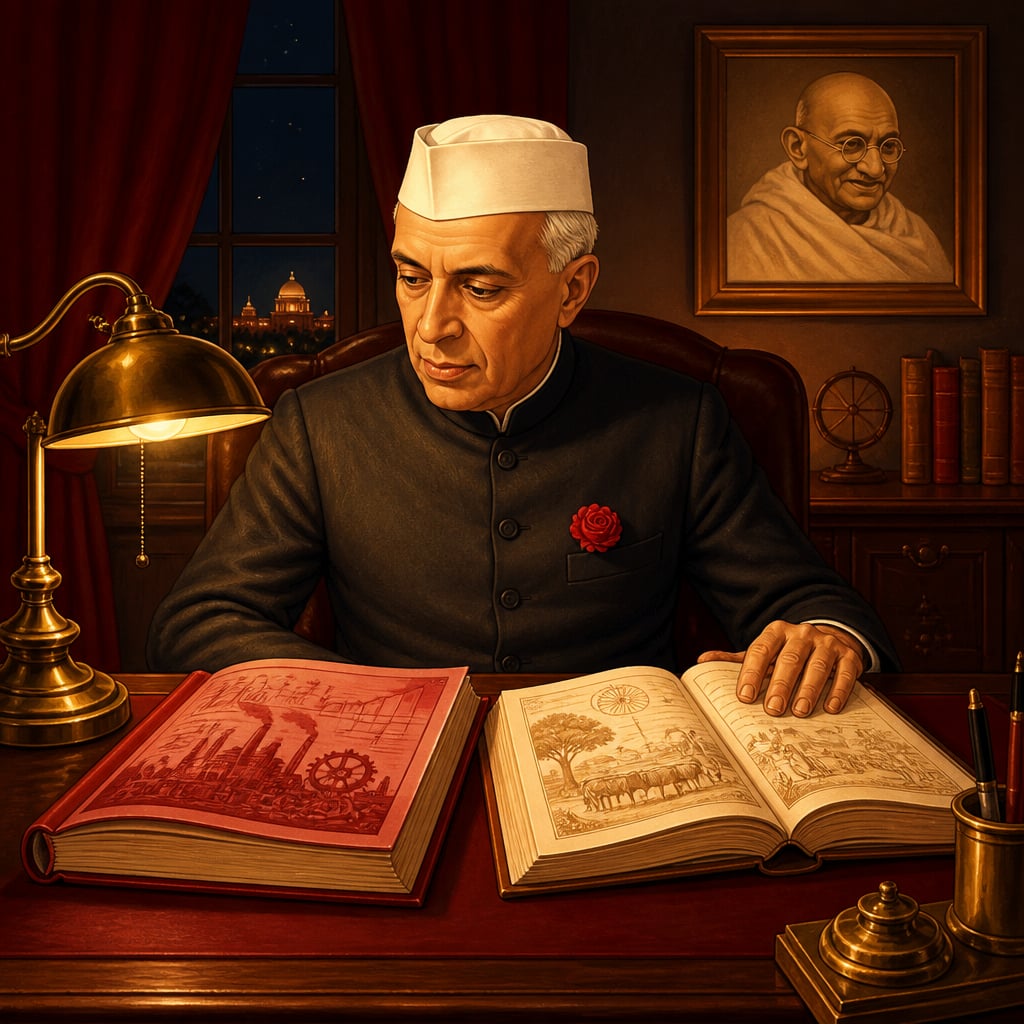
Nehru choosing between Soviet and dharmic economic models

In the winter of 1950, Prime Minister Jawaharlal Nehru sat in his study, surrounded by economic reports. Independent India was barely three years old. Half the population lived in poverty. Literacy was 18%. Life expectancy was 32 years. The question before him: what development model should India adopt?

On his desk lay two documents. One was a proposal from the Planning Commission for Soviet-style Five Year Plans, centralized control, heavy industry focus, state-directed investment. The other was a paper from Gandhians advocating for village-centered, decentralized development based on swadeshi principles.

Nehru chose the Soviet model. He was not anti-Indian, he genuinely believed rapid industrialization required centralized planning. But in making this choice, he did something perhaps more consequential: he implicitly accepted that economics was a technical domain, separable from culture and spirituality.

The Purushartha framework that had guided Indian economic thinking for millennia was quietly set aside. The results would take decades to unfold.

The Purushartha Framework: A Quick Review

The ancient concept of Purushartha identifies four legitimate goals of human life:

  1. Dharma (धर्म), Righteousness, ethical conduct, duty
  2. Artha (अर्थ), Wealth, material prosperity, resources
  3. Kama (काम), Pleasure, aesthetic enjoyment, desire fulfillment
  4. Moksha (मोक्ष), Liberation, spiritual freedom, transcendence

The genius of this framework is its integration. These aren't competing goals, they're complementary. You don't have to choose between prosperity and spirituality, between enjoyment and ethics. The challenge is to pursue all four in harmony.

Critically, artha is explicitly included. Wealth creation isn't merely tolerated in dharmic thought, it's celebrated as a sacred duty. The Mahabharata states:

"अर्थस्य पुरुषो दासः दासस्त्वर्थो न कस्यचित्। इति सत्यं महाराज बद्धोऽस्म्यर्थेन कौरवाः॥"

"A person serves wealth, but wealth serves no one. This is truth, O King, we are all bound by the need for resources." , Mahabharata, Shanti Parva

This isn't a complaint about money, it's an acknowledgment of reality. Humans need resources to fulfill their duties. Ignoring artha doesn't make you spiritual; it makes you unable to fulfill your dharmic obligations.

Artha Within Dharma: The Critical Constraint

The Purushartha framework places a crucial constraint on wealth-seeking: artha must operate within dharma. This isn't a vague moral guideline, it's a structural principle.

The Vidura Niti, one of the most respected texts on practical ethics, makes this explicit:

"धर्मेण अर्थं समीहेत धर्मं चैव अर्थेन समीहेत। न त्वधर्मेण अर्थं समीहेत न च धर्मं अर्थेन हानयेत्॥"

"Seek wealth through dharma, and support dharma through wealth. Never seek wealth through adharma, nor sacrifice dharma for wealth."

This creates a bounded optimization problem: maximize artha subject to the constraint of dharma. You're encouraged to be prosperous, but not by any means necessary.

What does this look like in practice?

Artha Pursuit Within Dharma? Why?
Building a profitable business through quality products ✅ Yes Creates value, employs people, serves customers
Profiting by adulterating food products ❌ No Harms consumers, violates non-harm principle
Earning wealth to support family ✅ Yes Fulfills householder duty
Hoarding beyond need while others starve ❌ No Violates sharing principle (dana-dharma)
Strategic pricing in competitive market ✅ Yes Normal commerce within fair dealing
Price gouging during disasters ❌ No Exploiting vulnerability is adharmic

This isn't anti-capitalism. It's capitalism with guardrails, guardrails that come from dharmic principles rather than external regulation.

What Happens When Artha Divorces Dharma?

The Mahabharata provides the cautionary tale of Duryodhana, a prince who had every material advantage and lost everything.

Duryodhana was wealthy, powerful, educated, and connected. His artha was exceptional. But he pursued it without dharma, through deception (the rigged dice game), through exploitation (refusing the Pandavas' rightful share), through violence (the attempted burning of the lac house).

The result? Not only did he lose the Kurukshetra war, but he lost his entire lineage, his kingdom, and his life. His 'success' was illusory because it was built on adharmic foundations.

Krishna's analysis is instructive:

"He who seeks to build his house upon another's ruin shall find his own house falling. This is the law."

This isn't mystical karma, it's practical wisdom. Wealth built on exploitation creates enemies, erodes trust, and eventually collapses. Duryodhana's story is a 5,000-year-old case study in unsustainable business practices.

India's License Raj: Artha Divorced from Both Dharma and Freedom

Entrepreneur waiting at a License Raj clerk's window

Nehru's Soviet-inspired model didn't just ignore dharmic principles, it also constrained legitimate artha-seeking through excessive regulation.

The License Raj (1947-1991) required government permission for:

An entrepreneur wanting to produce more to meet customer demand needed bureaucratic approval. The result was corruption, inefficiency, and what economist Raj Krishna mockingly called the "Hindu rate of growth", 3.5% GDP growth that barely exceeded population growth.

Ironically, this system violated both dharmic and modern economic principles:

The dharmic framework would have suggested a different approach: enable artha-seeking (economic freedom) while enforcing dharma (ethical constraints). Instead, India got restricted artha-seeking with widespread adharma (corruption as the only way to navigate the system).

Global Perspectives on Ethical Constraints in Economics

The dharmic insight, that wealth-seeking must operate within ethical boundaries, finds echoes and contrasts in Western economic thought.

Milton Friedman (1912-2006), the Nobel laureate and champion of free markets, famously declared: "The business of business is business." His 1970 essay argued that a corporation's sole responsibility is maximizing shareholder profits, managers who spend on 'social responsibility' are essentially taxing shareholders without consent. This represents the pure artha position: profit unconstrained by explicit dharma. Friedman trusted market competition and law to provide sufficient ethical guardrails.

R. Edward Freeman (born 1951) challenged Friedman directly with stakeholder theory. Freeman argued that businesses have obligations not just to shareholders, but to employees, customers, suppliers, communities, and the environment, all 'stakeholders' affected by corporate decisions. This mirrors the dharmic principle that artha-seeking must consider impact on others. Freeman's framework, now mainstream in business schools, essentially rediscovered what Vidura articulated millennia ago.

Max Weber (1864-1920) offered a different angle in 'The Protestant Ethic and the Spirit of Capitalism.' Weber argued that Calvinist Christianity created capitalism by making worldly success a sign of divine favor, work became worship. This echoes the dharmic legitimization of artha: wealth-seeking as sacred duty, not sin. But Weber saw danger too: capitalism became an "iron cage" where profit-seeking lost its spiritual moorings. This is precisely the Duryodhana problem, artha divorced from dharma.

Thinker Position on Ethics in Business Dharmic Parallel
Friedman Profit is the only business responsibility Pure artha; trusts external law for dharma
Freeman Stakeholders matter, not just shareholders Dharma-bounded artha; consider all affected
Weber Work as worship, but risk of losing meaning Artha as purushartha, but danger of moksha-loss

The dharmic framework synthesizes these insights: pursue artha vigorously (with Friedman's entrepreneurial energy), consider all stakeholders (with Freeman's breadth), and maintain spiritual grounding (with Weber's warning about hollow materialism).

M. Visvesvaraya's Dharmic Industrialization Vision

Sir M. Visvesvaraya (1861-1962), the legendary engineer and Diwan of Mysore, offered an alternative vision that was both modern and dharmic.

Visvesvaraya believed in industrialization, but industrialization rooted in Indian conditions. His 1920 book Reconstructing India proposed:

As Diwan of Mysore, he demonstrated this vision practically:

Mysore under Visvesvaraya grew faster than British India while maintaining dharmic governance. It was a proof of concept for what India could have been.

When asked about his success, Visvesvaraya said: "Efficiency is doing things right. Effectiveness is doing the right things. A developed nation does both."

This is Purushartha in action, artha (wealth, growth) pursued through dharma (ethics, excellence).

The 1991 Liberation: Partial Return to Purushartha

In 1991, facing a balance of payments crisis, Finance Minister Manmohan Singh dismantled much of the License Raj. The liberalization was pragmatic, not ideological, but it inadvertently began restoring the artha dimension of Purushartha.

Indians were now freer to pursue wealth:

The results were dramatic:

But liberalization was incomplete from a Purushartha perspective. It freed artha without strengthening dharma. The result has been growth accompanied by:

True Purushartha economics would require both, freedom to pursue artha AND robust dharmic constraints.

Applying Purushartha to Your Economic Decisions

This framework isn't just for policymakers. It applies to your daily economic choices.

The Purushartha Economic Audit:

  1. Is my artha-seeking dharmically grounded?

    • Am I earning through honest means?
    • Does my work harm or help others?
    • Am I fulfilling my obligations to family and society?
  2. Am I balancing artha with kama?

    • Is my work leaving space for joy, relationships, beauty?
    • Am I working to live, or living to work?
  3. Is my artha connected to moksha?

    • Does my wealth-seeking serve a purpose beyond accumulation?
    • Am I using resources for growth, or just hoarding?
  4. Am I contributing to collective artha?

    • Am I creating jobs, value, opportunities for others?
    • Or am I extracting wealth at others' expense?

The dharmic entrepreneur isn't less ambitious than the pure profit-maximizer. They're more comprehensively ambitious, seeking wealth AND ethics AND joy AND meaning. This is harder, but it's also more sustainable and more fulfilling.

In our next lesson, we'll explore how some nations have tried to measure beyond GDP, including Bhutan's famous Gross National Happiness index, and what India can learn from these experiments.

Constrained optimization / Ethical business practices

Milton Friedman argued 'the business of business is business', profit maximization as sole duty. The dharmic view is more nuanced: profit is legitimate, but not at any cost. This aligns with modern stakeholder capitalism (Larry Fink, Business Roundtable 2019 statement).

The dharmic framework provides moral grounding that utilitarian ethics struggles to achieve. 'Why be ethical?' In dharma: because adharmic wealth eventually destroys itself (karma). This isn't superstition, it's the recognition that trust-destroying behavior has long-term costs.

Companies with strong ESG (Environmental, Social, Governance) scores outperform peers by 4.7% annually over 5-year periods (MSCI research, 2023). Dharmic constraints, far from hindering returns, may enhance them.

Adam Smith's argument for free markets and Amartya Sen's 'Development as Freedom' both recognize that economic restrictions harm human flourishing. The dharmic insight adds: they also prevent dharmic duty fulfillment.

The dharmic case for economic freedom is stronger than the purely utilitarian case. It's not just that markets are efficient (they are); it's that preventing people from earning prevents them from being dharmic, from supporting family, serving society, giving charity.

Key terms

Puruṣārtha
The four goals worthy of human pursuit: Dharma (righteousness), Artha (wealth), Kama (pleasure), and Moksha (liberation). Together they constitute a complete framework for a balanced and meaningful life.
Vidura Nīti
The practical wisdom teachings of Vidura, the wise counselor in the Mahabharata, covering governance, ethics, economics, and personal conduct. Represents dharmic pragmatism, idealistic ends through realistic means.
License Rāj
The system of excessive government permits, licenses, and regulations that controlled Indian economic activity from 1947 to 1991. Characterized by bureaucratic delays, corruption, and suppressed entrepreneurship.
Antyodaya
Literally 'rise of the last person', the principle that true development must reach the poorest and most marginalized. A development philosophy where success is measured not by average growth, but by whether the weakest members of society have risen.

Verses

धर्मेण अर्थं समीहेत धर्मं चैव अर्थेन समीहेत। न त्वधर्मेण अर्थं समीहेत न च धर्मं अर्थेन हानयेत्॥

dharmeṇa arthaṃ samīheta dharmaṃ caiva arthena samīheta | na tvadharmena arthaṃ samīheta na ca dharmaṃ arthena hānayet ||

Seek wealth through righteousness, and use wealth to uphold righteousness. Never pursue wealth through unrighteousness, nor abandon righteousness for wealth's sake.

This verse anticipates the modern debate about 'stakeholder capitalism' vs. 'shareholder primacy.' The dharmic position is clear: profit-seeking is legitimate, but only within ethical constraints. What Vidura said 3,000 years ago, business ethicists are rediscovering today.

Vidura Niti / Mahabharata, Udyoga Parva (Bibek Debroy and K.M. Ganguli translations)

अर्थस्य पुरुषो दासः दासस्त्वर्थो न कस्यचित्। इति सत्यं महाराज बद्धोऽस्म्यर्थेन कौरवाः॥

arthasya puruṣo dāsaḥ dāsastvartho na kasyacit | iti satyaṃ mahārāja baddho'smyarthena kauravāḥ ||

A person serves wealth, but wealth serves no master. This is truth, O King, by the need for resources, we are all bound.

This verse legitimizes economic activity. Unlike medieval Christian suspicion of commerce or socialist disdain for profit, dharmic thought accepted that humans need resources and that seeking them is natural. The question isn't whether to seek wealth, but how.

Mahabharata, Shanti Parva (Bibek Debroy translation)

अर्थनाशं मनस्तापं गृहे दुश्चरितानि च। वञ्चनं चापमानं च मतिमान्न प्रकाशयेत्॥

arthanāśaṃ manastāpaṃ gṛhe duścaritāni ca | vañcanaṃ cāpamānaṃ ca matimānna prakāśayet ||

The wise person does not broadcast their financial losses, mental troubles, household scandals, deceptions suffered, or insults received.

This reveals the dharmic attitude toward wealth: significant enough to warrant mention alongside mental health and family honor, but not so overwhelming that its loss should destroy equanimity. Wealth matters; it isn't everything.

Chanakya Niti, Chapter 1 (Traditional)

Key figures

Sir M. Visvesvaraya

Civil engineer, statesman, Diwan of Mysore (1912-1918), Bharat Ratna recipient (1955) · 1861-1962 (Pre-independence engineer-statesman)

Dr. Manmohan Singh

Economist, Finance Minister who liberalized Indian economy in 1991, later served as Prime Minister · Contemporary (born 1932, Finance Minister 1991-1996, Prime Minister 2004-2014)

Milton Friedman

Nobel Prize-winning economist, champion of free markets, advisor to governments worldwide · 1912-2006 (20th century economist)

Case studies

TVS Motor: 113 Years of Dharma-Bounded Artha

In 1911, T.V. Sundaram Iyengar started a bus service in Madurai with a radical policy: no bribes, ever. This wasn't idealism, it was strategy. In an era when transport licenses required 'greasing palms,' TVS chose to build reputation instead of relationships with corrupt officials. The policy was tested immediately. Competitors who bribed officials got better routes and schedules. TVS buses sometimes ran half-empty on less profitable routes. Sundaram Iyengar's sons questioned the approach. His response became family legend: 'A business built on bribes can be destroyed by bribes. A business built on trust survives everything.' For 113 years, across four generations, TVS Group has maintained this stance. When the License Raj made bribes almost mandatory for industrial licenses, TVS simply grew slower, but it grew clean. The family's internal code, called the 'TVS Principles,' explicitly states: 'We will not pay or receive bribes or engage in corrupt practices under any circumstances.'

TVS exemplifies Vidura's teaching: 'धर्मेण अर्थं समीहेत', seek wealth through dharma. The family chose dharmic constraints even when they reduced artha in the short term. This wasn't charity or CSR, it was a strategic choice to build an enterprise on foundations that couldn't be undermined. The dharmic insight is that trust is compounding capital. Each ethical decision builds reputation; each bribe erodes it. Over 113 years, this compounding has made TVS one of India's most respected industrial groups, precisely because they never took shortcuts that would have offered faster growth but weaker foundations.

TVS Group today comprises 90+ companies with $8.5 billion in revenue (2024), including TVS Motor (India's third-largest two-wheeler manufacturer), Sundaram Finance, TVS Electronics, and multiple joint ventures with global partners. The 'no bribe' policy became a competitive advantage: international partners like Toyota, Suzuki, and Daimler chose TVS precisely because they could trust its governance. When Transparency International surveyed Indian companies, TVS consistently ranked among the most ethical. The family's dharmic constraints didn't limit growth, they enabled a different kind of growth: slower initially, but more sustainable and scalable.

Dharmic constraints are not obstacles to artha, they are foundations for sustainable artha. TVS's 113-year experiment proves that the Vidura Niti principle works in practice: wealth sought through dharma compounds; wealth sought through adharma eventually collapses.

ESG (Environmental, Social, Governance) investing now manages over $30 trillion globally, reflecting a growing consensus that ethical constraints improve long-term returns. TVS's century-old experiment anticipated what modern capital markets are only now formalizing.

TVS Motor's market capitalization grew from ₹3,000 crore (2014) to ₹75,000 crore (2024), a 25x increase in a decade, while maintaining zero corruption scandals across 113 years. Clean governance enabled, rather than hindered, explosive growth.

HDFC's Founding: Building India's Housing Dream on Dharmic Foundations

In 1977, Hasmukhbhai Parekh faced a paradox. As chairman of ICICI, he saw that India desperately needed housing finance, millions of families wanted homes but had no access to long-term loans. Banks considered housing loans too risky; the government had no mechanism. Yet Parekh, at 66 years old and approaching retirement, chose to start from scratch rather than retrofit an existing institution. His reasoning was dharmic: housing finance required a different culture than corporate lending. It meant serving middle-class families, not industrialists. It meant 20-year relationships, not 3-year project loans. It meant trust at a scale that existing institutions couldn't deliver. 'If we are to serve the common man,' Parekh said, 'we must build an institution worthy of his trust.' HDFC (Housing Development Finance Corporation) launched with ₹10 crore capital and a radical commitment: approve loans based on repayment capacity, not connections; explain every term to every borrower; never foreclose without exhausting all alternatives. In an era when banks treated customers as supplicants, HDFC treated them as partners in a shared dream.

Parekh operationalized the Purushartha framework in institutional design. Artha (profit) was essential, HDFC was a for-profit company, not a charity. But artha was bounded by dharma: transparent pricing, fair dealing, customer service as sacred duty. The result was an institution that made money precisely because it could be trusted. The dharmic insight here is that in long-term relationships (like 20-year mortgages), trust is not just ethical, it's economical. Customers who trust their lender repay more reliably. Word-of-mouth from satisfied borrowers reduces marketing costs. Employees who believe in the mission stay longer and serve better. Dharma and artha, properly integrated, reinforce each other.

HDFC became India's largest housing finance company, enabling over 9 million families to own homes by 2023. Its loan recovery rate exceeded 98%, among the highest globally, proving that serving the middle class ethically was also serving shareholders excellently. In 2023, HDFC merged with HDFC Bank in India's largest-ever corporate merger (₹40 lakh crore combined assets). Parekh's vision created an entire ecosystem: HDFC Bank, HDFC Life, HDFC AMC, HDFC Ergo, each built on the same dharmic foundation. The group's combined market capitalization exceeds ₹15 lakh crore (2024). One man's commitment to dharma-bounded artha created wealth for millions of shareholders while enabling millions of families to own homes.

Institutions designed on dharmic principles can achieve both social impact and financial success. HDFC proves that serving the 'common man' ethically is not charity, it's a business model that outperforms extractive alternatives over the long term.

Affordable housing remains one of the world's most pressing challenges, from the US housing crisis to urban sprawl in developing nations. HDFC's model of profitable, ethical lending to middle-class families offers a counter-narrative to the predatory subprime lending that triggered the 2008 global financial crisis.

HDFC's cumulative housing loan disbursements exceeded ₹8 lakh crore by 2023, with NPAs below 2%, proving that dharmic lending to middle-class families is safer than aggressive lending to well-connected corporates. Trust is credit.

Historical context

Post-independence India (1947-1991) and liberalization era

Independent India's economic policy was shaped by colonial experience (fear of exploitation by private capital) and Cold War context (Soviet model seemed to offer alternative to capitalism). The resulting License Raj suppressed economic freedom while failing to provide socialist equity. The 1991 reforms were crisis-driven rather than principled, leaving ongoing tension between market freedom and social objectives.

While India stagnated under License Raj (3.5% growth), East Asian 'tigers' (South Korea, Taiwan, Singapore) achieved 8-10% growth through different models, state-guided capitalism with economic freedom. China's post-1978 reforms showed that even communist systems could embrace markets. India was late to learn this lesson.

India's share of world GDP fell from 24% (1700) to 3% (1947) under colonial rule, then barely recovered under License Raj (3.2% in 1991). Post-liberalization, it has risen to ~3.5% (2024). The journey to historical levels remains long.

Understanding why India chose the models it chose, and why those models failed, is essential for charting the path to Viksit Bharat. The lesson: economic freedom (artha-enabling) combined with ethical constraints (dharma) works better than either socialism or unbridled capitalism.

Living traditions

The ongoing debate about 'capitalism with Indian characteristics' essentially concerns Purushartha economics. Should India adopt Western shareholder-primacy capitalism? Chinese state capitalism? Or develop its own model balancing artha with dharma? The 2024 Budget's emphasis on 'growth with equity' and 'viksit bharat' reflects this ongoing negotiation.

Reflection

More in Dharmic Development: A Different Path

All lessons in Dharmic Development: A Different Path · Viksit Bharat: India's Development Journey course