Dharmic-Vikasa: Development Beyond GDP
Redefining Progress Through Ancient Wisdom
In 2023, India became the world's fifth-largest economy but ranked 134th in the UN Human Development Index. This paradox reveals what dharmic civilization understood millennia ago: GDP measures transactions, not flourishing. This lesson explores how the Purushartha framework offers India a unique path to becoming a 'developed' nation, one that transcends Western metrics.
The $3.7 Trillion Question
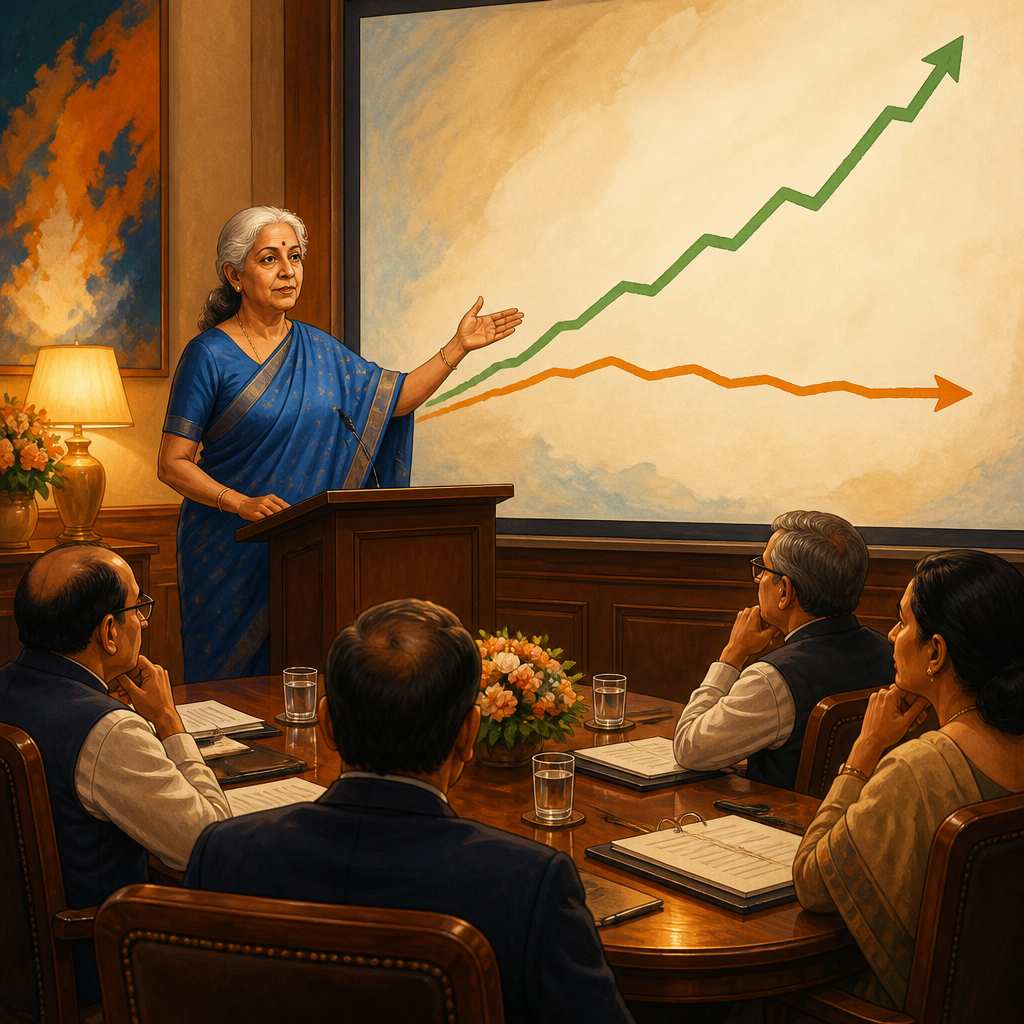
On an October evening in 2023, Finance Minister Nirmala Sitharaman stood before the Economic Advisory Council, pointing to a graph that told two contradictory stories. India had just overtaken the United Kingdom to become the world's fifth-largest economy, $3.7 trillion in GDP, growing at 7.2% annually, the fastest among major economies.
Yet another chart showed India ranked 134th out of 193 countries in the UN Human Development Index. A nation producing more wealth than Britain, yet with child malnutrition rates worse than sub-Saharan Africa in some districts. How could both be true?
"This is the paradox we must solve," Sitharaman said. "We cannot simply import Western definitions of 'developed.' India must define Viksit Bharat on its own terms."
This wasn't just policy rhetoric. It was, perhaps unknowingly, a return to an ancient Indian insight that modern economics had forgotten.
What the Rishis Knew About Development
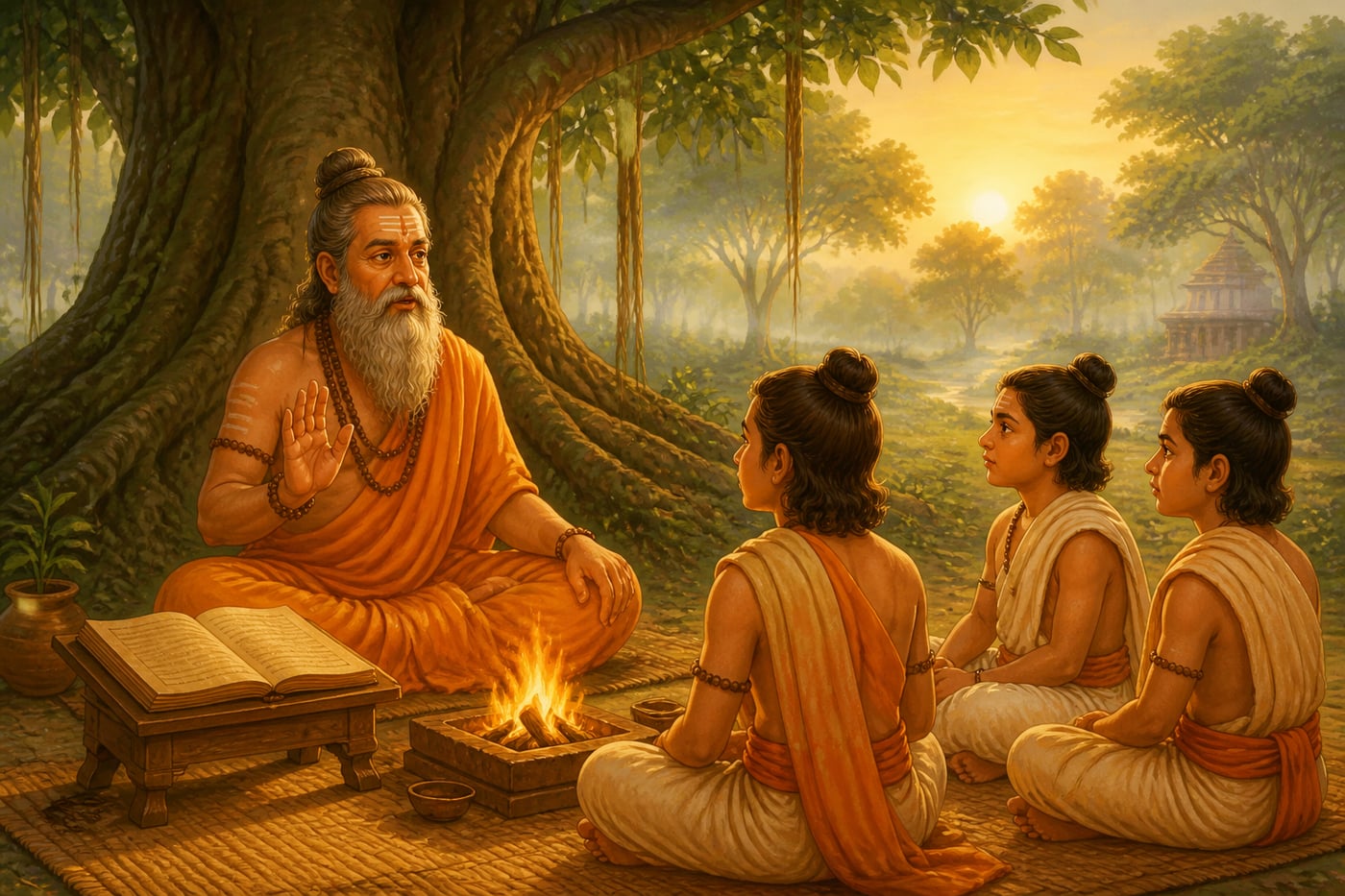
The Vedic seers never conflated prosperity with piling up gold. They understood something that GDP-obsessed economists are only now rediscovering: human flourishing is multidimensional.
The Arthashastra, Kautilya's ancient treatise on statecraft, opens with a profound statement:
"सुखस्य मूलं धर्मः। धर्मस्य मूलं अर्थः। अर्थस्य मूलं राज्यम्।"
"The root of happiness is dharma. The root of dharma is artha. The root of artha is good governance." , Arthashastra 1.7.7
Notice the sequence: the goal is sukha (happiness/wellbeing), not artha (wealth) alone. Wealth is a means, not an end. And wealth itself depends on dharma, ethical order, which depends on good governance.
This is precisely what modern economists discovered in the 2000s when studies showed that beyond a threshold, GDP growth doesn't correlate with citizen happiness. But India knew this 2,300 years ago.
The Purushartha Framework: A Development Model
The ancient concept of Purushartha, the four goals of human life, offers a comprehensive development framework that Western economics lacks:
| Purushartha | Meaning | Modern Development Equivalent |
|---|---|---|
| Dharma | Righteous conduct, social order | Governance quality, rule of law, social cohesion |
| Artha | Wealth, economic security | GDP, income, material infrastructure |
| Kama | Pleasure, aesthetic fulfillment | Quality of life, cultural vitality, emotional wellbeing |
| Moksha | Liberation, transcendence | Meaning, purpose, spiritual development |
Western development theory focuses almost exclusively on artha (GDP, per capita income). The United Nations' HDI adds basic health and education, touching kama slightly. But neither captures dharma (institutional ethics, social harmony) or moksha (meaning, purpose).
India's traditional development vision was never just about getting richer. It was about creating conditions where all four Purusharthas could flourish, for all people, not just elites.
Global Perspectives on Development Metrics
The tension between wealth measurement and wellbeing isn't uniquely Indian, Western thinkers have grappled with it too, though they arrived at similar conclusions millennia later.
Simon Kuznets (1901-1985), the economist who invented GDP in 1937, was the first to sound the alarm. Creating the metric to measure American economic output during the Depression, Kuznets explicitly warned Congress: "The welfare of a nation can scarcely be inferred from a measurement of national income." His warning was ignored. GDP became the global measure of national success, precisely what its creator cautioned against.
Amartya Sen (born 1933), the Nobel laureate who bridges Indian and Western economics, developed the "capability approach" that echoes Purushartha thinking. Sen argued that development should be measured by what people can do and be, their freedoms and capabilities, not just what they have. His work led to the Human Development Index (HDI), which adds health and education to income. Yet even Sen acknowledges HDI captures only a fraction of human flourishing.
Richard Easterlin (born 1926) delivered perhaps the most damaging blow to GDP worship. His 1974 research revealed what's now called the "Easterlin Paradox": beyond a threshold of basic needs, GDP growth doesn't correlate with happiness. A country can double its income and see no improvement in citizen wellbeing. This is precisely what the Arthashastra stated 2,300 years earlier, sukha, not artha, is the goal.
| Thinker | Key Insight | Dharmic Parallel |
|---|---|---|
| Kuznets | GDP measures transactions, not welfare | Artha ≠ Sukha |
| Sen | Development = expanding human capabilities | Purushartha framework (multiple goals) |
| Easterlin | Income growth ≠ happiness growth | Sukhasya mūlaṃ dharmaḥ (happiness rooted in dharma, not wealth) |
The difference? Western economists discovered these limits through empirical research in the 20th century. Indian philosophy began with this understanding.
GDP: The Metric That Missed the Point
Consider what GDP counts:
- Spending on prisons and police (more crime = higher GDP)
- Medical expenses for pollution-related diseases (more pollution = higher GDP)
- Rebuilding after natural disasters (destruction = GDP growth)
- Arms manufacturing and wars
And what it ignores:
- Unpaid care work (primarily by women)
- Environmental degradation
- Quality of relationships and community
- Spiritual and cultural vitality
- Leisure and rest
By GDP standards, a society where everyone is stressed, sick, and consuming antidepressants could appear more "developed" than one where people are content but consume less.
The dharmic view recognized this absurdity millennia ago. The Isha Upanishad teaches:
"ईशावास्यमिदं सर्वं यत्किञ्च जगत्यां जगत्। तेन त्यक्तेन भुञ्जीथा मा गृधः कस्यस्विद्धनम्॥"
"All this, whatever exists in the universe, is pervaded by the Divine. Enjoy through renunciation; do not covet, for whose is wealth?"
Wealth is for enjoyment, but with detachment. Accumulation for its own sake is explicitly discouraged. This is not anti-growth, it's anti-greed. The distinction matters enormously.
Deendayal Upadhyaya's Critique
Deendayal Upadhyaya (1916-1968), the RSS ideologue whose philosophy now influences BJP policy, saw this tension clearly. In 1965, he articulated "Integral Humanism" (Ekatma Manava Darshan) as an alternative to both Western capitalism and Soviet communism.
"Western economics," Upadhyaya argued, "treats humans as production-consumption units. Marxism sees them as class members. Both reduce the human being. Indian thought sees the complete person, body, mind, intellect, and soul, integrated and interconnected."
His critique anticipated the wellbeing economics movement by fifty years. Today, when economists like Amartya Sen speak of "capabilities" and "freedom" rather than just income, they're approaching what Upadhyaya called antyodaya, "the rise of the last person."
Prime Minister Modi frequently invokes Upadhyaya's "Integral Humanism" when describing the Viksit Bharat vision. Whether policy matches philosophy is debatable; that the philosophy exists as a coherent alternative is not.
From Theory to Policy: What Changes?
If India takes dharmic vikasa seriously, what would change in how we measure and pursue development?
1. Beyond GDP to Multi-Dimensional Metrics
Bhutan's Gross National Happiness (GNH) index, which we'll explore in Lesson 3, is one attempt. India could develop its own Rashtriya Sukha Suchak (National Wellbeing Index) measuring:
- Material sufficiency (not just income, but security)
- Health and vitality (not just absence of disease)
- Time balance (work, leisure, family)
- Social cohesion (trust, community bonds)
- Cultural vitality (arts, traditions, languages)
- Environmental sustainability
- Good governance (rule of law, corruption levels)
- Meaning and purpose (self-reported life satisfaction)
2. Inclusive Growth as Dharmic Imperative
The concept of sarvodaya (welfare of all) from Gandhi and antyodaya (rise of the last) from Upadhyaya aren't just slogans, they're dharmic principles. A 7% GDP growth that leaves 40% of the population behind fails the dharmic test.
Current policies like Jan Dhan (financial inclusion), Ayushman Bharat (health coverage), and DBT (direct benefit transfer) can be understood as modern implementations of this principle.
3. Sustainability as Non-Negotiable
Dharmic development cannot plunder future generations. The concept of rta, cosmic order, includes ecological balance. Ancient texts speak of panchabhuta (five elements) in harmony. Development that destroys air, water, and soil fails by dharmic standards, regardless of GDP impact.
Your Dharmic Development Audit
This framework applies to nations, but also to you.
Modern success metrics, salary, net worth, career title, focus entirely on artha. But by Purushartha standards:
- Dharma: Is your work ethical? Does it contribute to or harm society?
- Artha: Is your income sufficient for security and duty fulfillment?
- Kama: Do you have joy, beauty, meaningful relationships?
- Moksha: Are you connected to purpose beyond the material?
A person earning crores through exploitation fails the test. So does someone choosing poverty when they could provide for dependents. True vikasa, development, means all four in balance.
As India charts its path to becoming a developed nation by 2047, this ancient framework offers a compass that Western economics lacks. We don't have to choose between growth and wellbeing, between modernity and tradition. The dharmic vision was always both/and, never either/or.
In our next lesson, we'll explore how the Purushartha framework specifically applies to economic development, and why separating artha from the other three goals creates the very problems modern India faces.
The 'Easterlin Paradox' (1974) showed that beyond a threshold, GDP growth doesn't increase happiness, essentially rediscovering what Kautilya stated millennia earlier. The OECD's 'Better Life Index' and Bhutan's GNH are modern attempts at sukha-based metrics.
By starting from sukha rather than artha, Indian philosophy avoids the trap of growth-for-growth's-sake. It provides principled grounds for rejecting developments that increase GDP but decrease wellbeing, environmental destruction, overwork culture, social fragmentation.
India ranks 5th in GDP but 134th in Human Development Index and 126th in World Happiness Report (2024). This 130-rank gap between wealth production and wellbeing is precisely what dharmic vikasa addresses.
Modern circular economy thinking, designing products for reuse, emphasizing access over ownership (sharing economy), reducing waste, echoes this ancient principle. The Isha Upanishad anticipated the sustainability movement by three millennia.
Western sustainability often struggles for moral grounding, why shouldn't I consume? The Isha Upanishad provides it: because everything belongs to the cosmic order, not to you. Hoarding is literally misunderstanding reality. This gives sustainability a spiritual foundation, not just a practical one.
India's per capita carbon footprint is 1.9 tonnes (vs. USA's 15.5 tonnes), partly due to cultural frugality rooted in dharmic principles. As India develops, the question is whether it will adopt Western consumption patterns or chart a more sustainable 'tyaktena bhunjitha' path.
Key terms
- Dhārmika Vikāsa
- Development guided by dharmic principles, integrating economic growth with ethical conduct, social harmony, environmental sustainability, and spiritual purpose. Holistic progress rather than mere GDP expansion.
- Sukha
- Happiness, wellbeing, ease, comfort. In dharmic economics, sukha is the ultimate goal of development, not wealth itself. Represents a state of contentment and flourishing that includes but transcends material prosperity.
- Viksit Bhārat
- Literally 'Developed India', the government's vision for India to become a developed nation by 2047 (centenary of independence). Implies comprehensive development: economic, social, technological, and civilizational.
- Puruṣārtha
- The four goals of human life in Hindu philosophy: Dharma (righteousness), Artha (wealth), Kama (pleasure), and Moksha (liberation). Together they constitute a complete framework for human flourishing, integrating material, ethical, emotional, and spiritual dimensions.
Verses
सुखस्य मूलं धर्मः। धर्मस्य मूलं अर्थः। अर्थस्य मूलं राज्यम्।
sukhasya mūlaṃ dharmaḥ | dharmasya mūlaṃ arthaḥ | arthasya mūlaṃ rājyam |
Happiness springs from ethical order; ethics springs from prosperity; prosperity springs from good governance.
This verse provides a complete theory of development: good institutions (governance) → economic growth (artha) → social cohesion (dharma) → citizen wellbeing (sukha). Modern development economics has only recently returned to this integrated view after decades of GDP-only focus.
Arthashastra, Book 1, Chapter 7, Verse 7 (R. Shamasastry and L.N. Rangarajan translations)
ईशावास्यमिदं सर्वं यत्किञ्च जगत्यां जगत्। तेन त्यक्तेन भुञ्जीथा मा गृधः कस्यस्विद्धनम्॥
īśāvāsyamidaṃ sarvaṃ yatkiñca jagatyāṃ jagat | tena tyaktena bhuñjīthā mā gṛdhaḥ kasyasviddhanam ||
All that exists is pervaded by the Divine. Enjoy through renunciation, covet not, for whose is wealth?
This verse provides the philosophical basis for sustainable economics. Endless accumulation is adharmic. Resources are for use (bhunjitha) but with detachment (tyaktena). This is not anti-wealth but anti-greed, a crucial distinction modern sustainability movements are rediscovering.
Isha Upanishad, Verse 1 (Multiple translations consulted)
Key figures
Deendayal Upadhyaya
Political philosopher, RSS ideologue, founder of Integral Humanism (Ekatma Manava Darshan) · 1916-1968 (Pre-independence to early post-independence)
Nirmala Sitharaman
Union Finance Minister of India, first woman to hold the full-time position · Contemporary (born 1959, Finance Minister since 2019)
Richard Layard
British economist, founder of the 'happiness economics' movement, Director of the Wellbeing Programme at LSE · Contemporary (born 1934, active economist and policy advisor)
Case studies
Bhutan's Gross National Happiness: A Nation That Chose Sukha Over Artha
In 1972, Bhutan's fourth king, Jigme Singye Wangchuck, made a radical declaration: 'Gross National Happiness is more important than Gross Domestic Product.' This wasn't just rhetoric. Bhutan, a tiny Himalayan nation of 800,000 people, built an entire governance system around measuring and maximizing citizen wellbeing rather than economic output. The GNH Index measures nine domains: living standards, health, education, governance, ecological diversity, time use, psychological wellbeing, cultural resilience, and community vitality. Every major policy, from tourism limits to forest conservation to education reform, is evaluated through a 'GNH Policy Screening Tool' before implementation. When Bhutan opened to television and internet in 1999, it wasn't for economic development, it was after assessing impact on GNH domains. The country famously caps tourist numbers (and charges $200/day sustainable development fee) to protect cultural and environmental wellbeing, deliberately sacrificing GDP growth.
Bhutan's approach is essentially the Purushartha framework operationalized at national scale. The nine GNH domains map remarkably well: living standards and health (Artha), psychological wellbeing and cultural resilience (Kama), governance and community vitality (Dharma), and the explicit inclusion of time for meditation and spiritual practice (Moksha). Conventional economics would say Bhutan is 'underdeveloped', per capita GDP is only $3,500 (vs. India's $2,400 or USA's $76,000). But by sukha-based metrics, Bhutan outperforms: 91% of citizens report being 'happy' or 'deeply happy.' The country is carbon-negative, with 72% forest cover constitutionally mandated. This is what dharmic vikasa looks like when taken seriously.
Bhutan's experiment has influenced global policy. The UN adopted an International Day of Happiness (2012) following Bhutan's advocacy. The World Happiness Report, launched in 2012, owes its existence partly to Bhutan's proof-of-concept. Countries including New Zealand, Scotland, and Iceland now publish wellbeing budgets. Critics note Bhutan's limitations: it's small, homogeneous, and receives significant foreign aid. The 2008 expulsion of ethnic Nepalis raises questions about whose happiness counts. Yet as a policy laboratory, Bhutan demonstrates that sukha-based governance isn't utopian, it's implementable.
A nation can choose to optimize for sukha (wellbeing) rather than artha (GDP) and create functioning institutions around that choice. Bhutan proves dharmic vikasa isn't ancient philosophy, it's modern policy.
New Zealand, Iceland, and Scotland have adopted wellbeing budgets since 2019, measuring policy success by life satisfaction rather than GDP growth. The debate over whether GDP captures real progress is now mainstream in economics and public policy worldwide.
Bhutan's GNH surveys show 91.2% of citizens are 'happy' or 'deeply happy' (2022), while spending only 2.5% of GDP on healthcare (vs. USA's 17%) with comparable health outcomes. This suggests sukha can be achieved more efficiently than artha-maximization assumes.
India's DBT Revolution: When Welfare Trumped GDP Metrics
In 2013, India launched what would become the world's largest direct benefit transfer (DBT) system. By 2024, over ₹34 lakh crore ($410 billion) had been transferred directly to 950 million citizens' bank accounts, bypassing intermediaries, eliminating leakages, and reaching the 'last mile' that GDP growth had failed to reach for decades. The DBT architecture rests on the JAM trinity: Jan Dhan (500 million bank accounts opened for the unbanked), Aadhaar (1.4 billion biometric IDs), and Mobile (1.2 billion phone connections). Together, they enabled what no previous Indian government could achieve: putting money directly in the hands of farmers, students, pregnant women, and pensioners with 99% accuracy. During COVID-19, this infrastructure proved decisive. Within weeks of lockdown, ₹500 was transferred to 200 million women's Jan Dhan accounts. PM-KISAN payments reached 110 million farmers. No queues, no corruption, no 'leakage' to middlemen. The system that GDP metrics would have deemed 'inefficient spending' became the fastest welfare delivery mechanism in human history.
DBT embodies antyodaya, Deendayal Upadhyaya's principle that development must reach the 'last person.' Traditional welfare measured success by budgets allocated (an artha metric). DBT measures success by benefits actually received by the poorest (a sukha metric). This represents a dharmic inversion of priorities. Instead of asking 'How much did we spend?' (GDP contribution), DBT asks 'Did the pregnant woman in Jharkhand actually receive her nutrition allowance?' The World Bank estimates DBT saved $33 billion in leakages, money that now reaches those who need it rather than disappearing into bureaucratic friction.
DBT has fundamentally altered India's welfare architecture. By 2024: 315 government schemes use DBT; ₹2.7 lakh crore transferred in 2023-24 alone; 99.5% of LPG subsidies reach intended beneficiaries (vs. 50% pre-DBT). The system processed 8 billion transactions in 2023. Critics point to Aadhaar privacy concerns and exclusion errors (estimated 1-2% of legitimate beneficiaries face authentication failures). Yet the transformation is undeniable: India built a welfare delivery system that prioritizes actual wellbeing impact over mere expenditure statistics.
Development success should be measured by whether benefits reach the intended recipients (sukha), not by how much government spends (artha). India's DBT system operationalizes this dharmic principle at unprecedented scale.
Countries from Brazil to Kenya are studying India's DBT architecture as a model for reducing welfare leakage. The combination of biometric identity, bank accounts, and mobile phones has created a replicable blueprint for delivering benefits directly to citizens without middlemen.
India's DBT system saved ₹2.73 lakh crore ($33 billion) in 'leakages' between 2014-2024, money that would have been counted in GDP regardless of whether it reached the poor. This is the difference between artha metrics and sukha metrics.
Historical context
Ancient foundations to modern application (Vedic period to 21st century)
India's development philosophy draws on millennia of thinking about the relationship between prosperity and wellbeing. From the Vedas through Kautilya to modern thinkers, there has been consistent emphasis on artha as means to sukha, governed by dharma. This tradition was disrupted by colonial economics (which focused purely on extraction) and post-independence Nehruvian socialism (which adopted Western development metrics). The Viksit Bharat vision represents a potential return to dharmic development principles.
Most development frameworks globally are Western-derived, focusing on GDP, industrialization, and per capita income. Bhutan's Gross National Happiness (1972) is a notable exception. India's dharmic development tradition offers a more comprehensive framework than either Western capitalism or Asian developmental state models, potentially relevant for the Global South seeking alternatives.
India's GDP is $3.7 trillion (2024), making it the 5th largest economy. Yet HDI rank is 134th. This 130-position gap between wealth production and human development is the central challenge dharmic vikasa addresses.
As India aspires to become a 'developed' nation by 2047, the definition of 'developed' is contested. Adopting Western GDP-centric definitions would be a civilizational regression. Recovering dharmic vikasa principles offers India a unique development path, one that could also serve as a model for other nations seeking alternatives to Western materialism.
Living traditions
The tension between GDP growth and holistic development plays out daily in Indian policy. Infrastructure projects vs. environmental protection, industrial growth vs. displacement, digital payments vs. financial inclusion, each debate reflects the underlying question: what does dharmic vikasa actually mean in practice? The 2024 Economic Survey explicitly acknowledged the need for 'development with Indian characteristics,' suggesting growing policy consciousness of this framework.
- Antyodaya Programs: Government programs explicitly named after Upadhyaya's 'Antyodaya' (rise of the last person) principle, including Antyodaya Anna Yojana (food security) and Deendayal Antyodaya Yojana (livelihoods). These represent policy attempts to operationalize dharmic development principles.
- India Stack: Digital Public Infrastructure: India's unique approach to digital development, Aadhaar, UPI, DigiLocker, treats digital infrastructure as public good, not private commodity. This reflects the dharmic principle that foundational systems (rajya) should serve all, not just those who can pay.
- Deendayal Upadhyaya Smriti Sthal, Deen Dayal Dham, Farah, Uttar Pradesh
- Tirumala Tirupati Devasthanams (TTD): The world's richest temple exemplifies modern institutional management applied to ancient dharmic traditions, serving as a model for how traditional institutions can scale to meet contemporary development needs while maintaining spiritual authenticity
- Akshardham Temple: A modern temple complex that integrates traditional architecture with contemporary educational exhibits, demonstrating how dharmic values can be communicated through innovative presentation methods to inspire India's development vision
Reflection
- The Arthashastra places sukha (wellbeing), not artha (wealth), as the ultimate goal of development. When you evaluate your own life or your nation's progress, what metrics do you actually use? Are they artha-focused (income, assets, GDP) or sukha-focused (happiness, meaning, relationships)? What would change if you genuinely prioritized sukha?
- If you were to create a 'Personal Development Index' measuring your own holistic progress (like a nation's HDI but for an individual), what four or five dimensions would you include beyond income? How would you rate yourself on each? Identify one dimension where you're underinvesting and one concrete action to address it this month.