Mandir-Artha: Temple Economy as Ancient Social Security

How Sacred Institutions Provided Welfare Before the State

Every day, Tirupati's Sri Venkateswara Temple serves over 100,000 free meals through annadana, a practice that dates back millennia. This isn't charity; it's the continuation of an ancient economic system where temples functioned as banks, employers, welfare providers, and redistributive institutions. Long before modern welfare states, India's temple economy provided social security through dharmic principles of abundance and sharing.

The Daily Miracle at Tirupati
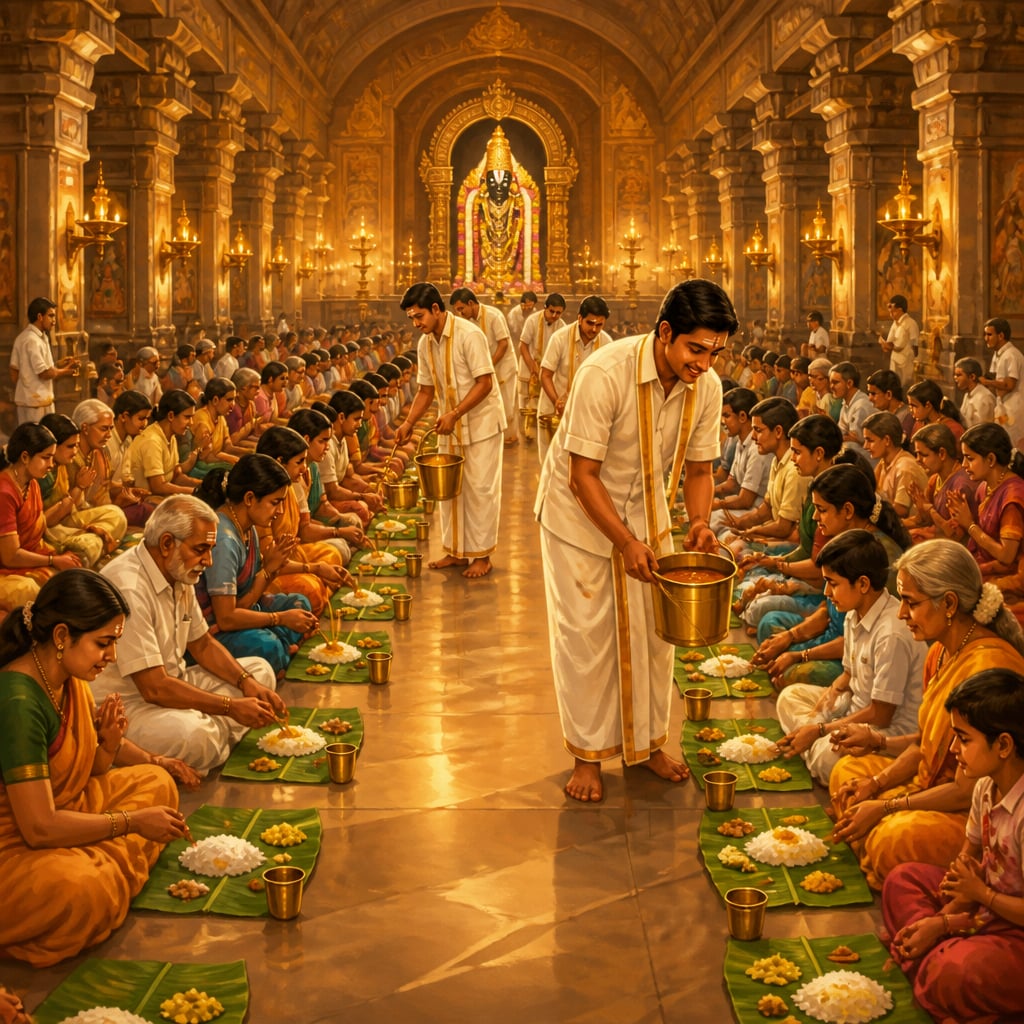
Pilgrims receiving the daily annadana meal at Tirupati

At 4:30 AM in Tirupati, long before dawn breaks over the Seshachalam hills, the kitchens of Sri Venkateswara Temple are already alive. Giant cauldrons bubble with sambar. Mountains of rice steam in enormous vessels. Hundreds of cooks work with assembly-line precision, their movements refined over decades.

By the time the sun rises, they will have prepared 100,000 meals. By evening, 150,000. On festival days, 250,000. Every single day, without fail, for centuries.

This is annadana, the sacred practice of free food distribution. At Tirupati alone, the annual budget for this single practice exceeds ₹400 crores ($50 million). If you measured it by Western metrics, you'd call it the world's largest free kitchen. But that would miss the point entirely.

This isn't charity. This is the continuation of a 2,000-year-old economic system, one where temples weren't just places of worship, but comprehensive economic institutions providing banking, employment, education, healthcare, and social security to entire regions.

The Viksit Bharat question isn't whether we can afford modern welfare programs. It's whether we remember that India invented comprehensive social security systems centuries before Europe.

What Was the Temple Economy?

When we think of temples today, we think of religion. But for most of Indian history, that separation would have made no sense. Temples were the beating heart of regional economies, simultaneously:

1. Banks: Accepting deposits, providing loans, storing wealth 2. Employers: Supporting priests, artisans, musicians, dancers, cleaners, guards 3. Landowners: Managing vast agricultural estates (devadana lands) 4. Welfare Providers: Free food, shelter, education, healthcare 5. Redistributors: Channeling wealth from donors to community services

Consider the Brihadisvara Temple at Thanjavur, built by Rajaraja Chola I in 1010 CE. Temple inscriptions record:

This wasn't a 'religious institution' in the modern sense. It was a multi-function economic enterprise operating on dharmic principles.

The Thiruvananthapuram Padmanabhaswamy Temple in Kerala holds an estimated $20 billion in treasure in its vaults, gold, jewels, artifacts accumulated over centuries. This wasn't hoarding; temples reinvested wealth continuously through lending, construction, employment, and redistribution.

The Dharmic Logic of Temple Economics

Why did temples become economic institutions? The answer lies in core dharmic principles that Western economics is only now rediscovering.

The Principle of Abundance

The Taittiriya Upanishad contains the profound Annapurna Sukta:

"अन्नाद्भवन्ति भूतानि पर्जन्यादन्नसंभवः। यज्ञाद्भवति पर्जन्यो यज्ञः कर्मसमुद्भवः॥"

"From food all beings are born; from rain comes food; from sacrifice comes rain; sacrifice is born of action." , Taittiriya Upanishad 3.8.1

This establishes a cosmic economic cycle: human action (karma) → sacred giving (yajna) → abundance (rain/food) → life sustained (beings) → new action. It's circular, not linear. The more you give, the more flows.

This is radically different from scarcity-based economics. The dharmic view: the universe is abundant if wealth circulates. Hoarding breaks the cycle and creates scarcity.

Temples embodied this principle. Wealth flowed IN through donations (dakshina, land grants from kings, offerings from devotees). Wealth flowed OUT through employment, annadana, education, festivals, construction projects that created jobs.

The temple was the circulation pump of the regional economy.

The Redistribution Function

Kings would grant entire villages to temples as devadana (divine gift). The temple would collect tax revenue from these villages, but unlike kings, temples couldn't spend on armies or palaces. By dharmic injunction, temple wealth was for lokasangraha (social welfare).

This created an automatic redistribution mechanism:

The Chidambaram Nataraja Temple inscriptions record detailed redistribution:

This was a comprehensive social security system operating on dharmic principles of dana (giving), seva (service), and sangha (community).

Rajaraja Chola overseeing the Brihadeeswarar temple construction

Rajaraja Chola: The Temple Builder as Economic Architect

Rajaraja Chola I (985-1014 CE) was one of India's greatest emperors, but his genius wasn't just military, it was economic. His construction of the Brihadisvara Temple at Thanjavur was an act of statecraft as much as devotion.

The temple inscriptions, meticulously carved into walls, provide a complete economic record. Historian Noboru Karashima spent decades studying these inscriptions, revealing:

Land Management: Rajaraja granted 296 villages to the temple. These weren't 'donations', they were economic infrastructure. The temple collected land revenue (about 1/6th of produce) and reinvested it in irrigation, agricultural tools, and famine reserves.

Employment Generation: The temple employed:

This was Keynesian demand-side economics 900 years before Keynes: the king invested in temple construction, which employed thousands (stonemasons, sculptors, laborers), who spent wages locally, stimulating the entire regional economy.

Banking Functions: The temple accepted deposits and provided loans at regulated interest rates (12-15% annually, compared to private moneylenders' 30-60%). Temple loans built houses, funded businesses, and financed agriculture. The institution was trustworthy, you can't run away from the gods.

Social Insurance: During the massive famine of 1006 CE (recorded in inscriptions), the temple opened its grain reserves, preventing mass starvation across the Kaveri delta. This was pre-modern social security in action.

Rajaraja understood something modern economists are rediscovering: economic institutions embedded in communities with spiritual legitimacy can solve coordination problems that pure markets or distant states cannot.

Y.V. Reddy: Rediscovering Temple Economics for Modern India

Dr. Y.V. Reddy, former Governor of the Reserve Bank of India (2003-2008), is perhaps the only central banker in modern history to publicly reference temple economics in monetary policy discussions.

In his 2002 Chintaman Deshmukh Memorial Lecture, Reddy observed that India's traditional financial institutions, temples, hundis, chit funds, operated on principles Western finance ignored:

Community-Based Trust: Temple banking worked because the institution was permanent and embedded in the community. You couldn't flee the divine creditor. This solved the enforcement problem that plagues modern microfinance.

Counter-Cyclical Lending: Temples lent during agricultural low seasons and collected during harvest, smoothing income cycles for farmers. Modern banks often do the opposite, lending in booms and cutting credit in recessions.

Social Capital as Collateral: Temple loans didn't require physical collateral, your reputation in the community was collateral. This enabled the poor to access credit long before microfinance 'innovated' the idea.

Reddy's insight: India doesn't need to import all financial models. Sometimes we need to rediscover and modernize indigenous institutions.

During his tenure as RBI Governor (2003-2008), Reddy's policies drew from this understanding:

When Western economists praised 'financial innovation' before 2008, Reddy reminded them of the 2,000-year-old innovations of Indian temple banking that never needed bailouts.

Global Perspectives on Institutional Economics

Western economists have increasingly recognized that economic institutions embedded in communities work differently, and often better, than pure market mechanisms. The temple economy anticipated insights that Nobel laureates discovered only recently.

Max Weber (1864-1920) explored how religious institutions shape economic behavior. In 'The Protestant Ethic and the Spirit of Capitalism,' Weber argued that Calvinist beliefs about predestination created a 'work ethic' that drove capitalist accumulation. But Weber also studied other traditions, noting that religious institutions often served economic functions, banking, charity, community coordination. Temple economies represent what Weber called 'embedded' economic activity: commerce interwoven with spiritual meaning, making transactions more than mere exchanges.

Douglass North (1920-2015), Nobel laureate in 1993, revolutionized economics by showing that institutions, not just markets, determine economic outcomes. North defined institutions as 'the rules of the game': formal laws, informal norms, and enforcement mechanisms. Temple economies were sophisticated institutional arrangements: property rights (devadana), contract enforcement (divine sanction), information systems (inscriptions), and dispute resolution (temple courts). North's insight validates what temple builders understood: you need trusted institutions before you get sustained prosperity.

Elinor Ostrom (1933-2012), the first woman to win the economics Nobel (2009), studied how communities manage common resources without government or private ownership. Her research on irrigation systems, fisheries, and forests found that community-governed institutions often outperform both markets and states. Temple economies exemplify Ostrom's findings: community-embedded institutions with clear rules, local monitoring, graduated sanctions, and conflict resolution mechanisms. Temples managed vast common resources (grain stores, water tanks, lands) through precisely the institutional design principles Ostrom identified.

Thinker Key Insight Temple Economy Parallel
Weber Religion shapes economic behavior and meaning Temples made commerce sacred, not separate
North Institutions determine economic outcomes Temples were sophisticated institutional arrangements
Ostrom Community governance can outperform markets/states Temple management of commons for 1,000+ years

These Western economists spent careers proving what temple builders demonstrated operationally: community-embedded institutions with spiritual legitimacy can solve economic coordination problems that pure markets or distant states cannot.

Modern Temple Economics: The Tirupati Model

The Tirumala Tirupati Devasthanams (TTD), the trust managing the Tirupati temple, is essentially a modern temple economy in action, with some significant differences.

Scale:

Services Provided:

But there's a critical modern tension: TTD is under state government control. The Andhra Pradesh government appoints the executive officer and board. This has led to:

Efficiency vs. Dharma Trade-offs: Political appointees sometimes prioritize optics over traditional temple functions. Construction projects make headlines; quiet support for village schools doesn't.

Revenue Diversion Concerns: There are recurring allegations that temple wealth is diverted to non-temple purposes, violating the ancient principle that devadana (divine wealth) is for dharmic purposes only.

Centralization vs. Local Impact: Ancient temples were decentralized, each temple served its region. TTD's centralization means one massive institution rather than distributed local welfare.

The debate: Should temples be autonomous dharmic institutions (as historically), or state-controlled welfare agencies? The answer shapes whether temple economy can genuinely contribute to Viksit Bharat's social security architecture.

The Welfare State vs. The Temple Economy

Western welfare states emerged in the 20th century to address market failures, poverty, unemployment, healthcare gaps. India had addressed these centuries earlier through temple economies. What's the difference?

Dimension Temple Economy Modern Welfare State
Funding Voluntary donations Compulsory taxation
Distribution Local, community-embedded Bureaucratic, distant
Legitimacy Dharmic obligation Legal entitlement
Flexibility Rapid response to local needs Slow, rule-bound
Dignity Receiving prasad (divine grace) Receiving 'handouts'
Sustainability Self-funding through land/banking Dependent on tax revenue

Neither is perfect. Temple economy excluded those outside the temple's reach (though major temples like Tirupati served all castes and even foreigners). Welfare states are often inefficient and create dependency.

The dharmic insight: welfare shouldn't be purely transactional (state → citizen). It should be embedded in community institutions with spiritual legitimacy, creating dignified participation rather than passive receipt.

Your Personal Annadana

The temple economy offers principles applicable beyond massive institutions.

The Abundance Mindset: The Taittiriya Upanishad's teaching, that giving creates more, is increasingly validated by modern research. Generous people are happier, healthier, and often wealthier. The universe rewards circulation.

Applied to Your Life:

The Dignity Principle: Temple annadana didn't stigmatize recipients, everyone from kings to beggars ate the same prasadam. The food was divine grace, not charity. This matters.

Applied to Your Life:

The Circulation Principle: Wealth should flow like water, not sit like stone.

Applied to Your Life:

As India charts its path to becoming a developed nation, the question isn't whether to adopt Swedish welfare models or American free markets. It's whether we can rediscover and modernize the dharmic systems that sustained Indian civilization for millennia, systems where abundance, dignity, and circulation were built into the economic architecture itself.

In our next lesson, we'll explore another indigenous institution that the modern world is rediscovering: India's traditional village-level governance and economic systems that provided local autonomy long before anyone theorized about decentralization.

Modern economics recognizes that GDP = Money Supply × Velocity (how fast money circulates). The Taittiriya Upanishad essentially teaches: prosperity = resources × circulation. Hoarding wealth (low velocity) creates poverty; circulating it (high velocity) creates abundance. Keynes advocated government spending during recessions for the same reason, get money moving.

The dharmic framework provides moral grounding for circulation that pure economics lacks. Why circulate wealth? Economics says: because velocity drives GDP. Dharma says: because hoarding breaks cosmic order and creates scarcity. The spiritual framing potentially creates stronger behavioral change than utilitarian arguments.

Tirupati receives ₹3,400+ crores annually in donations and immediately recirculates ₹3,200+ crores through annadana, employee salaries, construction, education, and healthcare. This high-velocity circulation stimulates the entire regional economy, a modern application of the Upanishadic circulation principle.

Western welfare often stigmatizes recipients through means-testing, application processes, and different treatment for 'welfare recipients' vs. others. Universal programs (like NHS in UK or public schools) avoid this stigma. Temple annadana was universal millennia before modern universal basic services, everyone eats the same prasad.

By framing assistance as prasad (divine gift), temple economy removed shame. You're not 'receiving charity', you're participating in sacred circulation. This psychological framing matters enormously for social cohesion. Modern welfare creates 'taxpayers' vs. 'recipients' division; temple annadana created shared identity as devotees.

Studies of conditional cash transfer programs (where poor must prove poverty) vs. universal programs (like India's Aadhaar-linked DBT to all) show universal programs have better uptake, less administrative cost, and less social stigma. Temple annadana's universalism anticipated this insight by 2,000+ years.

Key terms

Annadāna
The sacred practice of free food distribution. Not charity but dharmic obligation, temples, wealthy families, and communities providing free meals to all without discrimination. Represents the principle that food abundance should be shared, not hoarded.
Devadāna
Land or wealth granted to temples by kings or devotees. Once given, it belonged to the deity (not the temple management) and could only be used for dharmic purposes, worship, welfare, education, public works. Created automatic wealth redistribution from wealthy donors to community services.
Mandir-Artha
Temple economics, the system where temples functioned as comprehensive economic institutions providing banking, employment, land management, welfare, education, and redistribution. Represents the integration of sacred and economic functions in dharmic civilization.
Yajña
Sacred offering, sacrifice, or ritual giving that sustains cosmic and social order. In economic context, yajna represents the principle of circulation, giving to receive, sharing to generate abundance. Temple annadana is yajna institutionalized: wealth offered to the divine returns as community welfare.

Verses

अन्नाद्भवन्ति भूतानि पर्जन्यादन्नसंभवः। यज्ञाद्भवति पर्जन्यो यज्ञः कर्मसमुद्भवः॥

annādbhavanti bhūtāni parjanyādannasaṃbhavaḥ | yajñādbhavati parjanyo yajñaḥ karmasamudbhavaḥ ||

From food all beings are born; from rain comes food; from sacred action comes rain; sacred action arises from work.

This anticipates modern circular economy thinking by 3,000 years. The insight: economies are flow systems, not stock accumulations. Giving (yajna) creates more than hoarding. Temple annadana is this principle institutionalized, feeding everyone maintains the cosmic circulation that ensures abundance.

Taittiriya Upanishad, Brahmananda Valli, Section 8, Verse 1 (Swami Gambhirananda and Max Müller translations)

यज्ञशिष्टाशिनः सन्तो मुच्यन्ते सर्वकिल्बिषैः। भुञ्जते ते त्वघं पापा ये पचन्त्यात्मकारणात्॥

yajñaśiṣṭāśinaḥ santo mucyante sarvakilbiṣaiḥ | bhuñjate te tvaghaṃ pāpā ye pacantyātmakāraṇāt ||

The virtuous who eat food that has been shared are freed from all wrongs. But those who cook only for themselves partake of sin.

This is the dharmic foundation of annadana and temple free food systems. Eating alone (cooking 'for oneself') is 'sin', not theologically, but economically. It breaks reciprocity, weakens social bonds, and creates vulnerability. Temple annadana institutionalizes the opposite: food shared by all, creating community resilience.

Bhagavad Gita, Chapter 3, Verse 13 (Multiple traditional translations)

अन्नदानं परं दानं विद्यादानमतः परम्। अन्नेन क्षणिका तृप्तिः यावज्जीवं च विद्यया॥

annadānaṃ paraṃ dānaṃ vidyādānamataḥ param | annena kṣaṇikā tṛptiḥ yāvajjīvaṃ ca vidyayā ||

Giving food is the highest gift; giving knowledge is even higher. Food satisfies for a moment; knowledge sustains a lifetime.

This is the ancient version of 'teach a person to fish vs. give them fish.' Temples did BOTH: annadana for immediate food security, pathshalas for long-term human capital development. Modern welfare programs often do one or the other; the temple economy integrated both, recognizing that hunger prevents learning and learning prevents future hunger.

Markandeya Purana, Traditional (Traditional oral transmission)

Key figures

Rajaraja Chola I

Emperor of the Chola dynasty, builder of the Brihadisvara Temple at Thanjavur, patron of temple-based economic systems · 985-1014 CE (Medieval Chola Empire)

Dr. Y.V. Reddy

Former Governor of Reserve Bank of India, economist who publicly referenced indigenous financial institutions including temple banking · Contemporary (born 1941, RBI Governor 2003-2008)

Elinor Ostrom

Political economist, first woman to win Nobel Prize in Economics, pioneer of commons governance research · 1933-2012 (Nobel laureate 2009)

Case studies

Sikh Langars: The World's Largest Free Kitchen Network

In 1481, the young Nanak was given 20 rupees by his father to start a business. Instead, he spent it feeding hungry sadhus he encountered on the road. When his father demanded to know what happened to the investment, Nanak replied: 'I have done a true business. Feeding the hungry is the truest commerce.' This act became the foundation of langar, the Sikh practice of free community kitchens that has operated continuously for over 540 years. The Harmandir Sahib (Golden Temple) in Amritsar now operates the world's largest free kitchen, serving 100,000+ meals daily, matching Tirupati's scale. During COVID-19 lockdowns, Sikh gurdwaras worldwide mobilized instantly: Delhi's Bangla Sahib served 100,000 meals daily during lockdown; gurdwaras in London, New York, and Melbourne fed thousands of non-Sikhs. The langar principle (everyone sits together, everyone eats the same food, everyone is welcome) has operated without interruption for five centuries across every continent Sikhs have settled.

Langar operationalizes the temple economy principle of annadana in its purest form: (1) Universal dignity: the pangat (seated row) eliminates hierarchy; king and beggar eat together. (2) Circulation as worship: kar seva (voluntary service) makes food preparation itself a spiritual practice. (3) Yajna economics: wealth flows in as donation, flows out as food, creating the sacred circulation that generates abundance. Guru Nanak's 'true business' insight echoes Taittiriya Upanishad: giving food is the highest giving. Sikhs proved this can work at global scale for half a millennium.

Langar demonstrates that community-feeding infrastructure can scale globally through decentralized religious networks. Key economic features: (1) Funded entirely by voluntary donations (kar seva), not taxation. (2) Operated by volunteer labor: cooking, cleaning, serving is spiritual practice. (3) Universal access with no means-testing, no questions asked. (4) Remarkable efficiency: Golden Temple feeds 100,000 people daily for approximately ₹1.5 lakh ($1,800), or under 2 rupees per meal. (5) Resilience: the system has survived famines, wars, partitions, and pandemics without missing a day.

Decentralized, donation-funded community kitchens rooted in yajna economics can achieve global-scale food security. When feeding is framed as spiritual practice rather than charity, the system becomes self-sustaining across centuries.

Community kitchens have surged globally since COVID-19 exposed food insecurity in wealthy nations. Organizations like the Sikh Coalition's langar efforts in the US and UK during the pandemic showed that decentralized, volunteer-driven food networks can respond faster than government systems in a crisis.

The Golden Temple feeds 100,000+ people daily at under ₹2 per meal (total cost ~₹1.5 lakh/$1,800 per day), funded entirely by voluntary donations. This system has operated without a single day's interruption for over 540 years.

Germany's Church Tax: Religious Welfare at National Scale

When Napoleon secularized church properties in 1803, German states faced a dilemma: the Catholic and Protestant churches had provided education, healthcare, and poverty relief for centuries. Eliminate their funding and the welfare system would collapse. The solution was the Kirchensteuer (church tax), a mandatory 8-9% surcharge on income tax, collected by the government and transferred to religious institutions. This created Europe's largest religious welfare system, still operating today. Germany's church tax generates EUR 12-13 billion annually ($14 billion), comparable to the entire GDP of small nations. The Catholic and Protestant churches use this to operate: 52,000 kindergartens (one-third of all German childcare), 1,800 hospitals (one-third of hospital beds), thousands of nursing homes, addiction treatment centers, and refugee services. Caritas (Catholic) and Diakonie (Protestant) are Germany's largest private employers, with 1.3 million workers combined. The church remains Germany's primary welfare provider for many services the state doesn't offer.

Germany's church tax echoes the devadana principle: wealth systematically channeled to religious institutions that must use it for dharmic purposes (education, healing, feeding). Key parallels: (1) Mandatory contribution: like temple land grants, the church tax isn't voluntary charity but systematic obligation. (2) Purpose-restricted: funds can only be used for religious and charitable purposes. (3) Institutional permanence: the system has operated 220+ years, demonstrating sustainability. (4) Multi-function delivery: like temples, churches provide integrated services (education + healthcare + welfare) rather than fragmented programs. Germany proves the temple economy model can work in modern Western democracies.

The Kirchensteuer model demonstrates that religious institutions can operate national-scale welfare systems with state collection but religious delivery. Key outcomes: (1) Efficiency: churches deliver services at 15-20% lower cost than equivalent state programs. (2) Quality: German church hospitals consistently rank among the nation's best. (3) Coverage: religious infrastructure reaches communities too small for state services. (4) Legitimacy: services delivered through faith institutions carry spiritual meaning, not just transactional welfare. Critics note declining church membership (people can opt out by formally leaving their religion), raising long-term sustainability questions.

Systematic channeling of wealth to religious institutions for welfare delivery (devadana) can operate at national scale for centuries, providing integrated services more efficiently than fragmented state programs.

As European church attendance declines, the Kirchensteuer model faces existential questions about whether religious welfare systems can survive secularization. India's temple economy faces a parallel challenge: state control of Hindu temples channels religious wealth into government budgets rather than community welfare.

Germany's Kirchensteuer generates EUR 12-13 billion annually, funding 52,000 kindergartens (one-third of German childcare) and 1,800 hospitals (one-third of hospital beds) at 15-20% lower cost than equivalent state programs.

Historical context

Medieval temple economies (500-1700 CE) to modern temple trusts

Temple economies were India's primary social security system for over 1,000 years. Unlike European feudalism where lords extracted from peasants, Indian temples redistributed from wealthy donors to community services. Inscriptional evidence from Chola, Pallava, and Vijayanagara periods shows temples functioning as banks (regulated lending), employers (thousands on permanent payroll), welfare providers (annadana feeding tens of thousands daily), educators (pathshalas teaching Vedas, arts, sciences), and agricultural managers (devadana lands covering millions of acres). Colonial period deliberately dismantled this system, seizing temple lands and revenue, creating economic devastation that persists today.

No pre-modern civilization developed comparable social security systems. Medieval European monasteries provided some charity but nowhere near temple scale. Islamic waqf (endowment) systems were closer but less economically integrated. China's imperial granaries provided famine relief but not comprehensive welfare. India's temple economy was unique in scale, integration, and sustainability, operating for over a millennium without state taxation, funded entirely by voluntary donations and endowment income.

At peak (around 1700 CE), major South Indian temples collectively: managed 30-40% of cultivable land through devadana grants, employed 5-10% of population (priests, artisans, agricultural workers), provided daily free food to 1-2% of regional population, and operated as primary banking institutions for agriculture and small business. British seizure of these assets in 1800s created economic collapse across regions.

As India debates welfare policy for Viksit Bharat 2047, understanding temple economies offers alternative models: community-embedded (not bureaucratic), dignity-preserving (prasad, not charity), self-funding (endowments, not taxation), integrated services (food + education + healthcare), and sustainable (operating 1,000+ years). Question isn't whether to copy Western welfare states, but whether to rediscover and modernize indigenous social security systems that worked for millennia.

Living traditions

The debate over temple economics shapes contemporary policy: Should temples remain under state control (current model in most states) or become autonomous trusts (as demanded by temple freedom movements)? Should temple wealth fund general government welfare or only dharmic purposes? Can temple management models inform modern institutional design, especially community-embedded, trust-based, multi-function service delivery? The 2024 'Free Hindu Temples' movement argues that state control violates constitutional freedom of religion AND economic efficiency, noting that autonomous temples (like Tirupati historically) served communities better than government-controlled ones.

Reflection

More in Dharmic Development: A Different Path

All lessons in Dharmic Development: A Different Path · Viksit Bharat: India's Development Journey course