The Strawman Artist
Fighting an Argument You Never Made
The first archetype of the Chatur-Vadin Framework, first cluster, Vikriti Vadin, the Distorters. Level 1 (Obvious). The Strawman Artist takes your actual position, rebuilds it in its weakest or most extreme form, then demolishes the rebuild while the audience believes you have been answered. Once you see the pattern, you cannot unsee it.
The Court of Lanka
In the great court of Lanka, under a ceiling inlaid with gold and lit by hundreds of oil lamps, Ravana's younger brother Vibhishana has just stood up to speak. The war with Rama is already costing Lanka its best warriors. Akampana is dead. Prahasta is dead. Kumbhakarna has been destroyed. Vibhishana is not a warrior. He is a counsellor. He has been quiet for weeks. Now he steps forward and makes a specific argument.
The Ramayana preserves his words. He does not say Lanka should surrender. He does not say Ravana is wrong about everything. He says, precisely, that holding Sita against her will is adharma, that a king's duty is to return what has been wrongly taken, that the loss of Lanka's strongest warriors is the consequence of this one unresolved wrong, and that the remedy, returning Sita with honour, is still open.
The minister Indrajit speaks next. He does not answer Vibhishana's argument. He reframes it. He says Vibhishana is asking Lanka to surrender to humans and monkeys. He says Vibhishana has become a worshipper of Rama. He says Vibhishana wants the dynasty of the rakshasas to bow before a banished prince. The court applauds. Ravana's eyes narrow. Vibhishana stands silent while a version of himself he does not recognise is being destroyed in front of him.
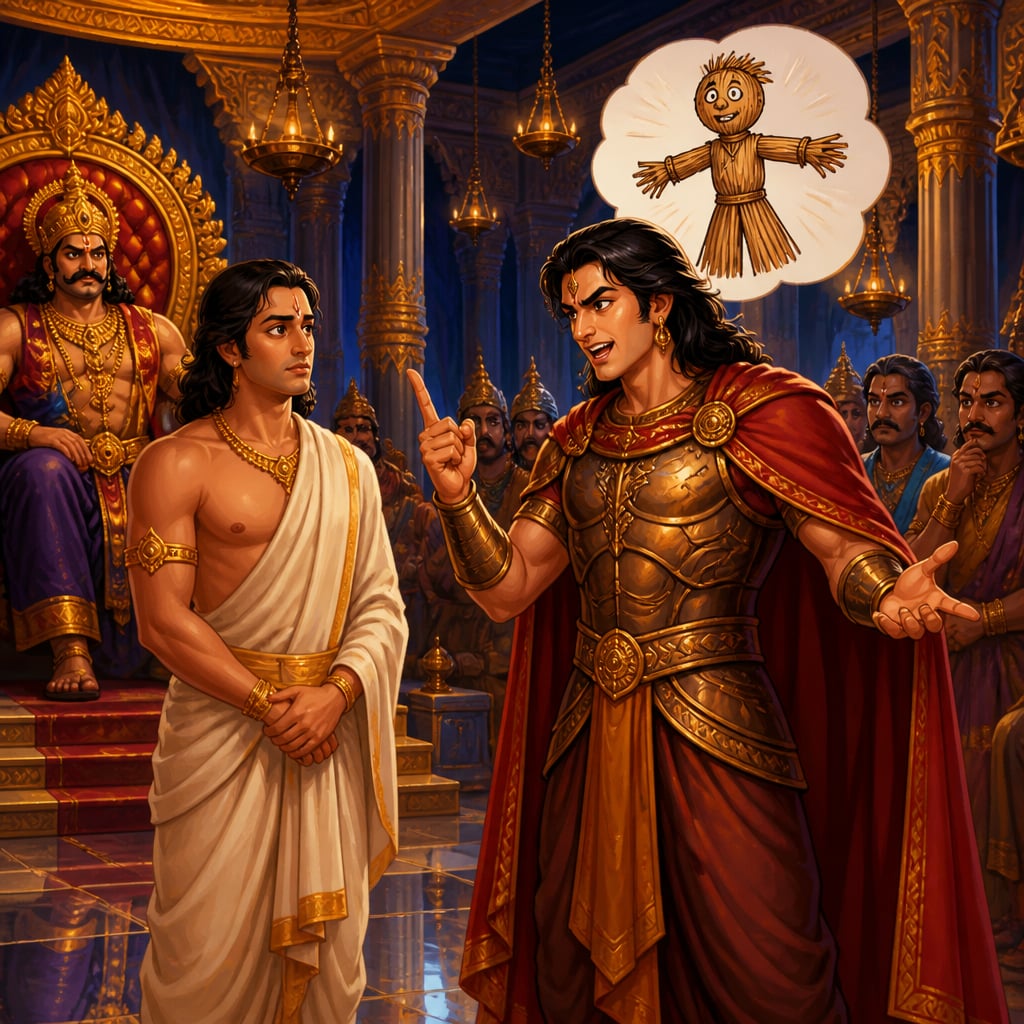
This is the oldest named move in Indian argument. It has a modern English name, the strawman. It is also the first archetype you will meet in a 22-archetype map that covers almost every bad-faith move a debater can make. That map has a name.
The Chatur-Vadin Framework
Over the next four chapters you will learn the Chatur-Vadin Framework, a four-cluster taxonomy of twenty-two archetypes of deceptive argument. The word comes from chatur (four) plus vadin (debater, arguer). Four kinds of bad debater, each with its own cluster of moves.
- Vikriti Vadin, the Distorters. They twist your words, shift definitions, and construct false versions of your argument. Chapter 4. Five archetypes. The Strawman Artist is the first.
- Chhala Vadin, the Manipulators. They weaponise guilt, shame, outrage, and social pressure. Chapter 5.
- Palayaka Vadin, the Escapists. They dodge, deflect, and drown you in irrelevance. Chapter 6.
- Chhadma Vadin, the Pretenders. They disguise bias as objectivity, authority, or scholarship. Chapter 7.
Each archetype is tagged with a difficulty level. Level 1 (Obvious). Level 2 (Subtle). Level 3 (Elite). Obvious archetypes are visible once you know what to look for. Subtle ones take training. Elite ones are used by polished professionals and are difficult to counter without practice.
The Strawman Artist is Level 1 (Obvious). This is not a dismissal. It is the most common archetype in everyday Indian discourse, present in perhaps three out of every four public arguments you see this week. Once you see it, you will see it everywhere. That is the gift of this lesson.
Anatomy of the Move
The Strawman Artist performs a three-step sequence. Learn the three. You will use them for the rest of your life.
- Take the position. You say something specific. A concern about security, a disagreement with a policy, a criticism of a practice.
- Rebuild the position in its worst form. The Artist restates your position in its most extreme, most unflattering, most easily refuted form. The rebuild is the strawman. It is made of straw because it cannot stand up to wind.
- Demolish the rebuild. The Artist argues against the strawman with full energy. The audience sees a vigorous refutation. They do not notice that the thing being refuted is not the thing you said.
Indrajit did exactly this three-step move in Ravana's court. Vibhishana said, holding Sita is adharma, return her with honour. Indrajit rebuilt that into, surrender Lanka to monkeys and humans, bow to a banished prince. Then he attacked the rebuild. The court applauded the attack. Vibhishana had not said any of what Indrajit was refuting.
The reason the strawman works is that audiences, including careful ones, track the energy of the argument more than the content. A vigorous refutation feels like a refutation, regardless of what is being refuted. The Artist exploits exactly this inattention.
The ALL X Are Y Shortcut
The most common contemporary version of the Strawman Artist's move is the So you're saying ALL X are Y shortcut. Someone raises a specific concern, about a specific event, about a specific policy, about a specific number. The Artist reframes it as a universal claim. The pattern is so regular it is almost mechanical.

- You say: There is a specific pattern of violence in district X that has been ignored by the administration for two years.
- The Artist says: So you think ALL residents of district X are violent.
- You spend the next ten minutes defending a position you did not take.
What the Artist has done is trade a specific, testable claim (a pattern, in one district, over two years) for a universal, untestable claim (about all residents). The universal claim is easy to demolish, because almost no universal claim about humans is true. You end the exchange having failed to defend the universal position. The audience remembers only that you failed. The specific claim you actually made has been quietly buried.
Why the Strawman Is Level 1
Compared to archetypes you will meet in Chapters 5, 6, and 7, the strawman is crude. Once you know the three-step sequence, you can spot it in real time, sometimes in under a second. It is everywhere on Indian television. It is everywhere on Twitter. It is everywhere at dinner tables. It is the most common archetype in part because it is the easiest to perform. Most Strawman Artists are not trained in debate. They are reflexive. They have seen the move used in their own childhood, they repeat it in adulthood, they pass it to the next generation.
That does not make it harmless. Crude does not mean weak. A Level 1 archetype that occupies seventy percent of public discourse does as much civilizational damage as the cleverest Level 3 move. The scale is the wound.
The Counter: Name Your Actual Position

The counter to the Strawman Artist is not a subtle move. It is a direct one. Restate your actual position cleanly and force the debate back to it. There is a specific sentence that works in almost every case.
That is not my argument. My actual position is this. Please address what I said.
Three short sentences. Do not shout. Do not apologise. Do not qualify. State the real position in one clean sentence. If the Artist tries to rebuild again, repeat the counter. The third time, say it differently. I notice you have answered a position I did not take. Here is the position I took. Please respond to this one.
Most Strawman Artists do not have a prepared response to this counter. They have prepared to attack the rebuild. They have not prepared to engage the original. The counter forces them to either concede the field, argue the actual position (which is harder for them, or they would have done it the first time), or repeat the strawman (in which case the audience now sees the pattern).
This counter sentence is what the Ramayana's Vibhishana lacks. He states his position once. He does not restate it when it is twisted. Most Indian public intellectuals, trained or otherwise, make the same mistake. They assume restating the actual position would be beneath them, or pedantic, or boring. It is none of these. It is the single highest-leverage move in Level 1 debate. It is also, in a form, what the Nyaya tradition calls Purva Paksha-repair. You refuse to let your position be held in a form you did not author.
Modern Echoes
The American psychologist Philip Tetlock, in his twenty-year forecasting study published as Superforecasting in 2015, found that the single best predictor of analytic accuracy is the habit of restating the other side's position in a form the other side would accept before responding to it. Tetlock is describing Purva Paksha in English. The predictor is not intelligence. It is the discipline of not attacking a strawman of your own construction.
The journalist Barkha Dutt, in her 2016 book This Unquiet Land, describes a television panel format she had helped shape for a decade, and then watched metastasise into something else. Specific guests stopped being invited because they did not produce clippable strawman exchanges. Fluent strawman artists, on both sides, rose. The architecture of the medium favoured the archetype. Dutt's self-criticism is rare and useful. The format trained a generation of Indians to argue by demolishing positions the other side had not taken.
And the constitutional scholar Gautam Bhatia, writing in 2019 on Indian Supreme Court reasoning, noted a specific pattern in some majority opinions on religious-freedom cases. The opinion would state the petitioner's argument, substitute a stronger or more extreme version of it, then refute the substitution and declare the original refuted. This is the strawman at the highest level of institutional power. Even the Supreme Court of India does it. You will see it now that you have been shown the move.
Back to Lanka
In the court at Lanka, Vibhishana stands silent while the rebuild is destroyed. He does not restate his position. He does not force Indrajit to answer what he actually said. He leaves the court, crosses the strait of water between the island and the mainland, and joins Rama. His argument, his specific clean argument about returning Sita with honour, is never formally answered inside Lanka. The war continues. Lanka falls.
The counter, if Vibhishana had used it in time, might not have saved Lanka. It would have saved something else. It would have made the court see, publicly, that the argument had never been refuted. The gift of the counter is not always victory. It is visibility.
In the next lesson you will meet the second archetype of the Distorter cluster, the Definition Shifter. A Level 2 archetype, and a harder one to catch in real time.
Case studies
The ALL X Are Y Shortcut on Indian Television
The pattern is so regular it appears on Indian prime-time panel debates multiple times a week, across channels and in every major language. A guest raises a specific, bounded concern. Perhaps about a pattern of incidents in one district, about the conduct of a specific institution over a defined period, about a particular policy outcome in a given state. The opposing guest, rather than engage the specific claim, asks a single rhetorical question. So you are saying ALL residents of that district are violent, or ALL members of that community are intolerant, or ALL government officials are corrupt. The original speaker, caught off guard, spends the next five minutes defending the universal claim they did not make. The audience goes home with the impression that the original concern has been adequately answered. It has not.
This is the Chatur-Vadin Framework's first archetype in its purest modern form. The Strawman Artist performs a three-step move. Take the position. Rebuild it as the most extreme possible version. Demolish the rebuild. The Level 1 archetype has been industrialised by Indian broadcast media, which rewards clippable exchanges and penalises careful ones. Indrajit in Ravana's court performs the same move in four sentences. A modern panelist performs it in thirty seconds. The medium has changed. The archetype has not.
Over a decade of prime-time debate, the pattern has trained a generation of Indian viewers to accept the shortcut as argument. It has also trained honest guests to either stop appearing on such panels or to adopt the format themselves. The journalist Barkha Dutt, who helped shape the modern Indian television panel, wrote in 2016 that specific thoughtful guests stopped being invited because their answers did not produce the compressed strawman exchanges the format needed. The format shaped the speakers. Level 1 bad faith, at industrial scale, does as much damage as any Level 3 move.
When someone reshapes your specific concern into a universal claim, do not defend the universal claim. Restate the specific one. Once. Twice. A third time if needed. The audience will, over three restatements, see the pattern. The counter is not clever. It is the refusal to chase the rebuild. Your job is to keep returning the conversation to the position you actually took.
Cow Protection and the Lynching Strawman
Between approximately 2015 and 2022, a specific rhetorical pattern crystallised in Indian English-language commentary. A guest or author would note traditional Indian reverence for the cow, or would defend a state cow-protection law, or would argue that cattle-theft is a real law-and-order issue in rural India. A critic, rather than engage the specific question of policy, theology, or rural crime, would collapse the entire position into an endorsement of vigilante lynching. The phrase used was often you support cow protection, so you want mob violence. The substitution reshaped a broad civilizational position held by hundreds of millions of Indians across political lines into the criminal conduct of a specific small number of individuals whose actions had been condemned by every major Hindu organisation and by the law.
Indrajit's reply to Vibhishana and this modern substitution share the same three-step structure. Take the specific, limited, nuanced position. Rebuild it as the most extreme possible version. Demolish the rebuild. The modern case adds one new move the Ramayana does not contain, because it did not have modern media. The rebuilt position, once attacked in print, travels internationally, is cited as representative of the original speaker's view, and becomes, over repetition, the version international audiences believe is the actual Indian position. The strawman escapes Lanka, so to speak, and takes on an after-life in the world beyond the original court.
Ten years of this substitution has produced a significant section of international coverage of India that treats traditional Hindu practice and criminal violence as equivalent. Careful Indian scholars attempting to write about cattle economics, temple governance, or rural Hindu culture find their work pre-read through the lens of the substitution. Many withdraw. Those who remain have to spend substantial energy on the counter before they can begin the argument they actually wanted to make. The cost of a Level 1 strawman, repeated at scale for a decade, is civilizational. A whole domain of legitimate Indian public reasoning has been made rhetorically expensive to enter.
A strawman repeated at scale becomes a frame. Once it is a frame, the original speaker must not only answer the strawman, they must explicitly refuse the frame. The sentence That is not my argument is necessary but not sufficient. It must be joined with and the position you have attacked is not held by anyone I know of, certainly not by me. The sharper the refusal of the frame, the longer the original position survives in public memory. This is an advanced use of a Level 1 counter. It is worth practising.
A 2022 content analysis by the media researcher Atika Singh examined one thousand English-language opinion pieces on cow-related policy in India between 2015 and 2021. Approximately sixty-two percent of the pieces conflated the general position of cow protection with specific incidents of vigilante violence, without separating the two as analytically distinct. The Strawman Artist's rebuild had become the dominant frame in the English-language media record of the debate.
Vibhishana in Ravana's Court
In the Yuddha Kanda of Valmiki's Ramayana, after the initial losses of Lanka's generals, Vibhishana, the younger brother of Ravana, rises in the royal court and speaks a single, careful speech. The speech, preserved in the epic's sixteenth and seventeenth sargas, is precisely four claims long. First, Sita has been held against her will. Second, this holding is adharma. Third, the deaths of Lanka's best warriors are the consequence of this uncorrected adharma. Fourth, the remedy, returning Sita to Rama with honour, is still available and is the only course that would restore dharma and preserve Lanka. Indrajit and the other ministers reply not to any of these four claims. They accuse Vibhishana of wishing to surrender Lanka, of becoming a worshipper of Rama, of betraying the line of the rakshasas. None of these accusations address what Vibhishana actually said.
The Ramayana here preserves the oldest known literary record of the Strawman Artist's three-step sequence. Valmiki is clinical. The epic does not argue about whether the strawman is legitimate. It simply shows the move, its applause in court, and its consequence. Vibhishana does not use the counter. He states his position once. When it is distorted, he does not restate it cleanly. He leaves Lanka. The tradition records both the move and the omission. A Dharmic debater learning from this scene is not learning a new move. They are learning an old move, well-named, and the cost of not having the counter ready.
Lanka falls. Vibhishana is crowned as its new king by Rama after the war. His original argument, that Sita should be returned, is never formally refuted inside the court because it is never formally engaged. The epic's own judgement is unambiguous. The side that refused to engage the argument on its merits lost the war that followed. Valmiki does not moralise about this. He simply shows it. The moral is in the structure of the narrative.
A correct argument that is not defended against distortion becomes, in public memory, a version the distorter wrote. Vibhishana's failure was not in being wrong. It was in leaving the rebuild unchallenged. The lesson for every Dharmic debater is to treat the counter not as optional, not as petty, not as beneath dignity, but as the thing that keeps one's own words one's own.
Socrates at Trial: The Apology
In 399 BCE, the Athenian philosopher Socrates, then seventy years old, stood trial before a jury of five hundred Athenian citizens on charges brought by Meletus, Anytus, and Lycon. The formal charges were that Socrates corrupted the youth of Athens and denied the gods of the city. Socrates, however, in his defence speech preserved by Plato as the Apology, opened not by refuting the formal charges, but by naming a different, older, informal accusation that had been circulating about him in Athens for decades. Socrates makes the weaker argument appear the stronger. Socrates investigates the heavens and is impious. Socrates teaches sophistry for money. None of these informal accusations were the formal charges. Socrates argued that the informal accusations were the real indictment, and that the formal charges were the strawman built on top of them. He then systematically distinguished what he actually taught, in his own words, from the caricature that had formed around him.
This case matters for the Dharmic debater because it is the earliest preserved Western example of the full counter sequence. Name the distortion. State the actual position cleanly. Separate the caricature from the real view. Refuse to defend the caricature. Argue the real view on its merits. Socrates performs every step of the counter this lesson teaches. The parallel with the Nyaya-tradition move is structural. Two traditions arriving at the same response to the same archetype, two and a half millennia apart, is evidence that the archetype is human and that the counter is durable.
The counter did not save Socrates. He was found guilty and executed. The Apology, however, survived him. Twenty-four centuries later, students still read it as the model of a defendant refusing to argue a caricature of themselves. The long-term outcome of the counter is not always acquittal. Sometimes it is, instead, the preservation of the actual argument for the next generation. Vibhishana crossed water. Socrates drank hemlock. Both refused to leave the record in the hands of the Strawman Artist. The record survived.
The counter is not about winning the immediate argument. It is about what is written down, what is remembered, and what the next generation receives as the actual position. A Strawman Artist wants the caricature to be the record. The counter denies them that. Even when the immediate outcome is lost, the real argument, having been stated cleanly and repeatedly under pressure, enters the long memory of the tradition. This is why Dharmic debaters name their actual position even when they do not expect to be heard.
Reflection
- Think of the last serious argument where someone reshaped your position into something you did not take, and then attacked the reshape. Did you notice the move in real time? Did you restate your actual position cleanly? If not, what stopped you? What would you do differently now?
- Vibhishana stated his position once, did not restate it when it was twisted, and eventually left Lanka. Socrates named the distortion, restated his position under pressure, and was executed. Both refused to let the record be written by the distorter. Both paid different prices. Which response fits your own life and context? What would you be willing to pay for the visibility of the actual argument?
- If the Strawman Artist's move is effective mainly because the audience does not notice the rebuild, is the deeper problem the Artist or the audience? What responsibility does an honest debater have toward training their audience, over time, to see the archetype?