The Cherry Picker
Curated Evidence as a Weapon
Level 2 (Subtle) archetype. The Cherry Picker selects only the data that supports their narrative and quietly leaves out everything that contradicts. You do not spot this by watching the evidence shown. You spot it by asking what is missing.
The Edit Bay
On the evening of the seventeenth of January 2023, the BBC released the first episode of a two-part documentary titled India: The Modi Question. The production had taken months. Its anchoring artefact was a leaked UK Foreign Office memo written in 2002. The documentary presented three episodes from that year with sharp editing and confident voiceover.
At no point across the two hour-long episodes did it name the 2012 Supreme Court of India monitored SIT closure report. At no point did it reference the 2022 Supreme Court ruling that dismissed the Zakia Jafri petition and endorsed the SIT's findings. At no point did it engage the many subsequent judicial rulings across Indian courts that had addressed the same events.
All of that material was in the public record. The production team knew it existed. The documentary did not include it.
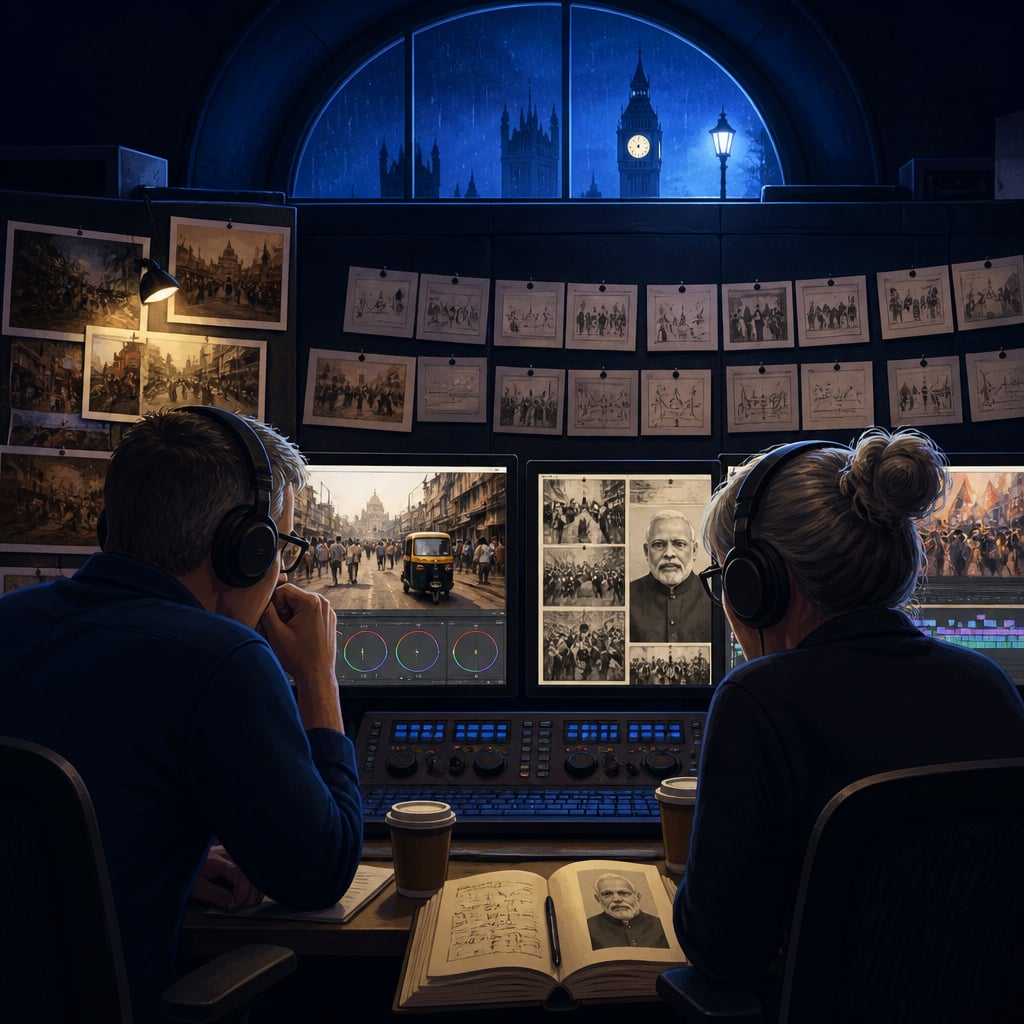
This is what a Cherry Picker looks like at documentary scale. It is not about lying. Every clip aired was real. Every document cited existed. The manipulation lived entirely in what was left out.
Welcome to the fourth archetype in the Chatur-Vadin Framework's Distorter cluster. The Cherry Picker is tagged Level 2 (Subtle). You do not catch this archetype by watching the evidence that is shown. You catch it by asking what evidence is missing.
What the Cherry Picker Actually Does
A Cherry Picker does not fabricate. That is what makes them hard to catch. They work by selection, not by invention. The factual record is huge. The Cherry Picker walks through it, picks the five facts that fit their story, leaves the other ninety-five in the drawer, and presents the five as if they were representative.
A clean definition: the Cherry Picker is a debater who presents a non-representative subset of the available evidence and lets the audience assume the subset is representative.
The manipulation has three common shapes.
- Source cherry pick. They cite the three studies that support their thesis and do not mention the thirty that contradict it. A documentary shows you four expert interviews. You do not see the forty experts who declined to appear or who said something that did not make the cut.
- Temporal cherry pick. They pick the year or decade that fits. A since 2014 graph tells one story. The same graph since 2001 tells another. Which baseline you choose decides what the data appears to show.
- Scope cherry pick. They quote a verse, a statistic, or an incident in isolation from its surrounding context. Three lines from a two-hundred-verse chapter. One district's numbers standing in for the whole country.
All three shapes use real evidence. That is what makes the Cherry Picker a Level 2 archetype. A Strawman lies openly. A Cherry Picker tells the truth badly on purpose.
Why This Archetype Is Subtle
In classical Indian terminology, the Cherry Picker is a producer of ardha-satya, half-truths. The Mahabharata gives us the canonical case. At Kurukshetra, Drona could not be defeated as long as he held his weapons. The Pandava strategy hinged on making him lay them down. A rumour was spread that his son Ashvatthama had been killed. In fact it was an elephant of the same name that had been killed. When Drona asked Yudhishthira, the one man he trusted to speak only truth, the answer came as: Ashvatthama is dead, whether man or elephant. The second half of that sentence was drowned out by Krishna's conch. Drona heard the part that was said loudly. He laid down his weapons. He died.

Yudhishthira had not lied. He had cherry-picked which half of the truth would be heard. The half-truth killed the teacher.
That story tells you why this archetype is rated Subtle. The Cherry Picker does not fail an honesty test in the narrow sense. They fail a completeness test. Most debaters never learn to run the completeness test, because most training focuses on catching lies, not on catching selective omission. Level 1 archetypes like the Strawman and the Overgeneralizer are usually obvious on the first reading. A Cherry Picker only becomes obvious after you go looking for what is missing.
How to Catch a Cherry Pick in Real Time
You catch this archetype by asking questions the Cherry Picker does not want asked. Three questions cover most cases.
First, what is the denominator? When you hear a statistic, ask what it is a fraction of. Top 1 percent holds 40 percent of wealth tells a very different story depending on whether the base is pre-tax income, post-tax income, or wealth including housing, and whether the comparison group is India, a peer developing economy, or the average OECD country. Get the denominator and half of the cherry pick collapses by itself.
Second, what is the time window? A chart that starts in 2014 and one that starts in 2001 can show opposite trends from the same underlying data. Ask why this start date. Ask what the series looked like ten years before that start date and ten years after. A speaker who cannot answer either question has probably picked the window to fit the story.
Third, what did you leave out? This is the direct one. What studies contradict the studies you cited? What verses in the same text disagree with the ones you quoted? What experts declined to appear? A serious speaker answers honestly. A Cherry Picker changes the subject.
When you ask these in a live debate, your tone matters. Do not ask them accusingly. Ask them as if you genuinely want to know, because in a fair debate you would. If the speaker has done the work, they answer well and you both learn something. If they have cherry-picked, they betray themselves by how they dodge.
Counter Preview: Name What Is Missing
The full Shat-Khandana counters come in Chapter 8. The one-line counter for this archetype, which the course plan flags as the preview, is: You have shown X. What about Y and Z?
You do not have to be able to produce Y and Z with full citations in that moment. You only have to be able to name the shape of what is missing. A reader who has read thirty pages of the Manusmriti can ask, which of its hundred-plus verses on impartial kingship did you consider? without being able to quote them all on the spot. The Cherry Picker's manipulation depends on the room not noticing the gap. The moment anyone in the room says there is a gap, the manipulation weakens.
In the BBC documentary's case, the counter was never asked in the documentary itself, because no dissenting voice was cast into it. It was asked afterwards by a generation of watchful Indian readers, commentators, and legal scholars, who pointed to the Supreme Court rulings the film had quietly stepped around. That counter took weeks to land. It did land. Cherry picks survive the day. The gap catches up with them.
Modern Echoes

Every year around the World Economic Forum at Davos, Oxfam releases an India inequality report with a one-line headline statistic. Top 1 percent holds 40 percent of wealth, or similar. Major newspapers run the headline globally within hours. The underlying methodology choices (the exclusion of tax and transfer effects, the exclusion of comparable Western distributions, the treatment of housing wealth, the absence of multi-dimensional poverty measures that have been falling) are in the report's footnotes. The headline is a cherry. The footnotes are the orchard. Almost no reader reads the orchard.
Classical Hindu texts have been cherry-picked in the same way for two centuries. Critics routinely quote three or four verses from the Manusmriti while ignoring the hundreds of verses from the same text on impartial kingship, the context-specific verses that contradict the cited ones, the Arthashastra and the Thirukkural that disagree with those verses on similar questions, and the lived practices of hundreds of jati communities that departed from the text in both directions. The three verses feel damning. The orchard, read in full, tells a far more complex story.
Back in the edit bay in London, the BBC documentary is five editing decisions wide. The rulings it did not cite are hundreds of court pages deep. A documentary that had cited both would have been a longer, more boring, and far more honest piece of work. Chapter 5 begins next. You have seen the Distorters. Now you will meet the Manipulators, who work on your feelings rather than on the evidence.
Case studies
BBC India: The Modi Question (2023)
The BBC released India: The Modi Question in two hour-long episodes starting 17 January 2023. The production centred on a leaked 2002 UK Foreign Office memo and three 2002 episodes, and interspersed sharp voiceover commentary. Across the two hours, the documentary made no reference to the Supreme Court of India monitored 2012 SIT closure report, the 2013 magistrate's ruling accepting the SIT's findings, the 2022 Supreme Court ruling that dismissed the Zakia Jafri petition and endorsed the SIT, or the extensive Indian judicial engagement with the same events across more than a hundred subsequent rulings.
This is a Level 2 Cherry Picker at documentary scale. The material in the film was accurate. The selection was systematically one-sided. The BBC's editorial choices ran source, temporal, and scope cherry picks simultaneously: one foreign-office memo stood for the entire evidentiary record, three 2002 episodes stood for a twenty-year legal process, and no dissenting Indian legal voice was cast into the film. Every Dharmic test for a documentary fails here: not 'did you speak lies' but 'did you speak the truth as a whole.' The ardha-satya framing maps exactly.
The Indian government invoked IT Rules emergency powers to block the documentary from domestic platforms. Western press coverage largely framed the blocking itself as the story, replicating the documentary's selection choices in their own reporting. Indian legal commentators, journalists, and social media users produced detailed breakdowns listing the court rulings the film had omitted. That breakdown did not reach most Western audiences in the news cycle. It did become part of the permanent record of how the film was produced.
A documentary whose selection is as one-sided as this one is a film-length Cherry Picker. The defense is not to argue with the clips that are in it. The defense is to name every major piece of evidence the film should have included and did not, and to put that list where it is as searchable as the film is.
The Annual Oxfam India Inequality Headline
Each year around the World Economic Forum at Davos, Oxfam releases an India inequality report. The 2023 report was titled Survival of the Richest. Its headline statistics (including that the top 1 percent of Indians hold 40 percent of the country's wealth) were carried by major international and Indian newspapers within hours of release. The report's methodology appendices document the choices behind those numbers: reliance on private wealth databases with known upper-tail estimation biases, exclusion of post-tax and transfer effects, absence of comparable distributions for OECD economies, limited treatment of housing wealth, and no engagement with the multi-dimensional poverty index (MPI) data released by UNDP and NITI Aayog that shows a 415 million person reduction in poverty between 2005 and 2021.
This is statistical ardha-satya at scale. The top-line statistics are arithmetically derived from the chosen methodology. The methodology itself is a chain of selection decisions, each of which individually tilts the headline in one direction. Pakshapata in the Sanskrit sense: the report does fall consistently to one side. A Dharmic reader who asks the three completeness questions (what is the denominator, what is the time window, what is left out) recovers a much more complex picture within an hour of reading the footnotes.
The annual cycle repeats. The headline reaches hundreds of millions of readers. The careful responses by Indian economists (who are themselves often critics of inequality, just not of this particular framing) reach a much smaller audience inside footnotes-reading circles. The permanent effect is that 'India has extreme inequality' becomes global common sense in one direction, without the countervailing 'India has reduced absolute poverty faster than any country in history' reaching the same audiences.
A single statistic in a headline is almost always cherry-picked. Ask what it is a fraction of, over what time window, and what adjacent statistics were not included. The ten minutes of reading this takes is the price of not being manipulated by your own news habit.
UNDP and NITI Aayog data released in 2023 show that 415 million people in India exited multi-dimensional poverty between 2005-06 and 2019-21. This statistic does not appear in the Oxfam India report that went to global headlines in January 2023.
Manusmriti Verses Out of Context
Modern critiques of Hindu tradition (from colonial-era missionaries through late twentieth-century academic work to contemporary social media) have routinely cited three to five harsh-sounding verses from the Manusmriti as evidence of the entire smriti tradition's moral character. The selected verses typically appear without acknowledgement of: (a) the hundreds of verses from the same text on impartial rulership, hospitality, gender-specific protections, and ethical conduct; (b) the Arthashastra, Thirukkural, Yajnavalkya Smriti, Narada Smriti, and Shukra Niti which disagree with the cited verses on parallel questions; (c) the context verses in Manusmriti itself that qualify, limit, or contradict the cited ones; and (d) the extensive jati-level lived practice across South Asia that routinely departed from the text in both directions.
This is a classic scope cherry pick executed at civilizational scale across two centuries. Three or four verses in isolation generate a strong emotional reaction. Those verses are real. The impression they leave does not survive one reading of the surrounding chapter, let alone of the rival smritis. The Dharmic tradition itself had a framework for this: no single smriti is taken as the sole authority, and the rule of conflict (when smritis disagree, the more widely accepted and the more contextually appropriate wins) ensures that no single text can stand as the moral code on its own. The Cherry Picker's method bypasses this entire multi-source Dharmic jurisprudence.
Two centuries of educated Indian opinion inherited a mental image of the Manusmriti that the text itself does not sustain on a full reading. The corrective scholarship exists (B. R. Ambedkar's own reading noted the internal contradictions; modern scholars like Pandurang Vaman Kane in his History of Dharmashastra ran the full textual survey). The cherry-picked image is still the one most readers carry, because most readers have encountered the selected verses in coverage and have not read the surrounding text.
When someone quotes three verses from a classical text to condemn the whole, ask: how many verses are in the text, what do the other verses say, what do the parallel texts say, and what do the commentaries say. Most cherry picks collapse by the second question. The full reading is always longer, slower, and less viral than the cherry. It is also almost always closer to the truth.
Reflection
- Think of a view you argue for that you feel strongly about. What are the three strongest pieces of evidence against this view that an honest critic would cite? If you cannot list three specifics right now, what does that tell you about how the cherry picks of the sources you read have shaped your own picture?
- Yudhishthira was the one Pandava who could not lie, and yet he was the one asked to speak the ardha-satya about Ashvatthama. Why does the Mahabharata put the cherry pick in the mouth of the most truthful man, and what does that choice teach about how this archetype actually works?
- Is there ever a Dharmic cherry pick? Krishna seemed to sanction one at Kurukshetra. If yes, what distinguishes a legitimate strategic omission from an ordinary ardha-satya, and who gets to decide? If no, what do we do with Krishna's role?