The Definition Shifter
When Words Mean Whatever They Want
The Definition Shifter changes the meaning of a key term mid-debate. Level 2 (Subtle) archetype in the Distorters cluster of the Chatur-Vadin Framework. Same English word, two operational meanings, twenty minutes of conversation that was never the same conversation. The Vaadin's counter is one sentence: let us define this term before we proceed.
The Word That Was Never The Same Word
A composite scene that any Indian who watches news will recognize. Nine boxes on the screen. The anchor in the centre. The topic for the night: a recent state move on temple administration. The first panellist, a constitutional lawyer, opens. "India is a secular republic. The state has no business managing temples or any other religious institution." The second panellist, a former judge, replies within ten seconds. "India is a secular republic. The state has every responsibility to ensure that religious institutions serve the public, prevent abuse, and respect constitutional rights."
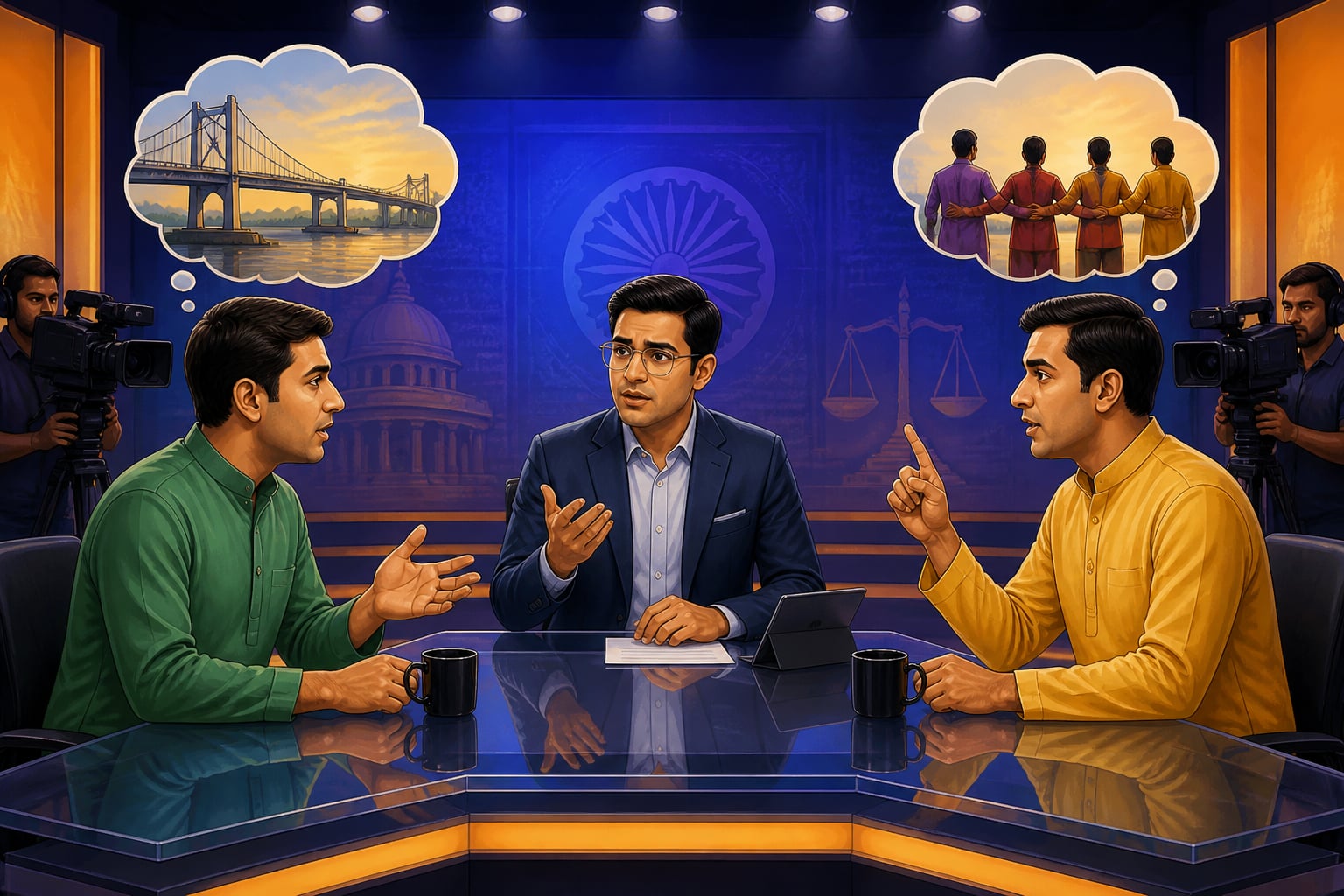
The two have just used the same English word in two opposite operational meanings.
The first speaker is using secularism in its Western sense: separation of state and religion, equal distance from all faiths, no state interference in religious life. The second is using it in its Indian operational sense: the state intervenes selectively, regulates Hindu temples directly while leaving most minority religious institutions autonomous, and treats the asymmetry as constitutionally settled. Same word. Same studio. Two completely different debates.
The anchor does not catch the shift. Neither panellist names it. They debate the word, not the underlying question, for the next twenty minutes. The audience leaves with the impression that they have heard two views on secularism. They have actually heard one word being used in two senses, repeatedly, with no disambiguation. The conversation that the country needed to have, about how the state should actually relate to religious communities, did not happen because the word the country was using to describe it had two definitions and nobody pinned which.
This archetype is the Definition Shifter. It is the second archetype in the Distorters cluster of the Chatur-Vadin Framework, and it is the most under-noticed of all twenty-two patterns in this course.
Difficulty Level: 🟧 Subtle
This is a Level 2 (Subtle) archetype. It is harder to spot than the Strawman Artist (Level 1) because nothing about the move sounds wrong. Both speakers are using the same word. Both speakers seem to be having a real disagreement. The disagreement is real, but it is not the disagreement either speaker thinks they are having. The shift hides inside the apparent agreement on vocabulary.
A Level 1 archetype announces itself: a strawman attack is visibly distorted, an overgeneralization is visibly broad. A Level 2 archetype like the Definition Shifter looks like ordinary debate. Detection requires the trained habit of asking, before any substantive exchange begins, which definition of this word are we using? Most debaters never form the habit. The shift then does its work in plain sight for twenty minutes, an hour, or two centuries.
The Anatomy Of A Definition Shift

The Nyaya Sutras, written some twenty-three centuries ago by the sage Akshapada Gautama, named this move with surgical precision. The Sanskrit name is Vāk-chhala (वाक्छल): the verbal sub-type of Chhala (छल), the deceptive shift inside a single word. Gautama defined it in Sutra 1.2.12 and his great commentator Vatsyayana mapped its sub-mechanisms.
विवक्षातोऽर्थस्यान्यार्थकल्पना वाक्छलम्
vivakṣato 'rthasya anyārtha-kalpanā vāk-chalam
Vāk-chhala is the forcing of an alternative meaning onto a word, in place of the meaning the speaker intended.
Nyaya Sutra 1.2.12
Four common sub-mechanisms fall under this definition. The Vaadin who knows them can name them in real time.
| Sub-mechanism | What shifts | Worked example |
|---|---|---|
| Register shift | Technical sense vs colloquial sense | Tolerance in classical liberal theory meant putting up with what one disagrees with. Current usage often means active affirmation. |
| Scope shift | Narrow definition vs broad usage | Genocide under the 1948 UN Convention requires specific intent and acts. Casual political usage now covers any large-scale violence. |
| Translation shift | Source-language baggage vs target reality | Caste (Portuguese casta) was imposed on the Indian categories of varna and jati, two structurally different things, both of which the single English word now flattens. |
| Stipulation shift | Private definition vs public usage | Hindutva in Savarkar's 1923 stipulation meant cultural-civilizational identity. Much current Western press usage means extremist Hindu nationalism. The speaker who slides between the two is doing a stipulation shift. |
All four sub-mechanisms produce the same surface effect: an apparent debate that is not the debate it appears to be. All four are defeated by the same first move.
The Shankara Move: Demand Disambiguation Before You Engage
In the eighth century, the philosopher Adi Shankara spent much of his short life in formal debate with Madhyamika Buddhist scholars. The Buddhist tradition, especially after Nagarjuna, used the word shunya (शून्य, emptiness) in two registers. Paramartha-shunyata was the absolute sense: that all phenomena are empty of intrinsic, independent existence. Vyavahara-shunyata was the conventional sense: that worldly objects are functionally real for practical purposes. The two senses were both philosophically valid. They became debate weapons when the Buddhist debater used one register to make a claim and shifted to the other when challenged.
Shankara's signature move, visible across his bhashyas, was to refuse engagement until the definition was pinned. He would not respond to a Buddhist position on shunya without first asking which sense was in play. He would record the answer. He would then hold the opponent to that sense for the rest of the exchange. If the opponent slid to the other sense, Shankara would name the slide and force a return.

The move sounds simple. It is the entire defence against this archetype. It is also the move almost no modern Indian debate ever performs. Two hours on prime-time television about secularism, and not one panellist asks the only question that matters: which definition of secularism are we operating under?
The Counter, In One Sentence
The Vaadin's counter to the Definition Shifter is one sentence delivered before any substantive exchange:
"Before we proceed, can we agree on what this word means? You said secularism. I want to make sure we mean the same thing."
The sentence costs nothing. It looks pedantic for the first eight seconds. By the second minute it has saved the conversation from being a different conversation. By the tenth minute the Definition Shifter, if there was one, has either accepted the disambiguation (in which case the real debate can proceed) or refused it (in which case the audience now knows what is happening).
Three elaborations of the same move are spelled out in the moral lessons of this lesson. The Vaadin who memorizes one of them and uses it consistently will spot and disarm Definition Shifters across politics, academia, family arguments, and corporate meetings. The pattern is identical across domains. The counter is identical too.
Modern Echoes
The behavioural economist Daniel Kahneman, in Thinking, Fast and Slow (2011), documented experimentally that the same statistical fact framed under two different labels produces opposite policy choices in the same person. The framing effect operates on whole sentences. The Definition Shifter operates one level below: it manipulates the meaning of single words inside a frame. Both are sub-cases of what Gautama called Chhala. Kahneman won the Nobel for documenting the larger phenomenon in laboratory settings. Gautama had named the smaller, more precise version twenty-three centuries earlier and given the Vaadin a one-sentence defence.
The Indian Supreme Court ruling in S.R. Bommai v. Union of India (1994) declared secularism a basic feature of the Indian constitution without ever defining which of the at least two operational meanings of secularism the court had in mind. Three decades and dozens of judgments later, the court is still using the word in both senses, sometimes within the same paragraph. The legal Vāk-chhala, embedded by the absence of an early definition, now governs how Indian courts decide cases on temple administration, religious autonomy, and state intervention in faith. A ten-minute disambiguation in 1994 might have saved thirty years of conflicting jurisprudence.
Back in the studio, the two panellists shake hands at the end of the hour. They believe they have had a real exchange. The audience believes it has watched a debate. The word secular leaves the studio still carrying both definitions, one in each panellist's mouth, ready to do the same work in the next debate, on the next channel, on the next night. The Definition Shifter is the archetype that does its damage by being too quiet to be noticed. The Vaadin's first job is to make the noise the archetype depends on its silence to avoid.
Case studies
Adi Shankara Pinning 'Shunya' in Buddhist Debate
In the eighth century, Adi Shankara travelled across the Indian subcontinent engaging in formal debate with Madhyamika Buddhist scholars. The Madhyamika tradition, especially after Nagarjuna, used the word shunya (emptiness) in two registers. Paramartha-shunyata was the absolute sense: all phenomena are empty of intrinsic, independent existence. Vyavahara-shunyata was the conventional sense: worldly objects are functionally real for practical purposes. Both senses were philosophically defensible. The senses became debate weapons when a Buddhist debater used one to make a claim and shifted to the other when challenged. Shankara's signature move, visible across his Brahma Sutra Bhashya and his commentary on the Mandukya Karikas, was to refuse substantive engagement until the opponent had specified which sense was in play. He would record the answer. He would then hold the opponent to that sense for the rest of the exchange. When the opponent slid to the other sense, Shankara named the slide and forced a return.
This is the textbook countermove to Vāk-chhala as Gautama defined it. The Definition Shifter's whole power rests on the unspoken assumption that both speakers mean the same thing by a key term. Shankara made the assumption visible by demanding it be voiced. Once the meaning was on the record, the shift had no room to operate. This is the operational form of paribhāṣā (technical definition) deployed not at the start of one's own treatise but in the middle of an opponent's argument: pin first, engage second.
Shankara reportedly defeated the major Madhyamika debaters of his era and re-established Vedantic discourse across India. Whether the historical record supports every traditional account or not, the philosophical record is clear: his bhashyas are unbeatable on Vāk-chhala terrain because every key term is pinned at first introduction and the Buddhist opponent has no room to slide. The four mathas he established continue to teach this disambiguation discipline as the foundation of debate twelve centuries later.
Do not engage the substance until the definition is on the record. The pause looks pedantic. The pause is the defence. Once the opponent commits to a sense in front of an audience, the slide they were planning becomes visible the moment they attempt it.
Shankara composed bhashyas (commentaries) on the ten principal Upanishads, the Brahma Sutras, and the Bhagavad Gita, and additional standalone works including the Vivekachudamani and the Upadeshasahasri. By traditional reckoning he completed all of this between roughly 788 and 820 CE, a working life of about thirty-two years. The disambiguation discipline visible across the corpus is uniform from earliest to latest text.
'Secularism' In India And The West: Two Words In One Studio
Through the post-2010 period of intensified Indian public debate on temple administration, religious freedom, and state-faith relations, the English word 'secularism' has been used routinely on Indian television, in Indian courtrooms, in Indian academic writing, and in Western press coverage of India. The word carries one operational meaning in its Western source-context (separation of state and religion, equal distance from all faiths, no state interference in religious life) and a structurally different operational meaning in actual Indian practice (state regulates Hindu temples through state-level Endowments Acts, controls their finances and appointments directly, while leaving most minority religious institutions autonomous under Article 30). In a single primetime debate it is common for two panellists to use the word repeatedly, in opposite senses, without either of them naming the shift. The studio audience and the home viewer are watching what looks like a debate on secularism. They are actually watching a Vāk-chhala that nobody in the room has named.
This is Vāk-chhala at civilizational scale. The shift is not deliberate in either panellist's mouth: each is using the word in the sense their training and constituency understand. The damage is the same as if the shift were deliberate. The legal, political, and constitutional debates that depend on the word produce conflicting jurisprudence and policy precisely because the central term carries two operational meanings that are never disambiguated. The Shankara-counter is available the entire time and is almost never deployed: a single panellist asking the anchor at minute one, 'Before we proceed, can we agree on which definition of secularism is in play tonight?' would change the next sixty minutes of debate in a way no rebuttal could.
Three decades after the Indian Supreme Court declared secularism a basic feature of the constitution in S.R. Bommai (1994) without specifying which operational meaning was intended, Indian courts continue to issue judgments on temple administration, religious autonomy, and state intervention in faith using the word in both senses, sometimes within a single paragraph. The unresolved Vāk-chhala has produced thirty years of conflicting jurisprudence, a politically unstable settlement on temple regulation, and a public debate in which most participants believe they are arguing about secularism while actually arguing about two structurally different concepts.
When a single English word carries two operational meanings, the speaker who pins the definition first wins the substantive ground. The second speaker must either accept that definition or openly stipulate a different one. Both moves are losses for the Definition Shifter who depended on the ambiguity.
'Genocide' From The 1948 Convention To Modern Political Usage
The 1948 UN Convention on the Prevention and Punishment of the Crime of Genocide defines genocide with five specific elements. There must be intent to destroy, in whole or in part, a national, ethnic, racial, or religious group, through one of five named acts: killing members of the group, causing serious bodily or mental harm, deliberately inflicting conditions of life calculated to destroy the group, imposing measures intended to prevent births within the group, or forcibly transferring children of the group. The definition is technically precise because the legal stakes are extraordinary. Through the 2010s and 2020s, the word 'genocide' has migrated steadily out of this technical legal usage and into routine political and media discourse, where it is now used for any large-scale violence, ethnic conflict, or contested military operation. The shift has happened without any explicit decision to redefine the term. By the time the word appears in a contemporary news headline, the speaker, the editor, and the reader almost never have the 1948 elements in mind.
Vatsyayana would have classified this as a scope shift sub-variant of Vāk-chhala: a term defined narrowly at one point and used broadly at another, with the speaker treating the broad usage as if it carried the moral weight the narrow definition was built to confer. The damage is two-sided. Genuine genocides become harder to discuss with rigour because the word has been hollowed by overuse. Contested mass-violence situations become impossible to discuss honestly because the word has been pre-loaded with a moral verdict. The Vaadin's countermove is unchanged from Shankara's: pin the definition before engagement. 'Are you using genocide in the 1948 Convention sense, or in the colloquial extended sense? My substantive response depends on the answer.'
Several recent international disputes (Israel-Hamas, Ukraine-Russia, Myanmar-Rohingya, China-Uyghur) have generated public debates in which the word 'genocide' is used by both supporters and critics with no agreed underlying definition. Legal proceedings under the 1948 Convention proceed in parallel using the technical definition, while political and media debate uses the loose definition. The two debates are not the same debate. Most participants in each are unaware the other exists in a different sense of the word.
When a technical legal term migrates into political vocabulary, its precision is the first casualty. Insist on the narrow definition for legal questions. Use a different word entirely (mass violence, ethnic conflict) for the broader phenomenon. Mixing the two in one conversation is itself a Vāk-chhala.
Reflection
- Pick a recent argument where you and the other person seemed to be debating a clear question but felt afterwards that you had been talking past each other. Was there a key word that each of you was using in a different sense? Which word, and which two senses?
- Why does the Definition Shifter belong in the Distorters cluster rather than in the Manipulators cluster, given that the move is often unintentional rather than deliberate?
- If a word carries two operational meanings in a community of speakers, can the community ever fully eliminate the ambiguity? Or is some unspoken Vāk-chhala unavoidable in any living language?