The Source Hierarchy
Have the Reference Ready
Primary sources outrank secondary sources, secondary sources outrank commentary, and commentary outranks opinion. The Nyaya tradition built a pramana hierarchy two and a half millennia ago that still tracks how honest debate is won. This lesson teaches the four-rung ladder, the discipline of having the reference ready before you speak, and the move that turns a confident opponent silent: ask which rung of the ladder their claim rests on, and ask to see it.
The Bikaner Box
In the late 1880s, in a stone-walled archive room at the Anup Sanskrit Library in Bikaner, an Indian historian named Jadunath Sarkar opened a wooden box of Persian documents. The box was old. It smelled of camphor and dust. The papers inside were brittle. Each one carried a Mughal seal pressed in red wax. Sarkar lifted them carefully, one at a time. The handwriting was Shikasta, the cursive Persian script of imperial chancery clerks. The dates ran from 1659 to 1707. The signature on the top of each document was the same. Aurangzeb Alamgir, Padshah-i-Ghazi.
Sarkar had spent twenty years preparing for this room. He had learned classical Persian at Patna College and at Cambridge. He had transcribed the Ma'asir-i-Alamgiri, the official chronicle of Aurangzeb's reign, line by line. He had read every available farmaan, every nishan, every state order. He was thirty-five years old. He had no university post worth defending and no political party to please. What he had was the discipline of going to the documents themselves.
The box contained the original orders for the destruction of specific temples at specific dates: Vishvanath at Kashi in April 1669, Keshava Rai at Mathura in January 1670, Somnath in May 1665. The orders were in Aurangzeb's own chancery hand. The seals were intact. The villages were named. The rebuilding fines were itemised.
In the public conversation of Sarkar's own time and for a century after, the question of what Aurangzeb had done was treated as a matter of opinion. Some commentators called him pious. Some called him a tyrant. The opinions had been arguing for two centuries. Sarkar walked past them and went to the chancery papers. The papers, in Aurangzeb's own hand, settled what no opinion could.
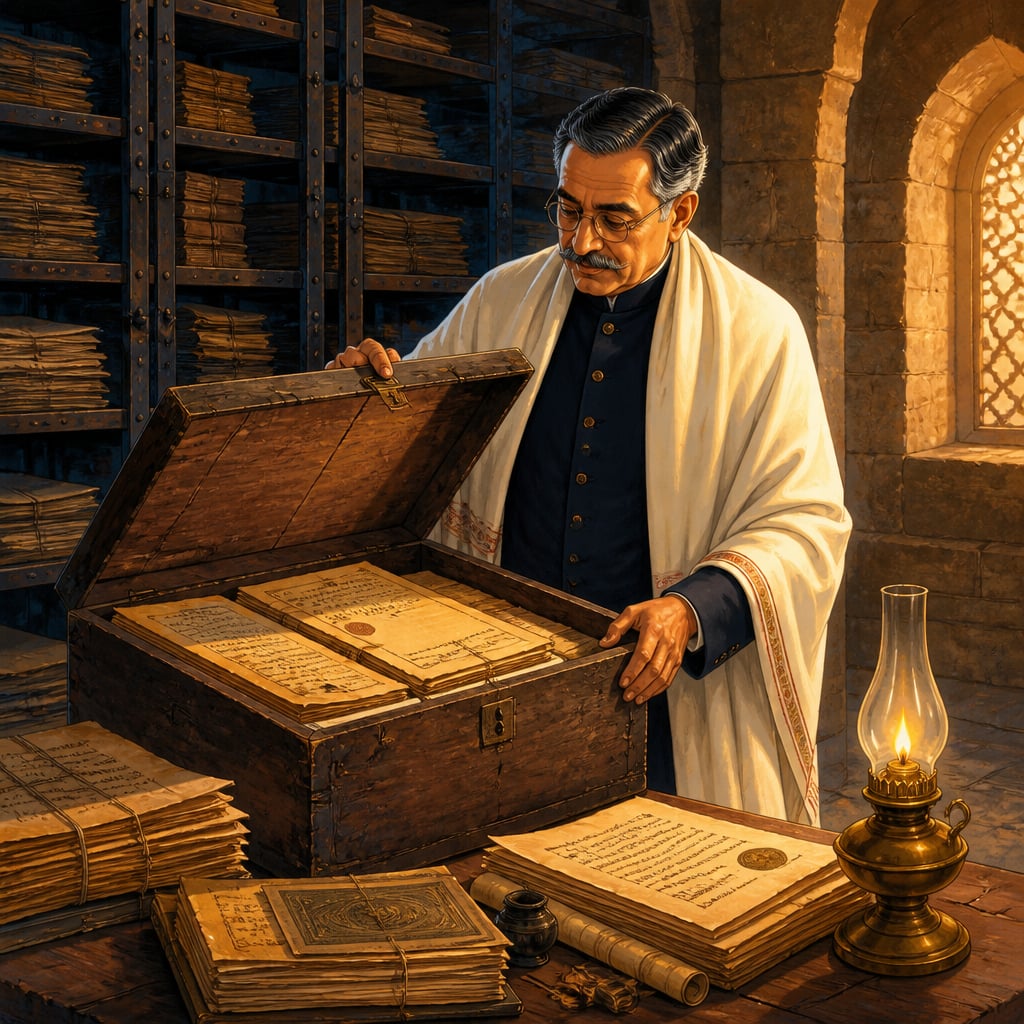
The Sanskrit word for what Sarkar did is Pramana-Sopana. The ladder of evidence. The Nyaya tradition's two-and-a-half-thousand-year-old rule for ranking sources of knowledge in a debate. Sarkar did not invent the rule. He applied it harder than his opponents did.
The Four Rungs Of The Ladder

Every claim rests on a source. Every source sits on one of four rungs. The higher the rung, the heavier the claim it can carry. Memorise the ladder. It is the entire skeleton of the lesson.
Rung 1: Primary source. The original document, artefact, or eyewitness testimony from the time and place of the event. Aurangzeb's own farmaan. The ASI excavation photograph. The original Sanskrit shloka in a recognised manuscript tradition. The RBI bulletin's published numbers. The court judgment in its full text. The audio recording of what someone actually said, in full. Primary sources have weight because no human has stood between the event and the evidence.
Rung 2: Secondary source. A trained scholar's careful, citation-bearing engagement with primary sources. Sarkar's History of Aurangzib. A peer-reviewed journal article that quotes its primary sources by manuscript number and folio. A textbook chapter that cites the Cambridge edition of a Sanskrit work with verse references. Secondary sources are real evidence, but they are evidence about evidence. They are only as strong as their citation discipline.
Rung 3: Commentary. Newspaper op-eds, public intellectual essays, podcast monologues, blog posts, expert interviews on television. These can be thoughtful or sloppy, honest or partisan, but they sit one full rung below secondary sources. Commentary is what someone said about the field. It is not the field. Most of what passes for debate in modern public venues is commentary citing other commentary.
Rung 4: Opinion. I read somewhere. Everyone knows. People say. It is well established. No source named. No reference produced. Pure assertion. The Nyaya tradition does not classify this as a category of evidence at all. It classifies it as the absence of evidence wearing the costume of evidence.
The rule, in one sentence: a claim from a higher rung beats a claim from a lower rung, every time, regardless of who is making it.
Have The Reference Ready
The first discipline of Pramana-Sopana is preparation. Before you walk into any debate, panel, conversation, or thread on a topic you care about, you must have the primary references ready.
Ready has a precise meaning. It means three things.
You have the citation. The full reference. Volume, chapter, verse, page, paragraph. Not the Manusmriti says. Manusmriti 7.143, in the Calcutta critical edition. Not the Vedas say. Rig Veda 10.129.7, the Nasadiya Sukta. Not the court ruled. Indian Supreme Court, M Siddiq vs Mahant Suresh Das, Civil Appeal Nos. 10866-10867 of 2010, paragraph 798. The citation is the proof that you have actually been to the source.
You can produce the original text. Not the English translation. The Sanskrit, the Persian, the original judgment, the original dataset, the original photograph. A printed page, a screenshot, a downloaded file, a bookmarked URL to the recognised digital repository. You may not need to display it. You must be able to display it. The opponent who knows you cannot produces a different debate than the one who knows you can.
You can read the original. At least enough to verify the translation. A reader of basic Sanskrit can check whether a Manusmriti shloka actually contains the word the English translation claims it does. A reader who can match Devanagari letters can verify that a quoted shloka exists in the manuscript tradition at all. The discipline of being able to read the source, however slowly, separates the dharmic debater from the citer of citations.
In the Nyaya tradition, the candidate who walked into the shastrartha hall without the references ready was disqualified before the debate began. The hall did not waste time on opinion. The dharmic debater inherits this discipline. Have the reference ready, or do not enter the room.
The Move That Turns The Room
The second discipline is the move you make in the moment.
When an opponent makes a claim, ask the ladder question, in plain language, before you respond.
Which source is that from?
Not rude. Not aggressive. The same tone you would use at a library counter. The question forces the opponent to declare a rung. The room learns more from their answer than from any counter-claim you could have prepared.
If they name a primary source, the debate is honest and you proceed to the source itself.
If they name a secondary source, ask the next question. And which primary source did that scholar use? You walk down the ladder one rung at a time until you reach a primary source or you reach an opinion. Most claims do not survive the walk.
If they name commentary, ask politely whether the commentator named their primary source. If yes, go to the primary. If no, the chain has already reached the third rung in two steps and you have your answer.
If they cannot name a source at all, the claim has been classified by the speaker themselves as opinion. You do not have to argue with it. The audience has watched it descend the ladder in real time.
चत्वारः सोपानाः प्रमाणस्य। प्रत्यक्षमुत्तमं तस्मादनुमानं ततः परम्। शाब्दं तत्परमिष्टं च लोकवादोऽधमस्तु यः॥
catvāraḥ sopānāḥ pramāṇasya | pratyakṣam uttamaṃ tasmād anumānaṃ tataḥ param | śābdaṃ tat-param iṣṭaṃ ca loka-vādo'dhamas tu yaḥ ||
The ladder of evidence has four rungs. Direct perception is highest. Inference comes next. Trustworthy testimony comes after. Mere public talk is the lowest, and not honoured at all.
Pramana-Sopana summary verse, in the tradition of Vatsyayana's Nyaya Bhashya
The Nyaya Tradition Built This Two Thousand Years Ago

The four-rung ladder is not a modern invention. The Nyaya Sutras of Gautama, composed around the second century BCE, classify the valid means of knowledge as Pratyaksha (direct perception, the original evidence), Anumana (inference grounded in evidence), and Shabda (reliable testimony from a trustworthy source). Pratyaksha had the highest standing because it was unmediated. Anumana came next because it was grounded in pratyaksha. Shabda was admitted, but the tradition was strict about who counted.
Vatsyayana, the fifth-century commentator, sharpened the rules. A shabda source had to satisfy three conditions. The source had to be apta, competent in the field. The source had to be abhrama, not subject to known error. And the source had to be avipralipsu, not motivated to deceive. A modern translation of these three conditions is, almost word for word, the textbook definition of a primary scholarly source: subject expertise, methodological reliability, and absence of conflict of interest.
The tradition then named the failure modes. Loka-vada, public talk, was excluded from pramana by name. Itihasa-aprasiddha, claims unsupported by traditional record, was a Nigrahasthana, a defeat condition. The tradition's vocabulary for opinion-as-evidence was a list of disqualifications.
The practical effect, in the Nalanda and Mithila debate halls, was that any speaker advancing a claim was expected, within the same conversational turn, to declare which pramana the claim rested on. Pratyakshat, anumanat, va shabdat? A claim that could not be assigned to one of the three was not admitted.
The modern Western analogue, eighteen centuries late, is the academic citation system. The footnote, the bibliography, the peer-review process, the Chicago Manual. All paper-based reconstructions of the pramana question. The dharmic tradition asked it first, and asked it in the room, in real time.
Why The Ladder Wins
A reader trained in modern habits might object. Surely a brilliant op-ed can be more useful than a dull primary source. Surely a famous historian's commentary deserves more weight than an anonymous chancery clerk's farmaan.
The Nyaya tradition heard this objection and rejected it. The reason is structural, not snobbish.
- A primary source can be checked. The chancery clerk's farmaan is in the Bikaner archive. Anyone can request a photograph. The op-ed cannot be checked at the same level, because it is the writer's interpretation of something else.
- A primary source does not move. The text of Manusmriti 7.143 in the Calcutta critical edition is the same today as it was in 1882 and will be in 2050. The famous historian's interpretation may have changed three times in the same period. Reasoning needs solid ground.
- A primary source carries no party loyalty. Aurangzeb's chancery papers were not written to please twenty-first-century historians. They were written to record orders. The neutrality of the document is the source of its weight.
- A primary source forces the debate where the opponent cannot easily lie. The opponent can produce a counter-interpretation. The opponent cannot produce a counter-document if it does not exist.
This is why dishonest debate gravitates downward. Opinion is the easiest to assert and the hardest to falsify. Primary source is the hardest to assert and the easiest to verify. The dharmic debater chooses the harder discipline because the harder discipline wins the room over time.
Dharmic Lens: The Pramana Hierarchy vs The Modern Citation Style
The Western academic tradition has built an extensive citation infrastructure. Footnotes, bibliographies, DOIs, citation managers, peer-review protocols. The infrastructure is real and useful. It is also a partial reinvention of Pramana-Sopana, with two specific weaknesses the dharmic tradition does not have.
The first weakness is that the modern citation system is page-based, not room-based. A scholar cites a primary source in a footnote that the reader can chase only after the debate is over. In a live exchange, the system collapses. The shastrartha hall demanded the citation in the same conversational turn as the claim. The modern television panel, podcast, and Twitter thread have no equivalent protocol. A speaker can assert all historians agree on live air and the audience has no way to check.
The second weakness is that the modern citation system flattens the hierarchy. A footnote is a footnote whether it cites the Bikaner farmaan or a 2017 Bloomberg column. The reader does the ranking work themselves. The Nyaya tradition kept the ranking explicit. Pratyaksha, anumana, shabda, loka-vada. The four words declared the rung as part of the citation. A claim labelled loka-vada was already disqualified by its label.
The correction is two-fold. In writing, label the rung explicitly along with the citation. In live debate, deploy the ladder question within the same conversational turn as the opponent's assertion. Both moves rebuild what the citation system left out. Both are learnable and free. The result, over time, is a public conversation in which opinion can no longer travel in the costume of evidence.
Modern Echoes
The Pramana-Sopana ladder is being reinvented under different vocabularies in several modern fields, by people who have not read the Nyaya Sutras.
- Ronald Coase, in his 1937 paper The Nature of the Firm, insisted that economic theory be grounded in observed contracts and observed transactions, not in abstract derivation. His later 1959 paper on the FCC's allocation of broadcast frequencies argued that economists who reasoned without going to the actual regulatory documents were producing folk economics. Coase won the 1991 Nobel Prize partly for re-anchoring economic argument in primary sources. He had, without knowing it, restored Pratyaksha to the field.
- The replication crisis in psychology and biomedical sciences, documented by John Ioannidis in 2005 and the Open Science Collaboration in 2015, found that roughly 36 to 60 percent of published findings in the soft sciences could not be reproduced. The remedy proposed across the field is, in dharmic terms, a return to Pratyaksha. Pre-register the hypothesis, share the raw data, publish the analysis code, allow independent verification. The crisis is not a crisis of opinion. It is a crisis of insufficient anchoring in primary evidence.
- The Indian historian and lawyer J Sai Deepak has built a public reputation in the last decade for one specific discipline: bringing primary-source citations into live television debates. When opponents cite what historians say, he produces the original Sanskrit verse, the original colonial document, the original court judgment, by paragraph number, on screen. The discipline is the Nyaya discipline. The medium is twenty-first-century cable news. The effect is the same effect Sarkar achieved in the Bikaner archive: the descending opinion meets the ascending document and concedes the room.
Back To The Bikaner Archive
In the stone-walled room in 1888, Sarkar lifted one more document from the box. The seal was intact. The date was 8 April 1669. The order, in Aurangzeb's chancery hand, instructed the demolition of the Vishvanath temple at Kashi. The order specified the timeline. The order specified the rebuilding fine to be collected. Sarkar copied it carefully into his notebook. He cited it in his five-volume History of Aurangzib. The volumes were published between 1912 and 1924. They have been in continuous print ever since. The opinions about Aurangzeb that swirled around them have come and gone many times. The chancery papers in the Bikaner archive remain.
In the next lesson, the source ladder becomes a weapon. Prashna Yoga, the Socratic question, takes the references the lesson just trained you to keep ready and turns them into the cross-examination instrument that forces the opponent's contradictions into the open.
Case studies
Aurangzeb's Own Chancery Papers
From the late nineteenth century onwards, public debate about Aurangzeb's policies toward Hindu temples ran through every available rung of the pramana ladder except the highest. Colonial-era apologists called him a pious ruler whose religious actions were exaggerated by enemies. Mid-twentieth-century commentators called him a tyrant. Late-twentieth-century revisionists called him misunderstood. Each generation of commentary cited the previous generation. Almost none cited the documents Aurangzeb himself produced. Jadunath Sarkar's five-volume History of Aurangzib (1912-1924) was built from a different rung. Sarkar had spent two decades learning classical Persian and Arabic. He read the Ma'asir-i-Alamgiri, the Akhbarat (the daily court news bulletins), the Mirat-i-Ahmadi, and crucially the surviving farmaans and nishaans in the Bikaner Anup Sanskrit Library and the Rajasthan State Archives. The chancery papers preserved specific orders. The order for the demolition of the Vishvanath temple at Kashi was issued on 8 April 1669. The order for the Keshava Rai temple at Mathura followed in January 1670. The orders specified dates, villages, executing officers, and rebuilding fines collected from local populations. Sarkar cited them by archive, manuscript, and folio. His footnotes are checkable today. His volumes have remained in continuous print for over a century.
This is Pramana-Sopana run at full power on a contested historical figure. The opinion-rung commentary on Aurangzeb is loka-vada in the Nyaya sense: it is what people say, with no anchor. The secondary-rung scholarship that cites only other scholarship is shabda without proper apta verification, because the ultimate sources are not produced. Sarkar's work climbs to pratyaksha, the highest rung. The chancery papers are the Mughal state's own direct testimony about its own actions. The papers were not written for historians; they were written for executing officers. They satisfy all three apta conditions of the Nyaya Bhashya. They are competent (chancery clerks were the imperial civil service, trained for accuracy). They are methodologically reliable (the chancery filing system was internally audited). They are absent of motive to deceive (the orders were administrative, not propagandistic). By the Nyaya tradition's own rules, Sarkar's evidence outranks every commentary written about Aurangzeb in the last hundred and fifty years, in his favour or against.
Sarkar's volumes are still in print as of 2026, by Orient BlackSwan and other publishers. The chancery papers he cited remain accessible in the Bikaner archive and adjacent collections. The contemporary debates about Aurangzeb continue in the public arena, but the academic argument has moved decisively in the last three decades toward primary-source-based readings, exemplified by historians like Audrey Truschke (in the opposite ideological direction from Sarkar) who at least follow the discipline of citing the Mughal sources. The commentary-only school has visibly declined in scholarly weight. The vindication of the method is independent of the conclusions any specific scholar draws from it. The ladder rewards whoever climbs it, regardless of what they find at the top.
Any contested historical figure can be settled, at the level of what they actually did, by going to the documents they themselves produced. The work is hard. It requires language acquisition, archival access, and methodological patience. The work also produces conclusions that survive a century of opposing commentary, which is the test the loka-vada cannot pass. Whoever wishes to debate honestly about a historical figure must inherit Sarkar's discipline or accept that they are debating at a lower rung.
The Bikaner Anup Sanskrit Library preserves over thirteen thousand manuscripts in Sanskrit, Persian, and other classical languages, including a substantial corpus of Mughal chancery documents from the reigns of Akbar through Aurangzeb. The Ma'asir-i-Alamgiri, the official chronicle of Aurangzeb's reign by Saqi Mustaid Khan, runs to roughly five hundred manuscript folios in its complete form. Sir Jadunath Sarkar's translation, published in 1947, took him approximately a decade of work after his initial five-volume history was complete. The translation remains the standard English-language reference for the chronicle and is cited in academic monographs published as recently as 2025.
The Ramjanmabhoomi Verdict and the ASI Excavation Report
On 9 November 2019, the Supreme Court of India delivered the unanimous verdict in M Siddiq vs Mahant Suresh Das, the case popularly known as the Ramjanmabhoomi verdict. The dispute over the site at Ayodhya had run through Indian courts for almost seven decades. The case turned, in its final stage, on the report of the Archaeological Survey of India's 2003 excavation of the disputed site, conducted under the supervision of the Allahabad High Court. The ASI excavation produced primary-rung evidence: stratified physical remains, structural foundations, pillar bases, datable terracotta figurines, and architectural features consistent with a pre-existing non-Islamic religious structure. The ASI report, hundreds of pages with photographs, measurements, and stratigraphic analysis, was submitted to the court. The opposing legal arguments largely operated at a lower rung, citing academic commentary that questioned the ASI's methodology in general terms without producing primary archaeological counter-evidence. The dharmic legal team, led by senior advocates including K Parasaran and others, walked the court systematically through the ASI report's primary findings, paragraph by paragraph. The judgment, when it came, devoted dozens of pages to the ASI report's evidentiary weight. The court accepted the report as primary evidence and weighed it accordingly. The verdict went 5-0 in favour of the Hindu side at the structural level, with a separate equitable arrangement for the Muslim side.
This is Pramana-Sopana applied at the highest stakes available in modern Indian public life. The case ran for seventy years not because the primary evidence was absent but because the primary evidence had not been admitted into the room with sufficient procedural weight. The 2003 ASI excavation, ordered by the High Court itself, finally produced the pratyaksha rung. The dharmic legal team's discipline was Nyaya in modern dress. They did not argue from commentary about the site. They argued from the site itself, mediated by the trained sensory perception of the archaeologists. The ASI team functioned as collective apta witnesses: subject-competent (trained archaeologists), methodologically reliable (court-supervised excavation), absent of motive to deceive (a multi-religious team operating under judicial protocol). The opposition's reliance on academic commentary, however eminent, occupied a lower rung. The court, applying its own rules of evidence (which are Pramana-Sopana under different vocabulary), ranked the rungs accordingly. The verdict is the modern proof that the Nyaya hierarchy is not merely a philosophical preference. It is the structure by which serious tribunals adjudicate contested fact.
The Ram Mandir was constructed at the disputed site and consecrated on 22 January 2024, with a substantial Muslim allocation of land at an alternative site in Ayodhya as part of the same equitable settlement. The verdict has been studied in Indian and international law schools as a model of evidence-driven adjudication of long-running religious disputes. The structural lesson, however, has been less widely absorbed in the public conversation. Many of the same commentators who lost the case at the primary-source level continued, after the verdict, to operate at the same lower rung in subsequent disputes, on subsequent topics. The court's discipline did not propagate automatically to the public square. The dharmic debater's task is to propagate it deliberately.
Even in the most contested civilisational dispute available in modern India, primary evidence, properly produced and properly weighted, settles the question. The settlement does not happen automatically. It requires legal teams, scholars, and lay debaters who have done the discipline of climbing to the primary rung and who can present the evidence in the room where it matters. The verdict is the proof that the discipline scales, when it is exercised. The longer-running task is to exercise it in the venues where the courts are not the arbiters: television panels, social-media threads, family conversations, and the daily traffic of opinion.
The 2003 ASI excavation report on the Ayodhya site, formally titled Ayodhya 2002-03: Excavations at the Disputed Site, runs to approximately five hundred and seventy pages with extensive photographic and stratigraphic documentation. The 2019 Supreme Court verdict in M Siddiq vs Mahant Suresh Das (Civil Appeal Nos. 10866-10867 of 2010) runs to one thousand forty-five pages. The court's discussion of the ASI evidence occupies roughly a hundred and thirty paragraphs of the main judgment, the largest single block of evidentiary analysis on a primary archaeological source in any reported Indian Supreme Court verdict to date.
The WhatsApp 'Manu Said' Forward
On a Saturday morning in February 2025, in a family WhatsApp group of fifty-seven members, a cousin in Mumbai forwards a poster image. The image carries a single shloka in Devanagari, followed by an English translation underneath. The translation reads: 'Manu said women have no right to study the Vedas, perform yajnas, or recite mantras.' The image attributes the quote to Manusmriti 9.18. Three group members react with angry-face emojis. A fourth, an aunt in Hyderabad, replies in agreement. A nephew in Pune, who has spent a year studying basic Sanskrit and who has the Bhandarkar Oriental Research Institute critical edition of Manusmriti as a PDF on his phone, opens the file. He searches Chapter 9, Verse 18. The verse exists. It reads, in the critical edition's reconstructed text, na asti strīṇāṃ kriyā mantraiḥ iti dharme vyavasthitiḥ. He reads the four classical commentaries (Medhatithi, Govindaraja, Kulluka Bhatta, Sarvajna Narayana) printed alongside the verse. The commentaries clarify that the verse is part of a longer technical discussion of ritual procedure in a specific class of grhyasutra-based domestic ceremonies, and that the standard commentary tradition explicitly distinguishes between mantra recitation in those particular ceremonies and Vedic study or Vedic recitation more generally. The forwarded poster has compressed a technical liturgical observation about one specific ceremony class into a sweeping prohibition on women's Vedic education. The nephew, in five minutes, has the primary source open, the manuscript reference, and the four classical commentaries. He posts a screenshot of the BORI critical edition page, the Sanskrit text in the original, and a one-paragraph note on what the commentary tradition actually says. The conversation in the group changes shape immediately.
This is Pramana-Sopana run at conversational speed in a daily-life venue. The forwarded poster is at rung 4, opinion. It cites a verse number but produces no primary source, no Sanskrit, no manuscript reference, no commentary. The angry-face emojis are loka-vada in real time. The nephew's response climbs the ladder in five minutes. He opens the BORI critical edition (the standard scholarly primary text of Manusmriti, prepared by Patrick Olivelle's editorial protocols and corresponding Indian philological work). He reads the actual Sanskrit. He consults the four classical commentaries that have read this exact verse for a thousand years. The Nyaya conditions are met sequentially. The BORI edition is apta as a primary text source (subject-competent editors, methodologically rigorous, absence of partisan motive). The classical commentaries are apta as shabda for ritual-procedural matters (the commentators were the field's working specialists, with full apta credentials in the Nyaya sense). The forwarded poster fails at the lowest rung because it produces neither the primary verse in full nor any commentary. It fails specifically the Nigrahasthana of itihasa-aprasiddha, the assertion that cannot be supported in the traditional record. The audience in the WhatsApp group, even those without Sanskrit, can see the difference between a screenshot of a poster and a screenshot of a critical-edition page.
The aunt who had agreed with the original poster reads the nephew's response and asks a follow-up question, which is itself a marker that the conversation has moved up the ladder. The cousin who forwarded the poster does not respond, which the group reads correctly. Over the following weeks, the nephew gets quietly tagged in three other Manusmriti-quote forwards in extended-family groups. He runs the same protocol each time. By the end of the year, the rate of bare-quote forwards in his network has visibly declined, because the senders have learned that someone in the chain will check. The outcome is small, local, and reproducible. The same protocol scales: any reader who acquires basic Sanskrit and the BORI critical edition (freely available in PDF from multiple academic repositories) can run the protocol in their own networks.
The single highest-leverage Pramana-Sopana intervention in modern Indian life is the daily WhatsApp counter. The cost of the discipline is one year of basic Sanskrit study and the bookmarking of two or three critical-edition resources. The benefit is the structural transformation of every group conversation the dharmic debater participates in. Most fabricated or distorted quotes do not survive a thirty-second consultation with the actual primary source. The protocol is not advanced scholarship. It is a five-minute discipline that any motivated graduate can install in their working memory and deploy at the point where the loka-vada arrives.
The Bhandarkar Oriental Research Institute's critical edition of the Manusmriti, prepared in collaboration with Patrick Olivelle and published in the 2000s, used over fifty manuscript witnesses from across India to establish the standard reconstructed text. The edition is freely available in academic and public-domain digital repositories and runs to roughly nine hundred pages including the four classical commentaries (Medhatithi, ninth century CE; Govindaraja, eleventh-twelfth century; Kulluka Bhatta, fifteenth century; Sarvajna Narayana, fourteenth century). A reader with basic Sanskrit and the PDF on a phone can verify any single Manusmriti quote, in original Sanskrit, alongside a thousand years of expert commentary, in under five minutes. The ladder is sitting in the reader's pocket.
Reflection
- Pick the topic you find yourself debating most often, in any venue (work, family, social media, podcast comments). Be specific. Now ask yourself honestly: when you make claims about this topic, can you, right now, name the three most important primary sources by manuscript or document, page or folio, and produce the original-language text on demand? If the answer is no, what does that tell you about the rung your debate has been running on, and what would it cost you to spend a single weekend climbing one rung higher on this single topic?
- The Nyaya tradition treats loka-vada, public talk, as specifically excluded from valid evidence. Modern public discourse, by contrast, treats public talk as the default operating medium. What changes about your relationship to news, social media, and casual conversation when you start applying the Nyaya rule consistently? What do you stop reading, what do you stop sharing, and what do you start asking of the people whose claims you used to accept on the strength of their delivery alone? Is this a discipline you can sustain, or does it create social friction you are not yet ready to absorb?
- The Nyaya tradition arrived at the four-rung pramana hierarchy by the second century BCE. The Anglo-American common-law tradition arrived at the analogous evidentiary hierarchy in the early modern period. The modern academic citation system arrived at the Chicago Manual style in the twentieth century. The replication crisis is teaching the soft sciences the same hierarchy in real time, in the twenty-first. Why has this same structure been rediscovered repeatedly across cultures and centuries? What does the convergence tell you about whether the hierarchy is a culturally local convention or a universal property of honest reasoning? What follows for how Hindus should engage with global discourse, given that the Nyaya tradition arrived at the rule first by a margin of two thousand years?