Narrative Construction: Arguments for the Heart

Stories Persuade Where Data Cannot

Closing lesson of Chapter 9 (Nirmana Yukti, the Art of Construction). Arguments persuade the mind. Narratives persuade the heart. The Dharmic debater learns to embed her position inside a story arc, to deploy analogical reasoning (Upamana) as a narrative device, and to recognise that the tradition's greatest argument, the Mahabharata, is itself a hundred-thousand-verse story whose every dharma teaching is delivered through the lives of named persons rather than through treatise. Vidura's man-in-the-well allegory and Steve Jobs's Stanford commencement are two cases, twenty-seven centuries apart, of the same technique operating identically.

The Sage Who Chose to Tell a Story

In a cave somewhere in the Himalayas, sometime around the third millennium BCE by traditional reckoning, the sage Vyasa sat across from his scribe Ganesha. The Mahabharata tradition records that Vyasa had a single condition for the project: Ganesha must understand each verse before writing it down. Ganesha had a single condition in return: Vyasa must not pause in his dictation. The cave smelled of bark and ink. The river outside ran cold. Vyasa began.
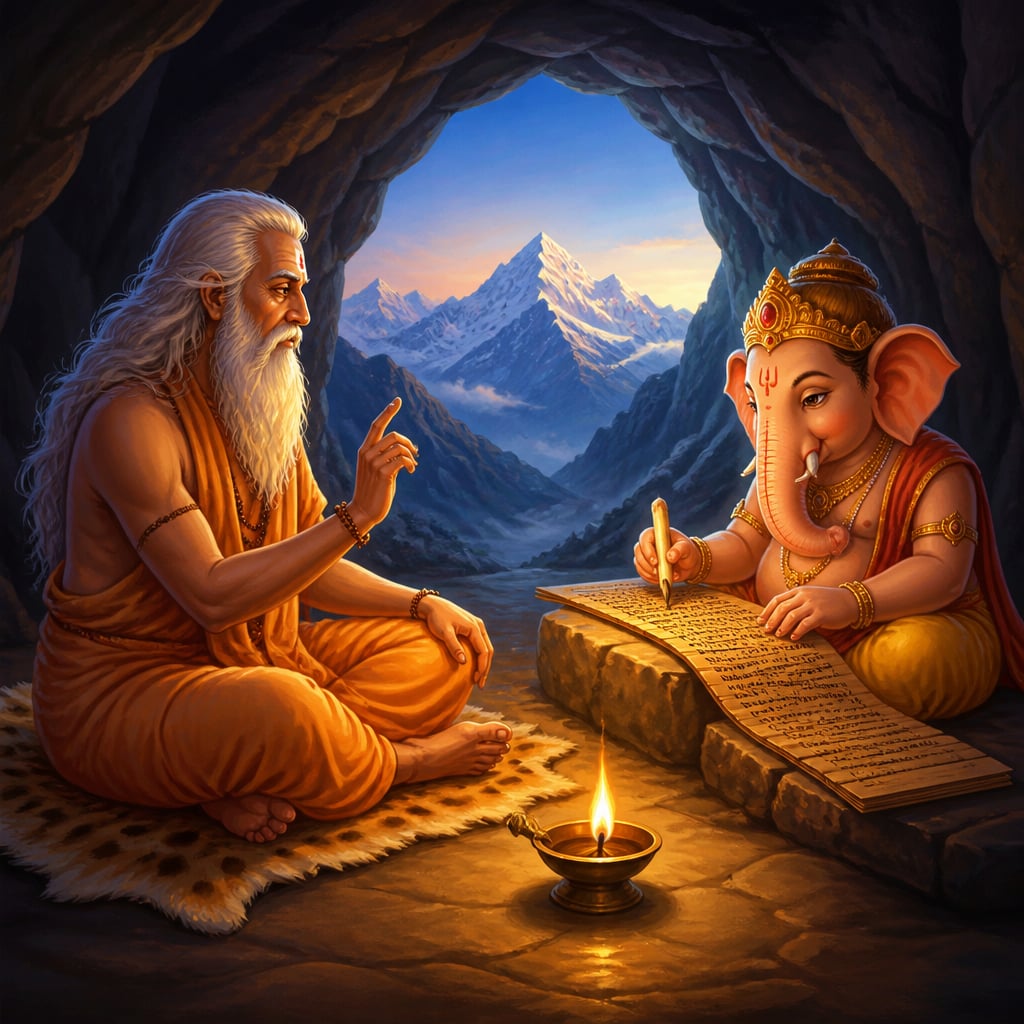
Sage Vyasa dictating the Mahabharata to Ganesha in a Himalayan cave

He could have chosen any form. The Sanskrit literary tradition by his time had Sutra texts, terse aphoristic prose that compressed entire systems into a few hundred lines. He could have written a Dharma-Sutra of two thousand pithy verses naming the principles he wished to transmit. The Manusmriti had done this for jurisprudence. The Yoga-Sutras would do this for meditation a few centuries later. The form existed. Vyasa chose against it.

He chose, instead, to write a story. A hundred thousand shlokas long. A war between cousins. A king who could not see, both literally and politically. A boy who broke a wheel out of a chariot trying to lift it. A queen who was dragged into court and asked, in front of her elders, whether her husband had the right to stake her in a dice game. A charioteer's foster-son who learned every weapon from a teacher who lied to him about his birth, then died holding to his given word. By the time Vyasa was done, the entire late-Vedic civilisational corpus on dharma was embedded inside the lives of these named persons, watched across decades, in moments of decision, against opponents whose own dharma made every choice difficult.

The form was the argument. The Mahabharata persuades not because Vyasa names the principles cleanly, though he does, but because the reader watches the principles operate inside lives that look like her own life. The Sutra-text would have produced students. The story produced a civilisation.

This is the closing lesson of Chapter 9, Nirmana Yukti. Across the four prior lessons you have learned to build the argument map (9.1), audit your sources (9.2), deploy the cross-examining question (9.3), and reframe a hostile question on your own terms (9.4). Now the final move: when argument has done what argument can do, what is left is to embed the position inside a story. The Sanskrit name is Akhyana-Kala, the art of storytelling, and the technique is the closing weapon of the constructive debater.

Why the Heart Hears Differently from the Mind

The distinction this lesson rests on is not a poetic flourish; it is a structural fact about how persuasion works in human cognition. Argument operates on the analytical mind, buddhi: the faculty that weighs propositions, audits evidence, and arrives at conclusions. Narrative operates on the relational mind: the faculty that locates the listener inside a scene with named persons and asks her to feel what they feel.

The Dharmic tradition's term for the relational faculty is bhava, the inner emotional disposition. The classical Indian theatre treatise, the Natya Shastra of Bharata Muni (compiled roughly 200 BCE to 200 CE), is essentially a manual for moving an audience's bhava through narrative structure. The eight rasas, eight moods that narrative can produce, are not a literary curiosity. They are the formal taxonomy of the channels through which a story moves the heart while the mind is still arguing.

This is why a three-minute personal anecdote in a panel debate routinely outperforms twenty minutes of data on the same topic. The data is being processed by the buddhi, which is doing what it always does: questioning premises, looking for omitted evidence, comparing the speaker's claims to the listener's prior beliefs. The anecdote bypasses the buddhi's audit and enters the relational faculty directly. By the time the buddhi has noticed what is happening, the listener has already located herself inside the story and has begun to feel what the protagonist feels. The persuasion is structural. The defence the audience has been preparing against the argument was never the right defence.

The Vidura Move

The locus classicus of narrative-as-argument in the tradition is in the Mahabharata's Udyoga Parva, on the night before Kurukshetra. Dhritarashtra, the blind father-king, cannot sleep. He has heard, all day, his son Duryodhana's hardening positions and his own counsellors' warnings. He summons Vidura. He wants, finally, an argument that will let him do what he already wants to do, which is to permit the war. He has spent decades resisting Vidura's earlier counsel; he has the scar tissue of a man who has heard policy arguments before and can deflect them.

Vidura tells the man-in-the-well allegory to Dhritarashtra

Vidura, who has been Hastinapura's prime minister for forty years and knows every counter-move Dhritarashtra will deploy against any direct argument, does something extraordinary. He does not begin with policy. He begins with a story. There was once a brahmin who fell into a well... The man's body dangles above an enormous python at the well's bottom. His feet are tangled in the roots of a creeper. White and black mice are gnawing at the creeper. From above, drops of honey from a beehive fall onto the man's tongue. The man, oblivious to the mice, the python, and the time, licks the honey.

The story is barely six hundred Sanskrit verses. The whole framing of Dhritarashtra's situation, an old man oblivious to imminent catastrophe because of the small daily pleasures of indulging his son, is delivered through the image of the man-in-the-well without any of the propositional language Dhritarashtra had spent forty years learning to deflect. By the close of the story, the king is weeping. The argument has, for the first time in their long acquaintance, reached him. That he ultimately permits the war anyway is not the technique's failure. It is the limit of the listener, not of the form. The Vidura move worked; the heart was reached. Dhritarashtra's downstream choice is a question about Dhritarashtra, not about Akhyana-Kala.

The Three Components of an Argument-Carrying Narrative

A story that is also an argument has, almost always, three structural components. Naming them lets you build them on demand.

Component one. A specific named person, not a category. A teacher I had in school, named Suresh, not teachers in general. My grandfather, who lived through Partition, not that generation. The specific name is what lets the listener locate herself inside the scene. Categories do not have rooms; named persons do, and the listener walks into the room with them.

Component two. A moment of concrete decision. Not the protagonist's general life, but a single named moment when something specific had to be chosen. The honey drops above the well, falling. The chariot wheel stuck in the mud. The morning Steve Jobs got the cancer biopsy back from the hospital. The narrative gathers force at the decision-point because that is where the listener herself is being asked to imagine what she would have done.

Component three. The teaching arrives as the resolution of the moment, not as a separate claim. The argument does not appear after the story as an explanatory paragraph. It is what the moment teaches when it resolves. The man in the well does not need a postscript explaining that this is a metaphor for Dhritarashtra; the resolution of the image is the teaching. The listener performs the inference herself, which is the move's most powerful asymmetry: a teaching the listener inferred is held more durably than a teaching she was told.

Upamana as the Single-Sentence Form

The Nyaya tradition lists six Pramanas (valid means of knowledge) you met in Lesson 2.2. The fourth is Upamana, knowledge by analogy or comparison. A wild ox is like a domestic cow except for these three features. Upamana is, in classical epistemology, a recognised path to genuine new knowledge: the listener acquires real information about the wild ox even though she has never seen one, because the comparison gives her enough structural grip on the unknown via the known.

Upamana is, in operational terms, the single-sentence compression of Akhyana-Kala. It is what you reach for when you do not have three minutes for a full anecdote and you do have ten seconds for a comparison. His position is like a man trying to mop the floor while leaving the tap running. That argument is like a building with no foundation but a beautiful facade. The mind does the inferential work the comparison sets up, and the position you wished to convey arrives without the audit-pathway the listener was preparing.

The Bhagavad Gita is, structurally, a sustained Upamana sequence. The disciplined mind is like a lamp in a windless place (6.19). The senses are like horses that the wise charioteer holds in check. The world-tree is like an inverted fig tree, with roots above and branches below (15.1). When direct propositional argument has failed to move Arjuna across chapters one and two, Krishna pivots into Upamana imagery and the teaching becomes available in a way it had not been before. The pivot, not the imagery, is the technique you are learning to deploy.

Five Modern Cases You Have Probably Already Seen

The technique is so structurally efficient that examples are visible across registers in any given week.

Steve Jobs delivering the 2005 Stanford commencement

Steve Jobs at Stanford, 2005. Three personal stories (dropping out of Reed College, getting fired from Apple, the cancer diagnosis). Zero data. Fifteen minutes. The most-cited commencement address in American memory. Stanford's own communication faculty teach it as the canonical case of narrative outperforming argument in a setting where the audience expected data.

Brene Brown at TEDx Houston, 2010. Twelve minutes of academic findings on shame and vulnerability research, anchored to one personal story (her therapist visit, the breakdown moment). The talk crossed sixty million views and converted decades of academic research into civilisational impact. The data without the story would have stayed inside academic journals.

A senior counsel in the Sabarimala constitutional case, 2018. Among the affidavits and primary citations, one short narrative passage about the lived practice of women across generations of his own family on the deity's brahmacharya. The personal narrative humanised a constitutional argument that would otherwise have read as abstract right-versus-tradition.

Sridevi Murthy at her son's wedding, 2024. Mother of the groom; thirty-second story about the morning her son brought home his first paycheck and bought her a sari before himself buying a shirt. The hall was wet-eyed before any policy argument about the new household.

Your uncle on the family WhatsApp group last month. Reservations argument going nowhere with policy data. He said: Let me tell you about my classmate Suresh, who... The temperature shifted within ninety seconds. Whether or not anyone changed positions, the room had become human again.

Five cases. Five different registers, from Stanford auditorium to Indian Supreme Court to Bengaluru living room. The structural move in each case is identical: a specific named person, a moment of decision, a teaching that arrives as the resolution.

When NOT to Reach for Narrative

The technique is powerful enough that it must be deployed with discipline. Three settings where narrative is the wrong move.

Inside a courtroom or formal Shastrartha, where the form requires propositional argument with citations. Narrative there is unprofessional and the audience will score it accordingly. Use it as a brief insertion within the formal argument, never as a replacement for it.

When you do not actually have a relevant specific story, and would have to invent one. A fabricated anecdote is dambha (the Gita's first asuric quality from Lesson 7.6) regardless of how compelling its rhetoric. The classical tradition is sharp on this: a story that is structurally a lie, even in service of a true position, is still a lie, and the listener's downstream trust collapses if the fabrication is ever discovered.

When the audience has already been moved emotionally and now needs the analytical structure, not more emotion. Vidura's man-in-the-well worked because Dhritarashtra had been arguing all day. By the morning, he needed the legal-strategic argument that Krishna would give Arjuna the next day, not another story. Reading the audience's current state is part of the technique, and the discipline is to know when to stop reaching for narrative and let the buddhi finish what the bhava began.

The Bridge to Chapter 10

Chapter 9 has now equipped you with the full constructive toolkit. You can build the argument map (9.1), audit the source hierarchy (9.2), cross-examine with Prashna Yoga (9.3), reframe hostile questions (9.4), and embed the position inside a narrative arc (9.5). What is left is the inner state from which all of this is deployed, the Sthitaprajna, the unshakeable equanimity, that Krishna defines in Bhagavad Gita 2.54 to 2.72. Chapter 10 is the final movement of the course. Without the inner state, every technique above can be deployed in service of ego rather than truth. With the inner state, the same techniques become instruments of dharma.

The construction tools are sharp now. The next chapter is about the hand that holds them.

Modern Echoes

The Stanford psychologist Jennifer Aaker, in her work on narrative persuasion (The Power of Story, Stanford GSB curriculum, 2014), documents that listeners retain factual claims roughly twenty-two times more reliably when those claims are embedded in story arcs than when they are presented as standalone data. Paul Zak's neuroscientific work at Claremont (2014, Cerebrum) shows that narrative arcs reliably elevate oxytocin levels in listeners, producing measurable increases in cooperative and empathic behaviour. The mechanism Vyasa intuited in his cave was identifying a real cognitive and neurochemical fact about how human beings absorb truth.

In Indian discourse, Nrisimha Prasad Bhaduri's commentaries on the Mahabharata across the 2010s have repeatedly drawn the same point in plain Bengali and Hindi: the epic's persuasive power is structural, not ornamental. The Sutra-form would have transmitted the principles to the few; the story-form transmitted them to the many. A civilisation that wanted to embed dharma into the daily emotional life of farmers and weavers and merchants had to choose narrative, and Vyasa, in the cave with Ganesha, made that choice on its behalf.

Back to the Cave

Ganesha is still writing. The river is still cold. Vyasa has just begun the section where Vidura speaks to Dhritarashtra, and the man-in-the-well is about to fall toward his python. Vyasa knows what he is doing. He is teaching dharma the only way it can be taught at scale, by making readers across millennia watch named persons make difficult choices and feel what those choices cost.

The construction tools of Nirmana Yukti are now complete. The Sthitaprajna who deploys them is what Chapter 10 will build.

Case studies

Vidura's Man-in-the-Well: Story Where Argument Had Failed for Forty Years

On the night before the Kurukshetra war, in the Mahabharata's Udyoga Parva, the blind king Dhritarashtra cannot sleep. He has spent the day hearing his son Duryodhana's hardening positions, his counsellor Sanjaya's reports of the Pandava camp's preparations, and his own anxieties about the imminent destruction of his lineage. He summons his half-brother Vidura, the prime minister of Hastinapura and the most consistent voice of dharma in his court for forty years. The king has heard Vidura's policy arguments many times across those decades and has developed a practiced ability to deflect them; the scar tissue is real. Vidura does not begin with policy. He begins with a story. *There was a brahmin who fell into a well in a great forest...* The man dangles upside-down above an enormous python coiled at the well's bottom. His feet are tangled in the roots of a creeper growing along the well's wall. White and black mice are gnawing at the creeper. From above, drops of honey from a beehive fall onto the man's tongue. The man, oblivious to the python beneath, the mice gnawing, and the time passing, licks the honey-drops. The story runs roughly six hundred Sanskrit verses across the chapter.

By classical Nyaya accounting, Vidura's choice of Akhyana over direct argument is the operational deployment of *sākṣāt-kṛta-vacanam*, the *speech made directly visible* that he himself names as dharma in Udyoga Parva 36.2. The propositional argument (*your kingdom is about to be destroyed because you have indulged your son*) had been audited and deflected by Dhritarashtra for forty years. The Akhyana bypasses the audit-pathway. By the time Dhritarashtra has located himself inside the well, hanging above the python, oblivious to the mice on the creeper, the structural diagnosis of his own situation has reached him in a register the buddhi was not prepared to deflect. The man-in-the-well is not a metaphor in the literary sense; it is, in classical Pramana terms, an Upamana extended into full Akhyana, transferring real structural information about the king's predicament through analogical comparison.

Dhritarashtra weeps at the close of the story. The text records that he understands, for the first time, what every counsellor had been telling him: that he is licking honey-drops while the larger structure of his kingdom is collapsing. He nevertheless permits the war the next morning. The Akhyana succeeded in reaching him; his downstream choice failed the teaching. The Mahabharata preserves both halves of the case: the technique works (the heart was reached) and the technique has limits (the listener's downstream agency remains his own). The Udyoga Parva's editor preserves Vidura's narrative across roughly six hundred verses precisely because the technique is being modelled, in real time, for every future debater who might face an audience whose buddhi has been hardened against argument across decades.

When propositional argument has been audited and deflected for years by the same listener, narrative is the only remaining technique that may reach him. The Akhyana works on the relational faculty, which has not been trained to deflect the way the analytical faculty has. The Dharmic debater's discipline is to recognise the moment when argument has hit its ceiling for a particular listener and to switch into Akhyana-Kala without apology. Vidura's six hundred verses are the locus classicus of the move.

~40 years of failed direct counsel; ~600 verses of one Akhyana; 1 weeping king; 0 changed downstream actions. The Akhyana reached the heart but not the will, and the form preserves both halves of the lesson.

Steve Jobs at Stanford, 2005: Three Stories in a Setting That Expected Data

On 12 June 2005, the Apple co-founder Steve Jobs delivered the commencement address at Stanford University. The audience was roughly 23,000 graduates, families, faculty, and visitors, in a setting where commencement addresses traditionally featured policy frameworks, professional advice, or industry forecasts. Jobs had, at his disposal, the full corpus of Apple's technology history, market data on the personal-computing revolution he had helped lead, and a wealth of business-strategic frameworks. He used none of them. The fifteen-minute speech contained three personal stories. Story one: dropping out of Reed College in 1972 and the calligraphy class he then took for free, which would resurface eighteen years later in the Macintosh's typography. Story two: getting fired from Apple in 1985 by the board he himself had recruited, and the unexpected creative freedom that followed in the founding of NeXT and Pixar. Story three: the pancreatic cancer diagnosis in October 2003, the morning he was told he had three to six months to live, and the corrected biopsy two days later that revealed a treatable form. Each story was named-person specific (himself, his teacher Robert Palladino, the doctor in the diagnosis room), each had a concrete moment of decision, each delivered its teaching as the resolution of the moment rather than as a separate claim afterward.

By classical Akhyana-Kala accounting, Jobs's structure is identical to Vidura's structure across the three stories: named protagonist, concrete moment of decision, teaching as resolution. The form is the form. The setting is roughly opposite (a Western university auditorium versus a late-Vedic darbar) and the cultural register is roughly opposite (commencement-formal English versus Sanskrit Itihasa); but the cognitive mechanism the form exploits is the same. The audience's analytical defence (a graduate population trained to audit claims) is bypassed by the relational entry-point of the named-person scene, and the teaching arrives in a register the buddhi was not prepared to deflect. Stanford's communication faculty teaching the speech as canonical case is therefore not Western reinvention; it is contemporary recognition of a structural mechanism the Sanskrit tradition formalised twenty-five centuries earlier.

The Stanford 2005 commencement crossed forty million views on YouTube within the first decade after Jobs's death in 2011, has been translated into more than fifty languages, and is the most-cited commencement address in American memory. The address is taught at Stanford's Graduate School of Business and at communication faculties across multiple universities as the contemporary canonical case of narrative outperforming argument in a high-stakes formal setting. Jobs's three stories have, by 2025, reached an audience roughly the size of medium-sized nations, while contemporaneous commencement addresses by senior executives at the same university across the same decade have substantially zero comparable reach. The asymmetry is not subtle, and it is structural rather than circumstantial.

The Akhyana technique scales across cultures, registers, and centuries because it operates on a cognitive mechanism that is invariant across human listeners. A constructive debater equipping herself with Akhyana-Kala is not learning a tactic local to her own civilisation; she is acquiring a structurally universal instrument that the Sanskrit tradition merely formalised earliest and most explicitly. The discipline is to recognise the setting in which Akhyana is the right move and to deploy three-component stories (named person, concrete moment, teaching-as-resolution) without fabrication and without apology.

3 personal stories, 0 data slides, 15 minutes, ~40M+ views by 2025. The most-cited commencement in American memory; canonical case in communication-faculty curricula across multiple continents.

Reflection

More in Nirmana Yukti: The Art of Construction

All lessons in Nirmana Yukti: The Art of Construction · Vaada Shastra: The Dharmic Art of Debate course