Reframing: Answer on Your Terms
The Real Question Is Not X, It's Y
Most public debates are lost not in the answer but in the question. The opponent picks the frame, and the responder, by answering inside that frame, ratifies it. The Dharmic counter, named in the Nyaya tradition as Prakarana-Parivartan (context shift) and refined in Kautilya's Arthashastra as the concession-and-pivot, is the disciplined refusal to answer on the questioner's terms when the question itself is the trap. The lesson teaches a three-move sequence: name the frame, offer the better question, then answer the better question. The model line is: 'The real question here is not X, it is Y.' Done well, the reframe is not evasion. It is the move that lets the truth find a venue.
The Question Behind The Question
At 12:42 in the afternoon, Indian Standard Time, on 23 September 2017, Sushma Swaraj walked to the green-marble podium of the United Nations General Assembly hall in New York. She was sixty-five years old. She had been Minister of External Affairs for three years. The morning before, the Pakistani Prime Minister Shahid Khaqan Abbasi had stood at the same podium and built his speech around a question. The question was: when will the world hold India accountable for human-rights violations in Kashmir? He used the word Kashmir twenty-one times.
Sushma Swaraj walked up holding a single sheaf of papers. She did not begin with Kashmir. She did not deny the question. She refused to answer it.
What she said, in the third minute of her speech, was preserved word for word in the UN's official transcript. "Pakistan's leaders love to lecture us on human rights. Look at the world today. Look at where you stand and where India stands. We are completing seventy years of independence. We have produced IIT and IIM, the world-class technical institutions whose graduates run Silicon Valley. They have produced Lashkar-e-Taiba and Jaish-e-Mohammed." The hall went quiet in the way halls go quiet when a question has just been moved. The next morning, the four words IIT-IIM versus LeT-JeM travelled across more newspapers in more languages than any phrase her ministry had produced that decade. The Pakistani delegation walked out before her speech ended.
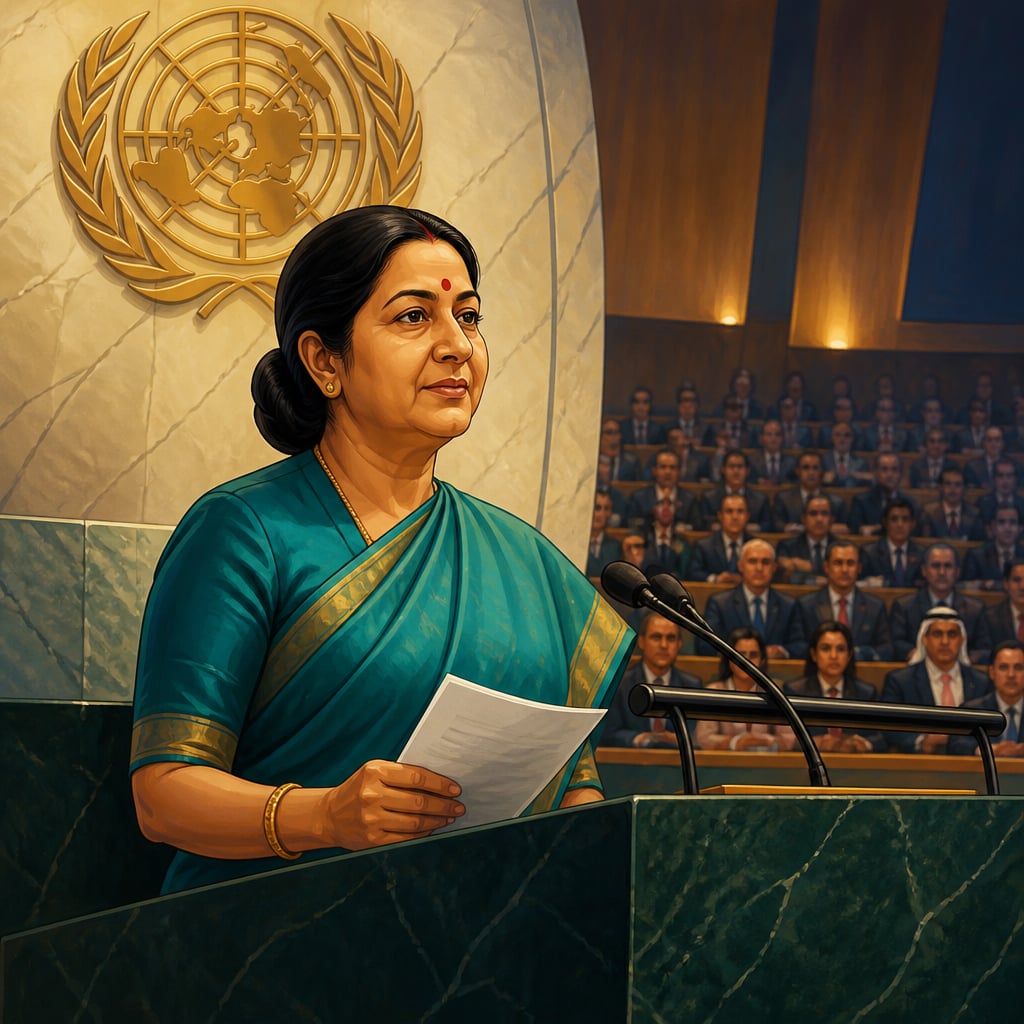
She had not refused to engage. She had refused to engage on the framing the questioner had handed her. The Sanskrit word for what she did is Prakarana-Parivartan, the change of the surrounding context. The Nyaya tradition has named this move for two and a half millennia. The lesson that follows is the working manual.
What Reframing Is, And What It Is Not
A reframe is not a dodge. The two are constantly confused, especially by audiences trained on Western political-debate norms, where any departure from the literal question is read as evasion. The Dharmic distinction is sharp. A dodge refuses to answer. A reframe refuses to answer the wrong question and offers a better one in its place. The audience, given the choice between the two questions, almost always sees that the better question is the one that should have been asked.
The move has three beats. The order matters.
- Name the frame. "The question, as you have asked it, assumes X." In one sentence, surface the assumption the question is sitting on. Audiences often do not see the assumption until it is named. The naming is half the work.
- Offer the better question. "The real question here is not X. It is Y." Y is the question whose answer would actually settle the matter. Y must be honest; it must not avoid the hard part of X. It must move the hard part to a location where it can be examined.
- Answer the better question. "And the answer to Y is..." Now you actually answer. With evidence. With specificity. With the calm that the previous two beats earned you.
Notice what is absent. There is no attack on the questioner. There is no claim that the question was malicious. There is no defensive sentence about why X is unfair. The reframe does the work without any of those. The audience reads it as cleaner thinking, not as evasion, because the new question is visibly the better one.
The Nyaya Source: Prakarana And Its Shift
The Sanskrit word prakarana has two living meanings, and both are in play in this lesson. In the Nyaya Sutras of Gautama, prakarana is the context of a debate, the surrounding frame within which a particular sentence is being examined. In the Mimamsa and grammatical traditions, prakarana is the section of a text, the local territory within which a rule operates. Both meanings converge on the same idea: a claim does not stand alone; it stands inside a context, and the context determines whether the claim is true.
The Nyaya Sutras, in Book 1 and Book 5, list the conditions under which a debate's prakarana can legitimately be challenged. If the questioner has set up the context to predetermine the answer, the answerer is permitted, in fact required, to surface the framing before responding. The technical name for this challenge is prakarana-sama, the claim that the question's frame is itself the problem. A challenge of prakarana-sama, properly delivered, halts the debate at the level of the question and forces both parties to renegotiate the context before any further answer is offered. Modern political debate has nothing structurally equivalent. The Dharmic tradition has had it for two thousand five hundred years.
The second source is Kautilya. The Arthashastra, in Book 5 and Book 12, develops a related move that the modern manuals call concession-and-pivot. The Sanskrit phrase Kautilya uses is alpa-tyaga, mahat-labha: a small concession, a large gain. The negotiator concedes a minor point, openly and without grudge, in order to clear the air for the major reframe. The concession is real (no point is given away that cannot be given away), but the concession is also strategic: it earns the right, in the listener's ear, to introduce the better frame. A skilled Dharmic debater rarely reframes without conceding something first. The concession is the price of admission.
The Three-Move Sequence Worked
The model question for this lesson is the canonical hostile question Hindus have heard for a hundred years: "When did Hindus become intolerant?" Notice the question. It is grammatically a when-question. It is structurally an assertion. It assumes, without arguing for, that Hindus are intolerant, and asks only for the date at which the intolerance began. Any answer to the literal question (a date, a decade, a regime) ratifies the assertion that the date is being asked about. There is no honest answer inside the frame.
Beat 1: name the frame. "The question assumes that Hindus are intolerant and asks only when. The assumption is the part of the question that needs to be examined." The sentence is calm. It does not call the questioner names. It says, with precision, what the question is doing.
Beat 2: offer the better question. "The real question is not when Hindus became intolerant. It is what historical evidence we have on the comparative tolerance of Hindu civilisation across two thousand years, and what that evidence requires of any honest framing." The new question contains the hard part. It does not let the responder off the hook. It moves the hard part to where evidence can examine it.
Beat 3: answer the better question. Now, with the frame named and the better question on the floor, the responder can deliver the actual content. "Across two thousand years, the Indian subcontinent received Jewish refugees in 70 CE without persecution, hosted the first Christian community outside the Roman Empire from the first century CE, sheltered Parsi refugees from the seventh century onward, and built the only major civilisation in which a Buddhist polity, a Hindu kingdom, and an Islamic kingdom co-existed for centuries within the same century. The dated record is examinable. The framing of intolerance, applied to this record without a comparative metric, is the framing that needs to be defended, not the record."
The whole sequence is roughly ninety seconds. The opponent now has a choice. Defend the original frame in the face of the dated record (which the audience can check), or accept the reframe and continue the debate honestly. Either is a win. The reframe has done the work.
Concession-And-Pivot: The Kautilya Refinement
Not every hostile question is fully malicious. Sometimes the question contains a true component and a false framing. A pure reframe, in such cases, can come across as defensive. The Kautilya refinement is to concede the true component openly, then pivot to the better question.
The move has three sentences. "You are right that X. (Concession.) Where I would push back is on Y. (Pivot.) Because the real question is Z. (Reframe.)" The concession must be sincere. The pivot must be precise. The reframe must be the question whose answer would actually settle the matter.
A worked example. Suppose the question is: "Hindu society had problems with caste. Why do you defend it?" A pure reframe would refuse the assertion entirely. The Kautilya version concedes openly. "You are right that the historical record contains documented caste-based injustices, and I do not defend those. Where I would push back is on the framing that treats caste-based injustice as uniquely Hindu, when the comparative twentieth-century record across societies shows that hierarchies of birth, race, and class produced injustice everywhere humans organised. The real question is not whether Hindu society had hierarchical injustice. Every society did. The real question is which civilisations produced internal critiques and reform movements from inside their own dharmic vocabulary, and on that question, the Dharmic tradition's record from Basava in the twelfth century to Narayana Guru in the nineteenth is a different conversation than the one the original framing assumes."
The concession is honest. The pivot is precise. The reframe is the question whose evidence the original framing was hoping not to face. Kautilya's alpa-tyaga, mahat-labha in three sentences.
When To Reframe And When To Answer Straight
The reframe is a powerful tool. Like every powerful tool, it is wrong-footed when used by reflex. The Vaada Vriksha decision tree, taught in Chapter 10, will give the full answer. The working version for this lesson is short.
- Reframe when the question contains a hidden assumption that, if accepted, predetermines the answer. When-did-Hindus-become-intolerant is the canonical case.
- Reframe when the question is grammatically a question but structurally an attack. Have-you-stopped-beating-your-wife is the textbook example.
- Reframe when the literal answer would be true but misleading. "Did your government cut education spending?" If the answer is yes-but-restructured-toward-quality, a literal yes ratifies the framing of cuts; a reframe is required.
- Answer straight when the question is honest and specific, even if it is hostile. "What did your government do in week three of the lockdown?" is a hostile question with no hidden assumption. Answer it. Answer it specifically. The reframe in this venue would damage your credibility for the venues where reframing actually matters.
The rule of thumb: reframe the framing, not the question. If the question's frame is the problem, name the frame. If the question is the problem only because the answer is uncomfortable, answer it. Honest debate requires both moves, applied at the right moment.
Dharmic Lens: Western Pivoting vs Dharmic Reframing
Western political training has a related move it calls pivoting. The standard manual, taught in media-training rooms from Washington to Westminster since at least the 1970s, says: when asked an inconvenient question, acknowledge the question briefly, then steer to the talking point you wanted to deliver. The pivot is structurally a dodge. The audience, watching long enough, learns to hear the pivot as the moment the speaker stopped answering. Modern Western audiences are now so trained on the pivot that they often disengage at the first sign of it.
The Dharmic reframe is a different move. The pivot says: I will not answer your question, here is something else. The reframe says: your question is the wrong one, here is the right one, and here is its answer. The first dodges the question. The second does the harder work of arguing that a better question exists, and then delivers an actual answer to the better question.
Three differences are load-bearing.
- The Dharmic reframe names the frame openly. The Western pivot pretends nothing has happened. Naming is half the move.
- The Dharmic reframe offers a better question, not a different topic. The Western pivot changes the subject. The Dharmic reframe stays on the same subject and changes only the framing of the inquiry.
- The Dharmic reframe answers. The Western pivot avoids answering. The reframe earns the right to answer the better question by having visibly improved the question.
A Vaada debater trained only in Western pivoting will be read as evasive. A Vaada debater trained in Dharmic reframing will be read as clearer than the questioner. The skills look similar from outside. From inside, they are different disciplines, and the audience, watching long enough, can tell.
Three Moves, Three Centuries
The archetype of the reframe is older than any of its modern instances. Across centuries, the same three-beat sequence recurs.
Yajnavalkya in King Janaka's court, around the eighth century BCE. The Brihadaranyaka Upanishad preserves the moment. The female sage Gargi has pressed Yajnavalkya with a sequence of cosmological questions, each one drilling deeper into the metaphysical layers. At a specific point, Yajnavalkya stops the sequence. He does not refuse to answer; he names the frame. "Gargi, do not question beyond this. The question, asked beyond this point, has no answer that the questioner can receive without harm." The Sanskrit phrase the tradition preserves is atiprashna, the question that has crossed its own boundary. Yajnavalkya is performing prakarana-sama at the highest stake the tradition can imagine: the boundary of what the human frame can hold. The reframe lands in the canon as the model case.

Krishna in the peace embassy at Hastinapura, in the Udyoga Parva of the Mahabharata. Duryodhana has framed the question as: will the Pandavas accept five villages instead of the kingdom? Krishna does not answer the literal question. He reframes. "The question is not how much land the Pandavas will accept. The question is on what dharmic basis the kingdom is being withheld from its rightful holders." He then delivers the answer to the reframed question, with names, with precedents, with the scriptural ground for the Pandava claim. The diplomacy fails because Duryodhana refuses the reframe, but the reframe itself is preserved as the canonical Dharmic move at sovereign-political scale.

Adi Shankara, in the Madhaviya Shankara-vijaya's account of his debate with Mandana Mishra in the eighth century CE. Mandana asks Shankara to defend renunciation against householder dharma. Shankara refuses the binary frame. "The question is not which path is higher. The question is which path serves the specific adhikari, the specific qualified person, in the specific stage of life. The frame of higher-and-lower is itself the obstacle." He then proceeds to answer the reframed question with the doctrine of adhikari-bheda, the gradation of qualifications, which becomes the basis of his entire pedagogical system. The reframe is the move that, in retrospect, makes the next thousand years of Vedanta teaching possible.
Three examples, across more than two thousand five hundred years, all running the same three-beat sequence. The reframe is one of the oldest stable techniques the Dharmic tradition has preserved.
Modern Echoes
The contemporary literature is rebuilding pieces of the discipline.
George Lakoff, the Berkeley cognitive scientist, has written for forty years on the political importance of framing. His book Don't Think of an Elephant (2004) made the framing argument famous in American political circles. Lakoff's diagnosis is correct. The half he is missing is the Dharmic move of openly naming the frame in the live exchange and then offering the better question, not just choosing different vocabulary inside the existing frame. Lakoff teaches frame substitution. The Nyaya tradition teaches frame surfacing.
Daniel Kahneman's work on cognitive biases, particularly his treatment of framing effects in Thinking, Fast and Slow (2011), supplies the empirical-psychological evidence for what the Nyaya tradition was diagnosing. Kahneman shows that the same factual content, presented in different frames, produces measurably different decisions. The Dharmic tradition's two-and-a-half-millennium-old prescription (name the frame, offer the better question, answer the better question) is the operational counter to the empirical effect Kahneman has measured.
In diplomatic practice, the negotiator William Ury has popularised what he calls reframing as a negotiation tool in his sequel to Getting to Yes. Ury teaches the move clearly and well. He stops short of naming the frame openly to the room, which is the Dharmic step that converts a private reframing technique into a public-debate counter. The Dharmic tradition's contribution to the modern toolkit is exactly this final step: the public, calm, named reframe in front of the audience.
Back At The Podium
Sushma Swaraj finished her UNGA speech at 1:14 in the afternoon. She had spoken for thirty-two minutes. Of those thirty-two minutes, roughly ninety seconds had been the reframe. The rest of the speech was the answer to the reframed question, delivered with names, with comparative data, with a specificity that the original Pakistani question had no answer to. The Pakistani exercise of reply, traditionally permitted in such cases, was filed by a junior officer the following morning and received almost no coverage. The framing had moved, on the morning of 23 September 2017, from human-rights-in-Kashmir to comparative-civilisational-output. It would not move back for a decade.
In the next lesson, the chapter closes with the move that most non-Dharmic debaters do worst: the construction of narrative. Arguments persuade the mind. Narratives persuade the heart. The Dharmic debater needs both.
Case studies
Vivekananda at Detroit: Why Don't Hindus Convert? (1894)
On the evening of 12 February 1894, in the Unitarian Church on Woodward Avenue in Detroit, Swami Vivekananda delivered the third of his Detroit lectures to a packed hall. Five months earlier, his Chicago Parliament address had made him a continental celebrity. In the question session that followed the Detroit lecture, a local newspaper reporter asked, in the standard Christian-missionary frame of the period, why Hindus did not send missionaries abroad to convert the world to Hinduism. The question was not idle. It was the operative framing under which Indian religion was discussed in the American press of the 1890s. To answer the literal question (we do not, for these reasons) would have ratified the assumption that conversion is the natural work of a real religion, and that the absence of conversion is the absence of real religion. Vivekananda did not answer the literal question.
Vivekananda performed the three-beat reframe in real time, in front of a hostile-by-default press corps, in a city in which his only platform was a Unitarian church hall. Beat 1: he named the frame. The question, he observed, assumed that conversion is the measure of a religion, and asked only why Hindus did not measure up. Beat 2: he offered the better question. The real question, he said, is what it means for a tradition to hold that the divine has many forms, that no single form is final, and that the human who reaches the divine through any sincere form has reached it. Beat 3: he answered the better question. The Detroit Free Press the next morning carried the answer in long quotation, including his most famous Detroit line, that Hinduism does not send missionaries because it does not believe that the divine has authorised any single embassy. In Nyaya vocabulary, he had performed prakarana-parivartana on the Christian-missionary frame. The reframe was so clean that the same newspaper, which had been reflexively hostile to the visiting Hindu, reported the answer almost verbatim.
The Detroit lectures were reprinted across the American Unitarian press in March and April 1894. Vivekananda's reframe of the conversion question entered the standard American discussion of Hindu thought for the next generation. By 1899, the conversion question had been displaced, in serious American religious-press coverage of Vedanta, by the question Vivekananda had reframed it into: what does it mean for a tradition to hold that the divine has many forms? The reframe had moved a generation's frame in less than a decade, in a venue where the original frame had operated for half a century without challenge.
When a hostile question carries a hidden civilisational assumption (the standard of comparison, the measure of validity, the operative metric), the Dharmic counter is not to argue inside the assumption. It is to surface the assumption, name it calmly, and offer the question whose answer would actually settle the matter. The reframe is not aggressive; it is clearer than the original question. The audience reads the clarity and accepts the move, even when the speaker is a foreigner and the venue is the hostile party's home turf.
Sushma Swaraj's UNGA Reply to Pakistan (2017)
On 21 September 2017, the Pakistani Prime Minister Shahid Khaqan Abbasi addressed the United Nations General Assembly. He used the word Kashmir twenty-one times across a thirty-three-minute speech and built his framing around the question of Indian human-rights violations in Kashmir. He proposed the appointment of a UN special envoy. Indian diplomatic protocol allowed a reply at the same forum two days later. On the morning of 23 September, Indian Minister of External Affairs Sushma Swaraj walked to the same podium with a single sheaf of papers. The diplomatic question was: would she defend India's record on the Pakistani framing, or refuse the framing and offer a different one? The standard Indian-government precedent in such replies, going back several decades, had been to defend on the framing offered. She did not.
Sushma Swaraj performed the canonical three-beat reframe, in roughly ninety seconds, at minute three of her speech. Beat 1: she named the frame. Pakistan's leaders, she observed, love to lecture India on human rights, while the structural question of what each country has actually built in the seventy years since independence remains unasked. The naming was specific and calm. Beat 2: she offered the better question. The real question, she said, is comparative civilisational output. What did each country produce? What kind of institutions has each country built? Beat 3: she answered the better question, in the now-famous IIT-IIM versus LeT-JeM construction. The remaining twenty-eight minutes of her speech delivered the comparative-output answer with names, dates, and institutional specifics. Pakistan's right-of-reply, exercised by a junior officer the following morning, attempted to defend on the original frame, by which time the audience had moved. The reframe had won the venue.
The IIT-IIM versus LeT-JeM line was carried, within the next twenty-four hours, by every major international wire service, every major Indian English-language daily, and virtually every regional-language paper in India. The framing of the India-Pakistan UNGA dispute, in the international diplomatic press for the next decade, shifted measurably from human-rights-in-Kashmir toward comparative-civilisational-output. The Pakistani delegation's request for a UN special envoy on Kashmir, while it remained on the formal diplomatic record, lost the venue's attention. The reframe had done the institutional work that years of case-level rebuttal of specific human-rights claims had not.
When a sovereign-scale framing has been deployed against you in a high-prestige venue, the cost of defending on the original framing is the ratification of that framing for the next decade. The Dharmic counter is the named, calm, public reframe in the same venue, within the same diplomatic cycle, delivered as the answer to a better question. The reframe does not avoid the hard part; it moves the hard part to where evidence can examine it. Sushma Swaraj's reply remains the textbook modern Indian instance of Prakarana-Parivartana at sovereign scale.
Sushma Swaraj's 23 September 2017 UNGA reply was watched live by an estimated 1.4 million viewers across Indian television channels and an additional 600,000 international viewers via UN Web TV. The IIT-IIM versus LeT-JeM line trended on Indian Twitter for forty-three hours straight and was the most-quoted Indian diplomatic phrase of the 2017 UNGA session by global-media keyword count.
Modi's Walkout From the 2007 Karan Thapar Interview (Devil's Advocate, CNN-IBN)
On 21 October 2007, the journalist Karan Thapar conducted a televised interview with Narendra Modi, then Chief Minister of Gujarat, for the CNN-IBN programme Devil's Advocate. The interview was scheduled around the upcoming Gujarat state election. From the opening question, Thapar framed every prompt around the 2002 Gujarat riots, in the format of the demanded apology: did Modi accept that he had failed his constitutional duty, did he accept the riots had been his administrative responsibility, why had he not apologised. After roughly three minutes, having attempted twice to redirect to other questions and having had each redirection refused, Modi removed his lapel microphone and ended the interview. The walkout itself became a national news event for the next week.
The case is included as a useful contrast to the cleaner reframes of Vivekananda and Sushma Swaraj. The walkout was not a successful Prakarana-Parivartana. It was an exit, classified in the Vaada Lens of Chapter 1 as a Vitanda response: when the venue refuses the reframe, the debater leaves. The Dharmic diagnosis is mixed. On one hand, Modi correctly read that Thapar's framing did not allow a reframe to land, because Thapar was running a single-frame interview format in which any redirection would be cut from the broadcast. On the other hand, the walkout did not deliver the better question to the audience that was watching. It delivered only the refusal of the original. The audience accordingly received the framing (Modi will not answer the riot question) with no reframed alternative to consider. A more developed deployment of the lesson's three-beat sequence would have spent ten seconds, before walking out, naming the frame and offering the better question explicitly to the camera, even if the host refused to engage with it. The reframe-then-exit is a different move, with much higher information yield, than the bare exit.
The walkout dominated Indian English-language news for approximately one week and was replayed for years afterward as the canonical example of an Indian politician refusing a hostile interview. In the immediate political timeline, Modi won the 2007 Gujarat election decisively. In the longer media timeline, the walkout established a template (refuse hostile English-language framing) that Modi's subsequent press strategy followed for the next decade and a half, with Modi giving very few television interviews in formats he did not control. The Vaada lesson is mixed. The exit protected the principal from a single-frame venue. It did not move the framing for the audience. A different deployment, one that spent ten seconds reframing before exiting, would have done both.
Not every venue allows a reframe. When the format is structurally hostile (single-frame interview, no edit control, host who will refuse redirection), the Dharmic decision tree allows exit. But exit without naming the frame and offering the better question is a Vitanda response, not a reframe. The complete move, even on the way out, is the same three-beat sequence, compressed into the seconds available. Name the frame, offer the better question, then exit if the venue still refuses. The audience has now received the better question, even if the host has not.
The Modi-Thapar walkout interview, despite being only three minutes long before the walkout, generated approximately 17 hours of subsequent national-television commentary across Indian English-language news channels in the seven days following 21 October 2007 (BARC retrospective figures, 2017 Devil's Advocate decade-anniversary special). The walkout itself had higher media yield than any twenty-minute conventional interview Modi gave in the same period.
Reflection
- Recall a specific moment in the last six months when you accepted a hostile framing and answered the literal question rather than reframing. What exact words did the questioner use? Looking back, what was the hidden assumption the question was sitting on? What is the reframed better question you would offer now if the same conversation reopened tomorrow, and what three specific facts would you have ready to answer it? Why did you, in the original moment, default to the literal answer rather than the reframe?
- The Dharmic reframe is a public-debate move; it is performed in front of an audience and depends on the audience's perception of clarity. A purely private reframe, performed in one's own thinking, is a different move with different rules. What changes when the reframe goes from private cognition (Lakoff, Kahneman) to public performance (Yajnavalkya, Krishna, Sushma Swaraj)? What specifically does the audience need from a public reframe that a private one does not require, and why is the Western tradition's almost-exclusive focus on the private version a structural disadvantage in modern public-debate conditions?
- Yajnavalkya tells Gargi her head will fall if she over-questions. Krishna tells Duryodhana the question is dharmic, not transactional. Both reframes are delivered with calm authority by sages whose frame, in retrospect, is endorsed by the canon. But what stops the move from being abused? A debater can claim, of any uncomfortable question, that it is an atiprashna and refuse to answer. What is the dharmic test that distinguishes a legitimate reframe from an evasion dressed as a reframe? What does the test require the Dharmic debater to do about her own questions, when she is the questioner rather than the responder?