Third Nature in Dharmashastra

What Ancient Law Says

Two thousand years before Western law acknowledged gender-diverse people existed, the dharmashastras were already regulating their inheritance rights, marriage provisions, and social roles. Manusmriti, Narada Smriti, and Arthashastra contain detailed provisions for those of 'tritiya prakriti', not as an afterthought or exception, but as a recognized category within the natural order. Unlike Western legal systems that oscillated between criminalizing gender variance and creating 70+ confusing categories, the dharmic legal tradition offered clear recognition, defined rights, and stable categories grounded in the concept of inherent nature (prakriti).

When Law Recognized Nature

The Western legal relationship with gender diversity has been catastrophic. For centuries, European and American law criminalized gender variance, sometimes with death penalty. Only in the last few decades has Western law begun recognizing gender-diverse individuals at all. And now, in overcorrection, Western legal systems have created a confusing proliferation of categories (70+ genders in some jurisdictions) with no stable theoretical foundation.

The dharmashastra tradition offers a stark contrast: clear recognition, defined rights, and stable categories, grounded in the concept of prakriti (inherent nature), for over two thousand years.

The Dharmashastra Approach

The dharmashastra texts, Manusmriti, Narada Smriti, Arthashastra, and others, were practical legal codes governing everything from property rights to marriage to criminal punishment. They were not merely philosophical treatises but working law applied by courts and communities.

These texts recognized tritiya prakriti (third nature) as a legal category. The recognition was matter-of-fact, not apologetic or exceptional. Persons of third nature existed; law must account for them.

What the Texts Say

Narada Smriti (5th-6th century CE) provides the most detailed categorization:

"There are fourteen types of impotent persons: asekya (unable to discharge), sushka (naturally dry), vataretas (whose seed goes with wind), guhyaka (hidden genital), parisruta (whose semen flows), rishya (aroused only at certain times), nisarga (by nature, born this way), muncata (discharging prematurely), trinavat (erect like grass only), upapluta (temporary impairment), paccha (passive partner), girhi (swallower), vata (windy), and chitta (whose desire is mental only).", Narada Smriti 12.11-18

This detailed categorization reveals sophisticated observation of human variation. The text doesn't pathologize, it categorizes for legal purposes, just as it categorizes different types of property or contract.
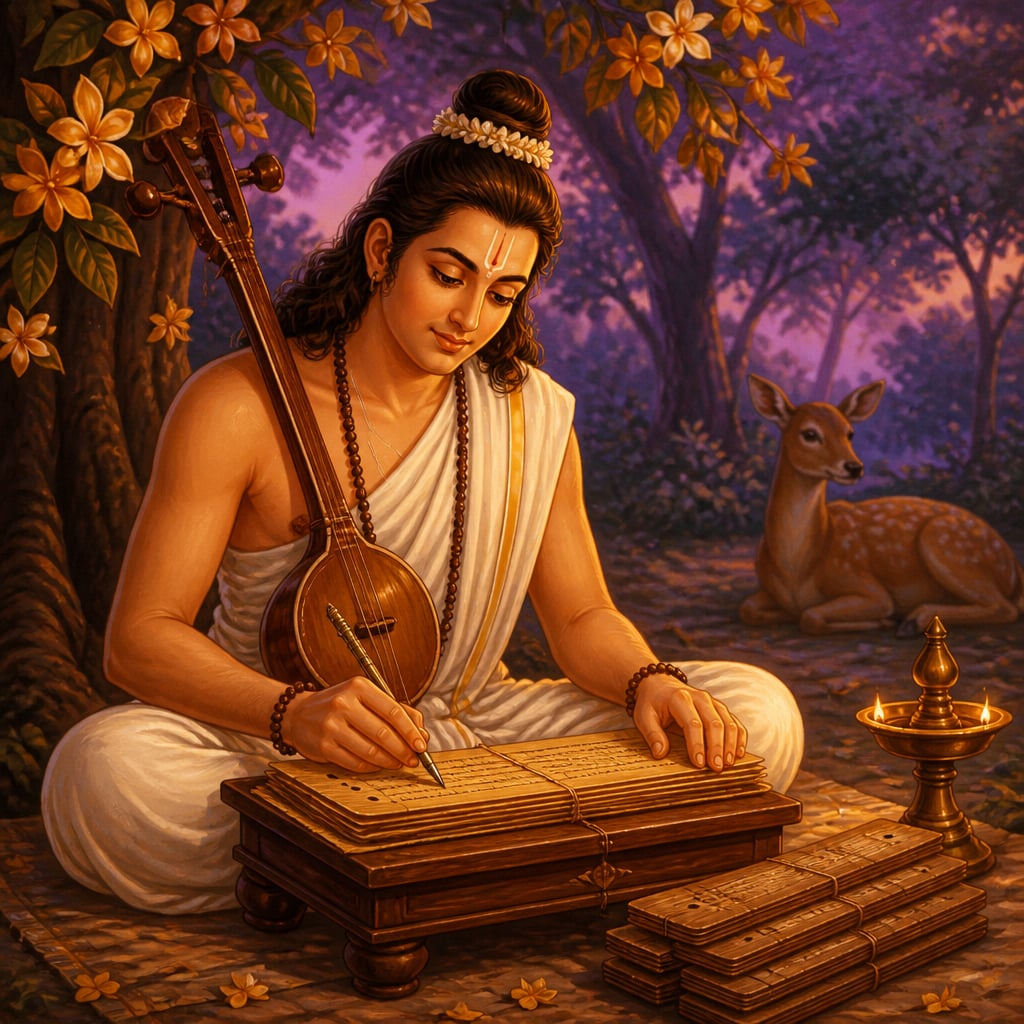
Sage Narada inscribing the Narada Smriti on a palm-leaf manuscript in a forest hermitage, ektara vina at his shoulder.

Manusmriti addresses inheritance:

"Impotent persons, outcasts, the blind, deaf, dumb, those deficient in any organ, and those deranged shall not receive a share.", Manusmriti 9.201

This verse is often misread as discrimination. In context, it establishes who inherits in normal succession, but Manu also provides that such persons must be maintained by the family:

A village elder mediating a dharmic inheritance assembly

"Their offspring, however, if unimpaired, are entitled to shares; and those who are impaired must be provided maintenance for life.", Manusmriti 9.202-203

The legal framework: tritiya prakriti individuals may not inherit property (which carried governance responsibilities), but they have a right to lifelong support from the family. They are not abandoned but integrated into family obligation.

Kautilya advising Chandragupta on Arthashastra provisions

Arthashastra (Kautilya, ~4th century BCE) addresses legal rights:

"Let the transgressor be fined for intercourse with a woman against her will... A kliba who has intercourse with a woman shall be fined double the standard amount.", Arthashastra 4.12

The very fact that Kautilya legislates fines for klibas committing crimes demonstrates their legal personhood. They are subjects of law, they can commit crimes, own property, enter contracts. They exist within the legal system, not outside it.

Recognition, Not Celebration

It's important to understand what the dharmashastras did and did not do:

They did:

They did not:

This is neither the persecution of Western traditional law nor the celebration of Western progressive ideology. It is pragmatic recognition within a structured system, acknowledging that some persons are of third nature and that law must account for them.

The Prakriti Foundation

The key dharmic concept underlying these laws is prakriti, inherent nature.

Western gender theory vacillates between:

The dharmic approach transcends both:

Western View Dharmic View
Gender is either body or construction Gender is prakriti, inherent nature that manifests through body
Categories are either fixed biological or arbitrary social Categories reflect natural variation within cosmic order
Third gender is either disorder or chosen identity Third nature is a prakriti, not chosen, not disordered, simply what some persons are
Law must either criminalize or infinitely accommodate Law recognizes and regulates according to natural categories

The shastras don't ask: "Is this person's gender identity valid?" They ask: "What is this person's prakriti, and what are the legal implications?"

Practical Legal Provisions

The dharmashastra texts addressed practical questions:

Marriage: Marriage was understood as a union for procreation and dharmic household. Since tritiya prakriti individuals could not fulfill procreative purpose, their marriage arrangements differed. Some texts permit certain forms of partnership; others restrict formal marriage but provide for maintenance.

Inheritance: Property in dharmic society carried governance responsibilities, land meant leadership of dependents, village duties, ritual obligations. Tritiya prakriti individuals were typically excluded from inheriting such responsibilities but guaranteed maintenance from family wealth.

Legal testimony: Some texts restrict kliba testimony in certain cases, reasoning that their social position might affect reliability. This is analogous to restrictions on testimony by interested parties, not unique discrimination but category-specific regulation.

Crimes and punishments: Klibas were subject to the same criminal law as others, with some adjustments for their circumstances. They could be victims and perpetrators, again demonstrating full legal personhood.

Stability vs. Chaos

The dharmashastra approach produced legal stability.

For two thousand years, the category of tritiya prakriti remained relatively stable. People knew what it meant. Courts could apply it. Families could navigate obligations. There was no constant redefinition, no political battles over categories, no proliferation of identity labels.

Contrast this with Western legal chaos:

Era Western Legal Treatment
Medieval-1800s Criminalized as "sodomy," death penalty in many jurisdictions
1900-1973 Classified as mental illness, subject to involuntary treatment
1973-2000s Decriminalized but unrecognized; no legal status
2000s-present Rapid proliferation of categories; 70+ genders recognized in some places; constant legal battles

The Western trajectory: persecution → pathology → confusion.

The dharmic trajectory: recognition → regulation → stability.

What Changed: Colonial Interruption

The stability of dharmic legal treatment was disrupted by British colonialism.

Section 377 of the Indian Penal Code (1861) criminalized "carnal intercourse against the order of nature", importing British Victorian sexual morality into Indian law. The Criminal Tribes Act (1871) classified hijras as a "criminal tribe" subject to surveillance and registration.

For over 150 years, British-imposed law replaced dharmic legal frameworks. The sophisticated dharmashastra recognition of tritiya prakriti was overwritten by Western criminalization.

India's Supreme Court struck down Section 377 in 2018, finally removing colonial-era criminalization. The Transgender Persons (Protection of Rights) Act of 2019 provides some legal recognition. But these modern laws draw on Western frameworks rather than reviving dharmashastra principles.

The irony is complete: India abandoned two thousand years of sophisticated legal recognition to adopt Western criminalization, and now adopts Western "progressive" frameworks rather than returning to its own tradition.

The Wisdom of Limited Categories

One of dharmashastra's greatest gifts was categorical clarity.

The texts recognized:

Three categories. Stable for millennia. Sufficient to address genuine human variation without fragmenting into chaos.

Western law now recognizes:

The list continues. Each year brings new categories. Legal systems struggle to keep up. Medical systems don't know what to do. Nobody knows what any of it means.

The dharmashastra approach was wiser: acknowledge natural diversity without infinite fragmentation. Some people are of third nature. Law should account for them. This doesn't require creating a new category every time someone feels unique.

Rights and Responsibilities Together

The dharmic legal framework understood something Western law has forgotten: rights come with responsibilities.

Inheritance in dharmic society wasn't merely "getting stuff." Property meant obligations, to dependents, to ancestors (through shraddha rituals), to community (through village roles). The restriction on tritiya prakriti inheritance wasn't pure discrimination but recognition that they couldn't fulfill these specific responsibilities.

In exchange, they received guaranteed maintenance, support without the burden of governance responsibilities. This was a different package of rights and responsibilities, not absence of rights.

Western law now grants rights without examining corresponding responsibilities. Anyone can claim any gender, and society must accommodate. But what does the claimant owe in return? What responsibilities attach to the rights claimed?

The dharmic framework asked: What is your prakriti, and what are both your rights and your duties given that nature?

Modern Application

What can we learn from dharmashastra for today?

1. Recognition should be based on prakriti, not self-declaration

The shastras recognized genuine tritiya prakriti, inherent nature observed over time. They did not allow anyone to claim any category at will. Patient observation distinguished genuine nature from preference or confusion.

2. Categories should be clear and limited

Three fundamental categories (with some subcategorization for specific legal purposes) served dharmic society for two thousand years. Infinite proliferation creates confusion without benefit.

3. Rights and responsibilities go together

Legal status carries duties, not just privileges. The dharmic framework balanced what one received against what one owed.

4. Family remains primary

The dharmashastra approach kept tritiya prakriti individuals within family obligation, maintained by family, not abandoned to state or activist organizations. Family as sangha, not family as obstacle.

5. Stability over trend-following

The dharmic categories proved stable for millennia. Western categories change by the decade. Legal systems should seek stable foundations, not chase the latest terminology.

The Gift of the Shastras

The dharmashastras gave gender-diverse individuals something Western law never could until recently: legal existence.

While Western law executed sodomites and lobotomized gender-variant individuals, the shastras were regulating inheritance rights and maintenance obligations for those of third nature. The approach was pragmatic, not sentimental, but pragmatic recognition beats persecutory invisibility.

As India and other dharmic societies navigate modern questions about gender, they have a resource Western societies lack: a two-thousand-year tradition of legal recognition that neither criminalizes gender diversity nor dissolves into categorical chaos.

The path forward may not be simply reviving ancient law, context has changed. But the principles remain instructive: recognition based on observed prakriti, limited stable categories, rights balanced with responsibilities, family as primary support, and the wisdom to resist trend-following in favor of tested tradition.

Case studies

The Inheritance Dispute: Dharmashastra in Action

In 12th century Karnataka, under Hoysala rule, a wealthy merchant died leaving substantial property. His eldest son claimed full inheritance. However, the merchant also had a child of tritiya prakriti, Kamala, who had lived as part of the family household and contributed to the business through accounting and customer relations work that their unique nature made them suited for. The eldest son argued Kamala should receive nothing, citing the general principle that klibas don't inherit. Kamala's supporters argued that complete exclusion violated dharmic principles of family maintenance. The dispute came before a panchayat (community council) that included a dharmashastra-learned Brahmin who could interpret the texts.

The pandit examined the relevant texts carefully. Manusmriti excluded klibas from inheritance (daya) but mandated maintenance (vritti). Narada Smriti classified different types of third-nature persons with different implications. The pandit distinguished: Kamala was a 'nisarga' (natural/by-birth) person of third nature, not one who chose this status. Moreover, Kamala had contributed to the family business. The ruling: The eldest son would receive the property with its governance responsibilities. However, a portion sufficient for Kamala's comfortable maintenance must be set aside, not as charity but as dharmic obligation. Furthermore, given Kamala's contribution to the business, the maintenance portion should be generous, reflecting what their labor had added to the estate. The pandit cited the dharmic principle: 'Those who cannot fulfill the responsibilities attached to inheritance should not receive it, but they must not be abandoned. Family remains family.'

Kamala received substantial vritti, enough to live comfortably, maintain household, and continue participating in community life. The eldest son received the property but with the obligation to ensure Kamala's portion was always provided. The case was recorded and became precedent for similar disputes in the region. It demonstrated dharmashastra's ability to address complex situations: neither automatic inclusion (which would burden Kamala with responsibilities they couldn't fulfill) nor complete exclusion (which would violate family dharma). Centuries later, when British colonial law replaced dharmashastra, such nuanced resolution became impossible. Colonial law knew only binaries: inherit or don't. The dharmic third way, different package of rights and responsibilities based on prakriti, was lost.

The dharmashastra system provided frameworks for resolving disputes about tritiya prakriti individuals' rights that balanced recognition with responsibility. Rather than the Western binary of 'full rights' or 'no rights,' dharmic law offered calibrated packages appropriate to different prakritis. Family obligation persisted across gender categories, integration through different means, not exclusion.

India's Transgender Persons (Protection of Rights) Act of 2019 attempted to create legal frameworks for recognition, yet many transgender individuals report that the law alone has not transformed their daily experience. Those embedded in traditional community structures, whether hijra gharanas or temple networks, consistently report greater stability than those relying solely on legal protections. The law provides a floor, but integration requires the kind of calibrated community roles that dharmic frameworks offer.

The Hoysala dynasty (1026-1343 CE) produced over 1,500 temple inscriptions documenting legal and social practices. Dharmashastra texts like the Mitakshara (11th century) codified inheritance rules recognizing tritiya prakriti individuals' right to maintenance (vritti), distinct from full property inheritance.

Legal Victory, Existential Defeat: When Rights Don't Bring Peace

Alex (composite, based on documented patterns in Western legal contexts) transitioned at 22 in the United States and spent the next decade in legal battles. First, for updated identity documents. Then, for workplace discrimination claims. Then, against insurance companies denying coverage. Then, for bathroom access. Then, against a former employer. Then, for the right to compete in sports. Alex won most of these battles. Documents were updated. Settlements were reached. Policies changed. Each victory was celebrated on social media, shared by activist organizations, cited as progress. But something was missing. At 35, Alex had a string of legal victories and also: no stable career (too much time in litigation), few close relationships (everyone was evaluated by their politics), no spiritual grounding (religion was rejected as oppressive), no sense of purpose beyond fighting the next battle.

The Western legal approach gave Alex rights but not purpose. Consider what dharmashastra would have provided: **Clear categories**: Alex would be recognized as tritiya prakriti, a known category with established implications. No need to fight for basic recognition; no need to constantly explain or prove identity. **Defined status**: Rights and responsibilities calibrated to prakriti. Not fighting for everything or nothing, but occupying a recognized position with known entitlements and obligations. **Family integration**: The dharmic framework keeps tritiya prakriti individuals within family obligation. Alex cut off family as 'unsupportive'; dharma would have maintained connection through maintenance obligations that flow both ways. **Spiritual grounding**: Western activism offered no divine connection. Dharmic tradition offers Bahuchara Mata's patronage, Ardhanarishvara's precedent, and spiritual practices available regardless of gender presentation. **Purpose beyond struggle**: Hijra tradition offers ceremonial roles, badhai, temple service, community functions. Western trans identity offers only the next legal battle. **What Western approach got wrong:** - Defined life through struggle rather than contribution - Offered rights without responsibilities or purpose - Replaced family with activist organizations - Provided no spiritual dimension - Created endless proliferation of categories requiring endless fights

At 40, Alex stepped back from activism, burned out and questioning. 'I won all these battles but I don't know who I am apart from fighting. I have rights but I don't have a life. I spent my thirties in courtrooms instead of building a career or relationships or anything that lasts.' Alex began exploring spiritual traditions, seeking what legal victories hadn't provided: meaning, purpose, connection to something larger than identity politics. This search led eventually to dharmic frameworks, the discovery that there were traditions that recognized gender diversity without requiring constant struggle. 'I wish I'd known,' Alex reflected, 'that recognition didn't have to mean fighting. That some traditions had already figured this out thousands of years ago. That I could have had a category and a role and a community without spending my whole life demanding them.' The dharmashastra system's gift was stability: recognition you didn't have to fight for, categories that didn't change every year, rights that came with responsibilities and therefore meaning.

Legal rights without spiritual grounding, family integration, or defined purpose produce hollow victories. Alex won battles but lost years that could have built a meaningful life. The dharmashastra approach, stable recognition, calibrated rights, family obligation, spiritual connection, provides what Western legal battles cannot: a framework for flourishing, not just for fighting.

The pattern of legal victory without personal fulfillment extends beyond gender issues. Studies of civil rights activists, disability rights advocates, and other movement leaders show elevated rates of burnout, depression, and relationship breakdown. Winning in court does not automatically produce the belonging, purpose, and peace that humans need. Movements that combine legal advocacy with community building and spiritual grounding consistently produce healthier participants.

Research on life satisfaction among gender-diverse individuals shows that those reporting 'strong spiritual/religious connection' and 'stable family relationships' score significantly higher than those reporting 'activism/advocacy involvement' as their primary community connection. Legal rights appear necessary but not sufficient for wellbeing.

Living traditions

Dharmashastra was largely replaced by British colonial law in the 19th century. Modern Indian law, including the 2019 Transgender Persons Act, draws on Western frameworks rather than dharmashastra principles. However, scholars increasingly argue that dharmic legal concepts could inform better approaches than Western models have produced. The recognition that gender diversity is prakriti (natural variation) rather than either disorder or infinite self-creation offers a middle path the West hasn't found.

Reflection

More in The Living Tradition

All lessons in The Living Tradition · Tritiya Prakriti: A Family's Dharmic Guide course