Arjuna as Brihannala

A Hero in Disguise

The greatest warrior of his age spent a year living as a woman, not in shame, but fulfilling dharma. When Arjuna transformed into Brihannala, the dance and music teacher at King Virata's court, the Mahabharata revealed something profound: identity is not diminished by crossing gender boundaries when done for righteous purpose. Unlike Western frameworks obsessed with 'authentic' gender expression, the dharmic tradition shows that a warrior can be a dancer, a man can move through feminine space, and both identities serve dharma when the situation requires. Purpose transcends presentation.

When the Warrior Became a Dancer

In the thirteenth year of their exile, the five Pandava brothers faced an impossible challenge. To complete the terms of their gambling loss, they had to spend one year in hiding, ajnatavasa, where if recognized, they would restart the entire thirteen-year exile.

Four brothers found disguises suited to their natures: Yudhishthira became a dice player, Bhima a cook, Nakula a horse trainer, Sahadeva a cowherd. But Arjuna, the greatest archer in the world, the hero of countless battles, the disciple of Drona, Indra's son, what disguise could hide his martial bearing?

He became Brihannala: a eunuch dance teacher in the women's quarters of King Virata's palace.

The Choice and Its Meaning

This was not random. Arjuna had the skills for this role, during his exile to heaven, he had learned dance and music from the celestial dancer Chitrasena. When the apsara Urvashi cursed him to become a kliba (one who is neither man nor woman), Indra commuted the curse to one year's duration. What seemed like punishment became preparation.

The Mahabharata presents this transformation without shame or tragedy. Arjuna:

This is purpose-driven gender crossing, not confusion about identity, not medical intervention to change the body, but adoption of a gender presentation to fulfill dharma.
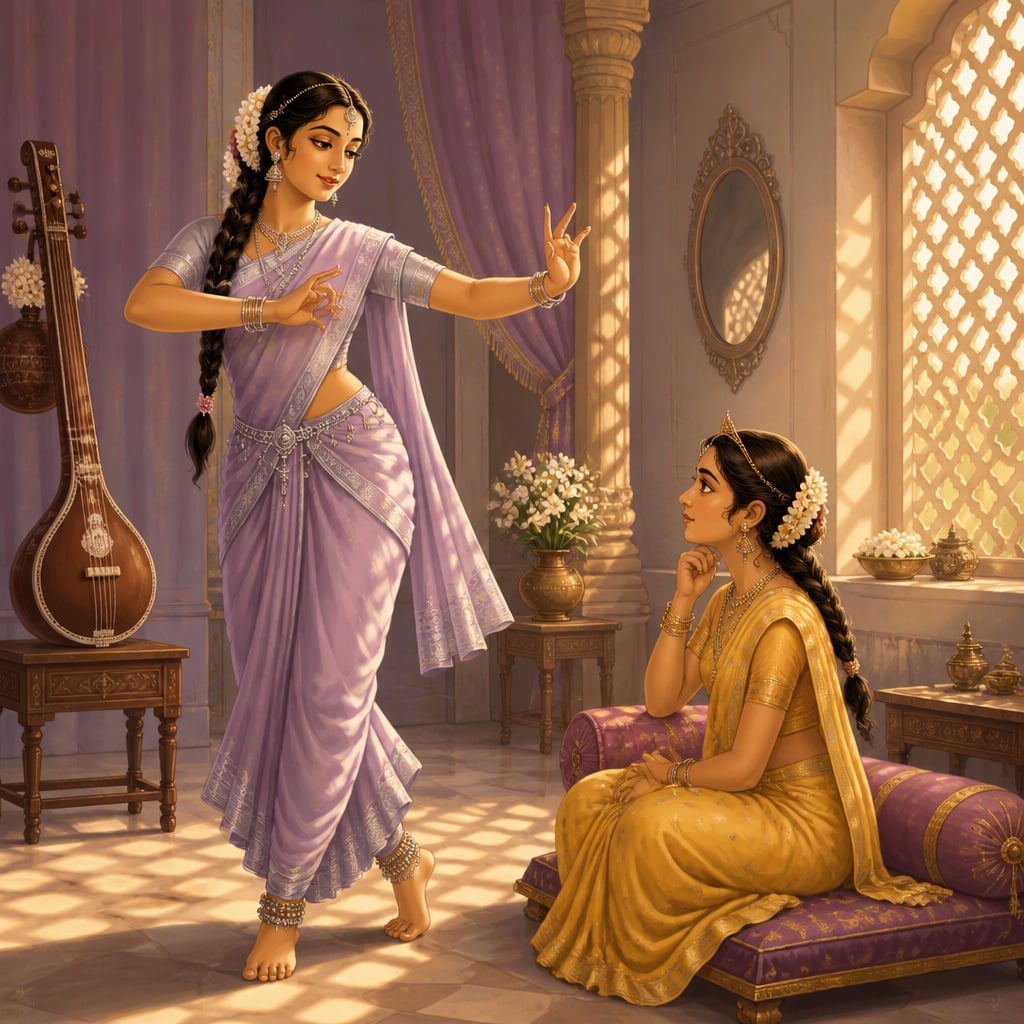
Arjuna as Brihannala, in a lavender silk sari, teaching a precise dance mudra to Princess Uttara in King Virata's palace.

What Brihannala Teaches

The Brihannala episode contains teachings that neither Western conservatives nor progressives can easily accept:

Gender crossing can be dharmic: Arjuna's transformation was not sinful or disordered. It served a righteous purpose, protecting his family, honoring the terms of exile, preparing for the eventual restoration of justice. The epic praises Brihannala's skill and grace.

Identity remains stable beneath presentation: Arjuna never forgot he was a kshatriya warrior. When the Kauravas attacked Virata's kingdom, Brihannala revealed himself as Arjuna and single-handedly defeated an entire army. The dancer was always the warrior, presentation changed, essential nature did not.

Role mastery matters: Brihannala was not a failed attempt at femininity. The dance teacher was excellent, Princess Uttara loved her, the court valued her instruction, the women trusted her completely. Whatever role one takes, excellence in that role is dharma.

Liminality has power: Brihannala could go where no man could, the women's quarters were completely closed to males. This access, born from gender ambiguity, became strategically valuable. The liminal position enabled what fixed positions could not.

The Urvashi Curse: Blessing in Disguise

The story of how Arjuna acquired the ability to become Brihannala is itself instructive.

Urvashi pronouncing the year-long curse in Indra's heaven

During his sojourn in Indra's heaven, the apsara Urvashi propositioned Arjuna. He refused, calling her "mother" because she had been his ancestor Pururavas's lover. Enraged, Urvashi cursed him to become a kliba.

Indra intervened, limiting the curse to one year, and telling Arjuna it would prove useful during ajnatavasa. What seemed like humiliation became essential preparation.

The teaching: What appears as affliction may be provision. The traits that make one different, that don't fit standard categories, may be exactly what dharma will require in some future situation. Arjuna's ability to credibly perform as Brihannala was a gift from what had seemed a curse.

Disguise vs. Essence

Here the dharmic approach differs fundamentally from Western gender theory.

Western Gender Theory Dharmic Understanding
Authentic gender must be expressed constantly Presentation can shift based on circumstance
Hiding 'true gender' is suppression/harm Strategic concealment can serve dharma
Identity = presentation Identity transcends presentation
Gender crossing requires body modification Gender crossing can be behavioral/presentational
The goal is alignment between felt identity and expression The goal is alignment between action and dharma

Arjuna did not "feel like a woman", he strategically adopted feminine presentation to serve a purpose. When that purpose was fulfilled, he resumed his warrior identity without psychological crisis. This fluidity, presentation serving purpose rather than demanding constant "authentic" expression, is foreign to Western thinking but central to dharmic pragmatism.

Excellence in Every Role

Brihannala was not a minimal disguise. The epic emphasizes that Arjuna excelled as a dance teacher:

"And that mighty warrior Arjuna, assuming the form of a woman, taught Uttara singing and the use of the vina (lute), and also the art of dancing... And the citizens, beholding him in that guise, took him for a eunuch.", Mahabharata, Virata Parva

This excellence was not incidental. The dharmic principle is clear: whatever role you take, master it fully. A warrior who becomes a dancer must dance well. A man who presents as gender-ambiguous must do so convincingly and gracefully.

This is the opposite of victim identity. Brihannala did not bemoan the need for disguise or demand acceptance of a "true" warrior identity while performing poorly as a teacher. Excellence in the current role IS dharma, regardless of what that role is.

The Revelation

When the Kauravas attacked Virata's kingdom, only Brihannala was available to drive Prince Uttara's chariot. What happened next is one of the Mahabharata's great moments:

Arjuna retrieving Gandiva from the sami tree

Brihannala guided Uttara to a sami tree where the Pandavas had hidden their weapons. The dance teacher retrieved the Gandiva bow, Arjuna's legendary weapon. In an instant, Brihannala vanished and Arjuna stood revealed: the world's greatest archer, undefeated in combat.

"I am Arjuna, called Savyasachin for fighting with both hands, called Dhananjaya for conquering enemies. I have lived as Brihannala to complete our vow. Now watch as I defeat those who would harm this kingdom."

Single-handedly, Arjuna defeated the entire Kaurava army, including Bhishma, Drona, and Karna. The dance teacher was always the warrior. The disguise was real, the excellence genuine, but the essential nature, kshatriya, protector, dharmic fighter, never wavered.

The Deeper Lesson

Brihannala teaches that purpose determines appropriate presentation.

Western gender theory insists on constant authentic expression, if you "feel" a certain gender, you must express it always, and suppression is harm. The Brihannala story offers a different wisdom:

For tritiya prakriti individuals, this is liberating. You need not constantly assert or explain your identity. What matters is: What role are you filling? Are you filling it excellently? What purpose does your current presentation serve?

Arjuna neither apologized for being Brihannala nor later claimed that Brihannala was his "true self." The dance teacher served a purpose; the warrior served other purposes. Both were Arjuna. Both were dharmic.

Modern Application

The Brihannala teaching applies far beyond gender:

For those whose nature crosses categories: Your difference may be preparation for contributions others cannot make. Like Brihannala's access to the women's quarters, your liminal position may enable unique service.

For those facing unexpected life changes: A career shift, a disability, a change in circumstances need not destroy identity. Arjuna remained Arjuna whether wielding bow or vina. Your essence persists through changing roles.

For families navigating a member's gender diversity: Patient observation over time, not unlike watching whether Brihannala excelled as a teacher, reveals whether the current presentation serves genuine purpose or is mere confusion.

For everyone: Excel in your current role, whatever it is. Don't spend energy asserting what you "really" are while performing poorly at what you're currently doing. Dharma is found in excellence here and now.

The Warrior and the Dancer

Arjuna as Brihannala demolishes the Western binary of "authentic self" versus "suppressed self." The warrior was authentic. The dancer was authentic. Both served dharma. Neither negated the other.

This is the dharmic gift: identity rooted not in constant self-expression but in service to purpose. You are not diminished by adapting your presentation to circumstances. You are not lying by showing different aspects in different contexts. You are navigating dharma, and that navigation, skillfully done, is itself the path.

As we continue exploring tritiya prakriti in dharmic tradition, let Brihannala remind us that the greatest warrior could be the most graceful dancer, and that both identities, fully embodied, served the same unshakeable soul.

Case studies

The Software Engineer Who Found Purpose Through Difference

Arun (composite, based on documented patterns in Indian professional contexts) grew up in Chennai with mannerisms and sensibilities that didn't fit male stereotypes. His voice was softer, his interests in art and design more developed than his interest in sports. His parents observed his svabhava over years without panic or rush to label. When Arun showed aptitude for technology, they supported his education in computer science despite relatives' comments that he should pursue something 'more normal.' In his twenties, working at a tech company in Bangalore, Arun faced a choice: spend energy asserting or defending his gender expression, or channel that energy into becoming excellent at his work. He chose excellence. His unique sensibility, the ability to bridge technical and aesthetic concerns, to communicate across different team cultures, to notice what others missed, became his professional superpower.

Arun's story echoes Brihannala's teaching: **purpose determines appropriate focus.** Like Arjuna, Arun did not spend energy constantly asserting a 'true identity.' He focused on excellence in his current role. His gender-atypical traits, sensitivity to design, ability to communicate across boundaries, attention to human factors in technical systems, became assets rather than obstacles. The dharmic approach his parents modeled was crucial: patient observation over years, support for genuine talents, no rush to medicalize or politicize his nature. They treated his difference as potential provision, not problem to solve. Arun found that his liminal position, not fitting neatly into 'bro culture' but also not identified as female, gave him access others lacked. Like Brihannala in the women's quarters, he could bridge spaces that more categorically fixed people could not.

By 35, Arun led a product design team, valued precisely for abilities that emerged from his atypical nature. He never publicly labeled his sexuality or gender, not from shame, but because identity-assertion wasn't his focus. His focus was contribution. When younger colleagues asked how to navigate being 'different' in corporate environments, Arun's advice echoed Brihannala: 'Be so good at what you do that your difference becomes an asset. Don't spend energy demanding acceptance, spend it developing excellence. The acceptance follows the excellence.' His parents' patient observation had distinguished genuine svabhava from passing phase. His own focus on purpose over identity-politics had channeled his unique traits into professional contribution. The warrior became a dancer, and the dancer was excellent.

Like Brihannala, Arun found that excellence in his role mattered more than asserting identity. His difference, patiently observed by family, channeled into contribution, became his professional advantage. The dharmic path: observe svabhava over time, develop genuine talents, focus on contribution, and let acceptance follow excellence.

In India's technology sector, contribution-based cultures at companies like Zoho, Freshworks, and numerous startups show that when evaluation centers on output and teamwork, diverse individuals thrive without needing special programs. The global shift toward skills-based hiring, where portfolios and demonstrated ability replace credentials and identity markers, aligns with the dharmic principle that excellence in role creates belonging more effectively than identity assertion.

A 2016 NASSCOM study found that India's tech workforce of over 3.9 million professionals included increasing numbers of gender-diverse individuals in leadership roles. Companies emphasizing contribution-based evaluation reported 21% higher team performance than those using identity-based diversity metrics.

The Identity Activist Who Lost the Years

Jordan (composite, based on documented patterns in Western contexts) came out as genderqueer at 19 while attending a liberal arts college in the United States. Immediately, Jordan's life became organized around identity. They joined the campus LGBTQ organization, then became an officer, then spent junior and senior years primarily on activism: protests, awareness campaigns, educational workshops, social media advocacy. Jordan had real talents, writing ability, visual design sense, capacity for organizing complex projects. But these talents were channeled entirely into identity work. Every paper became about gender. Every project centered queerness. Every social relationship was filtered through identity categories. When Jordan graduated, the resume showed extensive activist credentials but limited professional skills. Internship experience had been at LGBTQ nonprofits. Portfolio pieces were all identity-focused. Job interviews became conversations about pronouns and inclusion policies rather than about what Jordan could contribute.

Jordan's story illustrates what Brihannala's teaching warns against: **identity assertion replacing role mastery.** Arjuna did not spend his year as Brihannala demanding that the court recognize his warrior identity. He focused on being an excellent dance teacher. The identity was stable beneath the presentation; he didn't need constant affirmation of it. Jordan, by contrast, organized life around constant identity assertion. Real talents, writing, design, project management, were subordinated to activism. The question was never 'Am I excellent at what I do?' but always 'Is my identity sufficiently recognized?' The dharmic tradition would ask: What role are you filling? Are you filling it excellently? Jordan's answer had to be: 'My role is activist, and I'm effective at raising awareness.' But this limited what contribution could look like and foreclosed development of other capacities. **What Western approach got wrong:** - Treating identity-assertion as the primary life task - Channeling all energy into demanding recognition rather than developing excellence - Making difference the whole personality rather than one aspect of a fuller self - Organizing social life around shared grievance rather than shared contribution

At 28, Jordan struggled professionally. The activism skills didn't translate easily to other contexts. Employers wanted to know what Jordan could produce, not what Jordan's pronouns were. The years spent on identity work had not developed the excellence that creates genuine professional value. More painfully, Jordan had lost years that could have developed real skills. The visual design talent, undeveloped, had atrophied. The writing ability, used only for activist content, had narrowed rather than grown. The capacity for organizing projects existed but had never been tested in contexts where identity wasn't the organizing principle. Jordan's reflection at 30: 'I wish someone had told me that being different doesn't have to be your whole identity. I wish I'd spent those years becoming excellent at something beyond activism. Now I'm catching up on skills I should have developed a decade ago.' Meanwhile, peers who had focused on professional development, including some who were equally gender-diverse but less identity-focused, had careers, accomplishments, and contribution to show for their twenties.

Jordan's story shows what happens when identity-assertion replaces the dharmic focus on role excellence. Brihannala didn't need the court to affirm warrior identity, Brihannala focused on being an excellent teacher, and the warrior identity remained stable beneath. Jordan spent years demanding recognition rather than developing excellence, and found that recognition without contribution creates an unstable foundation. The dharmic path: let identity be stable beneath presentation, focus on excellence in your current role, and let contribution speak louder than demands for acceptance.

Social media amplifies the identity-first approach, with platforms rewarding those who build personal brands around marginalized categories. Yet research consistently shows that individuals who define themselves primarily through professional competence and relationships report higher life satisfaction than those whose primary identity is a demographic category. The growing 'post-identity' movement among younger gender-diverse individuals reflects a return toward contribution-based selfhood.

Research on life satisfaction among gender-diverse individuals shows that those who report focusing on 'contribution and purpose' score higher on wellbeing measures than those who report focusing primarily on 'identity affirmation and social recognition.' The dharmic emphasis on purpose over identity-assertion appears to correlate with better outcomes.

Living traditions

The Brihannala story continues to resonate in contemporary Indian performing arts. Dance productions frequently depict the episode, exploring the theme of identity beneath disguise. The story provides a traditional framework for understanding gender fluidity that predates Western categories by millennia, showing that dharmic tradition has long recognized the possibility of crossing gender boundaries for righteous purpose.

Reflection

More in The Living Tradition

All lessons in The Living Tradition · Tritiya Prakriti: A Family's Dharmic Guide course