Adoption and Family Formation

Alternative paths to parenthood

The dharmic tradition offers multiple models of family beyond biological reproduction, guru-chela bonds, adoption within community frameworks, and purposeful childlessness as seva. These time-tested paths provide belonging, legacy, and meaningful life without requiring the Western obsession with replicating the nuclear family at any cost.

Beyond the Nuclear Family

A Different Question

The modern Western approach asks: "How can same-sex couples have children?" and then pursues any technological or legal means to achieve that goal, surrogacy, IVF, third-party reproduction, legal challenges to adoption restrictions.

The dharmic approach asks a different question: "What forms of family and legacy are appropriate for those whose svabhava doesn't lead to biological reproduction?"

This isn't a compromise question. It's a wiser question. The dharmic tradition has always recognized that not everyone is meant for grihastha (householder) life, and has created meaningful alternatives that don't require manufacturing biological outcomes.

The Grihastha Path Is Not Universal

In the dharmic framework, grihastha (the householder stage focused on family and children) is one of four ashramas, and it's not mandatory for everyone.

And throughout history, many people, for various reasons, lived meaningful lives without biological children. This wasn't seen as tragedy or deprivation requiring technological intervention. It was simply a different path.

Tritiya prakriti individuals have always had their own paths, meaningful, dignified, and integrated into society. Let's explore them.


The Guru-Chela Tradition: Family Beyond Biology

The hijra community has maintained a sophisticated family structure for centuries, one that doesn't depend on biological reproduction but provides everything family is meant to provide: belonging, inheritance, guidance, legacy, and love.
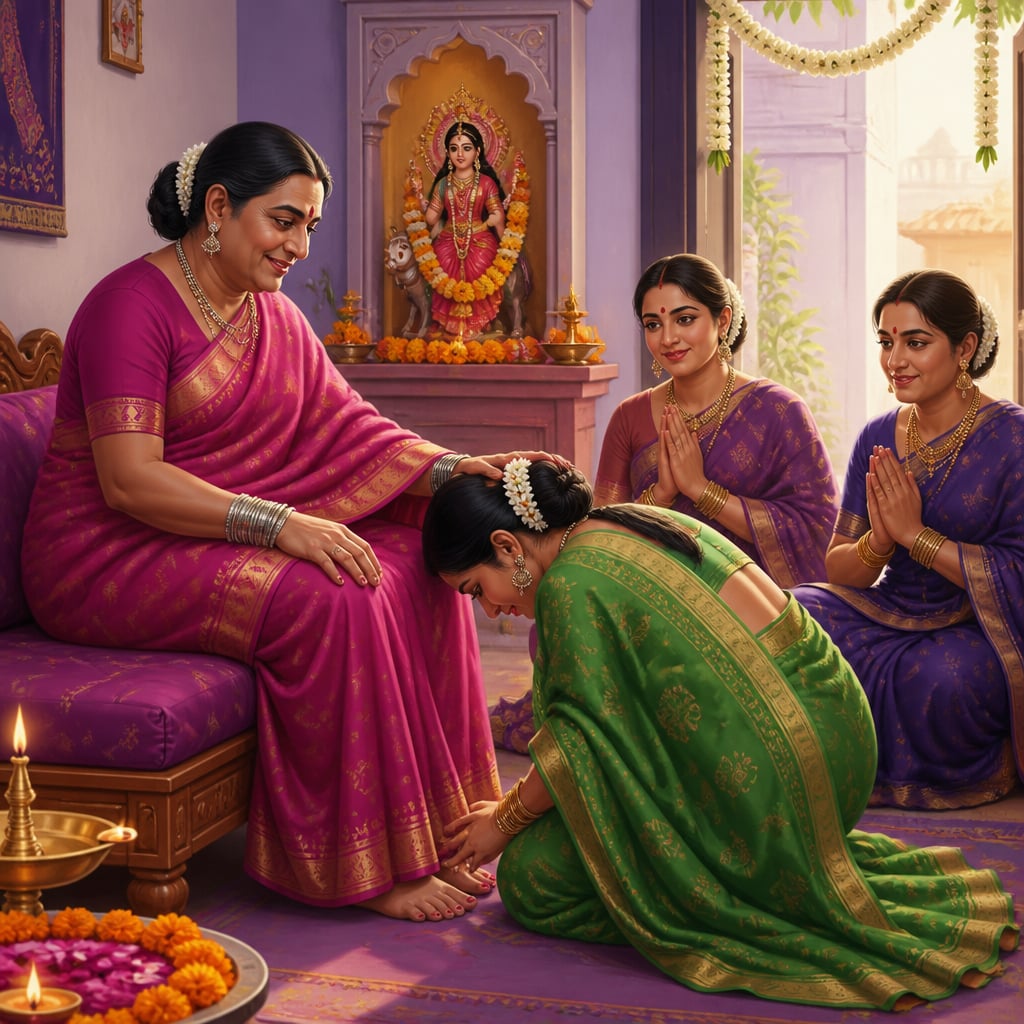
An elder hijra guru in a magenta saree welcomes a younger chela who bows to touch her feet inside a serene gharana household.

How It Works

The Gharana (Household)

Hijra communities are organized into gharanas, extended household lineages led by a guru (teacher/elder). When someone joins a gharana, they become part of a family structure:

Inheritance and Legacy

Unlike biological families where inheritance is automatic, the guru-chela system involves earned inheritance. A chela who serves well, maintains the traditions, and cares for the guru inherits their position and property. This creates:

Spiritual Lineage

The gharana maintains spiritual practices, ritual knowledge, and community traditions. These are transmitted from guru to chela just as they are in any sampradaya (spiritual lineage). The chela receives not just material inheritance but spiritual legacy.

What This Achieves

The guru-chela system provides everything the Western model claims to seek through surrogacy and assisted reproduction:

What People Want Western Approach Guru-Chela Approach
Legacy Biological children at any cost Spiritual and material inheritance to chosen successors
Belonging Nuclear family constructed artificially Extended gharana with clear relationships
Care in old age Hope children will provide Chela duty to care for guru
Purpose Parenting as identity Teaching, transmitting tradition, seva
Love Parent-child bond manufactured Guru-chela bond developed through relationship

The guru-chela model doesn't try to replicate biological family. It offers something different and equally valid, a family structure suited to those whose svabhava isn't oriented toward biological reproduction.


Temple and Ashram Traditions: Children Within Community

Throughout dharmic history, temples and ashrams have provided another model: children raised within community frameworks by those who aren't their biological parents.

Historical Practice

Temples and ashrams have always served as places where:

In these contexts, the raising of children wasn't limited to biological parents. Community members, including those who might be tritiya prakriti, contributed to raising the next generation.

The Karna Principle

Yashoda churning curd as baby Krishna reaches for butter

The Mahabharata itself normalizes non-biological parenting. Karna was raised by Radha and Adhiratha, not his biological mother Kunti. The Pandavas were raised by multiple parent-figures. Krishna was raised by Yashoda, not Devaki.

Dharmic tradition has never insisted that the only valid parent is the biological one. Raising a child well matters more than whose genes the child carries.

Temple Service and Children

A tritiya prakriti elder teaching temple children with a palm-leaf manuscript

In some temple traditions, tritiya prakriti individuals served as caretakers, teachers, and mentors to children dedicated to temple service. They weren't raising "their own" children, they were serving the community by helping raise the community's children.

This is a fundamentally different orientation than the Western "I must have my own child" approach. It asks: "How can I contribute to the next generation?" rather than "How can I possess a child?"


Modern Dharmic Adoption: Working Within Systems

For tritiya prakriti individuals today who feel called to raise children, adoption offers a dharmic path, one that doesn't require manufacturing children through technology but rather provides homes to children who already exist and need families.

The Dharmic Case for Adoption

Adoption is inherently dharmic because it:

Practical Considerations

For those considering adoption:

Legal Reality in India

Indian adoption law has evolved. Single individuals can adopt through CARA (Central Adoption Resource Authority). The focus is on the welfare of the child and the capability of the prospective parent.

Family Support

The most successful adoptions happen with extended family support. If your family has come to understand and accept your svabhava (as discussed in Lesson 4.2), they can provide the extended family network that helps children thrive.

Honesty with Children

Adopted children should know they're adopted, and should understand the family structure they're entering. This is honesty, not burden. Many adopted children thrive knowing they were specifically chosen and wanted.

Community Integration

Raising children well requires community. Whether through biological family, chosen family, spiritual community, or neighborhood connections, ensure the child has access to diverse role models and relationships.


Purposeful Childlessness: Seva as Legacy

Not everyone needs to raise children. For some tritiya prakriti individuals, the appropriate path may be channeling energy into service rather than parenting.

This isn't "missing out", it's a legitimate dharmic path.

Historical Models

Sannyasis throughout history have renounced family to serve larger purposes. Their legacy isn't biological children but the institutions they built, the teachings they transmitted, the lives they touched.

Many tritiya prakriti individuals throughout history have followed similar paths:

Legacy Beyond Children

Legacy can take many forms:

A life without children isn't a life without legacy. Many of history's most impactful figures, saints, artists, teachers, had no biological children but left enormous legacies.


What the Western Approach Gets Wrong

The Entitlement to Children

The Western approach increasingly treats having children as a right rather than a gift. If biology doesn't provide children, technology must. If technology isn't enough, surrogacy must. If domestic surrogacy is restricted, international surrogacy must. At every stage, the adult's desire for a child trumps other considerations.

This creates:

The Ideology Over Reality Problem

The Western approach increasingly insists that any family configuration is identical to any other, that children don't need mothers, don't need fathers, and that claiming otherwise is bigotry.

But children are not ideological props. They have their own needs and experiences. And many adults raised in ideologically-driven family configurations have complex feelings that the activist framework doesn't allow them to express.

The Dharmic Alternative

The dharmic approach:


Making Your Decision

Questions to Consider

If you're a tritiya prakriti individual considering family formation, ask yourself:

1. Why do I want children?

Is it genuine calling to nurture and raise the next generation? Or is it pressure to prove "normalcy" by replicating the nuclear family? The dharmic path honors genuine calling but doesn't require conformity.

2. What models are available to me?

3. What support do I have?

Raising children well requires community. Do you have extended family support? Spiritual community? Reliable networks? Children need more than two adults, they need a village.

4. What is my honest capacity?

Parenting is demanding. It requires stability, resources, patience, and presence. Honestly assess whether you have what children need, not to prove anything, but because children deserve that assessment.

5. Am I prioritizing the child's needs?

The dharmic question isn't "Do I deserve to have a child?" but "Can I provide what a child deserves?" If the answer is yes, pursue family formation. If not, other forms of legacy and purpose remain available.


The Empowered Position

You are not obligated to reproduce to live a meaningful life.

The Western model creates pressure: If you don't have children, you've failed. If you can't have children biologically, technology must fix this. If you're not pursuing every possible avenue to parenthood, you're giving up.

The dharmic model offers freedom: Multiple paths to meaning exist. Family takes many forms. Legacy transcends biology. Service is its own fulfillment.

Whether you choose the guru-chela tradition, formal adoption, community involvement with children, or purposeful childlessness focused on seva, you are making a legitimate dharmic choice.

The question isn't "How do I get a child?" but "How do I live my svabhava fully and contribute to the world?"

That question has many valid answers.

Case studies

Laxmi Narayan Tripathi's Gharana

The guru-chela tradition offers a complete family model for tritiya prakriti individuals, one that doesn't require biological reproduction, surrogacy, or manufactured children. It provides belonging, legacy, inheritance, and love through relationships suited to those whose svabhava doesn't orient toward conventional family. This is not compromise. This is dharmic alternative.

The Kinnar Akhara's recognition at Kumbh Mela represents a model that Western institutions are only beginning to explore. Spiritual communities that provide belonging, mentorship, and lineage without requiring biological reproduction offer gender-diverse individuals something that neither activism nor medicine can: a place in an intergenerational chain of meaning. Similar models are emerging in Buddhist, Jain, and Sikh communities across South Asia.

Laxmi Narayan Tripathi established the Kinnar Akhara in 2015, making it the first transgender religious institution recognized at the Kumbh Mela. The Akhara participated in the 2019 Prayagraj Kumbh Mela alongside 13 traditional akharas, with an estimated 1,000 members in its guru-chela network.

The Temple Guardian's Legacy

Temple and ashram traditions provided frameworks for tritiya prakriti individuals to contribute to raising the next generation without requiring biological reproduction or formal adoption. Serving the community's children, teaching, nurturing, providing for those in need, is a form of parenting that doesn't require possession. Muthu's legacy wasn't biological descendants but generations of students and orphans whose lives were shaped by devoted service.

The global mentorship gap, with studies showing that millions of young people lack meaningful adult guidance, suggests that the temple guardian model has wider application. Programs like Big Brothers Big Sisters and various ashram-based youth initiatives demonstrate that adults who invest in non-biological mentoring relationships create lasting impact. For individuals whose svabhava doesn't orient toward conventional parenthood, this path of nurturing legacy through service remains deeply relevant.

Tamil Nadu's major temples historically maintained networks of guardians and caretakers. The Meenakshi Amman Temple in Madurai employed over 600 temple servants across various roles, with inscriptions from the Nayak period (16th-17th century) documenting non-grihastha individuals serving as mentors to young ritual performers.

The Gender-Creative Parenting Experiment

When parenting becomes a vehicle for ideology rather than service to the child, children suffer. The "gender-creative" parenting movement claimed to liberate children but often burdened them with their parents' political beliefs. Children raised as experiments report confusion, not freedom. The dharmic approach asks what the child needs; the ideological approach asks what the child can prove. These produce very different outcomes.

The backlash against gender-neutral parenting experiments has grown as early cohorts reach adolescence and adulthood. Researchers tracking children raised without gender designations report that most adopted conventional gender identities by puberty, while experiencing confusion and social difficulty during childhood. The pattern confirms what dharmic tradition teaches: observe the child's emerging nature rather than imposing an ideology on them, whether that ideology enforces rigid gender roles or denies gender altogether.

In 2017, British Columbia issued Canada's first 'U' (unassigned) gender marker on a birth certificate for Searyl Atli Doty. A 2023 study in the Archives of Sexual Behavior found that 80% of children raised in gender-neutral environments reported confusion about social expectations, and the majority adopted conventional gender identities by adolescence.

Living traditions

Contemporary hijra communities continue the guru-chela tradition, adapting it to modern contexts. Legal recognition of transgender identity in India has allowed for more formal documentation of these family structures. Activists like Laxmi Narayan Tripathi work to preserve traditional practices while advocating for contemporary recognition.

Reflection

More in Hard Questions Part 2

All lessons in Hard Questions Part 2 · Tritiya Prakriti: A Family's Dharmic Guide course