My Child Seems Gender-Different

How to observe vs. impose

Your child doesn't play like other children of their gender. They prefer different clothes, different friends, different ways of being. Perhaps they've said something that surprised you. The Western approach says: affirm immediately, or you're a bigot. The dharmic approach says: observe patiently, for years if needed, because genuine svabhava reveals itself over time while social influence fades. This lesson teaches parents how to distinguish their child's inherent nature from external influence, when to accept and when to wait, and how to be the family that provides both love AND wisdom, protecting genuine tritiya prakriti children while also protecting children who are confused by ideology.

Two Families, Two Approaches

In the City: The Sharma Family

Ankita and Rajesh Sharma noticed early that their son Aryan was different. At age 4, he preferred dolls to trucks. At 6, he wanted to play with the girls at school. At 8, he asked why he couldn't wear his sister's salwar kameez.
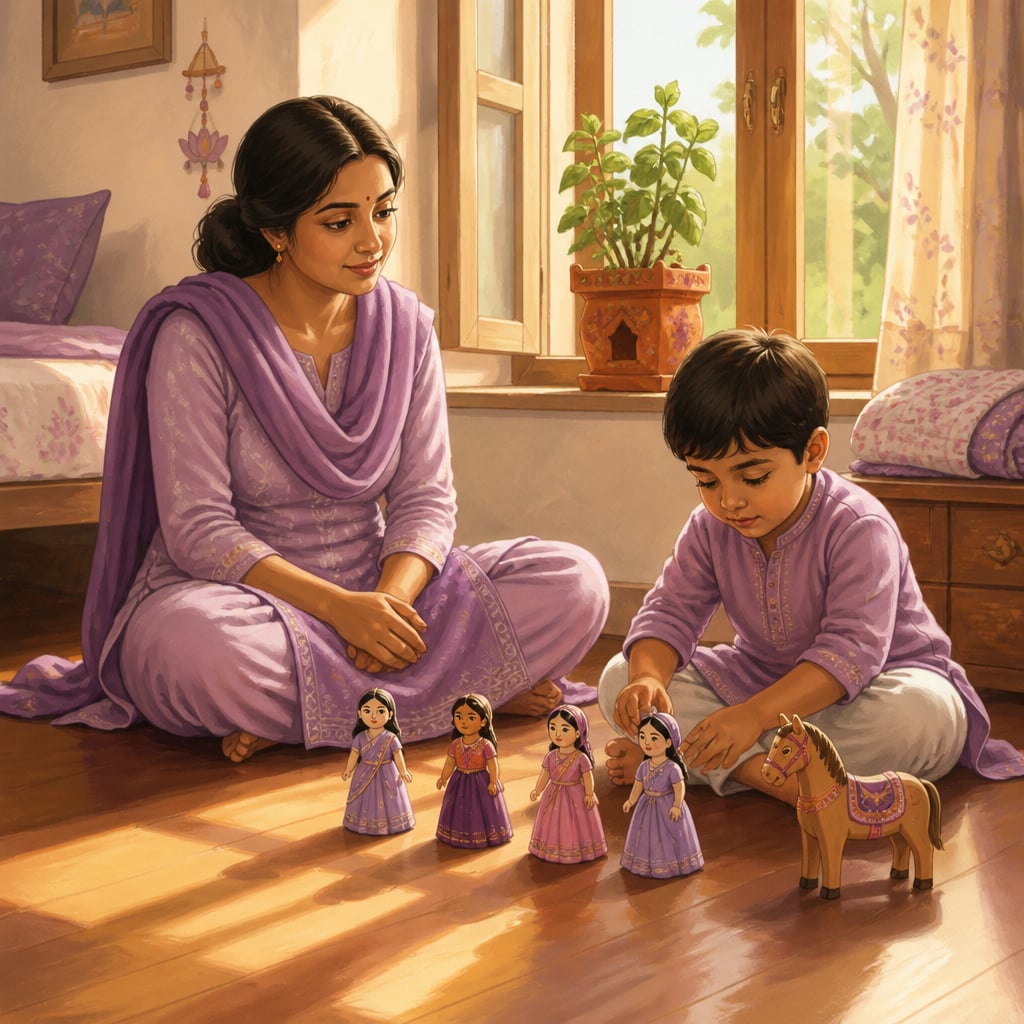
An Indian mother sits quietly watching her young son absorbed in play with dolls and a wooden horse.

Rajesh's first instinct was to correct it. "He's just confused. We need to be firm."

But Ankita remembered something her grandmother had said years ago: "Some children are born with a different nature. You cannot change what Brahma created."

They consulted their family pandit, not a young one trained in modern ways, but an old one who knew the shastras. He listened carefully.

"This may be svabhava, inherent nature," he said. "Or it may be a phase. You cannot know yet. Here is what dharma teaches: observe. Do not reject, but also do not rush. Create space for him to be himself at home, but do not label him. Watch for years, not months. If this is his true nature, it will remain consistent. If it is a phase, it will fade."

The Sharmas followed this guidance. They didn't shame Aryan, but they also didn't announce him as transgender. They let him wear what he wanted at home. They observed his friendships, his preferences, his ways of being.

By age 12, the pattern was clear and consistent. Aryan had always been this way. Multiple family members had noticed independently. It wasn't sudden; it wasn't influenced by media or peers. This was svabhava.

Aanya at fourteen welcomed by kinnar elders on the family verandah

At 14, Aryan, now going by Aanya among family, was introduced to a local community of kinnars (the respectful term for hijras in North India). The family consulted with a kinnar guru about Aanya's future. No medical intervention. No Western labels. A dharmic path: patient observation, family acceptance, community integration.

Today, Aanya works at a beauty parlor, participates in family functions, and blesses weddings with her kinnar sisters. Not fighting for acceptance. Accepted.

In the Village: The Reddy Family

In Warangal, the Reddy family faced a different situation. Their daughter Priya had always been a tomboy, climbing trees, playing cricket with boys, refusing to wear bangles.

At 13, after getting a smartphone and spending hours on Instagram, Priya announced: "I'm actually a boy. My name is now Pranav."

The family was shocked. But unlike Aryan/Aanya, this was sudden. Priya had never shown signs of being gender-different as a young child. She had been a tomboy, yes, but many girls are tomboys. The announcement came after months of intense social media use.

Reddy grandmother sitting patiently with teenage Priya on the swing

Priya's grandmother, the family elder, observed carefully. "This is different," she said. "Arun's daughter in Chennai, who is kinnar, that one, you could see from age 3. This one? Priya was always a girl. A strong girl. A girl who climbs trees. But a girl."

They consulted their family doctor, who asked about Priya's recent life: changes at school, new friends, online activity. It emerged that Priya had been bullied for not being "feminine enough." She had found online communities that told her: if you don't fit as a girl, you're probably a boy.

The family didn't reject Priya. They didn't affirm "Pranav" either. They addressed the bullying. They limited screen time. They found her a counselor, not a gender clinic, but someone who could explore what was really going on.

Within 18 months, Priya no longer identified as a boy. She identified as what she had always been: a strong girl who didn't fit stereotypes. "I thought not liking makeup meant I wasn't a girl," she said later. "The internet told me I was trans. I wasn't. I was just me."

The grandmother's patient observation had protected Priya from a path that would have led to irreversible changes.


The Dharmic Framework: Observe, Don't Impose

What the West Gets Wrong

The Western approach to gender-different children has undergone dramatic shifts in just a few years:

Phase 1 (Pre-2010): Pathologize Gender nonconformity was treated as disorder. Children were forced to conform. This was wrong.

Phase 2 (2010-2022): Affirm Everything The pendulum swung to the opposite extreme. "Affirmation" became mandatory. Parents who asked questions were labeled transphobic. Gender clinics multiplied. Children were put on puberty blockers at 10, hormones at 14, surgery at 16.

Phase 3 (2022-Present): Partial Reversal The Cass Review in the UK found the evidence base was lacking. Tavistock closed. European countries restricted youth interventions. Thousands of detransitioners spoke out. The West began questioning what it had promoted.

The dharmic approach avoided both extremes. It never pathologized gender diversity, tritiya prakriti was recognized for 4,000 years. But it also never rushed to medicalize children. The principle was always: svabhava reveals itself over time.

The Dharmic Principle: Patient Observation

Dharma teaches that every being has a svabhava, an inherent nature. For most children, this aligns with their biological sex. For a small minority, it doesn't. The challenge for parents is discernment: distinguishing genuine svabhava from temporary phases, social influence, or underlying issues.

Signs that may indicate genuine tritiya prakriti svabhava:

Signs that suggest social influence or other factors:

The dharmic response differs accordingly:

Genuine Svabhava Social Influence/Confusion
Accept and integrate Investigate underlying causes
Help find dharmic role Address mental health issues
Connect with traditional community Limit social media exposure
No rush to medicalize Definitely no medicalization
Family as support Family as anchor

What Parents Should Know

The Crucial Role of Early Childhood

Research and traditional wisdom both point to the same conclusion: genuine gender dysphoria typically manifests in early childhood (ages 3-5), before social media, before peer influence, before ideology.

A child who insistently, consistently, and persistently identifies as the other gender from age 4 is showing something real. This child often:

This is the child whose svabhava may genuinely be tritiya prakriti. This is the child who deserves acceptance and support in finding their dharmic path.

The Adolescent Pattern: Different and Concerning

A very different pattern has emerged in the past decade, predominantly among teenage girls with no childhood history of gender issues:

This pattern, documented by Dr. Lisa Littman as "Rapid Onset Gender Dysphoria", doesn't match the traditional presentation. These adolescents may genuinely believe they are trans, but something else is often going on:

For these children, the dharmic response is different: investigate, don't immediately affirm. What is actually going on? What needs are being met by this identity? What underlying issues need attention?


The Parent's Path: Neither Rejection nor Uncritical Affirmation

If Your Child Shows Early Childhood Signs

DO:

DON'T:

If Your Adolescent Suddenly Announces a New Identity

DO:

DON'T:

The Waiting Game: Why Time Matters

Studies consistently show that most children who experience gender dysphoria before puberty will resolve it by adulthood if not socially or medically transitioned. The numbers vary by study, but range from 60-90% desisting.

This doesn't mean ignoring a child's distress. It means:

A child who truly has tritiya prakriti svabhava will still have it at 18, at 25, at 40. There is no rush. But a child medicalized at 12 based on a phase cannot undo the changes.


Dharmic Guidelines for Parents

โœ… DO โŒ DON'T
Love your child unconditionally Confuse unconditional love with uncritical affirmation
Create space for authentic expression at home Let your child's identity become a public cause
Observe patterns over years React to single statements or phases
Distinguish early childhood patterns from adolescent sudden onset Treat all presentations the same
Consult traditional wisdom (elders, shastras, gurus) Rely only on Western gender clinics
Address underlying issues (mental health, bullying, social media) Assume gender identity explains everything
Protect from permanent interventions until adulthood Allow medicalization of minors
Be the anchor your child can depend on Become another voice pushing them in any direction

Why This Matters to YOU (The Karma Angle)

If you reject a child whose svabhava is genuinely tritiya prakriti:

If you uncritically affirm an adolescent whose "identity" is actually confusion:

The dharmic middle path:

This path requires more discernment than either simple rejection or simple affirmation. But it serves your child best.


Messages for Different Ages

For Children (8-12 years)

If you feel different from other boys or girls, that's okay. Some people are born with a nature that doesn't fit the usual patterns. Our ancient stories have people like this, and they were accepted.

But here's what's important: you don't have to decide anything right now. You're still growing. What you feel now might change, or it might stay the same. Both are okay.

Talk to your parents. They love you and want to understand. Don't let the internet tell you who you are, you're still discovering that yourself.

For Teenagers (13-17 years)

Identity questions are intense at your age. Everyone is trying to figure out who they are. Here's what you should know:

If you've felt different since early childhood: This might be your genuine nature. Talk to your family. Our tradition has recognized people like you for 4,000 years. You're not broken; you're not alone.

If these feelings are recent: Be careful. The internet is full of people who will tell you you're trans because you don't fit stereotypes. But not fitting stereotypes doesn't mean you're a different gender. Tomboys are girls. Sensitive boys are boys. "Not like other girls" is still a girl.

The difference matters because some paths have permanent consequences. Hormones change your voice forever. Surgery removes healthy tissue. These decisions can wait until you're fully adult. If your feelings are genuine, they'll still be there at 25.

Don't let anyone rush you, not the internet, not clinics, not even well-meaning teachers. And don't let anyone reject you either. Your family should be your anchor.

For Adults (Parents)

If your young child shows consistent, persistent gender nonconformity: This may be svabhava. Create a loving, accepting home. Let them express themselves. Observe over years. Don't medicalize a child; don't reject them either. Time will reveal what is genuine.

If your adolescent suddenly announces a new identity: Respond with love, but investigate. When did this start? What have they been watching online? Are their friends saying similar things? What else is going on in their life?

The Western approach says "affirm or you're a bigot." But affirmation of confusion is not kindness, it may lead to irreversible harm. The dharmic approach says: love, observe, protect, and wait. Genuine svabhava doesn't disappear with patience; confusion often does.

You are the adult. You are responsible for protecting your child from permanent harm while their brain is still developing. This is not transphobia; this is parenting.


The Real Question

The question for parents is not "Should I accept or reject my child's stated identity?"

The dharmic questions are better:

When you ask dharmic questions, you get dharmic answers. Answers that have guided families for millennia. Answers that protect both the genuinely different child AND the confused one.

Your child needs you to be their anchor, not another force pushing them in some direction, but a stable presence who loves them completely while also exercising the wisdom that protects them.

That is the dharmic parent's path.

Western 'gender-affirming' clinics have recommended social and medical transition for children as young as 4-6. The Cass Review found this approach lacked evidence and may have harmed children. The dharmic approach, patient observation with loving support, protects children while allowing genuine svabhava to reveal itself.

The Western approach told parents 'affirm or lose your child', implying that questioning meant rejection. This false dichotomy led thousands of parents to agree to interventions they had doubts about. The dharmic approach recognizes that loving questioning is not rejection. You can love completely while also exercising the wisdom that protects.

Western culture has politicized gender-different children, with different factions trying to claim them for their cause. The dharmic approach keeps the focus on the child and family. This is not about cultural battles; it's about one family navigating their child's nature with wisdom and love.

Case studies

The Menon Family: Patient Observation Over Years

In Kochi, the Menon family noticed by age 4 that their son Arun was different. He preferred playing with his sister's dolls. He asked to wear her frocks. He gravitated toward girls at school. The family was traditional; their first instinct was worry. But Arun's grandmother remembered an old saying: 'Some children are born between Shiva and Shakti.' Rather than panic or punish, the family consulted their temple priest and a respected elder aunt who was known for wisdom. Both gave similar advice: 'This may be his nature. Do not force him to be what he is not. But also do not rush to conclusions. Observe for years. Create space at home, but do not label him to the world. Let his path reveal itself.' For eight years, the family observed. At home, Arun wore what he wanted. They didn't shame him. But they also didn't announce him as transgender or seek Western medical intervention. They watched, loved, and waited.

The Menons embodied the dharmic principle of pariksha, patient examination. They distinguished between what might be a phase and what was emerging as consistent nature. By age 12, the pattern was undeniable: Arun had been this way since toddlerhood, consistently, without external influence. Multiple family members had noticed independently. This wasn't a sudden adolescent announcement; it was a gradually clarifying picture of svabhava. The grandmother's folk wisdom connected to shastric recognition. The temple priest's guidance aligned with dharmic principles. The family's patience allowed genuine nature to reveal itself without the distorting influence of Western labels and medical pathways.

At 14, with family support, Arun, now called Aruna within the family, began connecting with Kerala's traditional thirunangai community. The family consulted with a community elder about Aruna's path forward. No puberty blockers. No hormones. A gradual social transition with family involvement at every step. Today, Aruna works as a makeup artist, participates in temple festivals in traditional roles, and remains close to her family. The Menons are known in their community as a family that handled a difficult situation with wisdom. 'We didn't reject her,' the father says. 'But we also didn't rush. We watched until we understood. Then we accepted what was real.'

The dharmic approach, patient observation, family consultation, traditional guidance, no rush to medicalize, protected Aruna. Had the family rejected her, she might have lost her connection to family and tradition. Had they immediately affirmed and medicalized at age 10 (as Western clinics might have recommended), she would have undergone interventions that weren't necessary and couldn't have been reversed. The middle path served her best.

The Menon approach mirrors what developmental psychologists now call 'watchful waiting,' which multiple European countries have adopted as official policy since 2022. Research from the Netherlands, where this approach was pioneered, shows that 73-88% of children with early gender dysphoria reconcile with their birth sex by adulthood when not given medical interventions. Patient observation turns out to be evidence-based medicine, not just ancient wisdom.

The Menon family's approach took 10 years of observation before any social transition and involved no medical intervention. Aruna remains connected to family, tradition, and community, outcomes that detransitioner research suggests are protective for mental health.

Keira Bell: The Rushed Affirmation That Led to Regret

Keira Bell was a troubled teenager in the UK. She struggled with depression, social difficulties, and discomfort with her developing body. At 14, after discovering trans content online, she announced she was actually male. Her mother was uncertain, but the NHS referred Keira to the Gender Identity Development Service (GIDS) at the Tavistock clinic. At Tavistock, Keira had just three appointments before being prescribed puberty blockers. No one thoroughly explored her depression, her social difficulties, her possible autism, or why she had suddenly, with no childhood history of gender dysphoria, decided she was male. The clinic's approach was 'affirmation': if a patient says they're trans, they're trans. Questioning was considered harmful. At 16, Keira received testosterone. Her voice deepened permanently. Her facial hair grew. At 17, she had a double mastectomy. She was assured she was on the right path.

The Western approach failed Keira in ways the dharmic approach would not have: 1. **No pariksha (patient observation)**: Three appointments over a few months, versus years of family observation 2. **No viveka (discernment)**: No exploration of why a girl with no childhood gender issues suddenly identified as male at 14 3. **No family involvement**: Parents were sidelined, not partnered with 4. **Medical-first approach**: Puberty blockers and hormones presented as the path, not patient waiting 5. **Ideology over observation**: 'Affirm or you're transphobic' replaced careful assessment The dharmic approach would have asked: Why at 14? What was happening in her life? What does her early childhood show? Let's observe and explore before irreversible steps.

At 23, Keira detransitioned. She was now a woman again, but with a permanently deepened voice, facial hair requiring regular removal, and no breasts. She would likely never breastfeed any children she might have. She sued the NHS. In her landmark case (Bell v Tavistock, 2020), the court initially found that children under 16 could not meaningfully consent to puberty blockers. Though the ruling was later overturned on appeal, Keira's case contributed to the Cass Review, which found the evidence base for youth transition was lacking. Tavistock was ordered to close. Keira now speaks publicly: 'I was a depressed teenager who needed therapy, not hormones. The system affirmed me into permanent changes I now regret.'

The Western 'affirmation' model treated a confused teenager's declaration as medical truth. No one observed over years. No one involved family as partners. No one asked dharmic questions: Is this svabhava, or something else? The result: irreversible changes, lasting regret, and one of thousands of voices now questioning what the West promoted. The dharmic approach, patience, family, observation, no rush to medicalize, would have protected Keira. She might have worked through her depression and emerged as a healthy young woman. Instead, she carries permanent changes from decisions made at 14-17.

Since Keira Bell's case, over a dozen countries have revised their pediatric gender care protocols. The pattern she experienced, rapid affirmation without exploring co-occurring conditions, is now recognized as a systemic clinical failure. Professional organizations including the Royal College of Psychiatrists and the American Academy of Pediatrics are updating guidelines to include longer assessment periods and more thorough evaluation of mental health comorbidities.

The Cass Review found that 98% of children started on puberty blockers at Tavistock progressed to cross-sex hormones, not the 'pause to think' that had been promised. The UK now bans puberty blockers for minors outside clinical trials. Keira Bell is one of an estimated 10,000+ detransitioners in the UK alone.

Historical context

Traditional family guidance vs. modern gender clinic model

Living traditions

As the West questions its 'affirmation-first' model, some Indian families are rediscovering dharmic approaches. The principles, patient observation, family consultation, traditional wisdom, gradual integration without medicalization, are being recognized as protective factors that the Western model lacked. Some Western families are now seeking out these 'watchful waiting' approaches, finding them closer to common sense than ideology-driven medicine.

Reflection

More in Hard Questions Part 1

All lessons in Hard Questions Part 1 ยท Tritiya Prakriti: A Family's Dharmic Guide course