How to Talk to Children
Age-appropriate truth without Western ideology
How do you explain gender diversity to children? The West offers gender unicorns, identity worksheets, and the message 'you might be born in the wrong body.' Dharmic tradition offers something better: stories of Ardhanarishvara showing divine unity, nature metaphors that honor diversity, and the wisdom that children need protection, not ideology. This lesson equips parents and educators with age-appropriate ways to discuss tritiya prakriti that inform without confusing, acknowledge diversity without promoting it, and preserve childhood innocence while preparing children for the world they'll encounter.
The Question Every Parent Faces
In the City
Seven-year-old Arya came home from school with a question that stopped her mother mid-stride.
"Amma, our teacher said some people are born in the wrong body. Is that true? Can I be born wrong?"
Priya felt her stomach tighten. What had they been teaching? Arya was only in second grade.
"What else did the teacher say?" Priya asked, sitting down.
"She showed us a picture called the 'gender unicorn.' It had different colors for how you feel inside and who you like. She said we should think about which colors we are."
Priya took a deep breath. This wasn't the conversation she'd expected to have with her seven-year-old. But she couldn't leave Arya with the anxiety that 'born wrong' language had created.
"Come sit with me, kanna. Let me tell you what our tradition teaches."
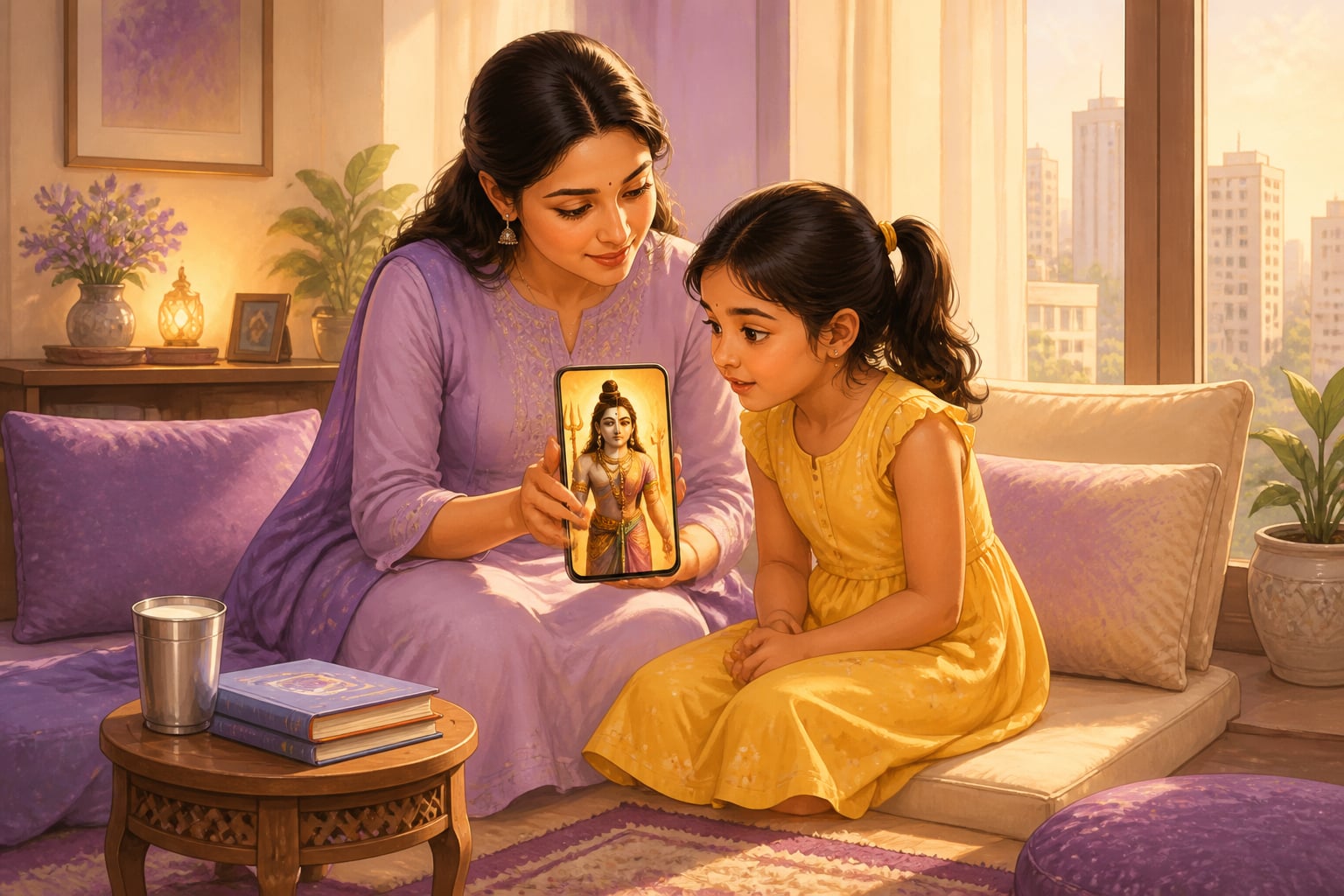
She pulled out her phone and found an image of Ardhanarishvara, Shiva as half-man, half-woman.
"See this? This is how our rishis showed that God contains both male and female. Not wrong, complete. The divine has everything."
Arya studied the image. "So being different isn't being wrong?"
"Exactly. In nature, there's so much variety. Peacocks are colorful, peahens are plain. Both are perfect peacocks. Some flowers bloom at day, some at night. Both are complete flowers. Some people are more like typical men, some like typical women, and some are different in their own ways. All are Brahma's creation."
"But the teacher said, "
"Your teacher learned from books written by people who didn't know our stories. We've known about different kinds of people for thousands of years. Our stories include them. Shikhandi was a great warrior in the Mahabharata, neither typical man nor woman. Krishna accepted Shikhandi completely."
Arya nodded slowly. "So I'm not wrong?"
"You are exactly who you're supposed to be. Your nature will unfold as you grow. No one is born 'wrong', that's a sad way to think about Brahma's creation. Some people are rare, like four-leaf clovers. Rare isn't wrong. It's just rare."
That conversation wasn't the end, children keep asking questions. But Priya had established something crucial: a dharmic frame that honored diversity without the anxiety-producing language of 'wrong bodies' and identity confusion.
In the Village
In a village near Thanjavur, eight-year-old Kannan had a different encounter. A hijra group visited during his cousin's wedding, singing and offering blessings.
"Patti, who are they?" Kannan whispered to his grandmother. "Why do they look like women but talk like men?"
His grandmother, 72-year-old Lakshmi Paati, didn't flinch.
"They are kinnar, kanna. Bahuchara Mata's special children. They've been part of our world forever."
"But why are they different?"

"Come, I'll show you something." She led him to the corner of the wedding hall where the family puja was set up. She pointed to a small Ardhanarishvara murti.

"See Shiva here? Half Shiva, half Parvati. God himself shows us that male and female can exist in one. When the gods made humans, they made most as men or women. But some they made different, like Ardhanarishvara. The kinnar carry blessings because they're special to the goddess."
"Are they happy?"
"Some are, some struggle. Like everyone. Their nature is different, so their path is different. Our job isn't to judge Brahma's creation but to treat everyone with respect."
"Can I become like them?"
"Your nature is your nature, kanna. It doesn't change because you want it to or because someone tells you it should. Watch the banyan tree outside, does it wish to be a coconut palm? It's a banyan. You're Kannan. As you grow, your nature will show itself. Just be honest about what you truly feel, not what you see others doing."
Kannan returned to the wedding, his curiosity satisfied without anxiety. He hadn't been told that he might be 'born wrong' or that he should 'explore his gender identity.' He'd been given a frame: divine precedent, natural diversity, his own nature unfolding over time.
The Dharmic Approach to Talking with Children
Core Principles
How do you discuss gender diversity with children without either hiding reality or exposing them to ideology? The dharmic approach rests on four principles:
1. Divine Precedent, Not Abnormality
Western gender ideology often begins with the message: "Some people feel wrong in their bodies." This creates anxiety, children who naturally have fluctuating feelings suddenly wonder if something is wrong with them.
The dharmic approach begins with divine completeness: Ardhanarishvara shows that God contains both masculine and feminine. Human diversity reflects cosmic reality. No one is "wrong", some are rare, like four-leaf clovers.
2. Nature Metaphors That Inform Without Promoting
Children understand nature. Use it:
- "Peacocks are colorful, peahens are brown. Both are perfect birds."
- "Most lotus flowers are pink. Some are white or blue. All are lotuses."
- "Most people are like Amma and Appa. Some are different in their nature. Brahma made variety."
These metaphors acknowledge diversity without suggesting children should "explore" whether they might be different.
3. Age-Appropriate Depth
A 5-year-old and a 15-year-old need different conversations:
| Age | Appropriate Teaching |
|---|---|
| 5-7 | "Some people are different. Like how flowers come in different colors. We're kind to everyone." |
| 8-10 | "Our stories include people like Shikhandi who was different. Ardhanarishvara shows God has both male and female. Different isn't wrong." |
| 11-13 | "As you grow, you'll learn more about how people are different. Some feel more like men, some like women, some are in between. This has always existed in our culture." |
| 14-17 | Full discussion of svabhava, the difference between nature and ideology, how to discern genuine difference from social influence |
4. Protecting Without Hiding
Children don't need to know everything immediately. A 7-year-old doesn't need details about adult relationships or medical transitions. But they do need:
- Assurance that being different isn't being wrong
- Stories that show diversity has always existed
- A frame for understanding the kinnar/hijra they might encounter
- Protection from the "wrong body" narrative that creates anxiety
What the West Got Wrong: The Classroom Experiment
The "Gender Unicorn" Approach
In recent years, Western schools have adopted teaching materials designed by activist organizations:
The Gender Unicorn: A cartoon unicorn with sliding scales for "gender identity," "gender expression," "sex assigned at birth," and "attraction." Children as young as 5 are asked to mark where they fall on each spectrum.
The Genderbread Person: Similar concept, a cookie-shaped figure with separate indicators for identity, attraction, expression, and biological sex.
"Born in the Wrong Body": The message that some children's internal sense doesn't match their physical body, and this might be them.
These approaches have been criticized even by secular experts:
Dr. Hilary Cass (UK Cass Review, 2024): "The current clinical approach is not reliable or safe... There has been a lack of appropriate screening for mental health problems."
Finland's COHERE Guidelines (2020): Recommended psychological support as primary treatment, noting concerns about "social contagion" influencing youth identification.
Sweden's Karolinska Institute (2021): Stopped puberty blockers for under-18s, citing lack of evidence and rising detransition rates.
The Harm Done
Confusion Created
When you tell a 7-year-old that they might be "born in the wrong body," you plant seeds of doubt where none existed. Children naturally have fluid expressions, boys who like art, girls who climb trees. The Western approach takes normal childhood variety and reframes it as potential gender incongruence.
A 2022 study published in the Archives of Sexual Behavior found that most childhood gender non-conformity resolves naturally by adulthood. The "affirm immediately" approach may interfere with this natural development.
Anxiety Induced
"Am I in the wrong body?" is a frightening question for a child. The dharmic frame, "Brahma made variety, you're exactly as you should be", provides security. The Western frame, "you might not match your body", creates existential anxiety.
Parental Exclusion
Many Western school programs explicitly teach children that they don't need to tell parents about their "gender exploration." This drives a wedge between child and family. The dharmic approach makes family the first support, not an obstacle to overcome.
Natural Development Disrupted
Children exposed to gender ideology before puberty show higher rates of later gender dysphoria than would have developed naturally. The Dutch researchers who pioneered puberty blockers never intended them for children identified through school programs, only for severe, persistent, childhood-onset dysphoria observed clinically over years.
The Dharmic Alternative: How to Actually Talk to Children
For Young Children (Ages 5-8)
What they need: Simple acknowledgment that people are different, reassurance that they are fine as they are.
Sample conversation:
Child: "Why does that auntie look different?"
Parent: "Some people are made differently. Like how we have roses in many colors, red, white, yellow, they're all roses. Some people aren't typical men or women. They're special in their own way. Our job is to be kind to everyone."
Child: "Am I normal?"
Parent: "You're exactly who Brahma made you to be. Perfect."
Key elements:
- Nature metaphors (flowers, birds, stars)
- Reassurance about their own nature
- Emphasis on kindness to all
- No introduction of "wrong body" concept
- No suggestion that they should "explore" their gender
For Middle Children (Ages 8-12)
What they need: More context, introduction to divine examples, preparation for what they'll encounter.
Sample conversation:
Child: "Kids at school were talking about transgender. What is that?"
Parent: "Our rishis knew about this thousands of years ago. They called it 'tritiya prakriti', third nature. Most people feel like men or women, but some feel different. Even God shows this, see this picture of Ardhanarishvara? Shiva as half male, half female."
Child: "Is it okay to be like that?"
Parent: "It's not wrong, it's rare. Like four-leaf clovers. Our stories include such people. Shikhandi was a great warrior in the Mahabharata who was different. Krishna himself accepted Shikhandi. But being genuinely like that is rare. Most children who wonder about this grow up to feel comfortable as regular men and women. Your nature unfolds as you grow, just be honest about what you truly feel, not what you see online or what friends say."
Key elements:
- Introduction to "tritiya prakriti" concept
- Divine examples (Ardhanarishvara, Shikhandi)
- Acknowledgment that it's rare
- Reassurance that most questioning resolves naturally
- Caution about social influence vs. genuine nature
For Teenagers (Ages 13-17)
What they need: Fuller understanding, tools to distinguish genuine nature from social influence, critical thinking about ideology.
Sample conversation:
Teen: "My friend just came out as non-binary. And there's a lot on social media about this. I've been thinking about my own identity."
Parent: "I'm glad you're talking to me. Let me share something important. Dharmic tradition has recognized people of 'third nature', tritiya prakriti, for 4,000 years. This is real. Some people genuinely are different from typical men or women."
"But here's what our tradition also teaches: svabhava, inherent nature, reveals itself over time. It's consistent from early childhood. It doesn't depend on social media or friend groups."
"What you're describing, thinking about this after social media and a friend's announcement, might be genuine exploration, or it might be social influence. Both are possible. The dharmic approach is patience. If this is your true nature, it will still be true in a year, in five years. There's no rush to decide."
"The Western approach says 'affirm immediately.' But even Western countries are pulling back, the UK closed its largest gender clinic for kids. Sweden, Finland, Norway have all restricted treatment for minors. They moved too fast. We don't want to make the same mistake."
"I love you regardless of who you are. But I also want to protect you from making decisions based on what's trending rather than what's truly you. Let's keep talking. Let's give it time. What do you feel you've known about yourself since you were young, before social media?"
Key elements:
- Affirmation that tritiya prakriti is real
- Clear teaching about svabhava revealing over time
- Acknowledgment of social influence possibility
- Information about Western reversal
- Unconditional love combined with wisdom
- Focus on long-term patterns, not recent feelings
When They've Already Been Exposed to Western Ideology
Undoing Anxiety Without Dismissing
If your child has already been taught the "wrong body" narrative or filled out gender identity worksheets at school, they may be confused or anxious. Here's how to help:
Step 1: Validate Their Feelings Without Validating the Frame
"I hear that you've been thinking about this. That makes sense, it's confusing when school teaches one thing and home teaches another. Your feelings matter. But let me share another way to understand them."
Step 2: Replace Anxiety with Divine Precedent
"The worksheet asked if you might be 'born in the wrong body.' That's actually a strange way to think about it. In our tradition, your body is sacred, it's Brahma's creation. Nobody is born 'wrong.' Some people's nature is different from typical men or women. But different isn't wrong, it's rare."
Step 3: Provide an Alternative Frame
"Our tradition has understood this for thousands of years. We have stories and images that include people who are different. The Ardhanarishvara, Shiva as both male and female, shows that diversity is part of the divine. You don't have to figure out your 'gender identity' on a worksheet. Your nature unfolds over time. We watch, we observe, we accept what emerges."
Step 4: Restore Security
"You don't need to decide anything right now. If you turn out to be different from typical men or women, our tradition has a place for you. If you turn out to be a regular boy/girl (as most children do), that's perfect too. Either way, you're my child, you're loved, and you're not 'wrong' no matter what anyone says."
If School Is Pushing Ideology
Some parents face schools actively teaching gender ideology to young children. Options:
Pre-emptive conversation: Before school addresses this, give your child the dharmic frame. "You might hear things at school about gender that are different from what we believe. Here's what our tradition teaches..."
Opt-out requests: Many schools allow parents to opt children out of specific health or sexuality lessons. Research your rights.
Counter-teaching at home: You can't control school, but you can establish home as the source of deeper wisdom. "School teaches many things. Some things are facts, some are opinions from a particular viewpoint. Let's talk about what they said and what our tradition says."
Community support: Connect with other dharmic families navigating the same challenges. Share resources and strategies.
The Wisdom of Waiting
What Research Actually Shows
Studies on childhood gender non-conformity find:
Most Desist Naturally: The majority of children who express cross-gender identification before puberty grow up to be comfortable in their birth sex. A 2021 study in Archives of Sexual Behavior followed children with gender dysphoria diagnoses and found that 65-85% no longer had dysphoria by adulthood.
Social Influence Is Real: Dr. Lisa Littman's research on "Rapid Onset Gender Dysphoria" documented clusters of teens, often friend groups or social media connections, coming out as trans simultaneously. This pattern doesn't match classical gender dysphoria presentation.
Waiting Causes No Harm: The Dutch protocol that pioneered puberty blockers required extensive psychological evaluation, consistent dysphoria from early childhood, and years of observation before any intervention. Modern "affirmative" approaches have shortened or eliminated this waiting period, and outcomes have worsened.
The Dharmic Parallel
Dharmic tradition arrives at the same wisdom through different reasoning:
Svabhava reveals over time: Inherent nature isn't declared suddenly, it manifests consistently over years. A child who has always been different (recognized by family from early years) has genuine svabhava. A teenager who suddenly announces a new identity after social media immersion needs time for genuine nature to be distinguished from influence.
Family as first observer: Parents and grandparents, who have watched the child since birth, are better positioned to recognize true nature than teachers or peers who met the child recently. The dharmic approach centers family wisdom, not institutional authority.
No rush, no force: The Bhagavad Gita teaches that one's own dharma, imperfectly performed, is better than another's dharma, perfectly performed. This applies to gender nature: forcing a child to be what they're not causes suffering. But so does prematurely labeling a child based on temporary confusion.
Dharmic Guidelines
| ✅ DO | ❌ DON'T |
|---|---|
| Use nature metaphors that acknowledge diversity without promoting it | Tell children they might be "born in the wrong body" |
| Teach divine precedent: Ardhanarishvara, Shikhandi, Mohini | Present gender as something to "explore" or "discover" through worksheets |
| Reassure children that they are exactly as Brahma made them | Suggest that being different is a problem to solve |
| Match depth of conversation to the child's age and questions | Give detailed information about transition to young children |
| Present tritiya prakriti as rare, like four-leaf clovers | Imply that being trans/non-binary is common and children should consider if it applies to them |
| Emphasize that nature unfolds over time, no rush to decide | Encourage children to pick labels or identities quickly |
| Keep family as the center of guidance and support | Present parents as obstacles to a child's "true self" |
| Acknowledge social influence as a real phenomenon | Assume every declaration of gender-difference reflects genuine svabhava |
Why This Matters to YOU (The Karma Angle)
If you introduce anxiety where none existed:
- A child who was happily playing now wonders if they're "wrong"
- You've planted doubt that may take years to resolve
- You've prioritized ideology over your child's peace of mind
If you hide all information:
- Your child encounters hijras, trans people, or gender ideology without any frame
- They may adopt Western narratives by default
- They miss the dharmic wisdom that could have grounded them
The dharmic middle path:
- Provide age-appropriate truth that acknowledges diversity
- Ground that truth in divine precedent and nature metaphors
- Reassure children about their own nature while teaching kindness toward difference
- Prepare them for what they'll encounter without creating anxiety
- Preserve childhood innocence while building eventual understanding
This path protects your child from both ignorance and ideology.
Messages for Different Ages
For Children (8-12 years)
You might hear people talking about "being born in the wrong body" or "exploring your gender." That's one way some people think about it. But our tradition has an older, wiser way.
We've known for thousands of years that most people are typical men or women, but some people are different, we call it "third nature" or tritiya prakriti. Look at Ardhanarishvara, Shiva as half-man, half-woman. The gods themselves show us that nature includes variety.
Being different isn't being wrong. It's being rare, like a blue lotus or a white peacock. But being genuinely different is actually rare. Most children who wonder about this grow up to feel comfortable as regular men or women. Your nature will unfold as you grow. You don't have to decide anything now.
If you hear confusing things at school or online, come talk to your family. We can help you understand.
For Teenagers (13-17 years)
You're at an age where identity questions become intense. Social media is full of gender content. Friends may be coming out as various identities. It's natural to wonder about yourself.
Here's what our tradition teaches:
Tritiya prakriti is real. Some people genuinely are neither typical men nor women. This has been recognized for 4,000 years in our culture, through Ardhanarishvara, Shikhandi, hijra communities, and more.
But svabhava reveals over time. Genuine nature is consistent from early childhood. It's recognized by family who've watched you grow. It doesn't depend on social media, friend groups, or trends.
The West moved too fast. The UK's Tavistock clinic closed. Sweden, Finland, and Norway restricted youth treatment. Detransitioners are speaking out. The "affirm immediately" approach caused harm.
The dharmic approach is patience. If you genuinely are different, this will still be true in five years. There's no rush. If recent feelings emerged suddenly after social media or a friend's announcement, that might be social influence rather than svabhava. Both possibilities deserve time and honest observation.
Talk to your family. We're not here to judge, we're here to help you understand your genuine nature, whatever it turns out to be.
For Adults (Parents and Educators)
Your role is protection and preparation, protecting children from harmful ideology while preparing them for the diverse world they'll encounter.
The dharmic approach offers: Divine precedent (Ardhanarishvara, Shikhandi) that makes diversity part of cosmic order, not abnormality. Nature metaphors that acknowledge variety without promoting identity exploration. Age-appropriate depth that matches what children can understand. Patient observation of svabhava over years, not instant affirmation of declarations. Family as the center of guidance, not an obstacle.
What Western ideology introduced: "Wrong body" language that creates anxiety. Gender worksheets for young children. The message that children don't need to tell parents. Immediate affirmation without psychological evaluation. Identity through activism and grievance.
Your task: Replace the Western frame with the dharmic one. Children who receive dharmic teaching about tritiya prakriti have both the security of "you are exactly as Brahma made you" and the knowledge that genuine diversity exists and is accepted in our tradition. This is better than both ignorance and ideology.
The Real Question
How do we talk to children about gender diversity?
The Western approach answers: Give them worksheets, teach them about wrong bodies, encourage exploration, exclude parents.
The dharmic approach answers differently:
- Show divine precedent: Ardhanarishvara, Shikhandi, Mohini
- Use nature metaphors: Variety in flowers, birds, seasons
- Match depth to age: Simple for young, fuller for teens
- Reassure about their nature: "You are exactly as you should be"
- Acknowledge diversity without promoting exploration: "Some people are rare. Most children turn out typical."
- Center family as guidance: "Come talk to us"
- Teach patience: "Your nature unfolds over time. No rush."
Children taught this way gain knowledge without anxiety, understanding without ideology, kindness toward difference without confusion about themselves.
They're prepared for the world they'll meet while remaining grounded in who they are.
Western approaches position parents as potential obstacles to children's 'authentic selves', schools facilitate social transition without notification, teach children that their feelings override parents' knowledge. The dharmic approach makes parents the first guides, the ones who have watched the child since birth and know their patterns better than any teacher or influencer.
Western education has increasingly positioned schools as the primary source of values, sometimes explicitly telling children that their teachers understand them better than their parents. This is ideological overreach. Dharmic tradition preserves family as the center; educators support family teaching, they don't supplant it.
Western culture often marginalizes elders' wisdom as 'outdated.' But on this topic, elders carry knowledge that young people desperately need: a longer view that precedes both Western ideology AND colonial shame. The dharmic recognition of tritiya prakriti is older than most Western nations. Elders who share this knowledge provide an anchor against ideological storms.
Case studies
Grandmother's Wisdom: Teaching Without Creating Confusion
Nine-year-old Arun from Bangalore came home with questions after seeing a program about 'gender identity' at a friend's birthday party. The friend's parents had hired an 'inclusive educator' who showed children a 'gender unicorn' worksheet. Arun was anxious: 'The lady said I should think about whether I feel like a boy inside or something different. How do I know?' His grandmother, 76-year-old Kamala Ajji, was visiting. She saw Arun's confusion and intervened before his parents could respond. 'Kannā, come here. Let me show you something.' She took him to the family puja room and pointed to the Ardhanarishvara murti. 'Do you know who this is?' 'Half Shiva, half Parvati,' Arun said. 'Yes. God shows us that both male and female exist in the divine. Now look at our garden, how many different types of flowers do we have?' Arun counted. 'Seven? Eight?' 'All different. Are any of them wrong flowers?' 'No, they're just different.' 'That's right. Most people are like roses, there are many of them. Some are like the rare blue lotus, different in their nature. The blue lotus isn't a confused rose. It's simply a blue lotus. You are Arun. You've been Arun since you were born. Has that ever felt confusing to you?' 'No.' 'Then why would a stranger's worksheet make you wonder? Your nature has been clear since you were small. Your parents know you. I know you. Some children are genuinely different, and we accept them too, like we accept the blue lotus. But we don't tell all children to wonder if they're secretly blue lotuses when they're clearly roses.'
Kamala Ajji demonstrated dharmic teaching in action: divine precedent (Ardhanarishvara), nature metaphors (different flowers), reassurance about his established nature, and critique of unnecessary confusion-creation. She didn't deny that gender-diverse people exist, she honored them as 'blue lotuses.' But she also protected Arun from the anxiety-inducing message that all children should question their identity. The dharmic approach is both-and: acknowledge diversity AND protect children from ideology that creates confusion where none existed.
Arun's anxiety resolved quickly. He had a frame: diversity exists (blue lotus), his own nature is clear (he's a rose), no one is 'wrong' (all flowers are perfect). Over the following years, when he encountered more gender ideology at school and online, he had a stable foundation. He could acknowledge genuine diversity while recognizing when ideology was trying to manufacture confusion.
Elders carrying dharmic wisdom can inoculate children against ideology in ways that facts and arguments cannot. Kamala Ajji didn't debate gender theory, she offered a better story, grounded in the divine, nature, and family knowledge of the child. This is the model for dharmic teaching: not arguing against Western concepts but offering richer, older, truer frameworks.
Grandparents and elders are increasingly recognized as protective factors against online radicalization of all kinds, not just gender ideology. Research on media literacy shows that children who regularly hear alternative narratives from trusted adults are significantly less susceptible to social media influence. The elder's role as storyteller, offering richer frameworks than what algorithms promote, may be one of the most underutilized tools families have.
Research from the UK's Tavistock clinic found that rates of children referred for gender services increased by over 4,000% between 2010 and 2022, a pattern inconsistent with stable population genetics and more consistent with social contagion through media and school programs. Dharmic families who provide alternative frameworks protect children from this pattern.
The Classroom Experiment: When Schools Introduced Gender Ideology
In 2022, Loudoun County, Virginia became a flashpoint for parental concern about gender ideology in schools. Elementary school teachers were introducing concepts from LGBTQ advocacy organizations: - The 'Gender Unicorn', a colorful unicorn with separate scales for 'gender identity,' 'gender expression,' 'sex assigned at birth,' and 'attraction', was presented to children as young as five. - Children were encouraged to mark where they fell on each scale. - Teachers told children that their 'gender identity' might be different from what their parents thought. - 'Social transition' (using new names and pronouns) was facilitated without parental notification in some schools. One parent, identified in news reports as Michelle, described her eight-year-old daughter coming home distressed: 'She asked me if she might really be a boy because she likes sports and doesn't like dresses. The worksheet made her think that liking 'boy things' might mean she's not actually a girl.'
The Loudoun County example illustrates everything the dharmic approach avoids: 1. **Creating confusion where none existed**: Michelle's daughter was a happy child who liked sports. The worksheet introduced anxiety by suggesting her preferences might indicate a different 'gender identity.' 2. **Excluding parents**: Some schools facilitated social transition without informing families, directly contradicting 'matridevo bhava, pitridevo bhava', the principle that parents are the child's sacred guides. 3. **Age-inappropriate content**: Five-year-olds were asked to contemplate 'gender identity' and 'attraction', concepts they have no developmental need to consider. 4. **Ideology presented as fact**: The gender unicorn's premises (that identity, expression, biology, and attraction are all separate spectrums) are contested theories, not established facts. Children were taught them as truth. The dharmic approach would never introduce such content to young children. Acknowledging that some people are different (rare, like blue lotuses) is very different from asking all children to analyze whether they might be different.
Loudoun County saw significant parental backlash. Board meetings became confrontational. Some families pulled children from public schools. The conflict became part of the broader national debate about parental rights in education. Michelle's daughter required several conversations over months to regain her previous confidence. Michelle used a strategy similar to Kamala Ajji, nature metaphors, reassurance about her established nature, and acknowledgment that different people exist without suggesting her daughter might be one of them.
When institutions adopt ideology, families must provide counter-narrative. The Loudoun County example shows why dharmic families cannot rely on schools to provide balanced education on these topics. Pre-emptive teaching, giving children the dharmic frame before they encounter ideology, protects them from anxiety and confusion. Waiting until schools have already introduced harmful concepts makes correction much harder.
School-based gender education programs have become flashpoints in the US, UK, Canada, and Australia. Parental opt-out rates have surged, and multiple US states have passed laws requiring parental notification or consent for gender-related instruction. The backlash is not primarily religious. It reflects a growing consensus among parents across political lines that young children should not be taught that their gender might be 'wrong' without parental knowledge and involvement.
A 2021 study published in JAMA Pediatrics found that 2.2% of high school students identified as transgender in 2017, approximately the same percentage who identified as 'gender non-conforming' in 1990. However, referrals to gender clinics increased over 4,000% during the same period, suggesting that classroom teaching and social media have influenced self-identification patterns beyond underlying population rates.
Historical context
2010s-2020s: The rise and questioning of gender ideology in Western education
Living traditions
The dharmic approach to teaching children about gender diversity has become increasingly relevant as Western ideology enters Indian schools and media. Parents and grandparents who preserve traditional teaching methods, through Ardhanarishvara darshan, itihasa storytelling, and nature metaphors, provide children with grounded frameworks. Organizations teaching traditional values are developing curricula that explain dharmic recognition of tritiya prakriti for modern parents. This represents neither adoption of Western ideology nor rejection of genuine diversity, but recovery of indigenous wisdom.
- Ardhanarishvara Darshan for Children: Taking children to see Ardhanarishvara murtis at temples provides a natural teaching opportunity. The image speaks for itself: God is both male and female. This visual teaching is more powerful than any verbal explanation and provides a foundation for later understanding of gender diversity.
- Story-Telling from Itihasas: Traditional grandparent storytelling includes tales of Shikhandi, Mohini, and other figures whose gender history is unconventional. These stories, told naturally as part of Mahabharata or Puranic narratives, normalize diversity through narrative rather than ideology.
- Elephanta Caves: The 6th-century rock-cut caves feature a magnificent Ardhanarishvara sculpture, one of the finest in India. Taking children here provides visual teaching about divine gender unity.
- Tiruchengode Ardhanareeswarar Temple: One of the few temples where the main deity is specifically Ardhanarishvara. The temple atop a hill provides both pilgrimage experience and teaching opportunity about the divine integration of masculine and feminine.
- Chidambaram Nataraja Temple: While primarily known for Nataraja, Chidambaram also has important Ardhanarishvara iconography. The temple's themes of cosmic dance and divine unity support teaching about how diversity is woven into the divine order.
Reflection
- The Western 'gender unicorn' approach asks children to analyze their own gender identity. The dharmic approach tells them 'you are exactly as Brahma made you' and 'your nature unfolds over time.' Which approach creates more security for the child? Which creates more anxiety?
- The Taittiriya Upanishad teaches 'matridevo bhava, pitridevo bhava', let mother and father be like gods to you. How does this principle conflict with school programs that teach children about gender identity without parental involvement or notification?
- How do nature metaphors (peacocks and peahens, different colored flowers, four-leaf clovers) help children understand gender diversity differently than identity labels and spectrum worksheets?
- What's the difference between 'preparing' children for a diverse world and 'promoting' exploration of gender identity? How can a parent do the former without the latter?