Vritra: Death of a Great Soul

A demon's final prayers

Vritra, the demon with a devotee's heart, battles Indra while praying for liberation. When his death comes, he welcomes it as union with Vishnu. His prayers reveal that even demons can achieve the highest spiritual realization through pure devotion.

The War Between Worlds

The conflict between the devas (celestials) and Vritra had erupted into full-scale cosmic war. Vritra, now inhabiting a monstrous asura body, commanded vast demonic armies. His power was terrifying, so great that even Indra, king of the gods, wielder of the thunderbolt, could not defeat him through ordinary means.

But this was no ordinary war. Both sides knew something strange was occurring. Vritra fought with devastating efficiency, yet showed no demonic malice. He made no speeches of conquest, expressed no desire for power, displayed none of the ego typically associated with asura leaders.

Instead, between battles, Vritra would withdraw and pray, not for victory, but for liberation. Not to defeat his enemies, but to be reunited with Lord Vishnu.

The Secret Weapon

Indra had received a special weapon from the sage Dadhichi. This great rishi, understanding the cosmic necessity, had offered his own bones to be fashioned into a vajra (thunderbolt) of unprecedented power. Only a weapon made from a brahmarshi's body could pierce Vritra's defenses.
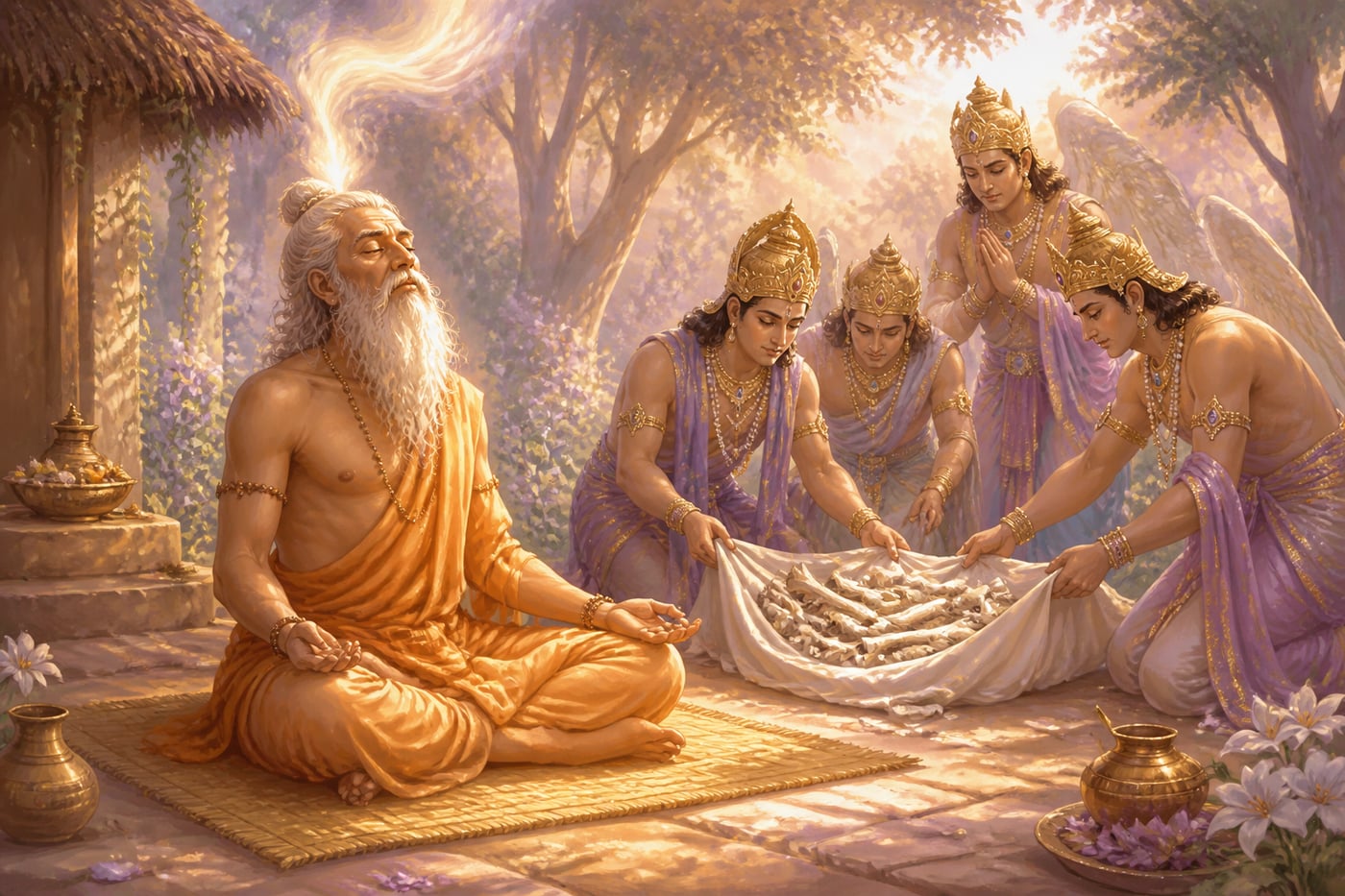
Sage Dadhichi sacrificing his body to forge the divine vajra

Dadhichi's sacrifice was extraordinary. When Indra approached him with this terrible request, the sage agreed immediately:

"If my body can serve dharma, it has fulfilled its purpose. Take my bones and fashion your weapon. I will gain liberation; you will gain victory; the universe will gain peace."

Armed with this sacred weapon, Indra approached the final confrontation. But as he faced Vritra, he encountered something he had never seen in a demon: a soul already at peace with death.

Vritra's Strange Joy

As the armies clashed around them, Vritra spoke to Indra with surprising gentleness:

"O Indra, you come to kill me, and I welcome your blow. Do you know who I really am? I am Chitraketu, once a king, once a celestial wanderer, now wearing this demonic form by a goddess's curse. But the curse could not touch my heart. I have loved Vishnu through all these transformations, and I love Him still."

Indra was bewildered. He had prepared for battle, not philosophy. He had expected rage, not resignation.

Vritra continued:

"You fear to strike because you sense what I am. But strike you must, it is your dharma as protector of the worlds. And I will fall joyfully, because death in battle, while chanting the Lord's name, will carry me directly to His presence."

The Prayer of a Demon

As the battle reached its climax, Vritra began to pray. These prayers, recorded in the Bhagavatam, are among the most exalted expressions of devotion in all scripture, spoken not by a sage or saint, but by a demon on a battlefield.

Vritra prayed:

"O Lord, I do not desire the positions of Brahma, Indra, or any heavenly ruler. I do not seek dominion over the earth or the underworld. I do not desire even liberation if it means being separated from You. My only prayer is this: let me be reborn as the servant of Your servants, always engaged in chanting Your glories."

This prayer reveals Vritra's spiritual depth. He rejects:

He asks only for bhakti, the chance to serve and love the Lord eternally.

The towering asura Vritra standing on the cosmic battlefield with hands folded in prayer, weapons set down, face lifted in tearful longing toward the heavens.

The Nine Expressions of Devotion

Vritra's prayers enumerate the classic nava-vidha bhakti (nine forms of devotion):

Form Sanskrit Meaning Vritra's Expression
Hearing Śravaṇa Listening to divine stories "Let me always hear of Your pastimes"
Chanting Kīrtana Speaking divine names and glories "Let me always chant Your names"
Remembering Smaraṇa Keeping God in constant memory "Let my mind never leave Your lotus feet"
Serving Pāda-sevana Serving the Lord's feet "Let me serve those who serve You"
Worshiping Arcana Formal ritual worship "Let me offer flowers at Your altar"
Bowing Vandana Offering respect "Let me bow before Your image"
Servanthood Dāsya Seeing oneself as servant "Let me be the servant of Your servants"
Friendship Sakhya Divine friendship "Let me know You as my dearest friend"
Self-offering Ātma-nivedana Complete surrender "I offer myself entirely to You"

This prayer, from a demon's lips, became a defining teaching on bhakti yoga.

The Hesitant Slayer

Indra hesitated. How could he slay one who prayed with such purity? Was this demon or devotee? Enemy or teacher?

Vritra sensed his confusion and roared with laughter, not demonic laughter, but the joyful release of one already free:

"Indra! You hold the vajra fashioned from Dadhichi's sacred bones. That weapon was made to kill me. If you do not use it, you fail your dharma. I have no such conflict, my dharma is simply to love the Lord, and I can do that whether I live or die. But you must act. Strike now, while I meditate on Narayana!"

The moment was cosmically charged. A demon inviting his own death. A god afraid to deliver it. And through it all, the name of Vishnu echoing across the battlefield.

The Final Blow

Indra striking Vritra with the vajra as Vritra welcomes death

Indra raised the thunderbolt. Vritra closed his eyes and turned his consciousness entirely toward the Lord. In that moment, the demon's body became irrelevant, he was already dwelling in Vaikuntha in his heart.

The vajra fell.

Vritra's massive form crashed to the ground. But from his body, witnesses reported, a brilliant light rose, the jyoti (luminous soul) of Chitraketu, finally freed from his temporary demon costume. That light ascended upward, toward the spiritual realm, leaving behind only the husk of a body that had never defined its inhabitant.

The devas cheered their victory. But Indra felt no triumph. He had killed a being more spiritually advanced than himself. The victory felt hollow, even shameful.

Indra's Aftermath

Indra's intuition was correct to trouble him. Having slain Vritra, who despite his demonic form was a great devotee, Indra incurred the sin of brahma-hatya (killing one of brahminical nature). This sin, personified as a terrifying woman, pursued Indra and would torment him for many years.

The story of Indra's penance and purification continues elsewhere in the Bhagavatam. But the point is clear: killing a devotee, even if that devotee wears a demonic body, carries severe karmic consequences. External appearance means nothing; internal devotion means everything.

The Teaching Emerges

The Vritra episode crystallizes several profound truths:

1. The body does not determine the soul's destiny. Vritra was a demon in form but a saint in essence. His prayers exceeded those of many devas. The body is a costume; the soul is the actor.

2. Death welcomed is liberation, not destruction. Vritra approached death with joy because he saw it as reunion with the Beloved. For a devotee, death is simply changing rooms in the Lord's house.

3. Devotion transcends all categories. Deva, asura, human, these distinctions matter less than the single question: Do you love God? Vritra's love was pure, and purity transcends form.

4. The servant of servants is the highest position. Vritra did not ask to become equal to God, or even to directly serve God. He asked to serve those who serve God, recognizing that humility compounds infinitely in the spiritual realm.

The Legacy of a Demon Devotee

Vritra's story has inspired generations of devotees who feel unqualified for spiritual practice. If a demon could achieve liberation, what excuse does anyone have?

The Bhagavatam uses Vritra deliberately, placing exalted prayers in a demonic mouth to shatter our assumptions about who can be spiritual. Saints and sinners, devas and asuras, brahmanas and outcasts, all distinctions dissolve before genuine devotion.

And somewhere in Vaikuntha, the soul once called Chitraketu, who wore the body of Vritra, eternally serves the Lord's servants, exactly as he prayed to do on that cosmic battlefield, in his final breaths, with Indra's thunderbolt descending upon his head.

Living traditions

Vritra's story has become a powerful metaphor in modern Hindu discourse for the principle that external circumstances cannot limit spiritual potential. Teachers frequently cite Vritra when addressing students who feel disqualified by their backgrounds, if a demon could become a great devotee, no one is excluded. The image of Vritra praying while facing death has also been used to teach about dying with consciousness fixed on God.

Reflection

More in Skanda 6: Prescribed Duties

All lessons in Skanda 6: Prescribed Duties · Srimad Bhagavatham course