Daksha-Narada: Conflict of Paths

Householder vs. renunciate

Daksha, father of the population, conflicts with Narada, who liberates his sons from material life. This tension between the path of worldly duty (pravritti) and renunciation (nivritti) reveals that while both are valid, ultimate liberation comes through devotion to the Lord.

The Patriarch's Mission
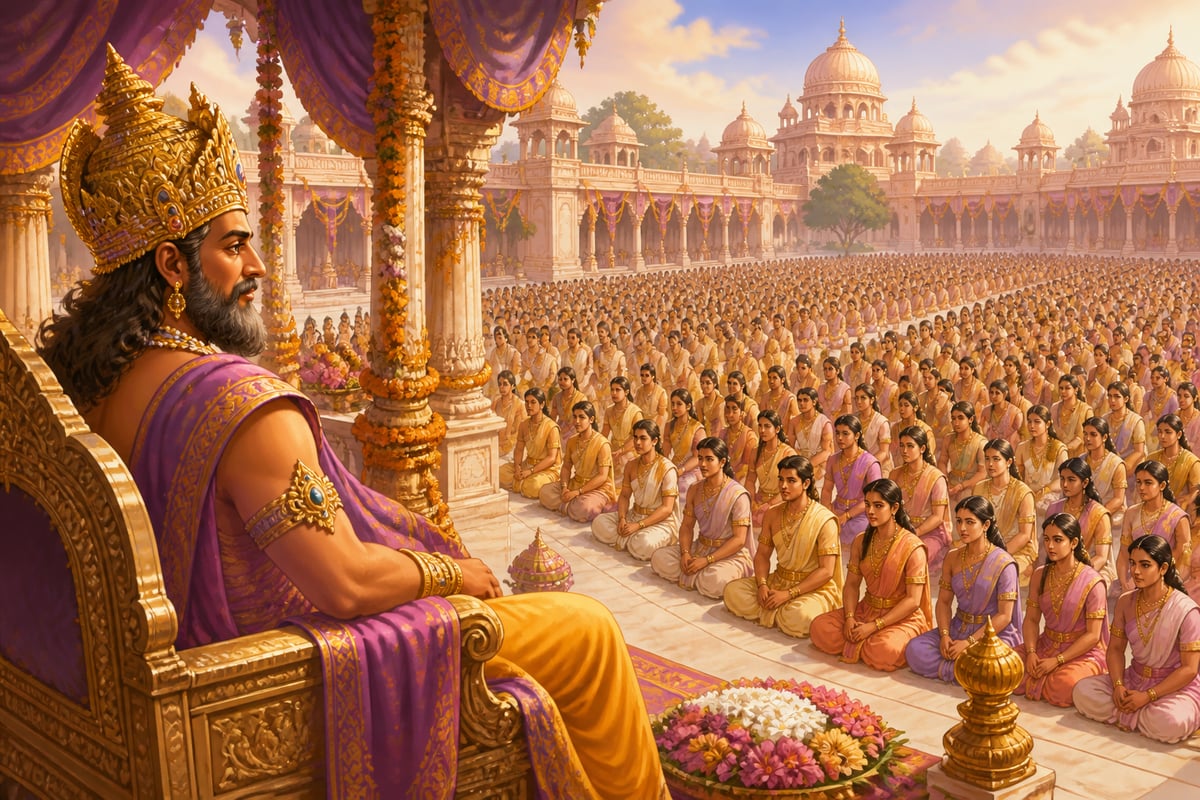
Daksha as patriarch surveying his vast assembled progeny

Prajapati Daksha, one of the original progenitors created by Brahma, had a sacred duty: to populate the universe. His very name means "capable" or "skillful," and his purpose was to generate progeny that would fill the worlds with conscious beings. It was a cosmic responsibility, entrusted to him by the creator himself.

Daksha approached this duty with zeal. He married Asikni, the daughter of Panchajana, and together they conceived vast numbers of children. First came the ten thousand Haryashvas, then another ten thousand Savalashvas. These were not ordinary children, they were potential progenitors, each destined to father nations and lineages that would shape the universe.

Brahma looked upon these numbers with satisfaction. The great project of creation was proceeding according to plan. Daksha had become the universe's most productive patriarch.

The Haryashvas' Test

The ten thousand Haryashvas were instructed by their father to prepare for their cosmic duty. Before beginning the work of procreation, they were to undergo austerities at the sacred lake of Narayana-saras, purifying themselves through penance.

As they performed their rituals by the lake's edge, a wandering sage appeared among them. This was Narada Muni, the celestial traveler who moves freely between all worlds, playing his veena and chanting the names of Narayana.
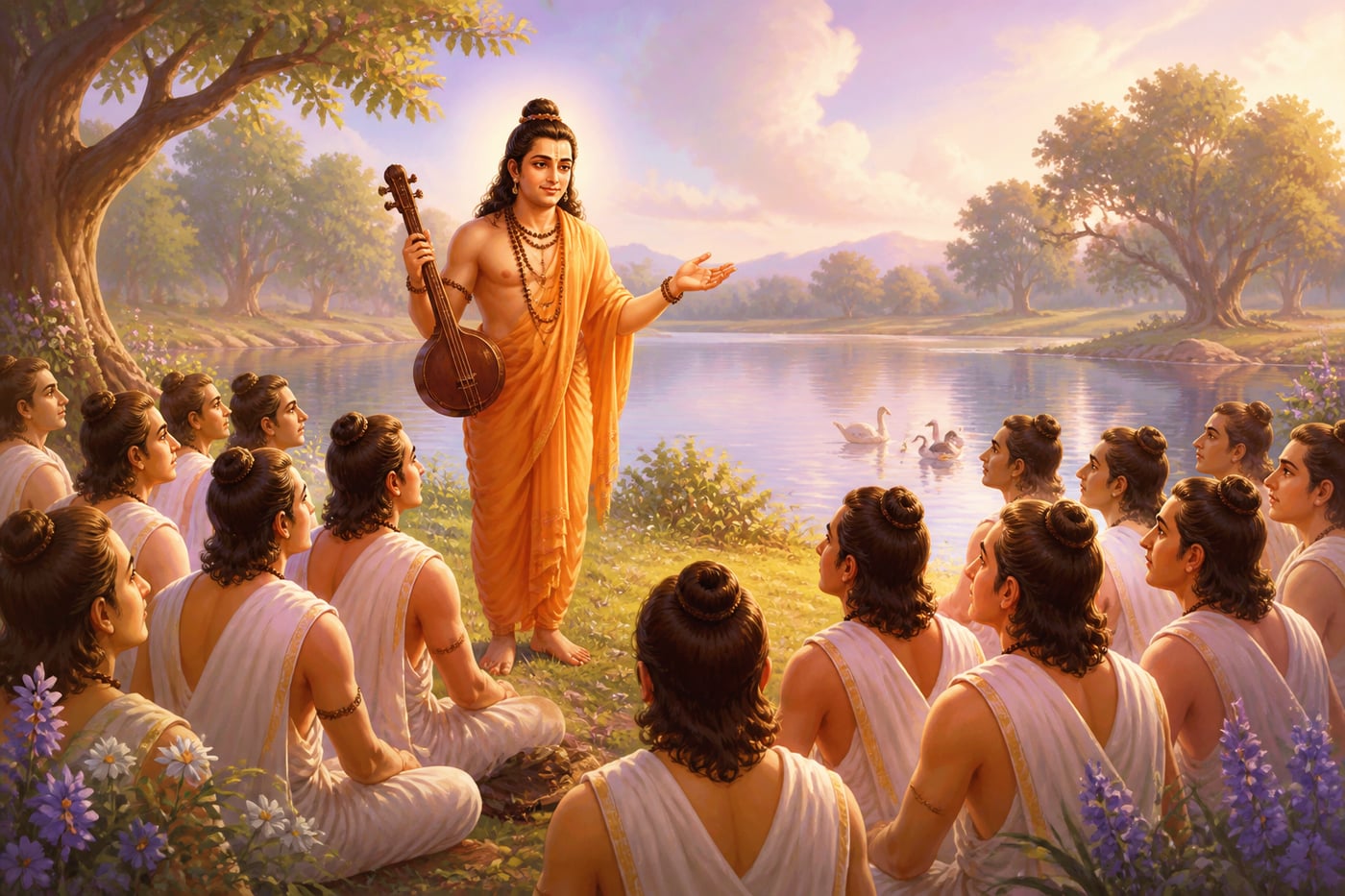
Narada teaching the Haryashvas his liberating riddles at the lake

Narada approached the young men and posed a seemingly innocent question:

"Dear brothers, have you understood the nature of the world you intend to populate? Have you seen its boundaries? Do you know where it ends and what lies beyond?"

The Haryashvas paused. They had never considered such questions. Their father had given them a mission, to create progeny. They had assumed this was the highest good.

Narada continued with a riddle:

"There is a land no one has seen. There is a woman who accepts all husbands but belongs to none. There is a creature that moves both ways. There is a river that flows from a mountain yet has no source. There is a house of twenty-five materials that can never be permanently inhabited. Until you understand these mysteries, how can you perform your duty properly?"

The First Liberation

The riddles were deceptively simple. But to minds prepared by austerity, their meaning became clear:

Riddle Meaning
The unseen land The spiritual realm (Vaikuntha), which material eyes cannot perceive
The all-accepting woman Maya, the illusory energy that entraps every soul
The two-way creature The Supreme Lord who enters creation yet remains transcendent
The sourceless river The Ganges of knowledge that flows from beyond matter
The 25-part house The material body composed of 25 elements, which cannot be a permanent home

The Haryashvas understood. They saw that the work their father proposed, creating more bodies, more entrapment in material existence, was not the highest purpose. A deeper liberation awaited.

One by one, all ten thousand brothers renounced their designated duty. They walked away from Narayana-saras, not to their father's palace, but into the paths of renunciation. They were never seen again, having achieved sannyasa and eventually moksha.

Daksha was devastated. His ten thousand sons, each a potential father of nations, had vanished. His entire project had collapsed.

The Second Wave

But Daksha was not easily deterred. He and Asikni conceived another ten thousand sons, the Savalashvas. These too were sent to perform austerities, this time with warnings about strange sages who might lead them astray.

The warning proved futile. Narada appeared again, spoke the same riddles, opened the same truths. And again, all ten thousand young men chose liberation over procreation. They followed the path of their elder brothers into the unknown.

Now Daksha's rage knew no bounds. Twenty thousand sons, the fruit of cosmic labor, had been "destroyed" (as he saw it) by a single wandering mendicant.

Daksha's Curse

When Narada next appeared before the assembly of sages, Daksha unleashed his fury:

"You hypocrite! You appear gentle with your veena and your mantras, but you are poison disguised as nectar! You have destroyed my lineage, made barren the future of creation! You claim to be a devotee, but what kind of devotee ruins a father's hopes?"

Daksha continued with his curse:

"From this day forward, Narada, you shall never be able to stay in one place! You shall wander eternally, without home, without rest. Your curse is homelessness, fitting punishment for one who made my children homeless in the material world!"

The assembled sages fell silent. Cursing a great devotee was a serious matter, and everyone expected divine retribution.

Daksha standing in raging fury before the assembled sages, pronouncing his curse on serene Narada who accepts it with folded hands.

Narada's Response

But Narada only smiled. He touched his veena gently and replied:

"O Daksha, you have given me the greatest blessing disguised as a curse. Wandering without attachment is the highest sannyasa! You have condemned me to precisely what every sage aspires to achieve, freedom from place, from possessions, from the chains of worldly life."

He continued:

"Your sons are not destroyed, they are liberated. You see loss because you measure success in numbers and lineages. But the soul's true success is freedom from the cycle of birth and death. Your sons have achieved in one lifetime what takes most souls millions of births."

The tension between the two perspectives could not have been starker:

Daksha's View Narada's View
Creating more life is the highest duty Liberating life from bondage is the highest duty
A father's hopes are sacred The soul's liberation transcends family bonds
Narada destroyed his sons Narada freed his sons
Wandering is punishment Wandering is freedom

Two Valid Paths

The Bhagavatam does not declare either figure entirely right or wrong. Both pravritti (engagement in worldly duties) and nivritti (renunciation and liberation) are legitimate paths sanctioned by the Vedas.

Pravritti creates the field in which souls can work out their karma, perform dharma, and eventually aspire to liberation. Without procreation, there would be no bodies for souls to inhabit, no world in which spiritual progress could occur.

Nivritti recognizes that ultimately, all worldly engagement is preparation for release. The soul's final goal is not to remain in the cycle forever but to transcend it.

Daksha's error was not in valuing pravritti but in seeing it as the only value. Narada's intervention, while seemingly disruptive, offered Daksha's sons a shortcut to the ultimate goal, one they were spiritually ready to take.

The Deeper Resolution

What reconciles these seemingly opposed paths? The Bhagavatam's answer is bhakti, devotion to the Lord.

A householder who performs duties with devotion, seeing all action as service to God, can achieve liberation while engaged in the world. A renunciant who lacks devotion may wander without progressing. The external form of one's life matters less than the internal orientation of one's heart.

Krishna would later declare in the Bhagavad Gita:

"Whatever you do, whatever you eat, whatever you offer or give away, whatever austerities you perform, do that as an offering to Me."

This principle dissolves the pravritti-nivritti conflict. Whether generating progeny or practicing celibacy, whether ruling kingdoms or meditating in caves, all becomes yoga when performed with devotion.

Narada's True Gift

Narada Muni was not a destroyer of families but a liberator of souls. His approach was radical because ordinary methods do not produce extraordinary results. The Haryashvas and Savalashvas were ready for the final breakthrough, and Narada recognized what their father could not.

History would vindicate Narada many times over. He would go on to inspire some of the greatest devotees in scripture, Prahlada, Dhruva, Vyasa himself. Each time, his intervention would seem to disrupt ordinary life, only to reveal the extraordinary life of the spirit.

As for Daksha, his story continues in the Bhagavatam. He would eventually sire sixty daughters by Asikni, many of whom married great sages and became mothers of important lineages. His cosmic duty was fulfilled, just not in the way he originally planned.

The Lesson for Seekers

The Daksha-Narada conflict presents a timeless question: How do we balance worldly responsibilities with spiritual aspiration? The answer is not to abandon one for the other but to transform both through devotion.

Most people are not called to abandon their families as the Haryashvas did. But all are called to understand that worldly success is not ultimate success, that family duties serve a higher purpose, and that the soul's liberation remains the final goal, whether approached through engaged life or renounced life.

The wandering of Narada continues even now. His curse became his blessing. And somewhere, in some realm, he plays his veena and chants the names of the Lord, the eternal reminder that no worldly achievement, however grand, compares to the freedom of the soul.

Living traditions

The Daksha-Narada conflict has become a popular topic in contemporary Hindu discourse about work-life-spirituality balance. Many teachers cite this story when explaining that spiritual practice need not conflict with worldly responsibilities, and that 'renunciation' can be internal (letting go of attachment) while maintaining external engagement. The story is also frequently used to discuss the role of spiritual mentors who may challenge conventional expectations.

Reflection

More in Skanda 6: Prescribed Duties

All lessons in Skanda 6: Prescribed Duties ยท Srimad Bhagavatham course