Ajamila: The Fallen Brahmana
From purity to degradation
Ajamila, once a pure brahmana, falls from grace after encountering a prostitute. He abandons his family and dharma, living a sinful life for decades. As death approaches, the Yamadutas arrive to take him to hell. But a single utterance will change everything.
The Perfect Beginning
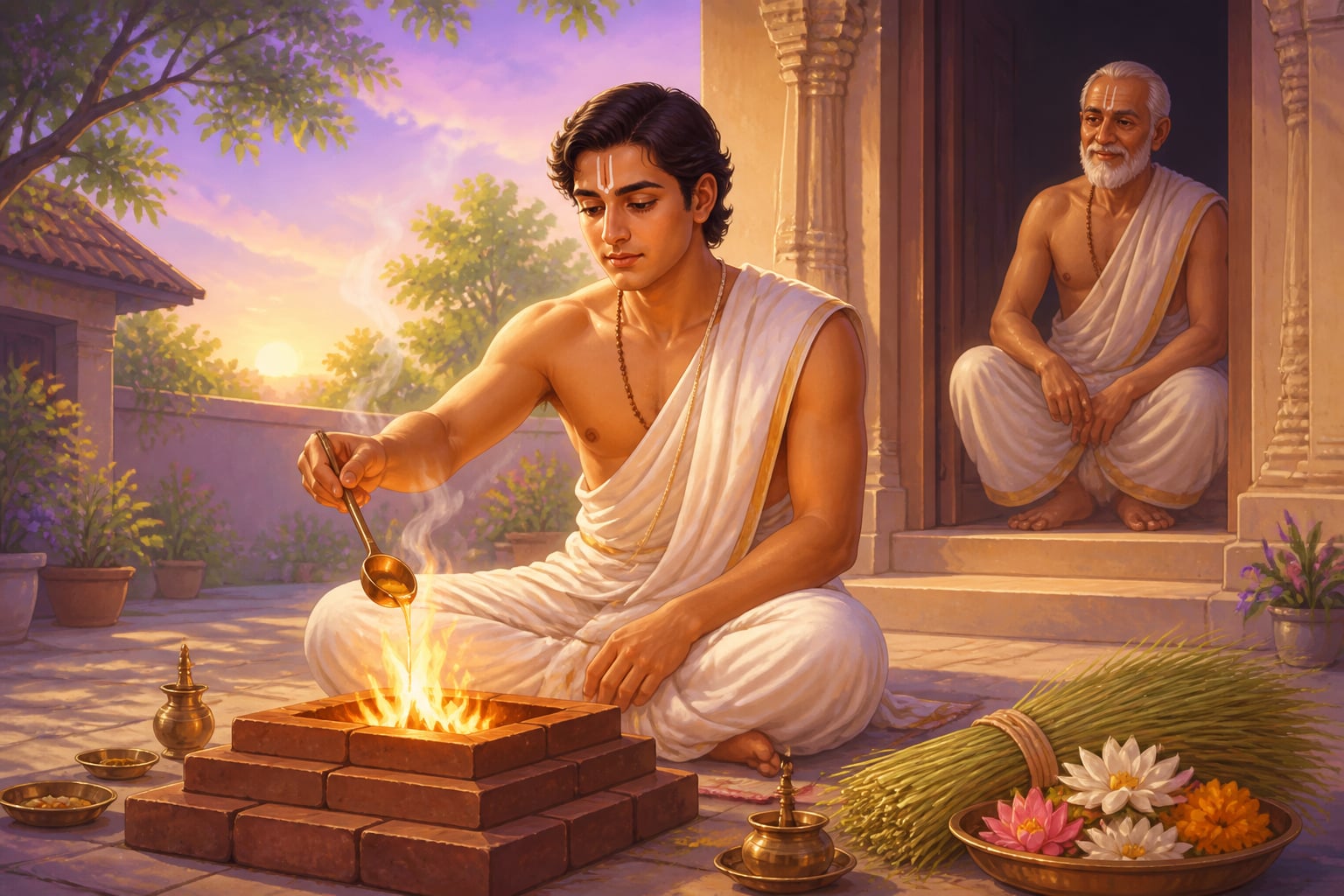
In the city of Kanyakubja, there lived a young brahmana named Ajamila whose life seemed destined for spiritual greatness. He was everything a brahmana should be, learned in the Vedas, pure in conduct, gentle in disposition, and devoted to his duties. He served his aging parents with tender care, performed his daily rituals without fail, and had married a beautiful girl from a respectable family. The community regarded him as an exemplar of dharmic living.
Ajamila possessed the twelve qualities that mark a true brahmana: truthfulness, self-control, austerity, cleanliness, tolerance, discrimination, knowledge, compassion, and unwavering devotion to God. His father, seeing such promise in his son, was filled with pride. Here was a young man who would bring honor to his lineage and liberation to his ancestors.
The Fateful Encounter
One day, following his father's instructions, Ajamila went into the forest to gather flowers, fruits, and sacred grass for the household worship. The forest was serene, filled with birdsong and the fragrance of blossoms. Ajamila walked the familiar paths, his mind absorbed in contemplation of the Lord.
But fate had arranged a different lesson.
In a clearing, Ajamila came upon a scene that would shatter his carefully constructed world. A shudra man and a prostitute lay together in a shameless embrace, intoxicated and lost in passion. The woman's clothes were disheveled, her eyes half-closed with drink, her body moving in ways that left nothing to imagination.
Ajamila knew he should look away. Every scripture, every teaching, every instinct of his training commanded him to turn and leave. But he could not. His eyes, like moths drawn to a flame, remained fixed on the scene. And in that moment of lingering, desire, long dormant, perhaps never truly tested, awakened within him.
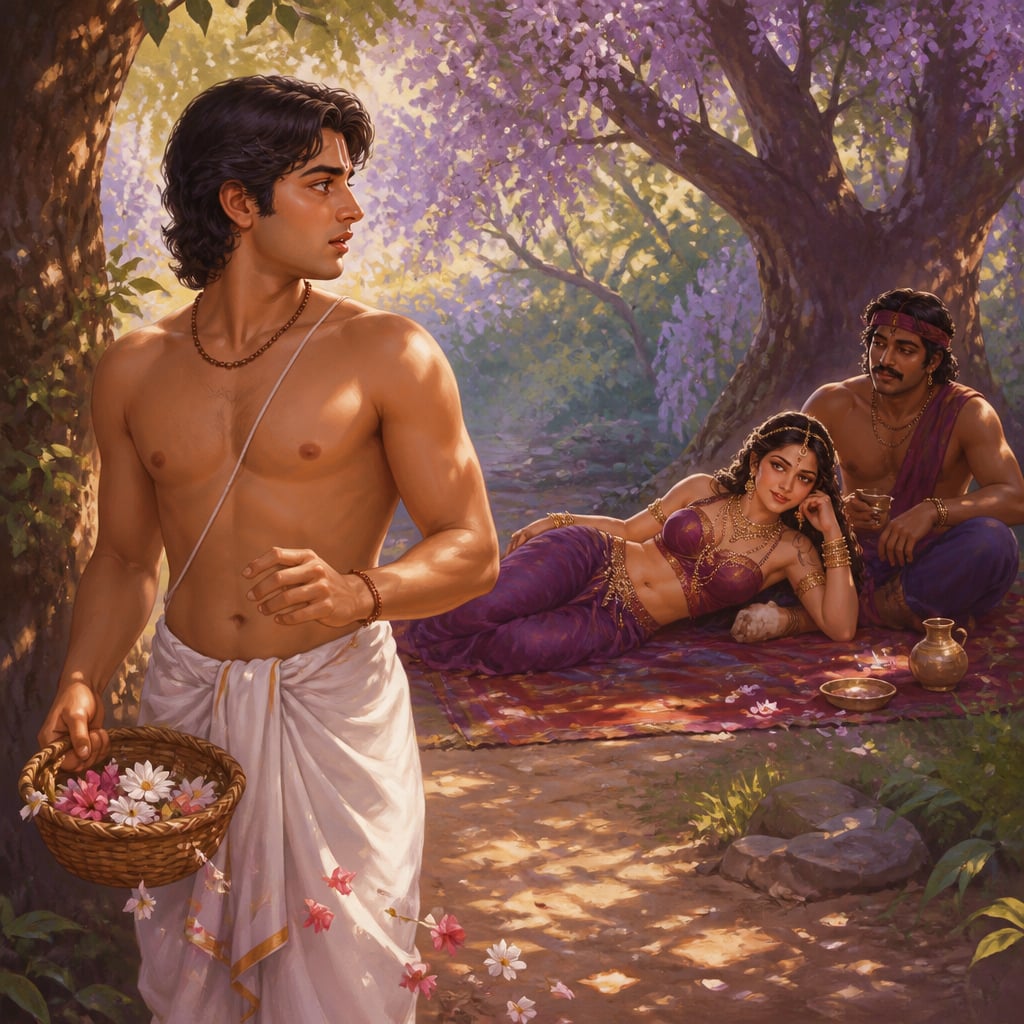
"Even a moment's association with sense objects can corrupt years of spiritual practice."
The Downward Spiral
What began as an unwanted glance became an obsession. Ajamila found himself returning to that place, searching for the woman. He could not eat, could not sleep, could not concentrate on his prayers. The image of her filled his mind, crowding out the sacred mantras he had memorized since childhood.
His transformation was gradual but relentless:
- He began neglecting his daily worship
- He started lying to his parents about his whereabouts
- He abandoned his chaste wife, who loved him faithfully
- He finally left his elderly parents without support
Ajamila took the prostitute as his companion. To maintain her expensive tastes, he turned to gambling, theft, and deceit. The young man who once would not harm an ant now cheated the innocent and stole from the helpless. Every boundary he had been taught to respect, he crossed.
Eighty-Eight Years of Sin
Decades passed. The once-pure brahmana became a hardened criminal. He fathered ten sons with the prostitute, and his attachment to the youngest, a boy named Narayana, became his only remaining tenderness. This child, with his innocent eyes and playful laughter, was the sole bright spot in Ajamila's dark existence.

Ajamila would spend hours watching little Narayana play, calling his name with genuine affection: "Narayana, come here! Narayana, eat this! Narayana, Narayana..." He did not realize that in speaking this name, the sacred name of Lord Vishnu, he was unknowingly planting seeds of redemption.
Meanwhile, his sins accumulated like thunderclouds before a storm. The laws of karma kept careful account:
| Sin | Duration | Karmic Weight |
|---|---|---|
| Abandoning parents | 80+ years | Severe |
| Abandoning wife | 80+ years | Severe |
| Theft and fraud | Continuous | Accumulating |
| Association with prostitute | 80+ years | Corrupting |
| Neglecting all dharma | Complete | Comprehensive |
The Moment of Death
At the age of eighty-eight, Ajamila's time came. As he lay on his deathbed, still absorbed in thoughts of his little son, terrifying figures appeared before him. These were the Yamadutas, the servants of Yama, the lord of death and justice.
They were fearsome to behold: twisted faces, eyes blazing with righteous wrath, bodies dark as thunderclouds. In their hands they carried the pasha, the noose with which they bind the subtle body of the dying and drag it to Yamaloka for judgment.
"Their forms were frightening, their voices harsh. They had come to collect the debt of a lifetime."
Ajamila saw them approaching and terror seized him. In that moment of ultimate fear, as the noose descended toward his throat, he did the only thing he could think of, he called out for the one person he loved most:
"Narayana!"
He meant to call his son. But the name he spoke was the name of God.
The Power of the Name
What happened next stunned everyone, the Yamadutas, the witnesses, even the cosmic order itself. At the utterance of that sacred name, four radiant beings appeared. These were the Vishnudutas, messengers of Lord Vishnu, resplendent in divine light, armed with lotus, discus, mace, and conch.
"Stop!" they commanded the Yamadutas. "You cannot take this man."
The servants of Yama were bewildered. They had never been challenged before. Their authority came from dharma itself, from the inexorable law of karma. How could anyone question their right to collect a soul so obviously destined for hell?
The Yamadutas protested: "This man has committed every sin imaginable. He abandoned his parents, his wife, his duties. He stole, he cheated, he lived with a prostitute. By what possible logic can you prevent his punishment?"
The Vishnudutas smiled serenely. Their answer would reveal one of the deepest truths of the Bhagavatam, a truth that would echo through the ages and offer hope to the most fallen souls.
The Suspended Moment
As Ajamila lay frozen between life and death, the debate between the cosmic messengers would unfold. The Yamadutas represented law, justice, the mathematical precision of karma. The Vishnudutas represented grace, mercy, the transcendent power of the Lord's name.
Both were right according to their own logic. But which would prevail?
Ajamila, still conscious, watched this celestial dispute with growing wonder. For the first time in decades, he began to remember who he had once been, a young brahmana full of promise, walking through a forest to gather flowers for worship. How had he fallen so far?
Yet here, at the very edge of damnation, something unexpected was happening. The name he had spoken carelessly for years, calling his son to dinner, to bed, to play, that same name had summoned divine intervention.
The lesson was staggering in its implications: even the shadow of devotion, even the echo of the Lord's name, carries power beyond measure. If this could save Ajamila, what could sincere devotion accomplish?
The debate would continue, but the question had already been answered in principle. In the court of divine love, mercy always finds a way.
Living traditions
The Ajamila story has become one of the most frequently cited narratives in modern Hindu discourse about grace and redemption. ISKCON founder Srila Prabhupada often referenced it when explaining why chanting 'Hare Krishna' is recommended for the modern age, if even unintentional utterance saved Ajamila, how much more powerful is sincere chanting?
- Nama Sankirtana: Congregational chanting of the Lord's names, considered the most accessible spiritual practice. The Ajamila story is often cited to explain why even casual or careless chanting carries spiritual power.
- Kannauj (Ancient Kanyakubja): The city where Ajamila lived. Though no temple specifically commemorates his story, the ancient temples here connect visitors to the world of the Bhagavatam.
Reflection
- Ajamila was well-educated in dharma yet still fell. What does this suggest about the relationship between knowledge and behavior? Have you ever known the right thing to do but failed to do it?
- Ajamila called 'Narayana' meaning his son, but the name carried divine power anyway. What does this suggest about the nature of sacred names and mantras? Is intention necessary for spiritual potency?
- The Yamadutas represent karma and justice; the Vishnudutas represent grace and mercy. Can these principles coexist? Is divine mercy a violation of cosmic justice, or does it operate on a higher principle?