Nandi: The One Who Waits

Shilada's tapas and the bull at the threshold

Walk into any Shiva temple and one figure greets you before Shiva does. A stone bull sits in the open courtyard, facing the inner sanctum, never moving, never entering. His name is Nandi. The Shiva Purana tells how he came to sit there, and what he is teaching by staying outside.

The Bull At The Door

A visitor walks up the steps of the Brihadeeswara temple at Thanjavur on a hot Tamil Nadu morning in 2026. The stone is warm under bare feet. A coconut vendor calls out near the gateway. A bell rings inside. The visitor passes through the gopuram and stops in the wide outer courtyard. Before he can take another step toward the sanctum, an enormous shape blocks the line of sight.

It is a bull. Carved from a single piece of black granite. Roughly six metres long. Three and a half metres tall. He has been polished by ten centuries of devotee hands until his back shines like wet stone. His head is turned slightly. His ears are alert. His eyes are open. He is looking through the door, straight at the linga in the inner sanctum, the way a son looks at his father.
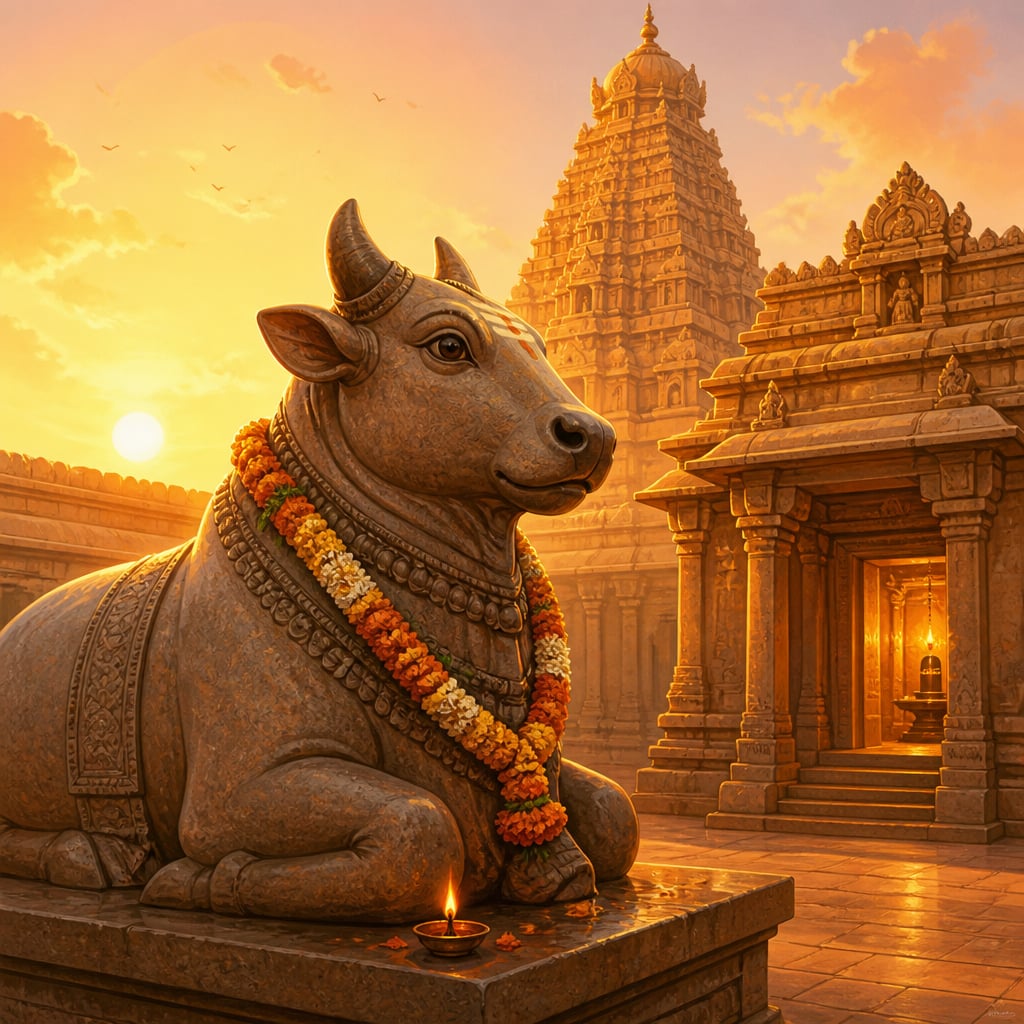
The colossal stone Nandi of Brihadeeswara temple gazing toward the inner sanctum.

The visitor's first reaction is to walk around him. He is in the way. But the priest at the entrance, if asked, smiles and says the same thing every priest at every Shiva temple has said for two thousand years. He is not in the way. He is the way. Bow to him first. Whisper your wish into his ear. Then look between his horns. You will see Shiva exactly where Nandi is looking.

This bull has a name. Nandi. He has a story. And the story is not about a bull at all.

Shilada's Tapas

The Shiva Purana opens the story long before there is any temple. There is only a forest, a river, and a rishi named Shilada who is heartbroken.

Shilada has been told that his lineage will end with him. He has no son. The pitru rin, the debt to the ancestors, hangs over him like an unpaid loan. He could marry. He could try the ordinary way. Shilada chooses the harder road. He goes into the forest, sits down beside the river, and begins tapas, ascetic heat, directed at one wish.

He does not ask for a son who will be rich. He does not ask for a son who will be famous. He asks for a son who will be immortal, deathless, free from the ordinary cycle of birth and decay. The Shiva Purana says he sits in this tapas for a thousand years. The forest grows around him. Ant hills cover his legs. His hair turns to roots. The animals stop being afraid of him.

Finally Shiva appears. The Lord listens to the wish and gives Shilada the son he asked for, with one twist. I will not send you a son. I will be your son.

Shilada finding the infant Nandi rising from the plough furrow

A short time later, Shilada is ploughing a field as part of a yajna. The plough strikes something soft. He kneels and brushes the soil away. A small boy is lying inside the furrow, glowing, smiling, three-eyed. The boy reaches up. Shilada lifts him out of the earth. He names the child Nandi, the joyful one.

A Son Who Is Not Quite Human

Nandi grows up in Shilada's hermitage. He is not quite an ordinary boy. He learns the Vedas in a few years. He learns the agamas. He sits at his father's feet and listens. The Shiva Purana describes him as quiet, attentive, with a stillness unusual for a child.

Then one day two sages come to visit. They look at Nandi and exchange a glance. Shilada notices. He asks what they have seen. The older sage answers carefully.

He is brilliant. He will know everything there is to know. But his life will be short. The signs are clear on his body.

Shilada is broken. The whole point of his tapas was a son who would not die. He goes to Nandi and weeps. The boy, who is perhaps eight years old, listens calmly. He stands up, kisses his father, and says he will go and speak to Shiva himself. He walks into the forest, sits down beside the same river his father once sat beside, and begins his own tapas.

The boy's tapas is so intense that the rivers slow. The wind stops. Shiva appears very quickly this time. Nandi does not ask for long life. He asks for one thing only. He asks to never leave Shiva's side. He asks to be Shiva's gana, his attendant, his disciple, his guard.

Shiva looks at the boy and laughs gently. He gives him more than he asked for. He places his own hand on Nandi's head. The boy's body changes. He grows tall. A garland of skulls appears at his neck. Three eyes open on his forehead. A bull's face appears in place of his own. His arms multiply. He is no longer a child. He is a being who can stand at the door of Kailasa for the rest of time.

Shiva tells him three things. You are my first disciple. You will be the chief of all my ganas. And from this moment, my temple is not built until you sit at the door of it.

Why The Bull

The bull form is not random. The tradition reads it as a deliberate teaching.

Nandi's role is not to enter the sanctum. His role is to face the sanctum. The Shaiva tradition is firm on this. You cannot become Shiva. You can only face him. The face is the practice.

Adhikara Nandi: The First Right

The agamas, the technical Shaiva manuals for temple worship, give Nandi a precise architectural location. Every Shiva temple, from the smallest village shrine to the largest at Tanjore, has a Nandi mandapa, a small pillared pavilion in the courtyard, exactly on the central axis between the door and the linga. Nandi sits inside it. His gaze is locked on the linga. The technical name for this seated Nandi is adhikara Nandi, the Nandi who has the right.

What right.

The right to look. The right to wait. The right to be there before anyone else. The agama tradition says that no human worship at a Shiva temple is complete until the worshipper has first bowed to Nandi. He is the doorkeeper, but not in the sense of a guard who keeps people out. He is the doorkeeper in the sense that his presence makes the door real. Without him, the sanctum is just a room.

A devotee whispering a wish into Nandi's ear at the temple threshold

This is also why devotees whisper their wishes into Nandi's ear before entering the inner sanctum. The tradition explains it gently. Shiva is the formless one. He does not always hear small wishes. Nandi is the listener. He carries the wish in.

The Eleventh Rudra, Hanuman's Cousin

The Shiva Purana gives Nandi a position even higher than chief gana. He is also counted among the eleven Rudras, the eleven forms of Shiva himself. Nandi is the form that waits. Hanuman, in another reading, is the form that serves.

This makes Nandi and Hanuman cousins in a quiet way. Both are amshas, partial forms, of Shiva. Both choose to be devotees rather than gods in their own right. Both are remembered in stone at the entrance to the master's space. Hanuman folds his hands at the door of every Rama temple. Nandi sits at the door of every Shiva temple. The same teaching, twice over, in two different epics.

The Shiva Purana underlines the point. The greatest beings in the dharmic world are not the ones who claim the centre. They are the ones who choose, freely and gladly, to face it.

Modern Echoes

The management writer Robert Greenleaf, working at AT&T in the 1960s and 1970s, gave the world the term servant leadership. His core claim was that the best leaders are the ones who first commit to serving the people and the mission, and that authority follows from that posture rather than from rank. Greenleaf had never read the Shiva Purana. The Shaiva tradition had been carving his thesis in granite for fifteen centuries. The Nandi at Thanjavur, sitting at the door, looking in, was already what he was trying to describe.

The Stanford psychologist Walter Mischel ran the famous marshmallow experiments at the Bing Nursery School in the 1960s. The children who could wait for the second marshmallow grew up, decades later, with measurably better outcomes in school, in work, and in health. Mischel called it delay of gratification. The Shiva Purana would call it Nandi. The capacity to sit at the door of what you want, look at it directly, and not lunge.

In 2026, this is harder than it has ever been. Notification dots, instant scrolls, twenty-four hour delivery. The whole architecture of modern life trains the opposite of Nandi. Walking into a Shiva temple and sitting beside the bull for one quiet minute is, in this sense, a counter-architecture. It is a one-minute education in how to want something well.

Back at Thanjavur, the visitor finally understands the bull. He bows. He whispers something into the great stone ear. He stands up and looks between the polished horns. The linga is exactly there, dark and silent, lit by a single oil lamp. Shiva is in the room. Nandi is at the door. Nothing has changed in a thousand years.

The next chapter steps back from the family of Shiva and into the philosophy that holds it all up. The Goddess turns to her husband with a question, and the long conversation called the Shiva Tattva begins.

Key figures

Nandi

The bull-faced first disciple of Shiva, chief of his ganas, and door-keeper of every Shiva temple

Shilada

The rishi whose thousand-year tapas for a deathless son brought Nandi into the world

Shiva

The Lord who became Shilada's son, transformed Nandi into the bull-faced gana, and decreed that his temple would not be complete without Nandi at its door

Historical context

From the bull seals of the Saraswati civilization (c. 5000 to 1900 BCE), through the codification of Shaiva temple architecture in the agamas (c. 600 to 1000 CE), to the great age of monolithic Nandi sculpture under the Pallavas, Cholas, and Vijayanagara kings (c. 700 to 1600 CE)

Across nearly four thousand years, Nandi moves from a recurring image on Saraswati civilization seals, to a named figure in the Shvetashvatara and Atharvashiras Upanishads, to the central narrative of the Shilada-Nandi cycle in the Shiva Purana, to a codified architectural element in the Shaiva agamas. Each of the major Shaiva architectural traditions (Pallava, Chola, Hoysala, Vijayanagara, and the later Nayaka builders) refined the placement and the scale of the Nandi mandapa. The Cholas in particular made the monolithic Nandi a political statement, with Rajaraja's Brihadeeswara setting a template that later kings competed to match.

Living traditions

Nandi has crossed from sanctuary to public memory in ways few other Hindu icons have managed. The Bull Temple at Basavanagudi gave a whole Bengaluru neighbourhood its name. Nandi Hills, the popular weekend hill station near Bengaluru, takes its name from the same bull. The Robert Greenleaf framework of servant leadership, taught at business schools from Harvard to ISB, repeatedly cites the Nandi posture as a non-Western prototype of the same idea. The annual Kadalekai Parishe groundnut fair at the Bengaluru Bull Temple, running for over four hundred years, draws several hundred thousand visitors annually and links the bull to the agricultural calendar of South Karnataka. In every Shiva temple opened anywhere in the world in the last century, including in the diaspora from Pittsburgh to Perth, the architectural rule still holds. No Nandi mandapa, no temple.

Reflection

More in The Family of Shiva

All lessons in The Family of Shiva ยท Shiva Purana course