Ganas: Kailasa's Court and the Eleventh Rudra
Why Shiva's court has no caste, and Hanuman's secret
Around Shiva on Kailasa sit the ganas: Nandi, Bhringi who refused to bow to Parvati, the bhutas and pisachas, the outcasts no other court would seat. There is no caste at the door. The lesson closes with the tradition that Hanuman is an amsha of Shiva, the Eleventh Rudra.
The Court With No Door
Late one afternoon in the high winter on Kailasa, a small group of devas climbed the last slope and stopped where the snow ends. They had come from Indra's bright assembly, where every seat is ranked and every visitor announced. They had expected something similar at the door of the greatest of gods. They found no door.
What they found instead was a wide, open ledge under a single peak, the snow swept clean by the wind. Shiva sat in the centre on a tiger skin, eyes half closed, ash on his skin. Around him, in a circle that had no head and no tail, sat his court.
The devas looked, and could not place anyone. A white bull lay near Shiva's right knee, breathing slowly. A skeletal sage stood balanced on three legs. Two figures with faces of dogs were curled together, asleep. A boy with a snake around his neck was laughing. A creature with no nose at all was eating an apple. There were small spirits, half-visible, sitting on the rocks. There were beings whose names the devas did not know in any heavenly register. There were a few humans. And every one of them was looking at Shiva with the same quiet, undivided attention.
One of the devas leaned to another. 'Where is the protocol?' he whispered. 'Where is the order of precedence? Who sits where?'
The other deva, older, had been to Kailasa before. He smiled. 'There is no order of precedence here,' he said. 'That is the order. This is the only court in the worlds where the door is not guarded by your birth.'
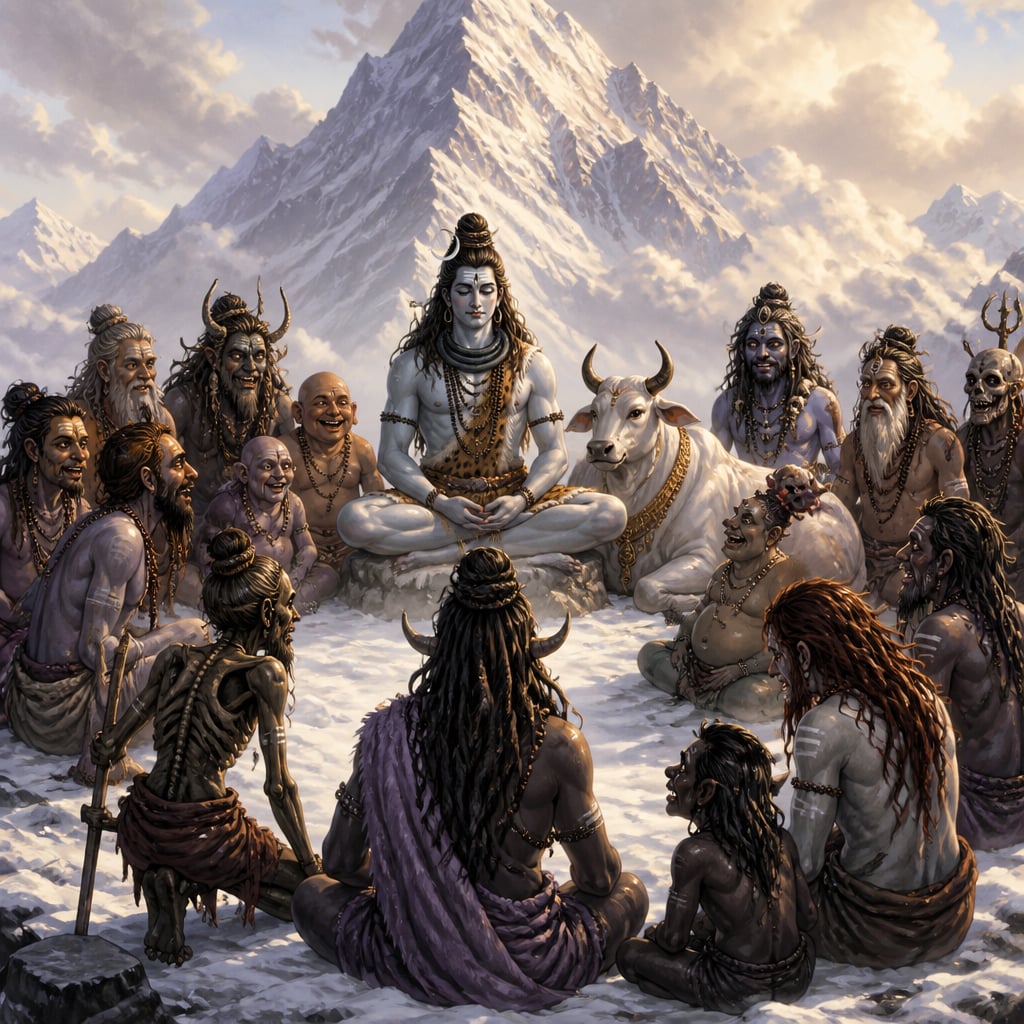
What that ledge taught the devas, and what it has been teaching the rest of us for as long as the Shiva Purana has been told, is the subject of this lesson. At the end is a quieter teaching about a particular monkey, sitting silent at the feet of a particular king, and the tradition that says he too is part of this same court.
The Ganas: Who Are They
The word gana means simply a group, a troop, a band. The ganas are the followers of Shiva. They are not gods of the upper heavens. They are not asuras of the lower worlds. They are something in between, and on Kailasa they are the family.
The Shiva Purana lists them with care, and the lists are long. Some are well known. Some are strange even to the Puranas.
- Nandi, the white bull, Shiva's first disciple and the guardian of every Shiva temple. His next lesson will tell his story in full.
- Bhringi, the three-legged ascetic sage. His third leg is a staff that Shiva gave him after his bones fell away from too much fasting.
- Veerabhadra, the fierce warrior born of Shiva's matted lock at the time of Daksha's yajna.
- Bhutas, the spirits, often invisible, sometimes attached to graveyards and crossroads.
- Pisachas, the goblins, with bodies that look strange to human eyes.
- Pramathas, the agitators, who churn obstacles out of the way wherever Shiva walks.
- Yakshas and kinnaras, half-human spirits of forests and mountains.
- The ten Ekadasha Rudras, the eleven fierce forms of Shiva himself, of which the eleventh has a secret we will return to at the end.
The ganas are led by Ganesha. The word Ganesha means Lord of the ganas. The boy with the elephant head, the one we met in the first lessons of this chapter, is not just Parvati's son. He is the captain of this strange, leaderless court.
Bhringi: The Ascetic Who Forgot Half The Truth
There is one gana whose story is so revealing of Kailasa's logic that it deserves its own scene. His name is Bhringi.
Bhringi was a great ascetic, born long before Shiva married Parvati. His devotion was absolute and very narrow. He worshipped Shiva alone. He would go around any deity to circumambulate Shiva alone, never Parvati. He thought of Parvati as Shiva's later attachment, an unnecessary addition, a softness in the great ascetic.
One day on Kailasa, Bhringi came to perform his pradakshina, his walk around Shiva. Parvati was sitting beside Shiva. Bhringi tried to find a way to circle only the male half. Parvati, watching this, did something the Shiva Purana describes with quiet humour. She moved closer. She joined her body to Shiva's so that the two became Ardhanarishvara, half woman, half man, in a single body. Now Bhringi could not separate them.

Bhringi, stubborn, took the form of a bee (the word bhringi means bee) and tried to bore his way through the joined body to circle only the Shiva half. Parvati closed the gap. He failed.
Furious at being thwarted, Bhringi denied himself the part of his body that came from his mother, the part the dharmic tradition holds the female line gives. His flesh, his blood, his marrow, all collapsed away. He stood reduced to a frame of bones, unable to balance.
Shiva watched all of this. He did not punish Bhringi. He did not banish him. He gave him a third leg, a wooden staff, so the broken sage could stand. And he kept him at Kailasa, in the circle of his court, as a permanent reminder of what happens when devotion becomes one-eyed.
The story is the Shaiva tradition's most direct teaching about the place of the feminine. You cannot love Shiva and refuse Shakti. The two are one body. To worship one is to worship the other. Bhringi stands on three legs at Kailasa to this day, in the middle of the gana circle, his missing flesh a teaching for any devotee who thinks the masculine of the divine is enough.
Why Shiva's Court Has No Caste
Look again at the ledge. The other heavens of the dharmic cosmos are organised. Indra's assembly has Vasus, Adityas, Maruts, each in his place. Vishnu's Vaikuntha has its own celestial order. Brahma's lokas have ranked sages. But Kailasa has spirits next to sages, animals next to gods, the malformed next to the beautiful, the silent next to the singing.
The Shiva Purana is precise about why. Shiva is Pashupati, the lord of pashus. The word pashu in Sanskrit means animal but also, in its older usage, the bound one, the soul that has not yet recognised its own nature. Every being on Kailasa is a pashu. Shiva is the pati, the lord, of all of them equally. Their forms are not their qualifications. Their bondage and their longing are.
This is why his court has no caste at the door. The ganas include every kind of being that the dharmic cosmos imagined: the high heavenly, the low spectral, the pure ascetic, the half-formed, the fierce, the gentle. None of them is admitted by birth. All of them are admitted by attention to Shiva.
The tradition draws an important line here. Caste, varna, jati, and birth still organise the social world that the dharmic householder lives in. The Shiva Purana is not a manifesto against social order. It is teaching something subtler. At the door of the divine, the social shape of a being is not the qualification. The pull of the heart is. Whatever shape you arrived in, you can sit in this court if you are looking the right way.
Adi Shankaracharya, walking down a narrow lane in Kashi in the eighth century, met an outcast carrying meat. Tradition says Shankara stepped aside. The man stopped him and asked, 'Whom are you asking to step aside? The body, or the Self in it?' Shankara recognised Shiva himself in the question and bowed. The story is told to remind every Shaiva that the door of Kailasa was always open. The work is to let the eyes recognise it.
The Eleven Rudras And The Hidden One
The Shiva Purana names eleven fierce forms of Shiva, called the Ekadasha Rudras. The lists vary across the Vayu Purana, the Vishnu Purana, the Shiva Purana, and the Mahabharata, but the count is steady at eleven. They are aspects of Rudra: the storm-god, the destroyer, the howler. Most lists are crowded with names that do not stay in popular memory: Manyu, Manu, Mahinasa, Mahan, Shiva, Ritudhvaja, Ugraretas, Bhava, Kala, Vamadeva. Ten names that scholars memorise.
The eleventh is the one the children of India know.

The Shiva Purana, and several traditions across the south and west, hold that Hanuman is the eleventh Rudra. He is an amsha, a portion, of Shiva himself, born to Anjana through the breath of Vayu, the wind god. The tradition is most clearly preserved in the Sankat Mochan school of Hanuman bhakti, and is repeated by Tulsidas in the Hanuman Chalisa, where Hanuman is called Shankara suvana, the noble son of Shankara.
Why does this matter for the story we are telling?
Because it explains a particular quality of Hanuman that any reader of the Ramayana has felt without being able to name. When Hanuman sits at the feet of Rama, his stillness is not ordinary devotion. It is Shiva's stillness on Kailasa, transposed into the court of Vishnu's avatar. The same lord who refused to be moved by Kamadeva's arrow now sits, in another body, at the feet of his own beloved Rama, the perfect dispassion turned into perfect service.
This is why the dharmic tradition has no contradiction in Rama-bhakti and Shiva-bhakti. The greatest devotee of Rama is Shiva himself in the body of a monkey. When Hanuman tears open his chest to show Rama and Sita seated in his heart, the picture is the whole Shaiva-Vaishnava synthesis in one image: the Eleventh Rudra holding Vishnu's avatar at the centre of his being.
Modern Echoes
The sociologist Erving Goffman built a career on the observation that every human institution sorts the people who enter it: by clothing, by accent, by credential, by visible signal of belonging. He called the institutions that admit only one type of person total institutions, and he warned that they tend to reproduce the world that built them. The Shiva Purana described, fifteen centuries earlier, the opposite kind of institution. Kailasa is, in Goffman's terms, an anti-total institution. The signals at the door are not checked. The strange, the malformed, the unranked, sit beside the high. The institution does not reproduce the social world. It corrects it.
The psychiatrist Carl Jung wrote that an integrated personality contains both its bright and its shadow side, and that any attempt to live in light alone produces a sicker, more dangerous self. Bhringi on his three legs is exactly this teaching in story form. Devotion that refuses the half it does not like collapses into bone. Shiva does not heal Bhringi. He gives him a stick to keep standing. The cure for one-eyed devotion is to stand visibly broken in the middle of the court so that everyone else remembers.
In 2018, the Supreme Court of India in Indian Young Lawyers Association v State of Kerala heard arguments about the entry of women into Sabarimala. Within those arguments, lawyers on every side cited Shiva texts about the absence of caste and gender bars at the door of the divine. Whatever one thinks of the legal outcome, the cited texts were the same texts this lesson rests on. The Shiva Purana's image of a court with no door is, two thousand years after it was first told, still one of the live arguments in Indian public life.
The Circle Closes
Look back at the ledge. The wind has picked up. The devas have left. The ganas remain. Nandi has not moved. Bhringi balances on his stick. A small spirit is dozing on a rock. In the centre, Shiva sits with his eyes half closed, and far to the south, in another age, a monkey at the feet of a king does the same thing in another body. The court has no door. It never did.
The next lesson goes to the white bull at the right knee, the one who came to Kailasa first.
Historical context
Puranic compilation period (c. 8th to 12th century CE), with the Hanuman as Eleventh Rudra identification crystallising in popular form through Tulsidas in the 16th century.
The first and second millennia CE were a period of sustained negotiation between hierarchical and non-hierarchical visions of social order across Indian religious culture. The Buddhist sanghas had argued for a horizontal community of seekers since the 5th century BCE. The early Shaiva movements answered with a parallel vision in mythological form. The Pashupata sect, attested from at least the 2nd century CE, made the open court of Shiva the centre of its theology. The Lingayat movement of Basava in 12th century Karnataka took the same logic into a working social experiment, rejecting caste at the level of community life. The Nayanar saints of Tamil Nadu (6th to 9th century CE) included Karaikkal Ammaiyar (a married woman who became a skeleton-saint), Tirunavukkarasar (a former Jain), Sundarar (raised as a brahmin but spiritually formed in the open court), and Nandanar (a so-called pariah saint). Each of these biographical entries into the Shaiva canon is an implicit citation of the gana circle. The Shiva Purana is not an outlier in this story. It is the textual centre.
Every Indian movement that has tried to imagine a non-hierarchical religious community has, knowingly or not, drawn on the Kailasa ledge. The Pashupatas, the Lingayats, the bhakti saints, the Sankat Mochan tradition, modern Indian republican thought, and even the legal arguments at the Supreme Court of India have circled back to the same image. Without the gana doctrine, the Indian religious imagination loses one of its most powerful arguments for an open door.
Living traditions
The image of the gana circle has been one of the most generative metaphors in modern Indian thought. Rabindranath Tagore in his 1921 lecture series at Visva-Bharati invoked the open court of Shiva to describe what he wanted his university to become: a place where the strange, the unranked, and the unfit could sit beside the high. M S Golwalkar in his Bunch of Thoughts and B R Ambedkar in The Buddha and his Dhamma both cited the Shaiva absence of caste at the door of Kailasa, with very different agendas, in defence of their respective social visions. The 2018 Supreme Court hearings in Indian Young Lawyers Association v State of Kerala on the entry of women into Sabarimala saw lawyers on multiple sides cite the Shiva texts on the open court, with a final 4-1 majority opinion that explicitly drew on the Pashupati tradition. The Hanuman Chalisa is, by some recent counts, the single most recited religious text in north India, with more than three hundred million devotees reciting its seventh verse on Tuesday and Saturday evenings. The actor Amitabh Bachchan has recorded a version of the Chalisa that has been streamed over a billion times across YouTube and music platforms. Inside the Shaiva sampradaya itself, the Sankat Mochan tradition of Varanasi continues to teach the Eleventh Rudra doctrine in daily kathas, and the Veerabhadra and Bhringi shrines at Tiruchengode and Ellora remain among the most heavily walked Shaiva pilgrim sites in the south. The court with no door has, in this sense, never closed.
- Pradakshina Of The Joined Pair At Ardhanarishvara Shrines: Across South Indian Shaiva temples, when a devotee performs pradakshina at an Ardhanarishvara shrine, the tradition is to circle the joined form as one body, never as two. Some priests will explicitly tell the devotee the Bhringi story before the circumambulation begins, as a warning against the bee-sage's mistake. The practice is the lesson made into a walk: you cannot worship the half you prefer.
- Hanuman Chalisa As Shaiva Hymn: In many Shaiva households across north India, the Hanuman Chalisa is recited as a Shaiva text rather than a Vaishnava one, on the strength of its seventh verse calling Hanuman the noble son of Shankara. The recitation is most commonly done on Tuesday and Saturday evenings, the days associated with both Hanuman and Shiva, often with a small image of Shiva at the centre of the altar and an image of Hanuman to its right. The Sankat Mochan tradition of Varanasi treats the Chalisa as the bridge text between Shaiva and Rama bhakti.
- Bhuta Worship At Bhuta Kola: In coastal Karnataka and parts of Kerala, the bhuta kola tradition treats the spirits, the bhutas of Shiva's ganas, as living deities of the village. A possession dancer, the patri, takes on the form of a named bhuta and adjudicates village disputes through the night. The tradition is over a thousand years old and is one of the few places in the dharmic world where the lower spirits of the gana circle are worshipped on their own terms, not as an annex to a higher deity.
- Sankat Mochan Hanuman Temple: The temple founded by Tulsidas in the 16th century at the spot where, by tradition, he had the vision of Hanuman that gave him the Hanuman Chalisa. The temple is the doctrinal centre of the tradition that Hanuman is the Eleventh Rudra, an amsha of Shiva. The seventh verse of the Chalisa is inscribed on a wall near the inner sanctum. The temple complex includes a small Shiva shrine that the Sankat Mochan tradition treats as inseparable from the Hanuman murti.
- Tiruchengode Ardhanarishvara Temple: The most famous Ardhanarishvara temple in India, perched on a hill nearly four hundred metres high. The main murti is a large stone image of Shiva and Parvati joined as one body, with the priests narrating the Bhringi story to pilgrims before they perform pradakshina. The hill is climbed via a stairway of over twelve hundred steps, with small Shiva and Murugan shrines along the climb. The temple also houses one of the most worshipped Veerabhadra shrines in the south.
- Elephanta Caves: The 6th century Shaiva cave complex carved out of a basalt hillside, containing one of the most celebrated Ardhanarishvara reliefs in Indian art (a five and a half metre high panel in the main cave) and one of the finest sculptural treatments of Shiva surrounded by his ganas. The Mahesha-murti, the three-faced bust at the centre of the main cave, is flanked by reliefs of Bhringi, Veerabhadra, and the bhuta-pisachas of the Shaiva court. UNESCO World Heritage Site since 1987.
Reflection
- Where in your week have you sorted people by birth, job, family, accent, or school before you spoke to them? What did the sorting cost the conversation that followed?
- Why does Shiva keep Bhringi in the gana circle on three legs instead of healing him or sending him away?
- If Hanuman is Shiva himself, what does it mean that the greatest devotee of Rama is the very lord who in another form refused to be moved by anything outside himself?