Ganesha: Born of the Mother Alone
The son made from turmeric paste
Parvati scrapes turmeric paste from her own body, shapes a small boy from it, and breathes life into him. She gives him one instruction: let no one in. This is the origin of Ganesha, and the Shiva Purana reads it as the mother's right to make a guardian of her own substance.
The Afternoon at Kailasa
It is a still afternoon on Mount Kailasa. Snow has melted on the lower slopes. The wind smells of pine and cold water. Inside her chamber, Parvati (the daughter of Himavan, queen of Kailasa, Shiva's beloved) is preparing for her bath. She has rubbed her body with haldi, the turmeric paste mixed with sesame oil and a little sandal, that women across the Indian subcontinent still use the same way today. The yellow paste is warm on her skin. It smells of root and earth.
She is alone in the chamber. Shiva is on the high slope, deep in meditation. He has been there for some weeks. The ganas, the attendants of Shiva who guard the gates of Kailasa, are at their posts. They are loyal to Shiva. They do not take orders from her.
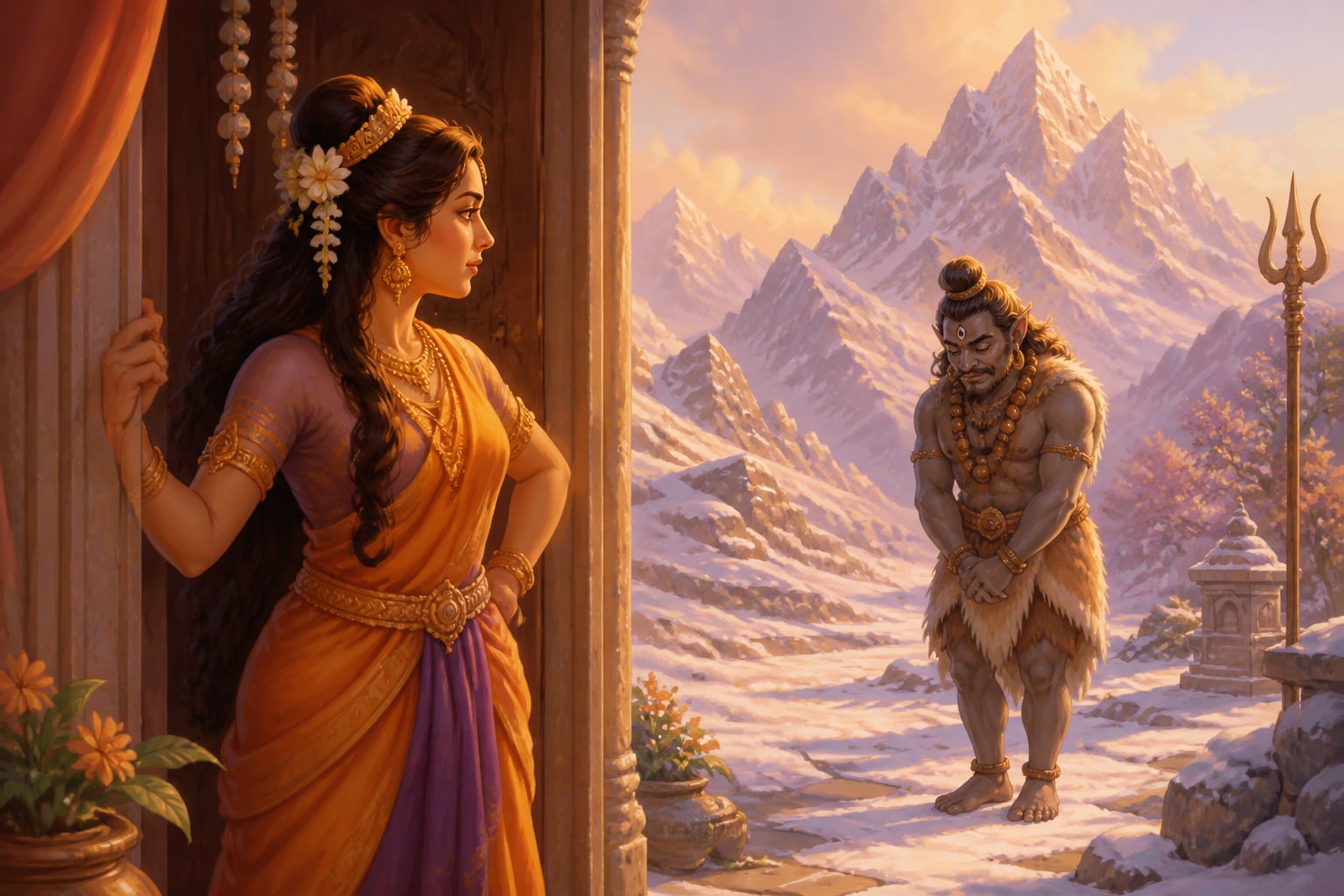
A few days earlier, when she had asked one of the ganas to stand at her door while she bathed, he had hesitated. He had not refused outright. He had simply said he would need to ask the lord first. The hesitation was small, and it was complete. Parvati had understood it. The household of Kailasa was Shiva's household. The guardians were Shiva's guardians. There was no servant of the queen that was not first a servant of the king.
She had not argued. She had walked back into her chamber and sat on the cool stone bench by the window. The thought had begun there.
The Son Made From Her Own Body
The Shiva Purana describes what happens next with great care.
Parvati scrapes the haldi paste from her own body. She gathers it in her palms. She mixes it with a little of the oil that has run down her shoulders and a few flakes of the sandalwood that had been pressed into the paste. The substance in her hands is no longer just turmeric. It is the residue of her own body, the cells of her own skin, the warmth of her own breath in the room.
She begins to shape it. The Purana does not describe the shaping in technical detail. It says only that the form was that of a beautiful boy, sundara baalaka, with curling hair, full cheeks, and the bright clear gaze of a child who has just been told he is loved. The size of a son who has just turned five.
She sets him down. She breathes on him. The Sanskrit word the Purana uses is prana-pratishtha, the establishing of life-breath, the same word used when a temple installs a stone image and turns it from stone into deity. The boy opens his eyes. He looks at her. He calls her maa.

She lifts him into her arms.
The First Instruction
The Shiva Purana then gives a small, decisive scene. Parvati holds her newborn son in her arms and walks to the door of her chamber. She sets him down. She crouches to be at his eye-level.

She says, in the Purana's own words, "You are my son. You are my own. I have made you from my own body. Today I am going to bathe. Stand at this door. Do not let anyone in. No one. Until I come out."
The boy nods. He picks up a small stick that is leaning against the wall. He stands at the door. His back is straight. His face is calm. He has been alive for less than an hour and he already knows what he is for.
The Purana lingers on the scene. There is no army. There is no boon from a higher god. There is no sage's penance behind it. There is a mother, a son, a stick, and a door. The most beloved god in Hindu life begins his story here.
Why the Mother Made a Son Without the Father
The story is sometimes read quickly as a domestic anecdote. The Shiva Purana asks the reader to read it more carefully.
The Vayu Samhita of the Purana names what is at stake. Parvati, as Adi Shakti (the original power), is not without resources. She does not lack respect from her husband. The Shiva Purana is clear that Shiva loves her completely. What she lacks, on this afternoon, is a guardian of her own. Every gana on Kailasa, every gate, every door, every privacy, runs through her husband's authority. The household is full of love. It is not yet full of her own sovereignty.
The Shaiva tradition reads the haldi-shaping as Parvati's quiet correction of this asymmetry. She does not raise the issue with Shiva. She does not call a council of ganas. She does not demand a separate establishment. She simply uses what is hers, the substance of her own body, to make what was missing.
This is one of the most radical scenes in the Puranic literature, and it is told with almost no fuss. The mother has the right to make a guardian of her own. The body of the mother is enough material to build a son. The son who guards the mother's door does not need any other authority to legitimise him.
| What Parvati did not have | What she made instead |
|---|---|
| A gana of her own | A son of her own |
| A guard who answered to her | A guard who answered only to her |
| A separate authority granted by Shiva | A separate authority shaped from her own body |
| A council to argue her case in | A small boy at her door |
The Substance of the Body Itself
The Shiva Purana's choice of haldi is not incidental. Turmeric is the most ordinary, most domestic substance in an Indian household. It sits in every kitchen. It is rubbed into the skin of every bride before her wedding in the haldi ceremony that South Asian families still perform today. It is the antiseptic on a cut, the colour of a temple offering, the warmth in the milk given to a child with a cough.
By choosing turmeric as the material of Ganesha's first body, the Purana is saying something important. The divine son is not made from a meteor or a celestial fire or a special substance reserved for gods. He is made from the most domestic possible thing. The kitchen turns out to be the same place as the cosmos. The yellow paste on a mother's arm is the same substance as the body of the most beloved god in India.
This is the deeper note of the lesson. The sacred is not somewhere else. It is in the haldi. It is in the body. It is in the residue of an ordinary afternoon's care.
A Mother's Sovereignty in Modern Frame
Adrienne Rich, the American poet writing at the City University of New York, gave the modern world her 1976 book Of Woman Born. She argued that the institution of motherhood, as imposed by patriarchal societies, was different from the experience of mothering as lived by women themselves. The institution borrowed the mother's labour while denying the mother her own authority over the household she actually built. Rich's call was for the mother's experience to be allowed to make its own structures, on its own terms, from its own substance.
The Shiva Purana, written somewhere between the eighth and the eleventh centuries of the common era, made the same point in story form a thousand years earlier. Parvati is not waiting for permission. She is not petitioning the institution. She is using what is hers, on the afternoon she needs it, in the chamber that is already hers, and the son she makes is not less divine for having been made without her husband's hand.
Sara Ruddick, at the New School in New York, made the related point in her 1989 book Maternal Thinking. Ruddick argued that the daily work of mothering, the protective attention, the preservative care, the training of a small life into a competent one, is itself a form of disciplined thought, not a domestic routine. Parvati's instruction to her son at the door, in one sentence, is exactly the kind of disciplined protective attention Ruddick names. She does not over-explain. She does not over-equip. She gives a clear post and a clear rule. The son meets the post.
The rest of Ganesha's story, the one the next lesson tells, is what happens when the post is met perfectly and the cost arrives. But the door has already been opened, in this lesson, on the first principle of the whole Ganesha-katha. The mother made him. The mother's body was the material. The mother's word is the law of his post. Everything else that follows in the Shiva Purana about Ganesha begins from this small scene of haldi, breath, and a small boy at the door.
Living traditions
The haldi-Ganesha origin story remains the most-told birth narrative of any Hindu god. Lokmanya Bal Gangadhar Tilak's 1893 reshaping of Ganesh Chaturthi into a public sarvajanik festival in Pune turned the household haldi-shaping into a community-scale celebration that today draws millions in Mumbai, Pune, Hyderabad, and the Hindu diaspora. The Shiva Purana's specific claim that Ganesha was born of Parvati alone, without Shiva's seed, has been picked up by contemporary Indian feminist scholars including Madhu Kishwar in the 1990s Manushi journal and Vrinda Nabar in her 1995 book Caste as Woman, both of whom read the story as the tradition's own indigenous theology of maternal sovereignty. Adrienne Rich's 1976 Of Woman Born and Sara Ruddick's 1989 Maternal Thinking name in modern academic terms what the Shiva Purana stated in story form a thousand years earlier. The Lenyadri temple in Maharashtra and the Pillayarpatti temple in Tamil Nadu hold the geographic memory of the lesson, and every household haldi-Ganesha at Ganesh Chaturthi is a small annual reenactment of the act this lesson opens.
- Haldi Ganesha at Ganesh Chaturthi: On the fourth day of the bright fortnight of Bhadrapada, households across India install a clay or turmeric Ganesha for Ganesh Chaturthi. In Maharashtra, Goa, Karnataka, and parts of Tamil Nadu, many families specifically prepare a small Ganesha from haldi mixed with sandal and water on the morning of the festival, in direct memory of the Shiva Purana's account. The household offers modaks, durva grass, and red flowers, sings the Ganesha Atharvashirsha, and on the eleventh day immerses the haldi murti in flowing water. The practice keeps the lesson's central image in the hands of every family that does it.
- Ganesha Sankashti Chaturthi Vrata: On the fourth day of the dark fortnight of every lunar month, devotees observe Sankashti Chaturthi, a fast for Ganesha that is broken only after moonrise. The vrata begins at dawn with a haldi-tilak applied to a small image of Ganesha and to the forehead of every household member. The Sankashtanashana Stotra is recited. The fast is held through the day. After moonrise, an arghya is offered to the moon, then the meal is taken. The monthly observance keeps the haldi-Ganesha alive in domestic ritual time, not only at the annual festival.
- Lenyadri Ganesha Temple: One of the eight Ashtavinayak temples of Maharashtra and the only one set inside a Buddhist-era rock-cut cave complex. Tradition identifies Lenyadri as the place where Parvati performed twelve years of tapas to receive Ganesha as her son. The cave temple, reached by climbing about three hundred steps cut into the hillside, holds a north-facing rock-cut image of Ganesha said to have been worshipped continuously since the early centuries of the common era. The site is read in the local tradition as the geographic memory of Parvati's mother-tapas, the inner counterpart of the haldi-shaping covered in this lesson.
- Pillayarpatti Karpaga Vinayagar Temple: One of the oldest continuously-worshipped Ganesha temples in India, dating to approximately the fourth century CE. The central murti is a six-foot bas-relief of Ganesha carved directly into a single rock face inside a cave shrine. The local tradition reads the rock-born iconography as a remembering of the haridrā-born origin in the Shiva Purana, the divine son emerging directly from the body of the earth as he once emerged from the body of his mother. The temple is the seat of the Karpaga Vinayagar tradition that spread across Chettinad and the Tamil-speaking world.
Reflection
- What in your own life is the haldi on Parvati's arm, the substance you already have on your hands that you have not yet recognised as enough material to make something whole from?
- Why does the Shiva Purana choose turmeric, of all possible substances, as the material from which the most beloved god in Hindu life is made?
- What does it mean for a god to be born of the mother alone, and how does this birth without a father reframe the way we read divine origins in the Hindu tradition?