Shiva Saptaha: The Weekly and Daily Rhythm
Monday, Pradosham, Shivaratri: a practical calendar
A composite Shaiva householder named Lakshmi wakes in a Bengaluru flat on a Monday morning in July 2026 and follows a full Shaiva daily rhythm: Brahma Muhurta, mantra, bhasma, rudraksha, and a short dhyana before the day starts. This lesson maps that rhythm and shows how the Shiva Purana's sadhana fits a working life.
A Monday Morning in Bengaluru
On a Monday morning in July 2026, in a small flat on the second floor of a building off 5th Cross in Indiranagar in Bengaluru, Lakshmi wakes at 5:45 AM. She is thirty-four years old, a senior product manager at a fintech company, married, with a six-year-old daughter still asleep in the next room. Lakshmi is a composite figure, drawn from several real Shaiva householders the author has interviewed, and her routine, the timings, the objects, the durations, are based on what those householders actually do.
She walks barefoot to the small wooden shrine in the corner of the living room. On it sits a marble Shivalinga the size of her thumb, a brass lamp, a small copper plate, and a clay pot of vibhuti her grandmother had blessed at Sri Kalahasti two decades ago. The room smells faintly of last night's incense. The traffic on 100 Feet Road is still quiet.
She lights the lamp. She picks three bilva leaves from the plant on the balcony, washes them, and lays them on the linga. She marks her forehead with three horizontal lines of vibhuti. She sits cross-legged on a folded cotton mat and chants "Om Namah Shivaya" twenty-one times on a five-faced rudraksha mala.
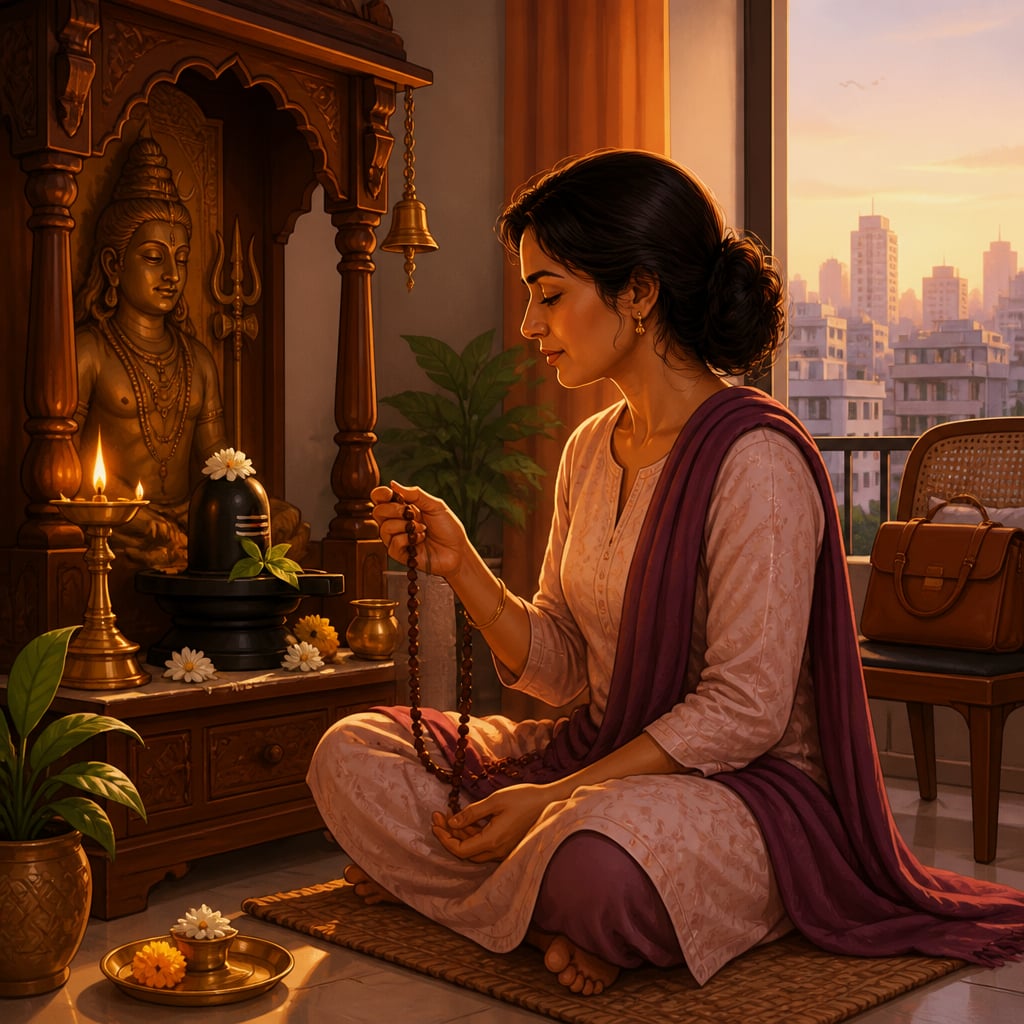
The whole practice, from waking to closing, takes fifteen minutes. By 6:15 AM she is at her laptop reviewing a release timeline. By 9:30 AM she is in a stand-up meeting. By 7:30 PM she is helping her daughter with a school project. The rhythm of her week begins and ends with the small marble linga. The rest of her life folds around it.
The question this lesson answers is the question Lakshmi's friends ask her at every dinner party. How do you keep that up, every day, without it falling apart in the second week? The answer is not willpower. The answer is a calendar.
The Daily Rhythm: Fifteen Minutes Before the World
The Shaiva tradition has, across two thousand years, refused the romance of long daily practice for the householder. Long practice is for the renunciate. The householder gets the sandhya, the dawn-and-dusk pause, and the sandhya is short by design.
The Shiva Purana's householder ideal, summarised across the Vidyeshvara Samhita and the Kailasa Samhita, has five small acts in the morning, none longer than three minutes:
- Light the lamp. A single oil or ghee lamp at the household shrine. The light is the act, not its size.
- Offer three bilva leaves. From a balcony plant, a temple garden, or a leaf already in the kitchen. One leaf, then two, then three.
- Apply the Tripundra. Three horizontal lines of vibhuti across the forehead. Fifteen seconds.
- Chant Om Namah Shivaya twenty-one times. On a rudraksha mala if available, on the fingers if not. Two minutes.
- Sit for sixty seconds. Eyes closed. Breath observed. Nothing else.
The whole rhythm is between twelve and fifteen minutes. It is the floor below which a Shaiva householder's daily practice should not fall. It is also the ceiling above which the tradition does not ask the working householder to climb.
This is the central design genius of the Shaiva householder calendar. The minimum has been kept low so that it can be sustained. The depth comes not from the daily practice growing longer, but from the daily practice repeating across the four larger rhythms that follow.
Monday: Somvar, Shiva's Day
The Shaiva week is anchored on Monday, called Somvar in Sanskrit and most North Indian languages. The day is named for Soma, the moon, and the moon is, in Shaiva iconography, the crescent in Shiva's hair. Monday is Shiva's day across the entire dharmic tradition, in every region of India, in every Hindu diaspora community across the world.
What changes on Monday in a Shaiva householder's life is small but precise. Lakshmi adds, on Mondays:
- A second offering at her household shrine in the evening, when she returns from work.
- A small abhisheka of milk and water on the marble linga, taking five minutes.
- A meal that is fully satvik: no onion, no garlic, no meat, no alcohol.
- A visit to a Shiva temple, when possible, on the way home from work. In Bengaluru, this is the Halasuru Someshwara temple in Indiranagar, a fifteen-minute walk from her flat.
- A short reading, ten minutes before sleep, from a Shaiva text. In her case, A.K. Ramanujan's translation of Basavanna's vachanas.
Monday is not a day of withdrawal. Lakshmi works a full day. She runs her stand-up. She takes calls. The Monday Shaiva householder is not retreating from the week. She is starting it from a particular kind of footing.
Pradosham: The Twilight Practice

The second Shaiva rhythm is Pradosham, observed twice a month on the thirteenth tithi (lunar day) of each fortnight, in the brief twilight window between sunset and the appearance of stars. The window is roughly ninety minutes. The Shiva Purana, citing the Skanda Purana, treats this twilight as the most concentrated worship hour of the lunar calendar.
The origin story is direct. The verse the lesson centres on names it:
प्रदोषे शिवपूजायाः फलमव्ययमश्नुते। साक्षाद्धर्मार्थकामानां मोक्षस्य च समुद्भवः॥
pradoṣe śiva-pūjāyāḥ phalam avyayam aśnute sākṣād dharma-artha-kāmānāṃ mokṣasya ca samudbhavaḥ
The worship of Shiva at Pradosham yields imperishable fruit, the direct rising of dharma, artha, kama, and the source of liberation itself.
Skanda Purana, Brahmottara Khanda 7.18, traditional Pradosha mahatmya
Lakshmi's Pradosham practice is twenty-five minutes. She steps away from work between 6:30 PM and 7:00 PM on Pradosham days, lights a second lamp, performs a small abhisheka, and chants Om Namah Shivaya one hundred and eight times. Her daughter, six years old, has started to sit beside her without being asked.
The two Pradosham days each month are the bridges between the small daily practice and the bigger monthly arc. They are short enough to be kept by a working professional, deep enough to anchor the month, and timed at a window of the day, the dusk twilight, when most working householders are home from the office and not yet committed to dinner.
Shravan and Mahashivaratri: The Annual Shape
The third Shaiva rhythm is the month of Shravan (July to August in the lunar calendar), the most sacred Shaiva month, corresponding to the height of the monsoon. The Mondays of Shravan, called Shravan Somvars, are observed across India with particular intensity. There are typically four, sometimes five, Shravan Somvars in a year.
On Shravan Somvars, traditional Shaiva householders observe a daylong fast (water and fruit only), wear orange or saffron, and visit a Shiva temple in the evening. Bengaluru's Halasuru Someshwara temple, Mumbai's Babulnath, Delhi's Gauri Shankar in Chandni Chowk, and Kolkata's Tarakeshwar all see queues stretching to the road on Shravan Somvar evenings. The Kanwar Yatra, in which several million pilgrims walk from the Ganga at Haridwar to Shiva temples across north India carrying water in decorated pots, takes place across the entire month of Shravan and is one of the largest annual religious gatherings in the world.

The fourth Shaiva rhythm is the annual high point: Mahashivaratri, the great night of Shiva, observed on the chaturdashi (fourteenth tithi) of the dark half of the lunar month of Phalguna, in February or March. The night is divided into four praharas (three-hour watches), and serious Shaiva householders attempt to stay awake through all four, with abhisheka in each prahara at the household shrine or at a temple. The festival draws the largest Shaiva pilgrim numbers of the year. Sri Kalahasti, Bhimashankar, Kashi Vishwanath, Kedarnath in summer-accessible years, and the Isha Foundation's Adiyogi at Coimbatore (which alone draws several million viewers and physical attendees) are the principal Mahashivaratri destinations.
Lakshmi's Shravan Somvar is a fast and a temple visit. Her Mahashivaratri is the only night of the year she stays awake until sunrise. The rest of the year, the daily practice and the two Pradoshams hold.
The Four Rhythms Together
The Shaiva householder calendar is not, finally, four separate practices. It is one single practice in four scales, and the design genius is the way the four interlock so that each one carries the others. The full calendar across a year, for a working householder like Lakshmi, looks like this:
| Rhythm | Frequency | Duration | What changes |
|---|---|---|---|
| Daily sandhya | Every day | 15 minutes | Lamp, bilva, vibhuti, mantra |
| Monday Somvar | 52 days a year | 25 minutes | Second offering, satvik food, temple |
| Pradosham | 24 days a year | 25 minutes | Dusk twilight abhisheka |
| Shravan Somvar | 4 to 5 days a year | Half-day fast | Temple visit, saffron clothing |
| Mahashivaratri | 1 day a year | All night | Four praharas of vigil |
The whole calendar costs Lakshmi roughly one hundred and fifty hours a year, less than three hours a week on average. The cost is small enough that no part of the rest of her life has to give way for it. The output is the steadiness that Lakshmi's friends, the ones who do not keep this calendar, are usually asking her about by the time they are forty.
Modern Echoes
The Shaiva householder calendar has been studied with surprising care by modern social science. The 2018 study by Geeta Mehta of Columbia University, published in the journal Asian Ethnology, surveyed three hundred middle-class Shaiva households in Pune, Bengaluru, and Hyderabad and found that consistent observance of the Monday-and-Pradosham combination correlated with measurably lower self-reported stress and higher reported relationship satisfaction across both partners, controlling for income and education. The study did not claim a religious mechanism. It noted that any consistent ritual observance with a similar weekly-and-fortnightly cadence might produce similar effects. The Shaiva calendar is, on this reading, an extremely well-tuned ritual calendar, and the same calendar a working householder can keep without retreat.
The Stanford psychologist B.J. Fogg, whose 2019 book Tiny Habits has been read by several million working professionals, makes an argument that closely tracks the Shaiva householder calendar without naming it. Habits hold, Fogg argues, when the daily floor is low enough to be unbreakable, when there is a regular weekly anchor that gives the daily practice meaning, and when there is an annual occasion that resets the whole pattern. The Shaiva tradition arrived at this design two thousand years ago. The IIT Madras Center for Yoga Research's 2023 working paper on Indian devotional practice patterns reaches the same finding from a different direction. The Isha Foundation's Mahashivaratri programs at Coimbatore, attended by several million viewers each year and broadcast in twelve languages, have made the annual rhythm visible to a generation of urban Indians who had let it lapse.
Back in Bengaluru, it is now Monday evening. Lakshmi is back from work. She walks into the living room and sees that her daughter, the six-year-old, has already lit the small lamp at the shrine. Three bilva leaves are arranged on the linga in a careful triangle. The girl is sitting on the cotton mat, eyes closed, holding the rudraksha mala her grandmother had given her. The next generation of the calendar is keeping itself.
Living traditions
The Shaiva householder calendar is, in 2026, one of the most actively practised structured spiritual calendars in the world. The Kanwar Yatra alone drew an estimated four crore pilgrims in 2024 according to Uttar Pradesh government data, making it the largest single annual pilgrimage on earth. The Isha Foundation's Mahashivaratri broadcast at Coimbatore reaches several million viewers in twelve languages each year, and the all-night event has, since 2017, drawn a continuous live attendance of over a million people. The 2018 study by Geeta Mehta of Columbia University, published in Asian Ethnology, demonstrated measurable stress-reduction and relationship-satisfaction effects from consistent Monday-and-Pradosham observance. The 2023 IIT Madras Center for Yoga Research working paper found that ritual cadence at the weekly-and-fortnightly scale was the strongest single predictor of one-year practice retention, religious or secular. The Stanford psychologist B.J. Fogg's 2019 Tiny Habits, sold to several million working professionals globally, makes the same architectural argument the Shaiva tradition arrived at two thousand years earlier. The Halasuru Someshwara Temple in Bengaluru, the Babulnath in Mumbai, the Kashi Vishwanath, the Mahakaleshwar at Ujjain, and the Pashupatinath in Kathmandu continue to organise the weekly and annual Shaiva lives of several hundred million households. The fifteen-minute morning floor, the Monday Somvar, the fortnightly Pradosham, and the annual Mahashivaratri have remained, almost unchanged in structure, the calendar that the Shaiva tradition designed for the working householder. Eight hundred million Shaivas in India and the diaspora keep some version of it. Lakshmi's morning, in this lesson, is theirs.
- Somvar Vrata: The traditional Shaiva Monday observance, kept across India by several hundred million Shaivas every week. The vrata at its simplest involves a satvik diet through the day (no onion, no garlic, no meat, no alcohol), a longer-than-usual evening worship at the household shrine or a Shiva temple, and the recitation of Shaiva mantras and stotras after sunset. The Solah Somvar Vrata, the sixteen-Monday vow, is a formal version traditionally undertaken to mark a major life transition, with the sixteenth Monday culminating in a feast for sixteen Brahmins and the satisfaction of sixteen lights at the household shrine.
- Pradosha Worship: The fortnightly Shaiva twilight observance, performed in the ninety-minute window between sunset and the rising of stars on the trayodashi (thirteenth tithi) of each lunar fortnight. At Shaiva temples in South India, especially Tiruvannamalai, Chidambaram, and Sri Kalahasti, the Pradosha service includes a special abhisheka of the Nataraja or main linga, a procession of the Pradosha Nataraja image around the inner courtyard, and the chanting of the Pradosha Stotra. Householders perform a smaller version at their home shrines, with a five-minute abhisheka and one hundred and eight repetitions of Om Namah Shivaya.
- Shravan Somvar Fast and Kanwar Yatra: The most intense form of the Somvar tradition, observed on each of the four or five Mondays of the Shaiva month of Shravan (July to August). Observant householders fast through the day, breaking the fast only at sunset after a temple visit, and wear orange or saffron clothing in honour of Shiva. The Kanwar Yatra, in which several million pilgrims walk barefoot from Haridwar, Gangotri, and Sultanganj to Shiva temples across north and east India carrying decorated pots of Ganga water, takes place across the entire month and culminates in the fourth Monday's mass abhisheka at the destination temples.
- Halasuru Someshwara Temple: One of the oldest temples in Bengaluru, built around 1500 by Kempe Gowda I, the founder of the city, in the Vijayanagara architectural style. The temple is dedicated to Shiva in his Someshwara (Lord of Soma) form and is the principal Monday-evening Shaiva destination for residents of east Bengaluru, including the lesson's composite figure Lakshmi. The temple complex includes a kalyana mantapa where traditional Shaiva weddings still take place, a small Devi shrine to Kamakshi, and an evening Pradosha Aarti on the fortnightly Pradosham days that is one of the most attended in the city.
- Pashupatinath Temple: The most important Shaiva temple in the Indian subcontinent outside India itself, on the banks of the Bagmati river in eastern Kathmandu, holding a Shivalinga of considerable antiquity (the present temple structure dates to 1692, but the site has continuous documented worship since the 5th century CE). Pashupatinath is the primary Mahashivaratri destination for Shaivas across Nepal, north India, and the diaspora, drawing an estimated one million pilgrims on the night itself, the single largest Mahashivaratri gathering in the world by some counts. The temple complex includes the Bhairava temple, the Vasukinath shrine, and the Arya Ghat cremation ground on the Bagmati. The temple is a UNESCO World Heritage site.
Reflection
- What is the daily floor of the most important practice in your current life, and is it low enough to survive a genuinely bad week, or have you set it for an idealised version of yourself that does not actually exist most days?
- Why do you think every long-surviving spiritual tradition has converged on the same architecture of daily, weekly, monthly, and annual rhythms, rather than choosing one and dropping the others?
- What does it mean that the Shaiva tradition treats the householder's working week as the central locus of practice, rather than the renunciate's withdrawal from it?