Netrtva: Leadership Without Ego

Decisive, detached, present

What does a Shiva-style leader look like in 2026? This lesson opens with M.S. Dhoni's bat-twirl at Wankhede on 2 April 2011 as the canonical modern image of decision without performance. It reads that moment through the Shiva Purana's teaching on leadership: act completely, take credit for nothing.

A Bat-Twirl at Wankhede

It is the night of 2 April 2011, at Wankhede Stadium in Mumbai. India needs four runs from eleven balls to win the Cricket World Cup. The bowler is Nuwan Kulasekara of Sri Lanka, running in for what may be the second-last over of the match. The crowd is forty thousand bodies pressed against the boundary fence. The lights are full. The air smells of dust and sweat and unburnt fireworks.

At the non-striker's end stands a thirty-year-old captain named Mahendra Singh Dhoni. He has done something no one watching the match was expecting. Yuvraj Singh, the in-form left-handed all-rounder, was supposed to bat at number five. Dhoni, who had been struggling with the bat through the entire tournament, has promoted himself ahead of Yuvraj. He has put his own bat on the line at the moment the country has waited twenty-eight years for.

The decision was not put to a committee. The captain made it walking out of the pavilion.

Kulasekara comes in. The ball is full and on the legs. Dhoni picks it up with a clean, unhurried swing of the bat. The ball sails over the long-on boundary. Six. India wins.
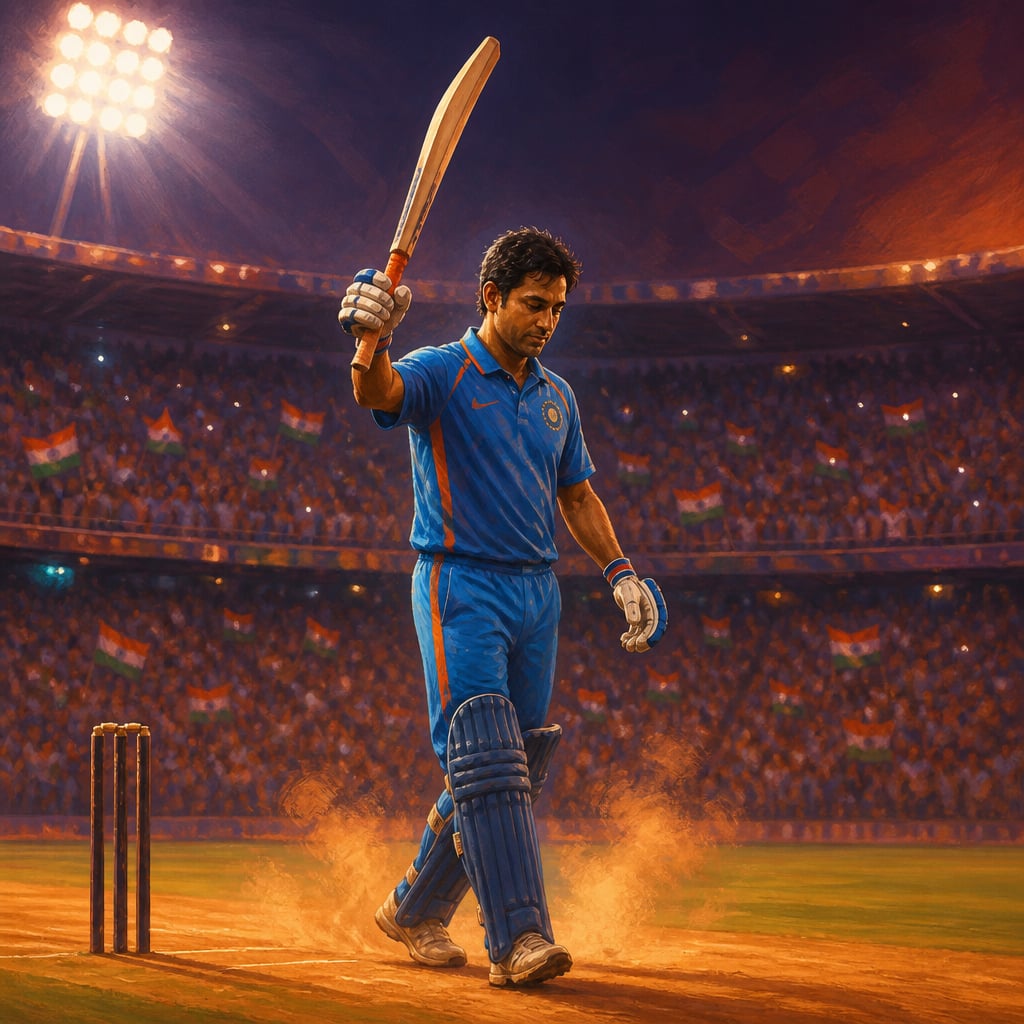
MS Dhoni at Wankhede after the winning six, twirling the bat in his right hand

The thing that happened next is the entire content of this lesson.

Dhoni did not run. He did not punch the air. He did not roar. He twirled the bat once in his right hand and stood at the crease, watching the ball clear the rope. Then, slowly, he began to walk. That walk was a Shaiva teaching delivered through a bat-twirl. What follows is what a Shiva-style leader actually looks like, in 2026, in a meeting, in a hospital corridor, in a school's parent-teacher conversation, and in a moment like that one at Wankhede.

The Two Forms of Shiva the Leader Becomes

The Shaiva tradition gives us two iconographic forms of Shiva that leaders are meant to study. They are not two different gods. They are two angles on the same inner posture.

The first is Nataraja, the dancing form, the most globally recognised image of Shiva. The bronze sculpture, perfected by the Cholas at Chidambaram in the 11th century, is precise. The right foot of Nataraja is firmly placed on the back of a small demon called Apasmara, the demon of forgetfulness and inertia. The left foot is raised in the air, signalling liberating grace. Four arms encircle the figure: a drum (creation), a flame (dissolution), one hand raised in the abhaya mudra (do not fear), and one hand pointing toward the raised foot (the way out). At the absolute centre of all this motion, Nataraja's face is smiling.

The second form is Dakshinamurti, the south-facing teacher. He sits under a banyan tree, facing south, the direction of Yama, the direction of endings. At his feet sit the four Kumaras, the four child-sages who had read every scripture and still not understood the deepest truth. Dakshinamurti does not speak. He simply sits. The Kumaras understand, in his silence, what the texts could not give them.

Most leadership writing focuses on one or the other. Decisive action without silence becomes Nataraja without Dakshinamurti, the leader who acts but cannot listen. Silent presence without action becomes Dakshinamurti without Nataraja, the wise person who sees clearly but never decides. The Shaiva tradition insists on both, in the same posture, at the same moment.

Quality One: Decisive Action

Nataraja dancing with his foot on Apasmara

The right foot of Nataraja is the entire teaching on decisiveness.

Apasmara, the demon under the foot, is not a person. Apasmara is inertia, forgetfulness, the gravitational pull of the comfortable choice. Every leader meets Apasmara every working day. The hire that should have been made last quarter and was not. The conversation that has been on the agenda for three meetings and is still being deferred. The product feature that the team has been polishing for six weeks instead of shipping. Apasmara is the thing that wants the decision postponed by one more day.

The Shiva-style leader does not negotiate with Apasmara. The right foot lands. The decision is made. The risk is taken.

Dhoni's promotion of himself in the batting order at Wankhede was a textbook example. The in-form player was Yuvraj. The struggling captain was Dhoni. The conventional choice was to send Yuvraj. Apasmara would have said: do not change the lineup. Stick with what is working. Do not be the captain who took the bat away from the team's best batsman in the World Cup final.

Dhoni placed his foot on Apasmara and walked out. He did not weigh the decision in front of cameras. He did not consult the dressing room. The decision had to be his alone, and it had to be made before the moment came. That is the right foot.

Quality Two: Detachment from the Outcome

Notice what the iconography does not show. Nataraja's face is not contorted with effort. The right foot is firmly placed but the body is not tense. The eyes are calm. There is, the Cholas insisted, a small smile at the centre.

This is the second quality, and it is the harder one. Shiva acts decisively but is not invested in winning. The dance happens because the cosmos requires it, not because Shiva has something to prove. The drum and the fire are equal in the dance. Creation and dissolution are equally welcome. Whatever the dance produces, the dancer remains the same.

Dhoni's bat-twirl was the closest modern image of this we have on film. The ball had cleared the boundary. The country had won. The captain had been redeemed in the most public possible way. And the man who had hit the shot did not look like he had won anything. He looked like a person who had completed a task. The smile, when it came, came slowly, and stayed small.

The leadership texts will tell you this is hard to fake. Jim Collins, in his 2001 book Good to Great, used the term Level 5 Leadership for this exact quality. Level 5 leaders, his five-year research with a team of twenty-one analysts at Stanford concluded, look out the window when assigning credit, and into the mirror when assigning blame. They are decisive, but they are not invested in being seen as decisive. The smile at the centre of the dance is, in Collins's data, the strongest single predictor of whether a company sustains greatness across decades.

Quality Three: Silent Authority

Dakshinamurti teaching the four Kumaras in silence

The third quality is what Dakshinamurti teaches. The four Kumaras came to him because they had read every scripture. They did not need more words. They needed the silence underneath the words. Shiva, facing south, gave them exactly that.

The leadership translation is precise. Most senior leaders over-explain. They send long emails, give long speeches, deliver long performance reviews, write long strategy memos. The team has, in most cases, already understood the situation. What the team does not have is a leader who can sit with the situation without filling the silence with more talk.

The Shiva-style leader speaks less than the room expects. When they do speak, the sentence is short. The instruction is precise. The follow-up is brief. The team learns that words from this leader have weight, because the leader does not spend them on filler.

Dhoni, again, is the standing modern example. His press conferences were famously short. His on-field communication with the bowlers was famously minimal. His memoir, when it was finally written, was sparing on words. The cricket commentator Harsha Bhogle has noted in multiple columns that the most striking thing about Dhoni in the dressing room was how little he said and how completely the room paid attention when he spoke.

The Three Qualities Together

You can hold any one of the three qualities and be a competent leader. You can hold any two and be a strong leader. The Shaiva claim is that holding all three at the same time is what produces the kind of leadership that compounds across decades and that the team continues to talk about long after the leader has left.

Quality Iconographic Source What It Looks Like in 2026
Decisive Action Nataraja's right foot on Apasmara The hard call, made on time, alone
Detachment from Outcome The smile at the centre of the dance No personal investment in being right
Silent Authority Dakshinamurti facing south Words spent rarely, weighed when used

The lesson is not asking you to become a captain in a World Cup final. The Shaiva tradition is asking you, in your Tuesday morning standup, in the difficult parent-teacher meeting, in the hospital decision about an aging parent, to bring all three to the room. The decision Apasmara has been postponing. The detachment that lets the decision land cleanly. And the silence that lets the team find their own footing once you have spoken.

Modern Echoes

Robert Greenleaf, in his 1970 essay The Servant as Leader, wrote that the leader who serves the team rather than the team serving the leader is the only kind of leadership that scales over time. His framework, developed at AT&T over the 1960s and now studied in business schools across the world, is a Western recovery of what the Cholas put in bronze a thousand years earlier. Servant leadership is Nataraja's right foot under the demon and the smile at the centre, in a single phrase.

Closer to home, Verghese Kurien, the founder of Amul and the architect of India's White Revolution, ran the Gujarat Co-operative Milk Marketing Federation from Anand for three decades with a leadership style that observers consistently described in Dakshinamurti terms. He spoke softly, made decisions without committees, and held a small office at the cooperative for thirty years without ever moving to a corner office. His memoir I Too Had a Dream (2005) is, in many ways, the most accessible modern manual on Shiva-style leadership written in Bharat.

Anand Mahindra, the chairman of the Mahindra Group, is among the few CEOs of Indian conglomerates who routinely names the Indic leadership tradition as the source of his approach. In a 2018 lecture at IIT Madras, he traced his own preference for decisive action without ego back to the Nataraja bronzes he saw at the Government Museum in Chennai as a boy.

Back to Wankhede

Back at Wankhede, on the night of 2 April 2011, the captain has finished his bat-twirl. The crowd is roaring. The team is running toward him. He has not yet smiled fully. He turns toward the dressing room with the look of a man who has just placed his foot on Apasmara, watched the ball clear the boundary, and is now walking back to his seat to complete the day's work.

That walk is the closing image of this lesson. Decisive action. Detachment from the outcome. Silent authority. The three forms of Shiva at the centre of one ordinary captain's ordinary night. The Shaiva tradition has been training leaders to walk like this for three thousand years. It is still available, in your next meeting tomorrow, in whatever Wankhede you happen to be standing in.

Historical context

Chola Bronze Age to Modern Bharat (roughly 8th century CE to present)

The iconography this lesson invokes was perfected during the high period of Chola rule in South Bharat (roughly 850 to 1280 CE). The Cholas were the most ambitious Shaiva patrons in Indian history, building temples on a scale that had not been seen before. Rajaraja I (985 to 1014 CE) consecrated the Brihadeeswara Temple at Thanjavur in 1010 CE; his son Rajendra I extended the empire to the Ganges in the north and to Sumatra and the Malay Peninsula by sea. The dynasty's artistic centrepiece was the Chidambaram Nataraja Temple, where the bronze Nataraja form, depicting Shiva's cosmic dance, was codified by hereditary sthapati (sculptor) lineages and the Dikshitar priesthood. From the 11th century onward, the form spread through the Chola kingdom and beyond, becoming the standard depiction of dancing Shiva across South Bharat, Sri Lanka, and the Chola maritime sphere of influence in Southeast Asia. The Dakshinamurti form, codified in Adi Shankara's 8th-century stotram, had by the 11th century become the standard depiction of Shiva as silent teacher in temple sub-shrines across the same region. The modern recovery of these forms as a leadership manual began in the late 20th century with Fritjof Capra's 1975 The Tao of Physics, the 2004 CERN Nataraja installation, and the published reflections of Indian leaders like Anand Mahindra and Verghese Kurien.

Living traditions

The Nataraja form has crossed more cultural and disciplinary boundaries in the modern era than perhaps any other Shaiva icon. In 2004, the Government of India presented a two-metre bronze statue of Nataraja to CERN, the European Organisation for Nuclear Research in Geneva, where it stands at the entrance to the laboratory that runs the Large Hadron Collider. The plaque cites Fritjof Capra's 1975 book The Tao of Physics, which drew the parallel between Nataraja's cosmic dance and the rhythm of subatomic particle physics. Anand Mahindra, the chairman of the Mahindra Group, has cited the Nataraja bronzes at the Government Museum Chennai as the early personal source of his preference for decisive-but-detached leadership; he discussed this publicly in a 2018 lecture at the Indian Institute of Technology Madras. Verghese Kurien, the founder of Amul, ran the Gujarat Co-operative Milk Marketing Federation from a small office at Anand for three decades with a leadership style that contemporaries described in Dakshinamurti terms; his 2005 memoir I Too Had a Dream is among the most accessible modern manuals on Shiva-style leadership written in Bharat. Indian Institute of Management Bangalore and the Indian School of Business have used both M.S. Dhoni's 2011 World Cup batting promotion and Kurien's Anand model in leadership case discussions since the early 2010s. The form the Cholas perfected in bronze continues to teach, in temples, in museums, in particle physics laboratories, and in business schools, exactly the synthesis the lesson names: decisive action, detachment from outcome, silent authority.

Reflection

More in Living Shiva Today

All lessons in Living Shiva Today ยท Shiva Purana course