Sadharana: Minimalism, Silence, and the Ash-Smeared Life
Relief disguised as austerity
At his death in January 1948, Gandhi's personal possessions sat on a small table behind glass at the Aga Khan Palace: fewer than ten items. Shiva on Kailasa owns less. This lesson reads the ash-smeared life not as poverty but as the freedom that comes from needing very little, and asks what that looks like for a person in a city in 2026.
A Small Table in Pune
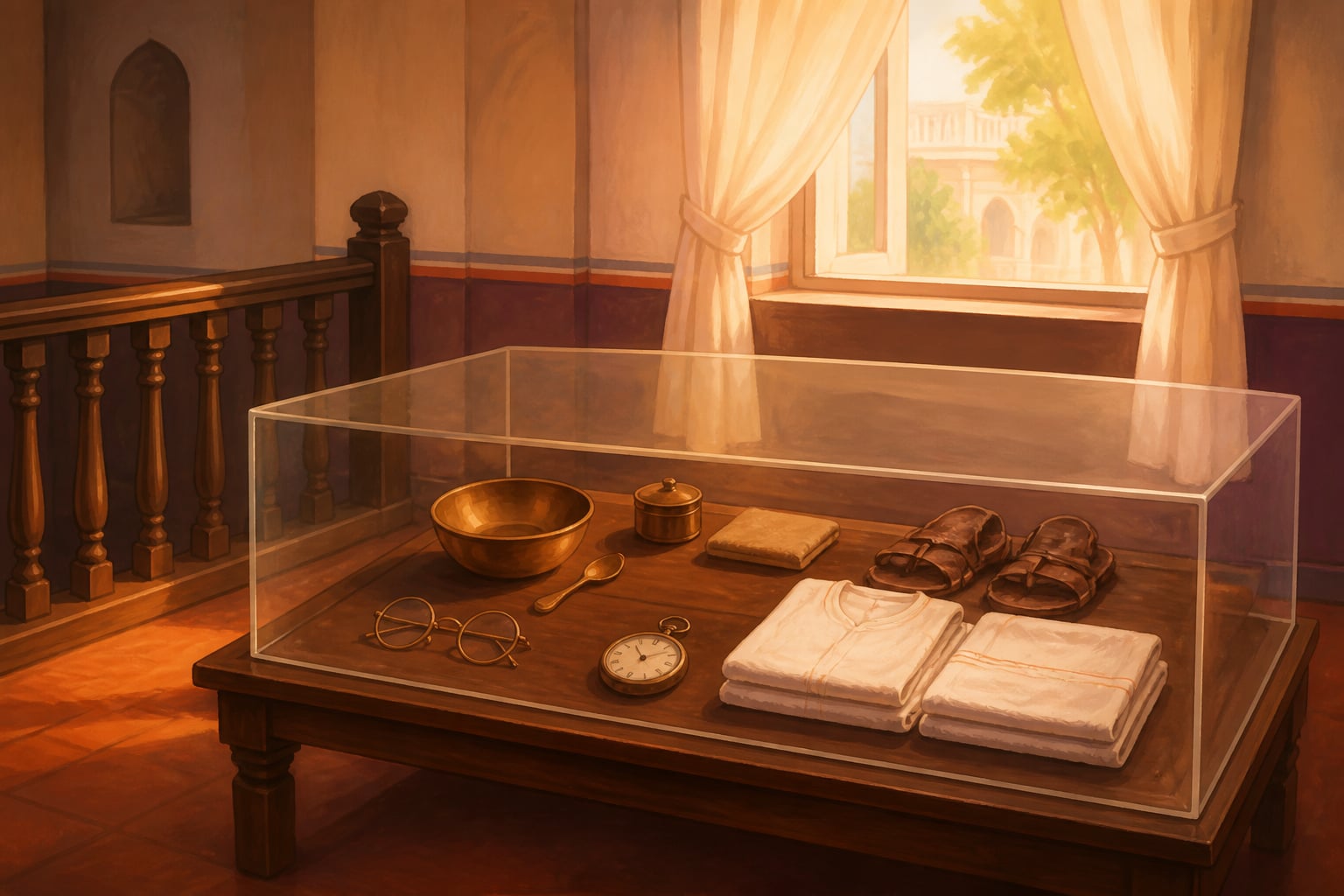
In a quiet upstairs room of the Aga Khan Palace in Pune, behind a single glass case, sits a small low table. The table is barely a metre wide. On it are arranged the complete personal possessions of Mahatma Gandhi at the time of his death on the evening of 30 January 1948. The label, written in plain Devanagari and English, lists the items. Two pairs of glasses. A pocket watch. A pair of leather sandals. A fountain pen. A small notebook. A copy of the Bhagavad Gita. Three small monkey statues, the see no evil, hear no evil, speak no evil set. A small brass bowl.
That is the entire list.
The man who carried these items had also, by then, carried the political weight of three hundred and fifty million people through the longest non-violent freedom movement in modern history. He had walked from Sabarmati to Dandi in 1930 with this same notebook. He had negotiated with Lord Mountbatten in 1947 with this same fountain pen. He had ended his every evening for the last quarter-century reading the Gita on this same charpoy mat that travelled with him.
Gandhi was not pretending. The list on the small table is the actual list. A senior Indian leader who could have held any palace, any wardrobe, any retinue, chose to live and to die owning what could fit in a small wooden box.
If this image has the texture of something familiar, it is because Gandhi was, in the most direct sense, doing something the Shaiva tradition had taught for three thousand years before him.
The Kit of Shiva
The Shaiva tradition has its own famous list. The thirty-first verse of the Shiva Mahimna Stotram, which the lesson on Shri Rudram introduced, sets out the entire personal inventory of Shiva.
महोक्षः खट्वाङ्गं परशुरजिनं भस्म फणिनः। कपालं चेतीयत्तव वरद तन्त्रोपकरणम्॥
mahokṣaḥ khaṭvāṅgaṃ paraśur ajinaṃ bhasma phaṇinaḥ kapālaṃ cetīyat tava varada tantropakaraṇam
A great bull, a skull-staff, an axe, a deer-skin, ash, serpents, and a skull-cup. This is the whole of your equipment, granter of boons.
Shiva Mahimna Stotram, verse 31, by Pushpadanta
The list is precise and final. Bhasma, sacred ash. A deer-skin. The bull Nandi as ride. A trishula (trident) as weapon. A kapala (skull-cup) as vessel. A few snakes. A rudraksha string. That is the entire wardrobe and toolset of the deity from whose silence the Shaiva tradition believes the universe issues. The verse goes on to make the doctrinal point. From this minimal kit, Shiva creates and dissolves universes. The minimal kit is not the leftover. It is the primary fact.

This is the single image the lesson asks the reader to carry. A god who owns almost nothing. A modern leader who owned almost nothing. The two figures are pointing at the same teaching, eight thousand kilometres and three thousand years apart.
Own Less
The first leg of the chapter is the simplest. Own less.
The Shaiva tradition treats accumulation not as wealth but as friction. The more an asker owns, the more they have to maintain. The more they maintain, the more decisions they have to make about maintenance. The more decisions they have to make, the less attention they have for the work that actually matters. By the time most modern professionals are forty, the household has reached a level of accumulation at which a significant fraction of every weekend goes into managing things rather than using them.
The Sanskrit term for this principle is aparigraha, non-grasping. Patanjali names it as the fifth of the five yamas (ethical foundations) in the Yoga Sutras. The corresponding positive virtue is santosha, contentment, the second of the five niyamas. Aparigraha is the not-grabbing. Santosha is the actual sufficiency. The two are paired in classical Yoga because, the tradition says, they cannot be separated. You cannot have one without the other.
The modern research is unambiguous. In 2014, the Princeton Neuroscience Institute (Stephanie McMains and Sabine Kastner, Journal of Neuroscience) published a study showing that visual clutter in a workspace measurably degrades the brain's attention system. Cluttered environments create cognitive load even when the items in them are not being actively considered. The 2010 work of the psychologist Sonja Lyubomirsky at the University of California, Riverside, separately found that experiences produce more durable happiness than possessions of equivalent monetary value. The ancient teaching had reached the same conclusions by inward inspection. The clutter slows you down. The clutter is not free.
Say Less
The second leg is the harder one. Say less.
Chapter 11's lesson on maunam laid the foundation. Silence is not the absence of speech but its more concentrated form. The application here is practical. Most modern professional and personal life involves a continuous low-level production of speech that adds nothing to the situation it pretends to address.
Gandhi's own diaries record a striking detail. He maintained an absolute weekly silence vow every Monday of his adult life, from 1925 until his death in 1948. He wrote with the fountain pen on the small notebook when he had to communicate. The day was not for retreat. He continued to work. He met visitors. He drafted statements. He simply did not speak. By his own account, the productivity of the Monday equalled or exceeded the productivity of any other day, often by a wide margin.
The Shaiva tradition reads this not as discipline but as relief. The asker who has not spoken for a day, by Monday evening, has noticed something subtle. A great deal of the speech the asker had been producing was not for the listener. It was for the asker, to fill the small anxieties that would otherwise have surfaced. Removing the speech does not reveal a problem. It reveals a quiet that was always there. The day grows longer. The mind sharpens. The relief is the data.
Take Yourself Less Seriously
The third leg is the one most adults get last. Take yourself less seriously.
The ash that Shiva smears across his body is not from any furnace. It is from the cremation ground. The Aghori at the Manikarnika ghat in Varanasi still gather it from the same fires the Shiva Purana describes. The reason the tradition specifies cremation ash is precise. Bhasma is the daily reminder of mortality. The body smeared in it is a body that has remembered its own ending.
A body that has remembered its own ending poses less. It also smiles more. Most adult posing, if examined honestly, is the body's protest against the fact that it will become ash. The ego works to maintain a face that the funeral will eventually burn anyway. The Shaiva tradition's insight is that the daily contemplation of the actual ending releases the body, paradoxically, from the gravity it had been carrying. Once you have looked at the ash, the morning's small slights, the boss's email, the awkward exchange at the elevator, all become smaller. The Shaiva yogi smeared in ash is often, in the iconography, also smiling.
The Roman Stoics, working in a parallel tradition, called this memento mori. Marcus Aurelius wrote in his Meditations (around 170 CE) that the daily contemplation of death dissolves the puffed-up self. Recent psychological research, including the work of Sheldon Solomon, Jeff Greenberg, and Tom Pyszczynski (the Terror Management Theory tradition since 1986), has shown that controlled contemplation of mortality, in the right register, increases altruism, reduces materialism, and improves decision quality. The bhasma is the ancient tool for the same outcome.
Why This Looks Like Austerity But Is Not
The single largest misreading of this chapter is the assumption that minimalism is austerity. The Shaiva tradition rejects this reading.
| Austerity (the misreading) | Sadharana (the actual teaching) |
|---|---|
| Denying yourself things you want | Returning to sufficiency you already had |
| Performance of poverty | Quiet sense of being un-burdened |
| Reduction of joy | Removal of friction from joy |
| Imposed by external rule | Chosen as inner relief |
| Visible, declared, performed | Invisible, comfortable, daily |
The Shaiva yogi smeared in ash is not denying himself silk. He is, in the doctrine of the Shiva Purana, simply someone for whom silk has stopped registering as something worth wanting. The deer-skin is not a renunciation of the woven cloth. It is what the body wears when the question of wearing has stopped being interesting. The same applies to the loincloth, the begging bowl, the trident. None of it is performance. All of it is what is left when the asker has stopped asking for the things that did not satisfy the previous asking.

The Lingayat tradition, founded by Basavanna in twelfth-century Karnataka, took this principle to its logical end. Every Lingayat devotee carries an Ishta-Linga, a small portable linga, in a thread around the neck. The temple is on the body. The deity is portable. The entire Shaiva paraphernalia, all the temples and rituals and mediating priests, can be reduced, the Lingayat insists, to one small object that fits in the palm of the hand. The eight to ten million Lingayats in modern Karnataka still wear the Ishta-Linga. They are walking arguments for the Shaiva chapter the lesson is teaching.
A Quiet Closing
Back at the Aga Khan Palace, the small low table sits in its case. The visitors filing through often pause without speaking. The list is the lesson. It is the lesson Shiva has been teaching from Mount Kailasa for three thousand years, restated in the language of a twentieth-century Indian leader who held the political weight of a sub-continent while owning what fit in a small wooden box. The bhasma was the Gita on the table. The trident was the fountain pen. The deer-skin was the white khadi.
The ash-smeared face is also a smile. The body that has remembered its ending poses less, owns less, says less, and laughs more easily. This is what the chapter calls the relief disguised as austerity.
The next lesson moves from the inner aesthetic to the outer relationship, from how Shiva dresses to how Shiva relates. The Ardhanarishvara test at home and the Uma-Maheshwara dialogue at work. The yogi who has stopped grasping is now ready to actually meet another.
Living traditions
The Shaiva sadharana teaching has had an extraordinary modern afterlife. Mahatma Gandhi's lifelong personal minimalism, with fewer than ten possessions at his death and a weekly Monday silence vow from 1925 to 1948, is the most powerful twentieth-century enactment of the Shaiva ash-smeared life in active public service. The 2014 Princeton study by Stephanie McMains and Sabine Kastner provided the first peer-reviewed neurological confirmation that visual clutter measurably degrades the brain's attention system, finding what the Shaiva tradition had held by inward observation for three millennia. Sonja Lyubomirsky's 2010 work at UC Riverside found experiential goods produce more durable happiness than possessions of equivalent monetary value, the same finding the Isha Upanishad's opening verse (tena tyaktena bhunjitha, enjoy through renunciation) reached three thousand years earlier. In the contemporary minimalism movement, Joshua Becker's Becoming Minimalist (founded 2008), Joshua Fields Millburn and Ryan Nicodemus's The Minimalists (founded 2010), Marie Kondo's KonMari method (2011), and Cal Newport's Digital Minimalism (2019) have each, in different vocabularies, rediscovered architectural pieces of the Shaiva position. Among contemporary leaders, the late Steve Jobs's famous black turtleneck and minimal personal possessions, Warren Buffett's notoriously simple Omaha office, and the Lingayat industrialist communities of Karnataka who carry the Ishta-Linga to corporate boardrooms all echo the same teaching across remarkably different idioms. The Naga sadhus at the Kumbh Mela, drawing tens of millions of pilgrims to their shahi snan, remain the most uncompromising visible enactment. Across all of it, the Shaiva claim that minimalism is not austerity but relief continues to be independently rediscovered, generation after generation, by people who have run the experiment of accumulation and found it wanting.
- Bhasma-Dharana and the Tripundra: The daily Shaiva practice of applying sacred ash (bhasma or vibhuti) to the forehead, arms, and chest, often in the form of three horizontal lines called the tripundra. The ash is traditionally collected from a sacred fire (havan), purified cow dung burnt in a specific way, or in the strict Aghora tradition, directly from the cremation ground. Each line of the tripundra has an inner significance: the three gunas (sattva, rajas, tamas), the three malas (impurities) being burned, or the three powers (ichchha, jnana, kriya) being remembered. The application takes thirty seconds. It is, structurally, the most accessible Shaiva practice of all.
- Naga Sadhu Tradition at the Kumbh Mela: The Naga (literally naked) sadhus are the most radical living Shaiva minimalists, organised into thirteen akharas (orders) descended from Adi Shankaracharya's eighth-century reform. They wear no clothes, owning only a small loincloth or sometimes nothing at all, and are smeared head to foot in bhasma. They appear publicly at the Kumbh Mela cycles (Prayagraj, Haridwar, Nashik, Ujjain, every twelve years on a rotating schedule), where they lead the shahi snan (royal bath) processions into the river. The largest gathering of Naga sadhus on a single day, at the Maha Kumbh at Prayagraj in 2025, exceeded 200,000.
- Lingayat Ishta-Linga: Founded by Basavanna in twelfth-century Karnataka, the Lingayat tradition gives every initiated devotee a small portable linga, the Ishta-Linga, which is worn on the body in a thread around the neck or in a small cloth pouch over the heart. The devotee performs a daily personal worship of the Ishta-Linga, bathing it with water and offering bilva leaves. There is no temple, no priest, and no ritual specialist between the devotee and the deity. The entire Shaiva paraphernalia, in the Lingayat reform, is reduced to one object that fits in the palm of the hand.
- Sabarmati Ashram (Gandhi Ashram): Established by Mahatma Gandhi in 1917 on the western bank of the Sabarmati river, this is the ashram from which the Dandi Salt March was launched on 12 March 1930. The ashram is preserved largely as it was during Gandhi's residence. Visitors can see Hriday Kunj, Gandhi's personal living quarters, where his actual possessions (the charkha spinning wheel, the writing desk, the few books, the simple bedding) remain in place. The ashram also houses an extensive museum with original letters, manuscripts, and the famous photograph of Gandhi's complete possessions at his death. Walking through Hriday Kunj is the closest a contemporary visitor can come to seeing the chapter's central image alive. The ashram is free to enter and remains an active centre of Gandhian work.
- Manikarnika Ghat: The principal cremation ghat of Varanasi and one of the most sacred sites in the Shaiva world, in continuous use as a cremation ground for over three thousand years. The ghat is the operational source of much of the bhasma used in traditional Shaiva worship across north India. The Aghori sadhus, the most uncompromising Shaiva minimalists, maintain a permanent presence at the ghat, gathering ash and performing tantric rituals within sight of the funeral pyres. The ghat operates twenty-four hours a day. An estimated three hundred to three hundred and fifty cremations are performed daily, the eternal flame at the centre having burned, the tradition holds, without interruption since at least the twelfth century. Visitors are welcome but should observe the rules (no photography of cremations, modest dress, respectful silence). The visit, even brief, is the most direct possible encounter with the lesson's central image.
Reflection
- Pick one category of your possessions (clothes, books, kitchen, devices). What proportion of items in that category have you used in the last six months? What does the unused fraction tell you about your asking?
- Why does the Shaiva tradition specify cremation ash, rather than ordinary ash, as the substance Shiva wears?
- If sufficiency is the original condition and accumulation is the deviation, why does almost every human society default to accumulation as the visible measure of a life well lived?