Kamakhya: The Bleeding Goddess
The Yoni (womb) of Sati and the Ambubachi Mela
Explore the most sacred and mysterious of all Shakti Peethas - Kamakhya in Guwahati. Understand the profound symbolism of menstruation worship, the Ambubachi Mela when the goddess bleeds, and why this temple is the heart of tantric Shaktism.
Kamakhya: The Bleeding Goddess
The Womb of the World
Of all the places where Sati's body fell to earth, none carries more mystery, more power, or more controversy than Kamakhya. Here, on Nilachal Hill overlooking the Brahmaputra River in Assam, fell the most intimate part of the goddess, her yoni, the womb and generative organ.
In a culture where menstruation was often considered impure, Kamakhya became a radical sacred space: a temple that celebrates the goddess's monthly bleeding as the holiest event of the year. Here, the processes that orthodox religion sought to hide are displayed, honored, and worshipped as the very source of cosmic creation.
This is not spirituality that transcends the body. This is spirituality that dives directly into the body's deepest mysteries.
The Hill That Desired
The name Kamakhya derives from kama (desire) and akhya (renowned), "she who is famous for desire." But the hill itself, Nilachal ("Blue Mountain"), carries its own legend.
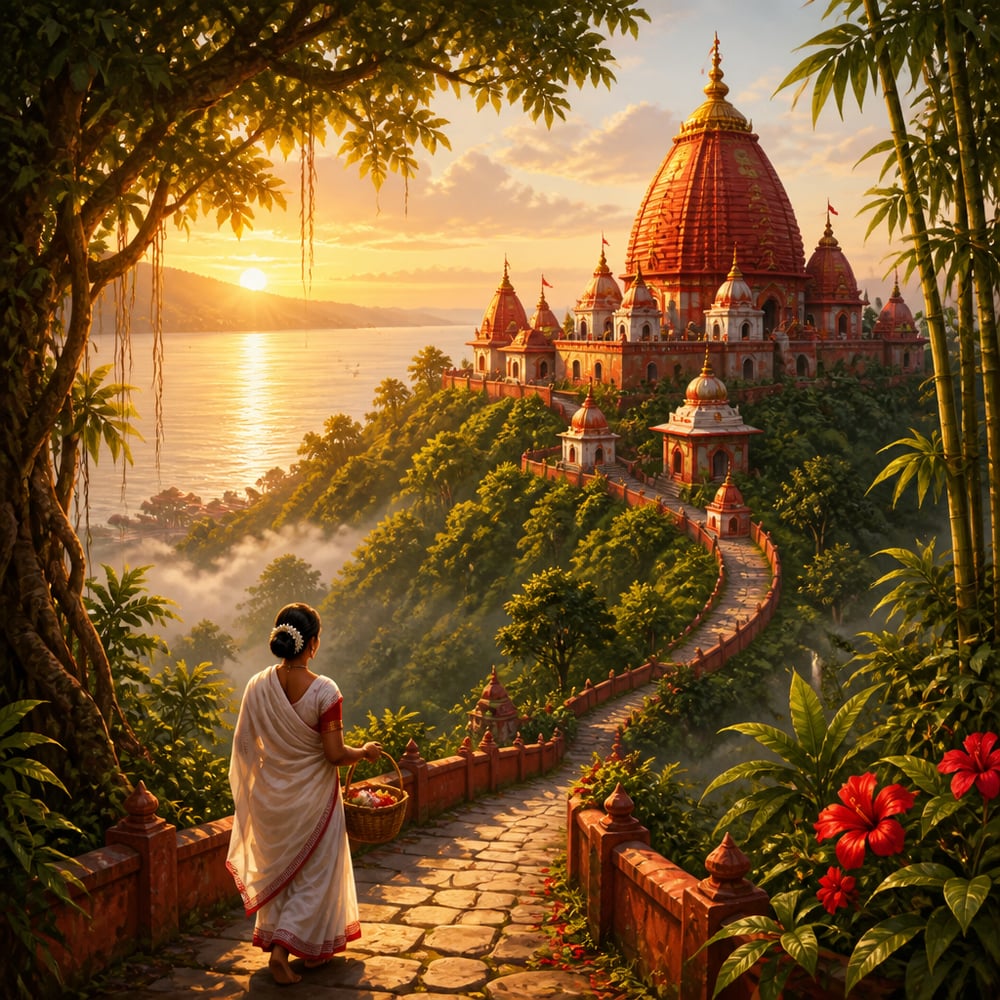
According to the Kalika Purana, before Sati's body part sanctified this place, the hill was already sacred. Shiva and Sati would come here for their cosmic lovemaking, hidden among the blue-tinged trees. When Sati's yoni fell here, it was as if the goddess chose to return to the place of her greatest intimacy with Shiva.
Another legend speaks of Kamadeva, the god of desire, who was cursed to lose his physical form when Shiva burned him to ash. Here at Nilachal, Kamadeva regained his body through the goddess's grace. The hill became forever associated with the redemption of desire, not its destruction, but its transformation into something sacred.
The Sanctum Without an Idol
Descend the stone steps into Kamakhya's inner sanctum, and you will find something that surprises many first-time visitors: there is no carved image of the goddess.
Instead, in a cave-like chamber, water from an underground spring flows over a natural rock formation shaped unmistakably like a yoni. This cleft in the stone, perpetually moist, is the goddess herself. No human artisan created her form, the earth itself manifested the sacred feminine.
The stone is covered with red sindoor (vermillion) and draped with red cloth. Fresh flowers, especially red hibiscus, the goddess's favorite, pile around it. The priests pour water and milk over the stone, maintaining the constant moisture that symbolizes the goddess's living presence.
For devotees, this is not symbolism. This is Kamakhya, the cosmic womb through which all beings enter existence, the gateway between the formless and the formed.
When the Goddess Bleeds

Once a year, during the monsoon month of Ashadha (June-July), something extraordinary happens: the Brahmaputra River runs red near Nilachal Hill, and the spring water flowing over the yoni stone turns the color of blood.
The scientific explanation points to iron-rich soil and particular monsoon conditions. But for the millions who believe, this is the goddess's annual menstruation, Ambubachi, the time when Kamakhya bleeds as all fertile women do.
During Ambubachi, the temple closes for three days. The goddess is said to be undergoing her period, and like any menstruating woman in traditional society, she takes rest. No worship is performed. No devotees enter.
On the fourth day, the temple reopens in an explosion of celebration. The cloth that covered the yoni stone, now stained red, is cut into tiny pieces and distributed as Angavastra or Rakta Vastra (blood cloth), the most sacred prasad in all of Shakti worship. Pilgrims who receive a fragment of this cloth believe they carry the goddess's menstrual blessing itself.
The Tantric Epicenter
If Kalighat represents tantric practice accessible to householders, Kamakhya represents tantra at its most intense and esoteric. This is the seat of the Vamachara, the left-hand path that deliberately transgresses ordinary religious and social boundaries.
The logic of Vamachara is radical: that which binds ordinary people can liberate the prepared practitioner. The five makaras (the "five M's", wine, meat, fish, grain, and sexual union) that mainstream Hinduism prohibits become sacraments here. The point is not indulgence but transformation, using the energy trapped in taboo to fuel awakening.
Kamakhya has been the training ground for tantric adepts for over a thousand years. The Kalika Purana, composed in this region around the 10th century, codified many of these practices. Tantric texts describe complex rituals performed in the temple's cremation grounds and subsidiary shrines, practices that outsiders find disturbing but that initiates understand as the fastest (and most dangerous) path to liberation.

The Ten Mahavidyas
Within the Kamakhya temple complex stand individual temples to the ten Mahavidyas, the "Great Wisdom Goddesses" who represent different aspects of the supreme feminine.
These are not gentle deities:
Kali, Time and death, the most famous of the fierce goddesses
Tara, The guide who carries devotees across the ocean of existence
Tripura Sundari (Shodashi), Supreme beauty and the sixteen aspects of desire
Bhuvaneshwari, The queen of the worlds, space itself as goddess
Bhairavi, Fierce austerity and the heat of spiritual practice
Chinnamasta, The self-decapitated goddess who feeds others with her own blood
Dhumavati, The widow, representing all that is inauspicious, teaching acceptance of loss
Bagalamukhi, The crane-headed one who paralyzes enemies
Matangi, The outcaste goddess, patron of art and the marginalized
Kamala, The lotus goddess, abundance and the blessing side of Shakti
Together, the Mahavidyas represent the full spectrum of feminine power, beautiful and terrifying, creative and destructive, socially acceptable and utterly transgressive. To worship at Kamakhya is to encounter all of them.
Umananda: The Island Bhairava
Every Shakti Peetha has its Bhairava, and Kamakhya's guardian is Umananda, whose temple sits on Peacock Island (Umananda Island) in the middle of the Brahmaputra River, visible from Nilachal Hill.
The name Umananda means "Uma's (Parvati's) joy", Shiva in his aspect as the one who delights his consort. The island temple, reached by ferry from the Guwahati ghats, offers a peaceful counterpoint to Kamakhya's intensity. Here Shiva dwells close to his beloved, watching over her sacred site from across the water.
The island is also home to golden langurs, rare monkeys considered sacred to Shiva. Pilgrims who complete darshan at Kamakhya often cross to Umananda to honor the divine masculine that eternally accompanies the feminine.
The Politics of Sacred Blood
Kamakhya's celebration of menstruation has made it a flashpoint in modern conversations about women's bodies and religious tradition.
In many Hindu traditions, menstruating women are prohibited from entering temples, cooking food, or participating in religious rituals. They are considered "impure" during their period, a status that feminist scholars have critiqued as patriarchal control over women's bodies.
Kamakhya turns this completely upside down. Here, menstruation is the holiest possible state. The goddess herself bleeds. Her blood-stained cloth becomes the most precious prasad. The "impurity" becomes supreme sanctity.
This inversion has attracted attention from those seeking to reclaim menstruation from stigma. Women who have been shamed for their periods find in Kamakhya a theological affirmation: the cosmic creative power itself bleeds monthly. There is nothing impure about what makes life possible.
Yet the temple remains complex. Many of its traditional practices exclude women during menstruation from certain rituals, even as the goddess's menstruation is celebrated. The tension between ancient taboo and the temple's own message continues to generate debate among devotees, feminists, and traditional practitioners.
The Teaching: Life Emerges from Darkness
What does Kamakhya teach those who make the pilgrimage?
First, that creation requires blood. The womb that brings forth life is not a pristine, sanitized space. It is dark, wet, bloody. The goddess does not give birth through immaculate conception but through the messy, painful, miraculous process that every mother knows. To honor the womb is to honor the reality of how we all came to be.
Second, that desire is not the enemy. Kamakhya is the goddess of kama, desire in all its forms: sexual, material, emotional. Rather than teaching suppression of desire, the temple teaches its transformation. Desire recognized and consciously directed becomes the fuel for spiritual practice. Desire denied becomes obsession and shadow.
Third, that what society rejects may be sacred. The menstrual blood that ordinary religion declares polluting, Kamakhya declares holy. The sexual energy that conventional paths demand we transcend, tantra harnesses for liberation. The goddess dwells precisely where the orthodox refuse to look.
The Womb Remains Open
Today, Kamakhya draws millions of pilgrims annually, from tantric adepts seeking initiation to curious tourists to women reclaiming their relationship with their own bodies. The temple has been rebuilt multiple times (most recently in the 17th century by Koch king Nara Narayana), but worship here stretches back into prehistory.
The stone yoni in the cave still receives water from the underground spring. The goddess still bleeds each monsoon. The red hibiscus flowers still pile around her form.
And every person who descends those stone steps into the dark sanctum confronts the same truth: we all emerged from a space like this. Before we were separate selves with names and histories, we floated in darkness, nourished by blood, waiting to be born.
Kamakhya remembers what we have forgotten. The womb of the goddess remains open, inviting us to remember our origin, and perhaps to be reborn.
Case studies
Menstrual Leave and the Goddess Who Bleeds
In 2017, the Indian company Culture Machine made international headlines by instituting 'First Day of Period' leave, allowing female employees to take paid time off during menstruation. The policy sparked fierce debate. Critics called it regressive, arguing it reinforced the idea that menstruating women were incapacitated. Supporters hailed it as recognition of biological reality and women's needs. What few news reports mentioned was that this 'modern' policy echoed an ancient tradition: during Ambubachi, when Kamakhya bleeds, the entire temple complex closes. The goddess herself takes three days' rest. Agricultural work stops across Assam. The earth is considered to be menstruating alongside the goddess.
The Kamakhya tradition offers a framework where menstrual rest is not incapacity but sanctity. The goddess doesn't close the temple because she is 'impure' or 'weak', she closes it because menstruation is a powerful process deserving honor and space. The Kalika Purana describes the Ambubachi period as when the goddess's creative energies turn inward for renewal. This is not absence but preparation, the 'rest' before new creation becomes possible. The blood-stained cloth distributed after Ambubachi, far from being polluting, is the most sacred prasad available anywhere in Shakti worship. What mainstream society treats as shameful waste, Kamakhya treats as divine blessing.
Culture Machine's policy remained controversial but sparked a global conversation about menstruation in the workplace. Several other companies in India and internationally implemented similar policies. Meanwhile, at Kamakhya, the tradition continues unchanged: every monsoon, the goddess bleeds, the temple closes, and when it reopens, hundreds of thousands of devotees compete for fragments of her menstrual cloth. The ancient and modern conversations about honoring women's cycles remain connected, whether or not either side recognizes it.
What we consider 'progressive' policies may have ancient precedents. Kamakhya has been celebrating menstruation as sacred for over a thousand years, not despite its 'impurity' but because it represents the creative power that generates all life. Honoring women's biological rhythms is not modern innovation but recovery of suppressed wisdom.
Countries like Japan, South Korea, and Spain have enacted menstrual leave policies, and global corporations are following suit. The debate remains the same one Kamakhya resolved centuries ago: is menstruation a liability requiring accommodation, or a biological process deserving respect? Framing it as sacred rather than shameful shifts the entire conversation from 'concession to weakness' to 'honoring a creative cycle that sustains the species.'
During the annual Ambubachi Mela at Kamakhya (celebrating the goddess's menstruation), approximately 2.5 million pilgrims visit over 4 days. The red-dyed cloth distributed as prasad is so sought after that pieces are auctioned for thousands of rupees.
The Entrepreneur's Pilgrimage
Ananya runs a fertility clinic in Bangalore. She helps couples conceive through IVF and other assisted reproductive technologies. She's good at her job, clinical, efficient, scientific. But after years of treating reproduction as a technical problem to be solved, she feels disconnected from the deeper meaning of her work. Conception has become about hormone levels and sperm counts and implantation rates. When a patient asks her to pray for them, she feels awkward, what does prayer have to do with medical procedures? On a friend's suggestion, she travels to Kamakhya. Standing in line to descend into the sanctum, surrounded by women praying for children, she feels the heat and press of bodies, smells incense and flowers, hears the continuous chanting. When she finally reaches the yoni stone, wet with spring water, red with sindoor, piled with hibiscus, something shifts. This is what she works with every day: the mystery of how life enters the world. The technology she uses is just one channel for a power far older and stranger than any laboratory.
Kamakhya teaches that the scientific and the sacred are not enemies. The yoni is both a biological reality and a cosmic symbol. The fact that conception can be assisted by technology doesn't make it less miraculous, it simply means we've learned to collaborate with the goddess's power in new ways. The Shakta tradition has never opposed scientific understanding; it insists only that science cannot exhaust the mystery. Ananya's IVF procedures work with the same shakti that flows through the stone at Kamakhya, the creative power that transforms potential into life. Recognizing this doesn't require abandoning medicine but contextualizing it within a larger understanding.
Ananya returns to her clinic with a subtle shift in perspective. She still performs the same procedures with the same technical precision. But now when patients ask her to pray, she does, not because she believes prayer will change hormone levels, but because she recognizes that what she facilitates is more than chemistry. She begins keeping hibiscus flowers in her office. Some patients notice; most don't. But she works differently now, with the awareness that her scientific training participates in something ancient and sacred.
Modern professionals often feel forced to choose between scientific rigor and spiritual meaning. Kamakhya suggests this is a false choice. The creative power that Shakti represents operates through all channels, including technological ones. Doctors, scientists, and technicians can be practitioners of the goddess's work without compromising their professional standards, once they recognize that their skills serve something larger than themselves.
Reproductive medicine has given us extraordinary control over conception, yet IVF success rates still hover around 30-40% per cycle. Something remains beyond the reach of lab protocols. Many fertility clinics now integrate counseling, mindfulness, and even chaplaincy services, recognizing that patients need meaning alongside medicine. Ananya's shift mirrors a broader trend: professionals discovering that technical mastery and reverence for mystery are not competing frameworks but complementary ones.
Kamakhya Temple, situated atop Nilachal Hill in Guwahati, has no idol. The sanctum contains a natural rock fissure shaped like a yoni, moistened by an underground spring. The temple was rebuilt by Koch king Nara Narayana in 1565 CE after Kalapahar's destruction.
Living traditions
Kamakhya has become a touchstone in global conversations about honoring the female body. Feminist scholars cite its celebration of menstruation as an alternative to patriarchal taboos. The temple draws international visitors interested in goddess spirituality, tantric practice, and the intersection of religion with women's health. Academic studies of Kamakhya have appeared in journals of religious studies, anthropology, and gender studies. Meanwhile, the temple continues its traditional function: initiating tantric practitioners, blessing those seeking fertility, and annually reminding millions that the power of creation flows through women's bodies as it flows through the goddess herself.
- Kamakhya Temple: The foremost of all Shakti Peethas where Sati's yoni fell. The main temple houses the natural yoni-shaped stone in an underground cave-like sanctum. The complex includes temples to all ten Mahavidyas. The unique architecture, the intense atmosphere, and the ancient tradition of worship make this essential pilgrimage for any student of Shakti.
- Umananda Temple (Peacock Island): The Bhairava shrine of Kamakhya, located on a small island in the Brahmaputra River visible from Nilachal Hill. Dedicated to Umananda (Shiva as Uma's joy), the temple is reached by ferry from Kachari Ghat. The island is home to the endangered golden langur. Completing pilgrimage to both Kamakhya and Umananda honors the divine couple.
- The Ten Mahavidya Temples: Individual shrines to each of the ten Mahavidyas (Wisdom Goddesses) are spread across the Kamakhya complex. These include temples to Kali, Tara, Tripura Sundari, Bhuvaneshwari, Bhairavi, Chinnamasta, Dhumavati, Bagalamukhi, Matangi, and Kamala. Devotees circumambulate the hill visiting each shrine, receiving darshan of the goddess in all her forms.
Reflection
- What does it mean that the most sacred Shakti Peetha celebrates menstruation, something most cultures consider impure or shameful? What might change if we saw the female body's creative processes as holy?
- Kamakhya is called the goddess of desire (kama). Why might a spiritual tradition sanctify desire rather than demanding its suppression? What is your relationship with your own desires?
- The yoni stone at Kamakhya was not carved by human hands but is a natural rock formation. What is the significance of worshipping a form that emerged from the earth itself rather than from human artistry?