Chatushpeetha: Understanding the Four Cardinals

Why these four form the foundation of Shakti worship

Synthesize your understanding of the four Adi Peethas. Learn why these four represent the cardinal directions, how they form a sacred mandala across eastern India, and the pilgrimage traditions that connect them.

Chatushpeetha: Understanding the Four Cardinals

The Four Who Hold the Corners

In the vast network of 51 Shakti Peethas scattered across the subcontinent, four hold special status: the Chatushpeetha, the Four Cardinal Seats. These are not merely four among many. They are the foundation upon which the entire geography of goddess worship stands.

The tradition identifies them as:

Together, these four form a sacred quadrilateral across eastern India, a mandala inscribed upon the land, marking the four corners of the goddess's most concentrated presence. To understand why these four were singled out as Adi (primordial) requires looking deeper into the body that was scattered and the geography that received it.
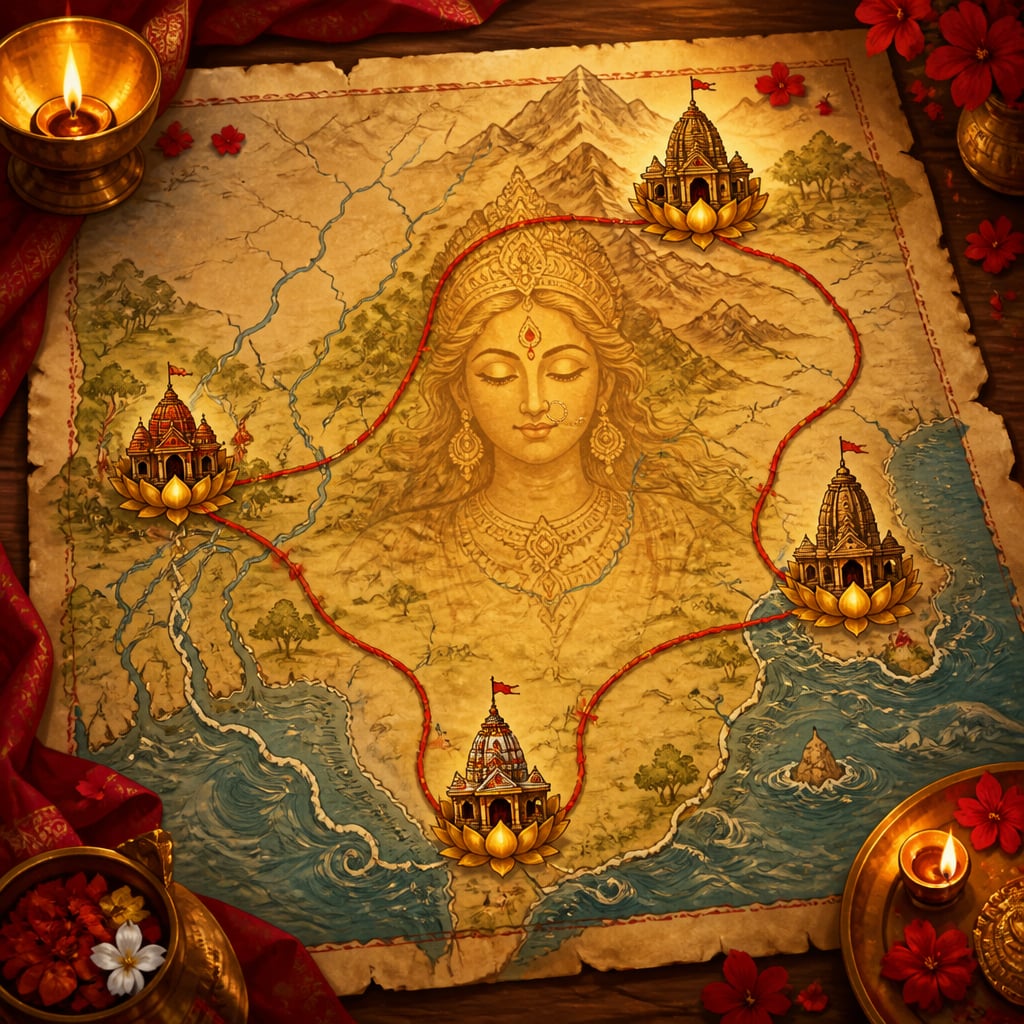
Chatushpeetha mandala across eastern India

The Body Parts That Matter Most

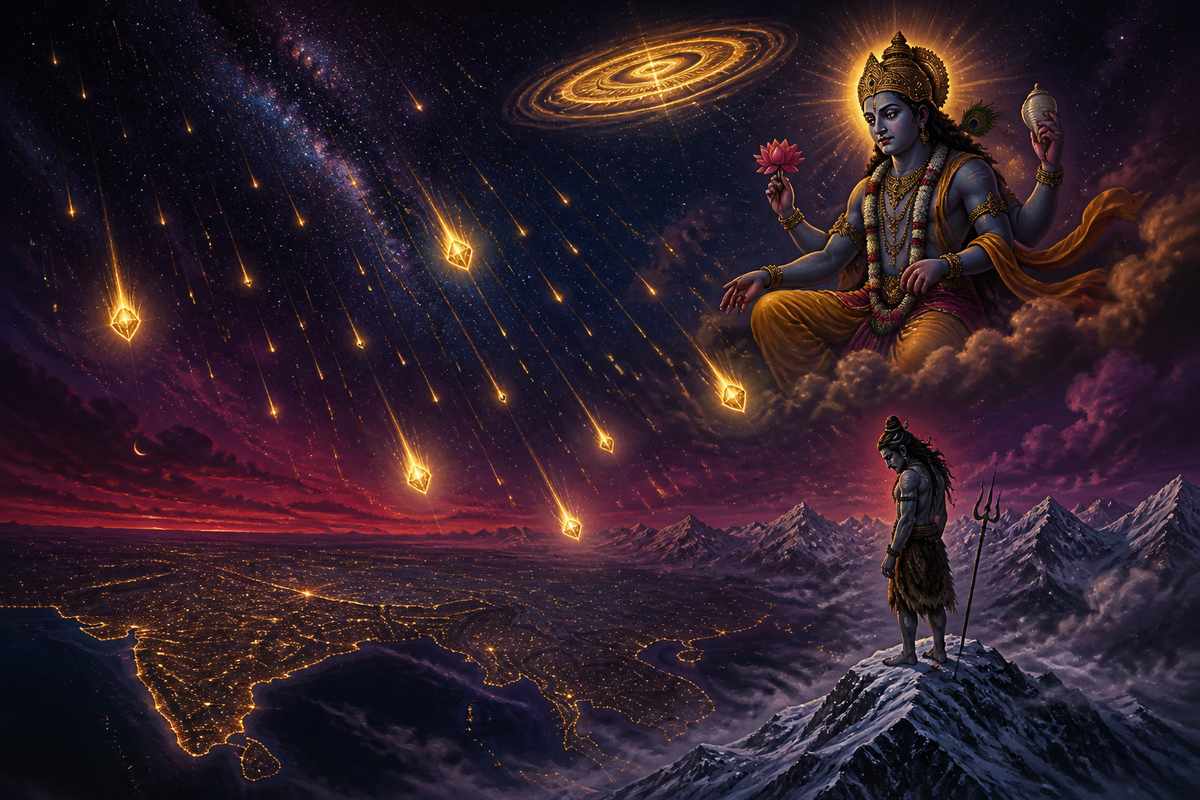
Vishnu's Sudarshana dividing Sati's body across the sky

When Vishnu's Sudarshana Chakra severed Sati's body, 51 parts fell across the land. But not all parts carry equal symbolic weight. The four that landed in eastern India represent perhaps the most significant aspects of the feminine:

The Yoni (Kamakhya): The creative center, the womb, the source of all manifestation. Where this fell, the goddess's generative power is most directly accessible. Kamakhya is thus the tantric heart of the Chatushpeetha, the place where practitioners work directly with Shakti's creative force.

The Breasts (Tara Tarini): The nurturing organs that sustain life after birth. The breasts represent the mother's gift of nourishment, the sustaining love that enables growth. Tara Tarini embodies maternal care, the goddess as the one who feeds and protects.

The Navel (Vimala): The center of transformation and the mark of our original connection. Where the umbilical cord once linked us to our mothers, the navel reminds us that we are not self-created beings. Vimala represents integration, the point where different traditions (Shakta and Vaishnava) meet and nourish each other.

The Toe (Kalighat): The point of contact with the earth, the foundation that supports the entire body. The right toe specifically represents grounded action in the world. Kali at Kalighat brings the fierce transformative power of the goddess into direct contact with worldly life.

These four body parts span creation (yoni), nourishment (breasts), connection (navel), and grounding (toe). Together they represent the complete cycle: the goddess who creates life, sustains it, links it to its source, and grounds it in reality.

The Mandala on the Land

Plot the four Adi Peethas on a map and a pattern emerges:

The geography forms a rough quadrilateral, with the four sites marking the boundaries of what might be called Shakti Kshetra, the special territory of goddess worship in eastern India.

This is not coincidence but conscious sacred geography. The tantric traditions that systematized goddess worship understood the land itself as the goddess's body. By identifying certain sites as marking certain body parts, they created a way of experiencing the entire landscape as sacred, as literally the flesh of the divine mother.

A pilgrim traveling the Chatushpeetha circuit walks upon the goddess. The mountains are her bones; the rivers, her blood; the forests, her hair. Every step on this land is contact with the divine body. The four Adi Peethas are simply the most concentrated points of presence, the places where the body-earth identification is strongest.

Why These Four Became Primary

Multiple traditions list multiple versions of primary Peethas. Some texts name just 4; others 18, 51, 52, or 108. The Chatushpeetha tradition, emphasizing exactly four, likely emerged from the intersection of several factors:

Tantric precedence: The four sites were already important tantric centers before the Shakti Peetha geography was fully systematized. Kamakhya, in particular, appears in texts as a seat of goddess worship predating any specific body-part mythology.

Directional completeness: Four is the number of cardinal directions. By identifying four primary Peethas, the tradition created a complete sacred geography that covered all directions (or at least all directions of eastern India).

Body symbolism: The specific body parts, yoni, breasts, navel, toe, represent a complete progression from creation through sustenance to grounding. Other body parts (head, hands, eyes) carry other meanings, but these four together form a self-sufficient system.

Pilgrimage practicality: For devout Shaktas who wished to visit all the most important sites, four was a manageable number. The sites are geographically close enough that all four could be visited in a single pilgrimage circuit, unlike the full 51, which span from Pakistan to Bangladesh to Nepal.

The Circuit: Walking the Goddess

An elderly pilgrim walking the Chatushpeetha parikrama

The traditional Chatushpeetha Parikrama (circumambulation of the four seats) follows a specific route:

Beginning at Kalighat in Kolkata, the pilgrim enters Shakti's presence through her fiercest form. Dakshina Kali strips away pretense and ego, preparing the devotee for the transformative journey ahead. The toe that touches the earth teaches grounding: start from where you are, firmly rooted in reality.

From Kalighat, the pilgrim travels northeast to Kamakhya in Assam. Here, the goddess is worshipped in her most intimate form, as the yoni itself, without anthropomorphic image. Kamakhya represents the creative mystery, the source from which all forms emerge. Having been grounded at Kalighat, the pilgrim now contacts the power that generates all life.

The journey then turns south to Tara Tarini in Odisha. The twin goddesses of the breast-peetha offer nurturing after the intensity of Kamakhya. Here the pilgrim receives the mother's milk, sustenance for the journey, love that asks nothing in return. The breasts that fell here continue to nourish all who approach.

Finally, the circuit closes at Vimala in Puri. The navel-peetha represents integration, the point where all journeys find their center. Here, within the Jagannath temple complex, Shakta and Vaishnava traditions merge. The pilgrim who began at Kalighat completes the cycle by touching the center from which their own life began, the cosmic navel that connects every being to the Divine Mother.

The circuit traces a rough clockwise motion, the sacred pradakshina direction, across the goddess's body-land. Each site offers specific teachings; together they constitute a complete initiation into Shakti's mysteries.

The Tantric Architecture

From the tantric perspective, the Chatushpeetha represents not just geography but subtle anatomy. The four sites correspond to key energy centers in the practitioner's own body:

Pilgrimage to the outer sites activates the corresponding inner centers. The practitioner walks the external geography while awakening the internal one. By the time the circuit is complete, the body has been systematically transformed, each chakra touched by its corresponding peetha's power.

This is why serious tantric practitioners still undertake the Chatushpeetha Parikrama despite modern conveniences that allow visiting individual sites independently. The circuit is itself the practice. The journey is the initiation.

Eastern India's Special Role

Why did all four Adi Peethas fall in eastern India? The western, northern, and southern regions have their own Shakti Peethas, yet none are classified as Adi, primordial, cardinal.

Several factors contribute to eastern India's special status:

Tantric density: Eastern India, Bengal, Assam, Odisha, has the highest concentration of tantric practice in the subcontinent. The goddess traditions developed here with particular intensity, and the Chatushpeetha concept likely emerged from eastern tantric schools.

Feminine geography: The land itself is intensely feminine, crisscrossed by rivers (goddess-forms in Hindu thought), thick with vegetation (the goddess's hair), receptive to monsoon rains (the goddess's blessing). The physical geography invites goddess interpretation.

Royal patronage: Eastern Indian kingdoms, particularly the Palas, Senas, and later the Hindu rajas of Assam and Odisha, actively supported Shakta worship. Royal sponsorship allowed temples, texts, and traditions to flourish in ways not always possible under rulers favoring other traditions.

Indigenous synthesis: Many scholars believe that Shakti worship incorporates pre-Vedic goddess traditions of the eastern tribal peoples. The Chatushpeetha may represent the synthesis of these older traditions with Sanskritic Hinduism, a marriage visible in Kamakhya's worship especially.

Whatever the historical reasons, the effect is unmistakable: eastern India is Shakti's special territory. The four Adi Peethas mark its boundaries and concentrate its power.

Unity in Diversity

Look at the four Adi Peethas and you see remarkable diversity:

The forms of the goddess differ dramatically: fierce Kali, aniconic yoni, nurturing mothers, serene Vimala. The rituals vary: blood sacrifice at some, vegetarian offerings at others. The theological frameworks range from pure Shakta to integrated Shakta-Vaishnava.

Yet all four are one goddess. The Chatushpeetha tradition insists on this unity: Sati's one body, distributed across the land, appearing in different forms but remaining essentially indivisible. The diversity of the goddess is not contradiction but completeness. She who can only be fierce, or only gentle, or only creative, or only nurturing, would not be the full Shakti. The Divine Mother contains all aspects, and the four Peethas together reveal what no single site could.

For devotees, this means that whichever peetha draws you is the right entry point. The fierce seeker goes to Kalighat; the tantric practitioner to Kamakhya; the one seeking nurturing to Tara Tarini; the one seeking integration to Vimala. All paths lead to the same goddess.

The Teaching: Completeness Requires Parts

The Chatushpeetha offers a profound teaching about wholeness and fragmentation.

Sati's body had to break for the Shakti Peethas to exist. Her death and dismemberment, tragic from one perspective, became the foundation of a spiritual geography that has blessed millions for millennia. What was whole became parts; what was parts became a greater whole encompassing all of eastern India.

This is the paradox at the heart of existence: unity manifests through diversity. The one goddess becomes four (or 51, or 108) sites, and each site offers access to the complete goddess. The devotee at Kalighat doesn't receive a fraction of Shakti; they receive all of her, concentrated through the lens of fierce Kali. The devotee at Vimala doesn't get less goddess because the temple is smaller; they get the same infinite Shakti, concentrated through the lens of pure integration.

The scattered body is more accessible than the intact body would have been. One centralized Shakti temple would be one location, reachable by some. Fifty-one Shakti Peethas mean that no matter where you are in the subcontinent, some part of the goddess's body is relatively near. The fragmentation was distribution, the goddess's way of being everywhere at once.

In our own lives, what seems like breaking may be expanding. What feels like loss may be distribution. The four corners of the Chatushpeetha, marking the scattered parts of a once-whole body, together form a mandala larger than any single form could be.

The goddess who was one became four, and the four remain one. In the Chatushpeetha, we learn to hold both truths simultaneously, unity and diversity, wholeness and parts, the intact body and its sacred fragments. This is Shakti's teaching: complete enough to break, broken enough to become complete.

Living traditions

The Chatushpeetha tradition continues to shape Shakta worship across eastern India. Travel agencies now offer 'Shakti Peetha Tours' covering all four sites in organized packages. Academic study of the peethas has increased, with scholars examining their historical development, theological significance, and regional variations. The Chatushpeetha concept has influenced modern Hindu feminist theology, with the goddess's distributed body interpreted as female power established throughout the land. Virtual darshan services now allow devotees worldwide to 'visit' all four peethas online, a technological extension of the tradition's basic insight that one goddess appears in many forms, accessible through multiple means.

Reflection

More in Adi Peethas: The Four Cardinal Seats of Power

All lessons in Adi Peethas: The Four Cardinal Seats of Power ยท The Shakti Peethas course