Kalighat: Where the Goddess Walks

The right toe (Dakshin Padangushtha) of Sati

Journey to Kalighat in Kolkata, where Sati's right toe fell. Discover the fierce Dakshina Kali, the temple's history from ancient times through colonial Calcutta, and why this peetha became the heart of Bengali Shakta worship.

Kalighat: Where the Goddess Walks

The Toe That Touched the Earth
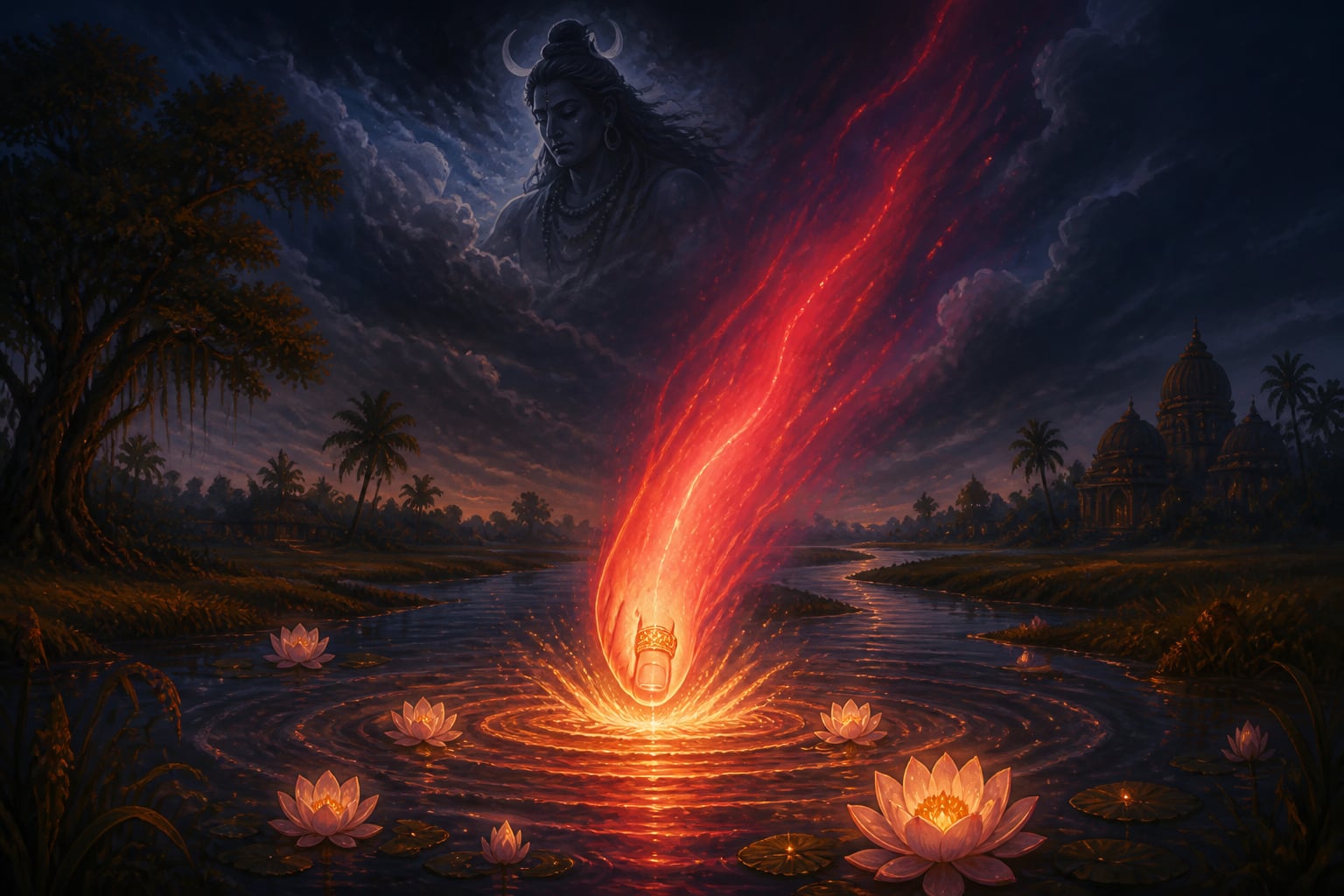
Sati's right toe falling toward the Adi Ganga at night

In the swirling chaos of Shiva's grief-stricken dance, as Vishnu's Sudarshana Chakra methodically severed Sati's lifeless body, a single toe, the right great toe, the dakshin padangushtha, fell upon the banks of a sluggish river in the Bengal delta. Where it touched the earth, the ground became sacred forever.

This was no ordinary body part. In the symbolic language of Hindu thought, the toe represents grounding, our connection to the earth, our ability to stand firm, to walk our path. The right toe specifically signifies the dakshina marga, the right-hand path of orthodox worship. Yet what emerged at this site was anything but ordinary: here arose the worship of Dakshina Kali, the fierce Dark Goddess who would become the patron deity of Bengal itself.

The river where the toe fell was called Adi Ganga, the original course of the Ganges before she shifted her path eastward. Today, this ancient channel flows as a narrow canal through the heart of Kolkata, but once it was a mighty waterway that gave the goddess's temple its name: Kalighat, literally "the steps (ghat) to Kali."

The Temple Rising from the Marsh

For centuries, the exact location of where Sati's toe fell was marked only by a simple shrine in the marshlands of lower Bengal. Pilgrims would wade through swamps and brave tigers to reach the holy spot. The original shrine was little more than a stone under a tree, yet devotees came in hundreds, then thousands.

The temple we see today dates primarily from the early 19th century, rebuilt in 1809 by Sabarna Roy Choudhury family. But do not mistake its relative youth for lack of sanctity. Archaeological evidence suggests worship at this site extends back at least 1,500 years, possibly much longer. The poet Kabir mentioned Kalighat in the 15th century. The Manasa Mangal Kavya, a medieval Bengali text, describes pilgrims to "Kalighata" where the goddess dwelt.

The temple architecture follows the distinctive Bengali Atchala (eight-roofed) style, a series of curved roofs that resemble stacked boats, an ingenious design that channels Bengal's torrential monsoon rains away from the structure. The main spire rises three stories, painted in alternating bands of red and white, visible from across the surrounding neighborhoods like a beacon calling the faithful.

Dakshina Kali: The Dark Mother

Step inside the temple, join the press of devotees shuffling forward through the narrow passage, and you will come face to face with one of Hinduism's most striking images. The main murti (sacred image) of Dakshina Kali is unlike any other.

Dakshina Kali murti at Kalighat temple

She is not carved from stone in the usual manner. The goddess's image is formed from three massive pieces: the face and hands are fashioned from black stone, but her body is symbolic, three enormous eyes of gold and silver dominate her visage, staring with an intensity that devotees describe as simultaneously terrifying and infinitely compassionate.

Her tongue protrudes, red and shocking, a symbol with deep meaning. According to tradition, Kali stepped on Shiva's chest during her rampage of destruction, and when she realized what she had done, she bit her tongue in shame. But the esoteric reading goes deeper: the protruding tongue represents the goddess consuming time itself (kala), from which her name derives. She devours past, present, and future. Nothing escapes her.

Her four arms hold her characteristic objects: a sword (knowledge that cuts through illusion), a severed head (the ego that must die), and her two right hands extend in abhaya and varada mudras, "fear not" and "I grant boons." The message is unmistakable: surrender your ego, release your fear, and receive her grace.

Nakuleswara: The Bhairava Who Guards

Every Shakti Peetha has its Bhairava, a fierce form of Shiva who guards the sacred site. At Kalighat, this is Nakuleswara (or Nakulisha), whose shrine stands within the temple complex.

The name Nakuleswara connects to the mongoose (nakula), an animal sacred to Shiva and famous for its ability to kill snakes. Just as the mongoose destroys serpents without being harmed by their venom, Nakuleswara represents consciousness that can engage with the world's poison (attachment, fear, desire) without being destroyed by it.

Pilgrims traditionally visit Nakuleswara's shrine before approaching Kali herself. The Bhairava prepares the devotee, strips away resistance, creates the inner space necessary to receive the goddess's fierce blessing.

The Calcutta Connection

The name "Calcutta" (now Kolkata) likely derives from Kalikata, "the land of Kali." Though scholars debate alternate etymologies, the spiritual truth remains: this city grew up around the goddess's peetha. When the British East India Company established their trading post in 1690, they chose land near an ancient pilgrimage site. The city that would become the capital of British India, the "second city of the Empire," was built quite literally in Kali's shadow.

This proximity created a unique tension. Colonial administrators viewed Kalighat with a mixture of fascination and horror, the animal sacrifices, the ecstatic worship, the crowds of half-naked sadhus smoking hemp offended Victorian sensibilities. Yet they could not suppress it. The goddess was too deeply woven into Bengali identity.

What emerged instead was a remarkable synthesis. The Bengali Renaissance of the 19th century, the flowering of literature, art, and reform that produced Ramakrishna, Vivekananda, Tagore, and countless others, was deeply shaped by Shakta worship. Ramakrishna Paramahamsa was a priest at the Dakshineshwar Kali Temple, where he experienced his famous visions. His disciple Swami Vivekananda carried the goddess's energy to the World Parliament of Religions in Chicago.

The Tantric Heart

Kalighat is not merely a temple of devotion, it is a center of Tantra, the esoteric tradition that sees the goddess as the supreme reality and the body as a vehicle for liberation.

The core teaching is radical: that which ordinary religion rejects (the body, death, sexuality, darkness, fierce emotions), Tantra embraces as doorways to awakening. Kali embodies this principle perfectly. She stands on corpses in cremation grounds. She wears severed hands as a skirt. She drinks blood. She is death itself, and therefore liberation from the fear of death.

For the tantric practitioner, Kalighat offers teachings unavailable in more "respectable" religious settings:

The body is sacred: At Kalighat, worship involves all senses, the smell of incense and hibiscus flowers, the sight of flames and blood, the taste of prasad, the sound of bells and mantras, the press of bodies in the narrow darshan corridor. The goddess does not reject physicality; she sanctifies it.

Destruction serves creation: The animal sacrifices performed at Kalighat (goats are offered to the goddess) represent the necessary death of ego, the cutting away of what no longer serves. Life feeds on life; this truth, evaded elsewhere, is confronted directly here.

Darkness holds wisdom: Kali is black, shyama, the color of night sky, of the womb before birth, of the void from which all creation emerges. In her darkness is not absence but infinite potential. Those who fear the dark cannot receive her deepest teachings.

Transformation Through Fire

Sri Ramakrishna in ecstasy before Dakshina Kali

The ultimate teaching of Kalighat is transformation through complete surrender. The goddess does not offer comfortable spirituality. She offers moksha, liberation, and the price is everything you think you are.

When devotees prostrate before Dakshina Kali, they are not asking for worldly boons (though many do, and she grants them). The deepest prayer is: "Take me. Consume my ego. Let me die to my limited self so I may be reborn in your infinite embrace."

This is why Kali worship has always attracted those at the edges of society, the outcasts, the seekers who have exhausted conventional paths, those who have suffered enough that they no longer fear death. It's also why Kali worship has produced some of India's greatest saints. When you have nothing left to lose, you can finally receive everything.

The right toe of Sati fell here, and from that single point of contact between the divine body and mortal earth, a tradition arose that has been transforming lives for millennia. Today, as pilgrims push through the crowds to catch a glimpse of those three enormous golden eyes, they join a stream that stretches back to the beginning and forward to eternity.

The goddess waits. The goddess walks. At Kalighat, she has never left.

Case studies

Ramakrishna's Divine Madness

In the 1850s, a young priest named Gadadhar Chattopadhyay arrived at the newly-built Dakshineshwar Kali Temple near Kolkata. His job was simple: perform daily worship of the goddess. But from the moment he gazed upon the image of Kali, something extraordinary happened. He began experiencing overwhelming spiritual states, laughing, weeping, falling into trances that lasted hours. He would refuse to eat, forget to sleep, run to the temple at all hours crying 'Ma! Ma!' ('Mother! Mother!'). His family thought he had gone mad. The temple authorities considered dismissing him. Even his nephew, later known as Swami Vivekananda, initially doubted whether his uncle was mentally ill. Yet Ramakrishna insisted he was experiencing direct communion with the Divine Mother. The question that tormented his relatives torments spiritual seekers still: How do you distinguish genuine mystical experience from delusion?

The Kalighat tradition offers a framework for understanding Ramakrishna's experience. In Shakta tantra, the goddess is not merely an object of worship but a living presence who can seize the devotee. The symptoms of divine possession, loss of ordinary consciousness, inability to maintain social convention, emotional extremity, are recognized signs of the goddess's descent. The Devi Mahatmya describes how even the gods were overwhelmed when they first beheld the goddess's true form. If cosmic beings tremble before her, how much more would a human priest? Ramakrishna's 'madness' was not pathology but *unmada*, divine intoxication. The tantric tradition distinguishes this from ordinary mental illness by its fruits: Ramakrishna emerged from his ecstasies with profound teachings, attracted serious seekers from across India, and sparked a spiritual renaissance. The tree is known by its fruit.

Ramakrishna became one of the most influential spiritual figures in modern history. His direct experience of Kali as the Divine Mother, not a frightening goddess to be appeased but a loving presence to be embraced, transformed how millions understand Shakti worship. Through Vivekananda's global teaching mission, this transformed understanding reached the West. Today, the Ramakrishna Mission runs hospitals, schools, and spiritual centers across the world, all rooted in one priest's 'mad' love for the Dark Mother.

What the world calls madness may be the breakthrough into a larger sanity. The Kalighat tradition teaches that genuine spiritual awakening often looks like crisis, the old self must shatter for something greater to emerge. The question is not whether the experience is disruptive, but whether it leads toward greater love, wisdom, and service.

Today's mental health discourse often pathologizes intense spiritual experiences as psychotic episodes, and the DSM itself now includes a category for 'religious or spiritual problem' to prevent misdiagnosis. Ramakrishna's story challenges clinicians and seekers alike to distinguish between breakdown and breakthrough. The test he embodied still holds: does the experience produce lasting wisdom, compassion, and service, or does it lead to withdrawal and dysfunction?

The Ramakrishna Mission, born from one priest's transformative experience at Dakshineshwar, now operates over 200 centers across 20+ countries, running hospitals, schools, and relief programs that have served millions since its founding in 1897.

The Artist's Ego Death

Priya is a successful commercial artist in Mumbai. Her work pays well, wins awards, satisfies clients. But increasingly she feels empty. The creative fire that once drove her has dimmed to ashes. She produces competent work but feels like a fraud, her art has become mechanical, soulless. Friends suggest she take a vacation. Colleagues recommend a creativity workshop. Her therapist explores childhood issues. Nothing helps. Then her grandmother dies, and Priya travels to Kolkata for the funeral rites. On impulse, she visits Kalighat. Pushing through crowds of pilgrims, she finally stands before the three golden eyes of Dakshina Kali. Something breaks inside her. She begins to weep, not for her grandmother, but for herself, for the artist she once was, for the creative passion she has killed through years of commercial compromise. She cannot stop crying. A priest eventually guides her out, pressing prasad into her trembling hands. She returns to Mumbai shattered, unable to work, unable to pretend anymore.

Kali worship teaches that destruction precedes creation. The goddess wears a garland of severed heads, each representing an ego that had to die before liberation could come. Priya's creative block was not a technical problem requiring technique; it was a spiritual crisis requiring death, the death of her false self, the successful artist who had traded authentic vision for approval and money. At Kalighat, she received the goddess's gift: not comfort but devastation. The tears that wouldn't stop were not weakness but the dissolution of everything she had built that needed to crumble. The tantric tradition calls this *bhanga*, breaking, and considers it essential to genuine transformation. You cannot build new structures on unstable foundations. Sometimes the foundation itself must be demolished.

After weeks of what felt like depression, Priya begins to create again, but differently. She abandons commercial work entirely, taking a part-time job to pay bills while devoting herself to a series of paintings that emerge from somewhere deeper than before. The work is strange, dark, intensely personal, nothing like her previous portfolio. Some old colleagues think she's lost her mind. But other artists recognize something genuine awakening. Her first gallery show of this new work receives mixed reviews but attracts a devoted following. More importantly, she feels alive again. The artist who died at Kalighat has been reborn.

Creative blocks often mask a deeper crisis of authenticity. We build false selves that achieve success but starve the soul. Kali's teaching is uncomfortable: sometimes the only way forward is through the death of who we have pretended to be. The goddess destroys precisely because she loves, what she takes from us was never truly ours to keep.

Burnout among high-performing professionals is at record levels, and most solutions focus on productivity hacks or self-care routines. Priya's story points to a deeper pattern: when success is built on suppressing authenticity, no amount of optimization fixes the emptiness. The growing interest in psychedelic therapy and 'ego dissolution' research echoes what Kali worship has taught for centuries. Real creative renewal often requires letting the false self collapse first.

Kalighat Kali Temple, one of the 51 Shakti Peethas, receives approximately 25,000 devotees daily and over 100,000 during Kali Puja. The temple dates to at least the 15th century, though the site's sanctity is referenced in texts over 1,000 years old.

Living traditions

Kalighat remains one of India's most visited pilgrimage sites, drawing millions annually. The temple has influenced global culture through the Kalighat painting style, now displayed in museums from the V&A to the Philadelphia Museum of Art. The Bengali Shakta tradition shaped thinkers from Tagore to Vivekananda and continues to influence contemporary spirituality through organizations like the Ramakrishna Mission. Mother Teresa's Missionaries of Charity, headquartered near the temple, have carried Kalighat's spirit of service to the dying across the world. In popular culture, Kali has become a global symbol of feminine power, appearing in contexts from Marvel movies to feminist art.

Reflection

More in Adi Peethas: The Four Cardinal Seats of Power

All lessons in Adi Peethas: The Four Cardinal Seats of Power ยท The Shakti Peethas course