The Cow at the Center
Gomata, Gopashtami, and Panchagavya: how a sixteenth-century Vijayanagara emperor maintained a goshala of thirty thousand cows as a royal agricultural and medical institution, why every Hindu household once kept a cow at the threshold, and how the same five products of the cow now sell back as A2 milk premiums, regenerative-agriculture dung composting, and five-billion-dollar grass-fed dairy
At the Vijayanagara court of Krishnadevaraya in the early sixteenth century, the imperial goshala held over thirty thousand cows. The court records, preserved in Telugu and Sanskrit on copper plates, document the goshala as a state institution with assigned cowherds, dedicated grazing lands, daily milk yields, and a separate kitchen that prepared the panchagavya for the court's medical use. The same court records show a direct correlation between the goshala's maintenance and the empire's agricultural surplus: the cows produced the manure that fertilised the fields, the bullocks pulled the ploughs, the dairy fed the population, and the panchagavya was the court physician's primary immunological preparation. The lesson opens the gomata reverence, the Gopashtami festival, and the panchagavya protocol, walks through the Vedic and Puranic scriptural sources, the modern A2 milk research and the panchagavya antimicrobial studies, and the contemporary five-billion-dollar grass-fed dairy market alongside the two-point-seven-billion-dollar lab-grown beef investment, with the cultural paradox of protecting and consuming the same animal named honestly and the dharmic frame restored without shaming the reader who currently eats beef.
A Royal Goshala at Vijayanagara, the Morning Count
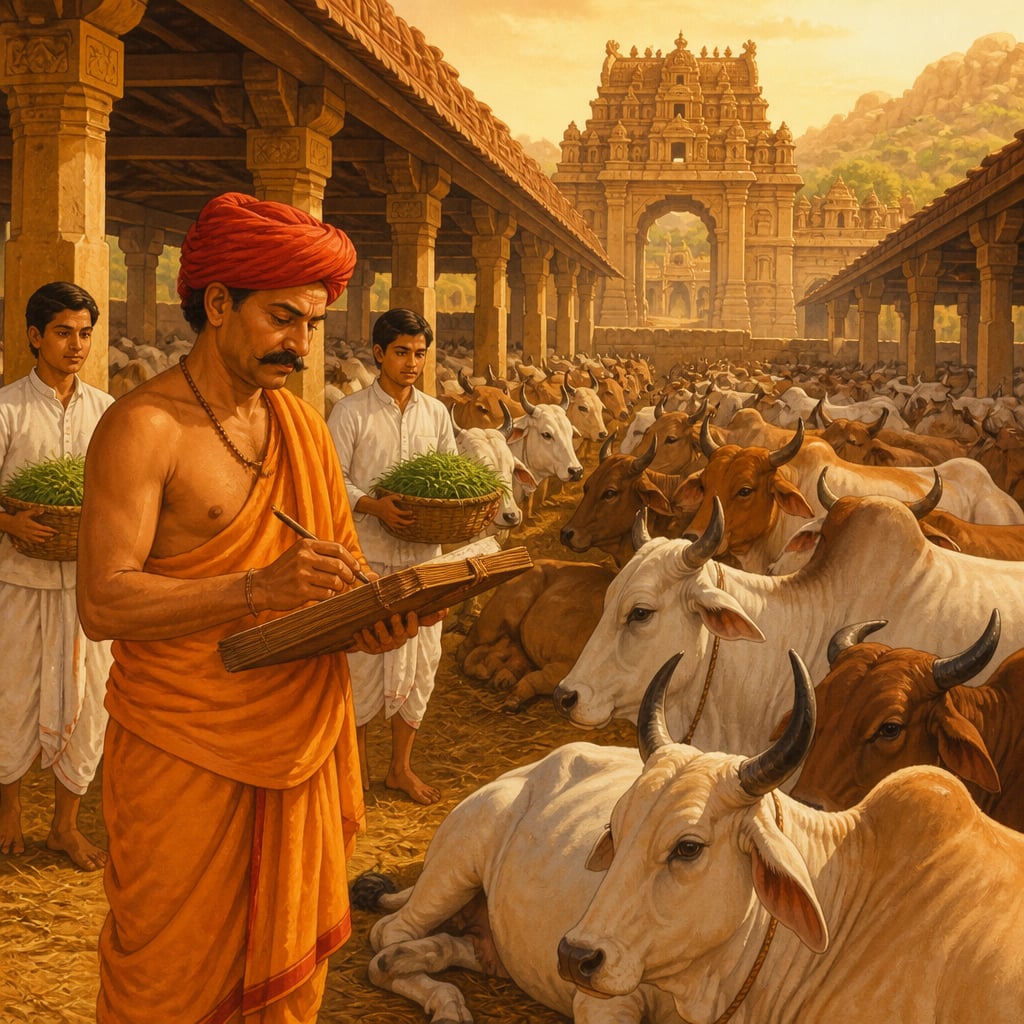
At Hampi in the empire of Vijayanagara, on a clear morning in the early sixteenth century, the chief cowherd of the imperial goshala stood at the gate of the central enclosure and counted the herd as it left for grazing. The count was thirty thousand. The cows were of the Ongole, the Hallikar, the Krishna Valley, and the Kangayam breeds, the four principal humped indigenous cattle of southern peninsular India. They moved out through the eastern gate of the goshala in slow ordered lines toward the riverbank pastures of the Tungabhadra. The chief cowherd marked the count on a palm-leaf roll. The roll would be carried to the court accountant by midday and entered in the imperial ledger. Krishnadevaraya, the Vijayanagara emperor, would receive the daily count among the morning briefings.
The goshala was not ornamental. The empire's agricultural productivity, documented in the Telugu and Sanskrit copper-plate inscriptions of Krishnadevaraya's reign, was directly correlated with the goshala's maintenance. The cows produced the manure that fertilised the empire's rice fields. The bullocks pulled the ploughs of the empire's farmers. The dairy fed the empire's population through a network of milk-distribution caravans. The panchagavya, prepared in a dedicated kitchen at the goshala, was the court physician's primary immunological preparation, used in the management of fever, pediatric weakness, post-partum recovery, and the seasonal flu. The goshala was a state agricultural and medical institution.
Five centuries later, on a Tuesday morning in March 2024, a wellness consumer in Brooklyn pays nine dollars and seventy-five cents for a quart of A2 grass-fed milk at Whole Foods. The premium over conventional milk is roughly four hundred percent. The marketing copy on the carton names the breed as Jersey or Guernsey, identifies the milk as A2 beta-casein, and describes the herd as pasture-raised in upstate New York. The carton does not mention that A2 beta-casein is the dominant variant in indigenous Indian cattle (the Bos indicus humped cow), and that the Vijayanagara goshala's thirty thousand cows produced exclusively A2 milk, by the basic biology of the breed, in a continuous institutional tradition that ran from at least the Indus Valley dairy seals of 2500 BCE.
The Cow Was the Threshold of the Hindu Household
Until the agricultural mechanisation of the twentieth century, the cow was the structural centre of the Hindu rural household. A married couple typically received a cow at the wedding as the most consequential family gift; the cow became the household's primary source of milk, ghee, curd, and buttermilk; her dung fertilised the kitchen garden; her bullock-calves became the household's plough-power and transport. The morning began with the cow's milking before sunrise, performed by the household's senior daughter-in-law or by the household head, with a small offering of grass and a touch of the cow's forehead before the first pull of the milk. The cow received the household's first respect of the day.
The cow was, in the cosmological frame, the gomata, the cow-mother. The Sanskrit term names the relationship: she gives, the household receives. Five products of the cow constituted the panchagavya, the five-cow-substances: milk (gorasa), curd (gorasa-dadhi), ghee (goghrta), urine (gomutra), and dung (gomaya). Each had a specific use. Milk and curd nourished the household; ghee fed the lamps and seasoned the food; urine was used in agricultural pest-control and in select Ayurvedic preparations; dung was the household's primary compost, fuel (as dried cakes), antibacterial floor coating, and ritual purifier. The cow returned, to the household, every product the household needed to subsist on the land.
The Gopashtami festival, observed on the eighth tithi of the bright fortnight of Kartika in October-November, is the canonical day for the formal recognition of the cow's role in the household. On this day, the household washes the cow with warm water, applies turmeric and kumkum to her forehead, garlands her with marigolds, feeds her the day's first cooked food (often a sweet preparation with jaggery and rice), circumambulates her three times, and gives a small charity in her name. The festival commemorates Krishna's first day of independent cowherding at Vrindavan, when he led the herd to graze without his elder brother Balarama for the first time, and the day on which the cow-herding tradition is foregrounded as the dharmic occupation par excellence. Gopashtami is observed in observant Hindu households, in temples with goshalas attached, and in the rural cattle economy across India.
The Practice, Across India
The gomata reverence runs through every major Hindu life occasion. At the start of a yajna, a cow is brought to the sacrificial enclosure, garlanded, fed, and her presence is held to confer auspiciousness on the proceedings. At the start of a wedding, the bride's family gifts a cow to the groom's family in the kanyadana ceremony (the cow being one of the canonical gifts of dakshina, distinct from any dowry transaction). At the start of a new home entry, the household leads a cow with her calf into the house through the front door before the household members enter; the cow's first step into the home is held to bring the household the dharmic blessing of nourishment, fertility, and continuity. At the time of death, the antyeshti rites include the godanam, the gift of a cow to a Brahmin or to a worthy recipient, with the cow-gift considered the most consequential post-mortem gift in the Garuda Purana's catalogue.
The panchagavya protocol is the household's medical kit. The standard preparation, documented in the Charaka Samhita and in the regional Ayurvedic compendia of southern, western, and northern India, combines milk, curd, ghee, gomutra, and gomaya in fixed proportions, allowed to ferment for a prescribed interval, and then administered orally in small doses or applied topically. The preparation is used in fever, in skin disorders, in pediatric weakness, in post-partum recovery, and in the management of seasonal infections. The Charaka Samhita lists panchagavya among the rasayana preparations, the preparations of long-term immunological strengthening. The same preparation is now manufactured by Patanjali Ayurved, by the Arya Vaidya Sala at Kottakkal, by the SDM Ayurvedic Medical College at Udupi, and by hundreds of smaller regional Ayurvedic pharmacies, and is consumed in measured doses by tens of millions of observant practitioners in modern India.
The goshala tradition, which once ran in every Hindu temple of significant scale, persists today in the form of the dedicated cow-shelter institution. The Pinjrapole goshalas of Gujarat (descended from Jain tradition but historically supported by Hindu donors), the Pathmeda Gosamvardhan Sansthan in Rajasthan (currently the largest goshala in the world, with over fifty thousand cows), the Kanchi Kamakoti goshala in Tamil Nadu, and the dedicated goshalas at Tirupati, Pandharpur, Puri, and Mathura together maintain over three lakh cows in modern India. The institutions are funded by donor contributions and by the sale of the panchagavya products to Ayurvedic pharmacies and the household market. The model descends, with continuous documentation, from the Vijayanagara state goshala and from the older Mauryan and Gupta state-cattle institutions documented in the Arthashastra and the Manusmriti.
The Scripture Says
The Rig Veda, the oldest of the Vedas, contains the foundational verses on the cow as the embodiment of the divine. Rig Veda 6.28.1 to 6.28.8, the Gosukta, is a hymn of eight verses dedicated entirely to the cow. The verses praise the cow as Aditi (the boundless), as the source of nourishment for the gods and the household, as the bringer of prosperity, as the holder of the sacred soma, and as the form of Lakshmi herself. Aghnya iti vai gauh, the Rig Veda declares: the cow is aghnya, that which is not to be killed. The verse is one of the earliest extant scriptural prohibitions on the killing of the cow in any tradition.
The Atharva Veda extends the cow-reverence into the household and the medical frame. Atharva Veda 10.10, the Vasha-Sukta, is a hymn dedicated to the gomata as the source of the panchagavya, with explicit identification of the five products and their uses. Atharva Veda 4.21 prescribes the cow as the centre of the household's prosperity and lists the rituals for the cow's morning feeding, the milking protocol, and the household's daily reverence. The Atharva Veda is the foundational source for the panchagavya as a structured immunological preparation.
The Mahabharata's Anushasana Parva contains an extended dialogue between Bhishma and Yudhishthira on the cow's role in dharmic life. Mahabharata, Anushasana Parva 76 to 78 names the cow as the gomata, names the panchagavya as the household's primary medicine, names the godanam as the most consequential gift, and prescribes the protocols for the cow's protection in the household and in the kingdom. The dialogue is presented as Bhishma's lying-on-the-bed-of-arrows wisdom-transmission to the new king, with the cow's protection treated as one of the central duties of the dharmic ruler.

The Bhagavata Purana extends the cow-reverence into the Krishna narrative. Bhagavata Purana 10.5.10 describes the day of Krishna's birth at Mathura, with Vasudeva and Devaki recommending the gift of cows as the appropriate naming-ceremony dakshina. Bhagavata Purana 10.21, the Venu Gita, describes Krishna's flute-playing in the morning as he leads the Vrindavan herd to graze, with the cows responding to the flute by stopping their grazing to listen. The Krishna narrative establishes the cowherd as the dharmic occupation par excellence and the gomata as the divine companion of the divine cowherd. The Gopashtami festival is the calendar realisation of this narrative.
The canonical mantra for the morning cow-reverence, recited at the goshala in observant temples and in rural households across India, is the Gomata mantra. Sarva-deva-mayi devi sarva-deva-bhushita. Matar mam-antara-stham tvam pavitri kuru sarvada. O divine one, embodied with all the gods and adorned by all the gods, mother who dwells within me, purify me always. The verse is short enough to be memorised by every householder and is recited at the moment of morning milking, at the moment of feeding the cow, and at the moment of circumambulating the cow at Gopashtami.
The Symbolism
The cow's symbolism in the Hindu frame is layered. At the simplest level, the cow is the household's mother in the same sense that the human mother is the household's mother: she gives nourishment without demanding return, she returns to the same place every evening, she is patient and even-tempered, she protects her young, and her presence is the household's calm centre. The naming of the cow as gomata is not metaphorical; it is the dharmic reading of the relationship's actual structure.
At the cosmological level, the cow is identified with Aditi (the boundless, the mother of the Adityas), with Lakshmi (the goddess of prosperity), and with Bhumi (the earth itself). The Rig Veda's identification of the cow with Aditi names the cow as the structural form of the boundless source of nourishment from which the universe arises. The Bhagavata Purana's identification of Bhumi with the cow extends the symbolism: when the earth is in distress, the Puranas describe her as approaching the gods in the form of a cow, weeping, asking for relief. The cow is, in this frame, the embodiment of the earth's nourishing capacity itself.
At the Krishna-narrative level, the cow is the divine companion of the divine cowherd. The Vrindavan herd is the embodiment of the bhakti-relationship between the soul and the divine: the cows respond to Krishna's flute, the cows follow the cowherd, the cows give their milk freely, and the cowherd is responsible for the cows' welfare. The relationship is non-transactional. The cow gives, the cowherd protects, and the bond is sustained by mutual care, not by extraction. The Gopashtami festival commemorates this relationship and re-presents the cow at the centre of the household's dharmic imagination every year.
The panchagavya symbolism is parallel. The five products of the cow are held to embody the five elements of the universe in their nourishing form: milk (the substance of growth), curd (the substance of transformation), ghee (the substance of fire-purification), gomutra (the substance of subtle cleansing), and gomaya (the substance of grounding). The five together constitute a household-medical kit derived entirely from the cow's daily output, with no extraction of the cow's life. The panchagavya is, in the dharmic frame, the inverse of the modern meat economy: the cow gives, the household receives, and the cow continues to live and to give.
Why the Body Responds
Layer four, habit architecture. The morning cow-reverence is one of the most precisely scheduled household-anchor rituals in any tradition. The cue is the dawn (the cow must be milked before the calf nurses fully); the routine is the cow's washing, feeding, and milking, in fixed sequence with the household's senior member present; the reward is the morning's first dairy yield and the household's calm centre established before the day's other activities begin. James Clear's identity-based-habits framework names exactly this kind of person-anchored daily ritual as the strongest form of habit-design: the action confirms the identity (the household member who tends the cow), the identity sustains the action, and the social anchoring (the cow's calf, the household's expectations) prevents the routine from drifting.
The panchagavya consumption produces the second behavioural effect. The daily morning consumption of fresh cow's milk, the weekly consumption of fresh ghee, the seasonal consumption of buttermilk in summer, and the periodic consumption of curd-rice as a base meal together constitute one of the most distributed structured food-supplementation protocols in any tradition. The protocol is calibrated to the agricultural seasons, to the human life stages, and to the body's varying needs. The result is a continuous, low-dose, structured consumption of cow-derived nutrients, with the household's dietary pattern anchored to the cow's daily output across the year.
The Gopashtami festival is the third behavioural effect. The annual festival of formal cow-reverence functions as a reset of the household's relationship with the cow: the day is dedicated to washing the cow, feeding her the day's best food, circumambulating her, and renewing the household's recognition of her role. The annual ritual reset prevents the daily routine from sliding into mere transaction (extracting the milk without recognising the giver). Studies on gratitude-anchoring rituals (Emmons and McCullough, 2003, Journal of Personality and Social Psychology; Lyubomirsky, Sheldon, and Schkade, 2005, Review of General Psychology) have consistently documented that structured annual gratitude-recognition rituals produce sustained increases in subjective well-being, in pro-social behaviour, and in the maintenance of valued relationships. The Gopashtami is a structured annual gratitude-anchoring ritual for the household's most consequential non-human relationship.
What the Labs Found
The research record on panchagavya is now substantial. Jha and colleagues, in a 2018 study published in the Journal of Ethnic Foods, reviewed the antifungal, antibacterial, and immunomodulatory properties of panchagavya and documented measurable activity against multiple human-pathogenic bacterial and fungal strains, with the active compounds identified across the five components. Mathivanan and colleagues, in a 2017 paper in the International Journal of Cow Science, extended the analysis to the agricultural application of panchagavya as a soil and crop fortifier, with documented increases in crop yield and soil microbial diversity in panchagavya-treated fields. The traditional household and agricultural protocols are validated by both medical and agricultural research streams.
The A2 milk research is the second substantial stream. The European Journal of Clinical Nutrition has published multiple studies (Jianqin et al, 2016; Brooke-Taylor et al, 2017) documenting that A2 beta-casein milk, the variant predominantly produced by indigenous Indian cattle (the Bos indicus humped breeds), produces measurably reduced inflammatory and gastrointestinal responses compared to A1 beta-casein milk, the variant predominantly produced by European Holstein-Friesian cattle. The mechanism involves the differential breakdown of the two beta-casein variants in the human gut, with A1 milk releasing the inflammatory peptide BCM-7 and A2 milk producing minimal BCM-7. The Vijayanagara goshala's thirty thousand humped cows produced exclusively A2 milk by the basic biology of the breed; the modern wellness market's premium A2 milk segment is selling, at four-hundred-percent markup, what the Indian indigenous cattle have produced as the default for at least four millennia.
The goshala-as-agricultural-institution research is the third stream. Studies by the Indian Council of Agricultural Research, by the National Dairy Development Board, and by the Vrindavan-based Goshala Conservation Federation have together documented the integrated agricultural model of the traditional Hindu goshala: the cows produce the manure that fertilises the fields without synthetic inputs, the bullocks pull the ploughs without diesel, the panchagavya produces both the soil-fortifier and the household-medical-supplement, and the integrated cycle is closed within the village economy with minimal external dependency. The model maps directly onto the contemporary regenerative-agriculture movement, with the Hindu goshala providing a working pre-modern reference for what the regenerative-agriculture community is now proposing to implement at scale in the West.
The deeper finding is that the gomata reverence, the panchagavya protocol, and the goshala institution are not, as a casual modern observer might suppose, simple religious sentiment. They are integrated agricultural, medical, and household-economic systems with documented effects on soil quality, crop yield, household nutrition, immunological resilience, and intergenerational continuity. The Vijayanagara emperor Krishnadevaraya operated the goshala on the basis of dharmic and economic outcomes; the modern researchers image the soil microbiology, the dairy biochemistry, and the regenerative-agriculture mechanisms. Both name the same institution.
What the World Calls It Now
The modern echoes are precise.

The A2 milk premium market sells the basic biology of the indigenous Indian humped cow back to the consumer at a four-hundred-percent markup. The global A2 milk segment, led by The a2 Milk Company (NZX-listed, with annual revenues over six hundred million New Zealand dollars in 2023), sells A2-only milk in North America at premium prices. Whole Foods sells A2 grass-fed milk at nine to twelve dollars per quart against four to six dollars for conventional. The marketing copy describes A2 as a recently discovered nutritional advantage; the Bos indicus humped cattle of India have produced A2 milk by default for at least four millennia. The Vijayanagara goshala's thirty thousand cows were, in modern dairy-science terms, a thirty-thousand-head A2-grass-fed-organic operation in the early sixteenth century.
The grass-fed dairy premium market, with global annual sales exceeding five billion dollars by 2023 according to Grand View Research and IBISWorld retail data, sells the structural logic of the traditional Hindu pasture-grazing model back to the wellness consumer. The marketing copy invokes pasture-raised, hormone-free, antibiotic-free, and grass-finished as the premium-tier descriptors. The traditional Indian goshala, including the Vijayanagara state goshala and every contemporary Pinjrapole or Pathmeda institution, runs the pasture-grazing model by default, with no synthetic hormones, no antibiotics in the feed, and no grain-finishing.
The regenerative agriculture movement, with brands including Patagonia Provisions, White Oak Pastures (Georgia, with annual revenues over twenty million dollars in 2023), and Singing Frogs Farm (California), sells the integrated cattle-and-soil model that the traditional Hindu goshala has run for centuries. The movement's core practice (rotational grazing, on-farm composting, manure as the primary soil-fortifier, no synthetic chemical inputs) is the operational structure of the pre-mechanisation Hindu rural household. The movement has been led primarily by Western farmers, with no general acknowledgment of the pre-modern Hindu reference. The Vrindavan goshala model, the Pathmeda goshala model, and the Tirupati goshala model are all working pre-modern references that the regenerative-agriculture community could study directly.
The lab-grown beef investment market, with cumulative venture-capital investment exceeding two-point-seven billion dollars by 2024 (across companies including Upside Foods, Eat Just's GOOD Meat, Mosa Meat, and Aleph Farms), reflects the modern consumer's growing discomfort with the industrial cattle-slaughter economy. The investment thesis names the industrial cattle economy as both ethically and ecologically problematic, and proposes lab-grown beef as the technological alternative. The Hindu dharmic frame named both the ethical and ecological problems of the industrial cattle economy more than two thousand years ago in the Manusmriti, the Arthashastra, and the Mahabharata, and proposed the goshala model as the structural alternative. The lab-grown beef investment is the modern technological attempt to solve a problem the Hindu tradition addressed by structural alternative.
The paradox of the contemporary Western relationship with the cow is that the same culture that pays five billion dollars for grass-fed dairy and two-point-seven billion dollars for lab-grown beef simultaneously consumes industrial-feedlot beef at twenty-eight billion dollars annually in the United States alone. The Hindu tradition resolves the paradox at the structural level by maintaining the cow as the gomata throughout the household and state economy, with the cow's products consumed without the cow's slaughter, and with the cow's life and the household's economy mutually sustained over generations. Many readers of this lesson currently eat beef. The course names the cultural and ecological structure honestly without shaming, and stops there. The structural alternative is on the record.
What to Call It Yourself
From this lesson onward, when the wellness consumer pays nine dollars for a quart of A2 grass-fed milk, name the older biology. Bos indicus, the humped cow of Bharat. When the regenerative agriculture documentary celebrates rotational grazing and on-farm manure composting, name the older institution. The goshala. When the Whole Foods aisle markets pasture-raised dairy as a premium tier, name the older default. The traditional Hindu rural household. When the Ayurvedic pharmacy sells the panchagavya tonic, name the older preparation as it is. Panchagavya. The Hindu rural household has run the gomata reverence, the panchagavya protocol, and the goshala institution as an integrated agricultural-medical-household system for centuries. The system is not a museum piece. It runs today in over three lakh cows across India's modern goshalas. The course names the protocol so the practitioner can carry it deliberately, with the dharmic frame intact and without imitating the wellness market's premium-tier framing of what was, in the original tradition, simply how the household lived.
Key figures
Krishnadevaraya
1471 to 1529 CE
Krishna of Vrindavan
Traditional dating: late Dvapara Yuga; textual establishment: Mahabharata (5th century BCE) and Bhagavata Purana (8th to 10th century CE)
Case studies
Krishnadevaraya's Goshala at Vijayanagara, Early 16th Century
At Hampi, the capital of the Vijayanagara empire, in the reign of Krishnadevaraya (1509 to 1529 CE), the imperial goshala maintained over thirty thousand cows as a state institution. The court records, preserved in Telugu and Sanskrit on copper plates and now archived at the Mysore and Hyderabad state museums, document the goshala's assigned cowherds, dedicated grazing lands on the banks of the Tungabhadra, daily milk yields entered in the imperial ledger, and the dedicated panchagavya kitchen at the goshala. The court's agricultural productivity records show a direct correlation between the goshala's maintenance and the empire's surplus grain output. The panchagavya is documented in the royal medicinal records as the primary immunological preparation for the court, used in the management of fever, pediatric weakness, post-partum recovery, and seasonal infection.
The Vijayanagara goshala was, in the dharmic frame, the imperial-scale realisation of the household-scale gomata reverence. The empire's investment of state resources in the goshala was not philanthropy; it was structural agricultural and medical policy, with the cow recognised as the centre of the integrated village economy and the panchagavya recognised as the primary medical preparation. The Manusmriti, the Arthashastra, and the medieval dharmashastra literature all prescribe the maintenance of the state goshala as a duty of the dharmic ruler, and Krishnadevaraya's institutionalisation of the goshala at thirty-thousand-cow scale is the worked example of the imperial application of the prescription.
The Vijayanagara empire's agricultural surplus, military strength, and architectural and cultural flowering during Krishnadevaraya's reign coincided with the largest documented pre-modern state goshala. The goshala model continued to operate at smaller scale in subsequent regional kingdoms (the Maratha Confederacy, the Hyderabad State, the Mysore State, the Travancore State, and the Punjab Sikh State) and persisted through the colonial period as the foundation of the rural Indian cattle economy. The contemporary goshala network in India, with over three lakh cows across institutions including Pathmeda, Tirupati, Pandharpur, Puri, Mathura, and the Pinjrapole network, descends in continuous institutional lineage from the Vijayanagara model.
The Vijayanagara goshala is the worked historical example of the integrated agricultural-medical-household model that the Hindu tradition has run for over four millennia. The empire's structural integration of the cow into the agricultural, medical, and dharmic frameworks is the worked alternative to the industrial cattle-slaughter economy. The contemporary regenerative-agriculture movement is, in essence, attempting to reconstruct from scratch what the Vijayanagara goshala represented as institutional default. The Hindu tradition's worked reference is on the historical record.
The Vijayanagara goshala provides the worked institutional reference for any contemporary attempt to operate the integrated cattle-and-soil agricultural model at scale. The contemporary regenerative-agriculture movement, led primarily by Western farmers including White Oak Pastures and Singing Frogs Farm, is independently arriving at the same operational structure (rotational grazing, on-farm composting, manure as the primary soil-fortifier, no synthetic chemical inputs) that the Hindu goshala has run as default for centuries. The historical record is on file.
30,000+ cows in the Vijayanagara imperial goshala under Krishnadevaraya (1509 to 1529 CE); documented direct correlation between goshala maintenance and agricultural surplus; panchagavya documented as the primary court medicinal preparation in royal records
The Panchagavya Antimicrobial and A2 Milk Research
In 2018, Jha and colleagues at the Journal of Ethnic Foods published a study reviewing the antifungal, antibacterial, and immunomodulatory properties of panchagavya. The study documented measurable activity against multiple human-pathogenic bacterial and fungal strains, with the active compounds identified across the five components (milk, curd, ghee, gomutra, gomaya). In a parallel research stream, the European Journal of Clinical Nutrition published multiple studies (Jianqin et al, 2016; Brooke-Taylor et al, 2017) documenting that A2 beta-casein milk, the variant predominantly produced by indigenous Indian cattle (the Bos indicus humped breeds), produces measurably reduced inflammatory and gastrointestinal responses compared to A1 beta-casein milk, the variant predominantly produced by European Holstein-Friesian cattle. The mechanism involves the differential breakdown of the two beta-casein variants in the human gut, with A1 milk releasing the inflammatory peptide BCM-7 and A2 milk producing minimal BCM-7.
The Hindu tradition prescribed the panchagavya as the household's medical-and-agricultural kit and prescribed the indigenous humped cow (the Bos indicus breeds: Ongole, Hallikar, Kangayam, Krishna Valley, Gir, Sahiwal, Tharparkar) as the canonical source of dairy. The traditional account does not describe the panchagavya in terms of antimicrobial peptides or the indigenous humped cow's milk in terms of A2 beta-casein. The traditional account describes the panchagavya in terms of its dharmic and medical efficacy, and the indigenous humped cow in terms of her dharmic identity as the gomata. The two perspectives describe the same institution from different angles.
The Jha 2018 panchagavya research and the Jianqin 2016 and Brooke-Taylor 2017 A2 milk research together confirm that the panchagavya protocol and the indigenous humped cow's milk, prescribed by the Hindu tradition for over four millennia, encode empirically valid medical and nutritional benefits whose mechanisms were not formally described until the twenty-first century. The Vijayanagara goshala's thirty thousand cows produced exclusively A2 milk by the basic biology of the breed; the modern wellness market's premium A2 milk segment is selling, at four-hundred-percent markup, what the Indian indigenous cattle have produced as the default for millennia.
The panchagavya and A2 research is a worked case for the broader thesis of the Sanatan Operating System course. A traditional ritual and dietary prescription, transmitted across centuries on the basis of dharmic and cosmological reasoning, encodes empirically valid practical protocols that the modern research images but did not need to invent. The same lesson applies to the broader catalogue of Hindu dietary and ritual prescriptions: the daily ghee consumption, the buttermilk after meals, the curd-rice base meal, the seasonal panchagavya supplementation.
The research validates two distinct streams of the Hindu cattle tradition: the panchagavya as a structured medical preparation, and the indigenous humped cow's milk as a structured dietary component. The contemporary wellness consumer who pays nine dollars for a quart of A2 grass-fed milk at Whole Foods is paying premium prices for what the Indian rural household has consumed as the default for at least four millennia. The course names the source so the practitioner who already has access to indigenous humped-cow dairy can recognise the structural advantage of the tradition.
Jha et al, Journal of Ethnic Foods, 2018, on panchagavya antimicrobial and immunomodulatory properties; Jianqin et al, European Journal of Clinical Nutrition, 2016, on A2 beta-casein reduced inflammatory response vs A1; Brooke-Taylor et al, 2017, on A2 milk gut tolerability
The Five-Billion-Dollar Grass-Fed Dairy Market and the Lab-Grown Beef Investment
By 2023, the global premium grass-fed dairy market exceeded five billion dollars in annual sales according to Grand View Research and IBISWorld retail data. The market sells the structural logic of the traditional Hindu pasture-grazing model back to the wellness consumer at premium prices, with brands invoking pasture-raised, hormone-free, antibiotic-free, and grass-finished as the premium-tier descriptors. In a parallel development, cumulative venture-capital investment in lab-grown beef exceeded two-point-seven billion dollars by 2024 across companies including Upside Foods, Eat Just's GOOD Meat, Mosa Meat, and Aleph Farms. The investment thesis names the industrial cattle economy as both ethically and ecologically problematic, and proposes lab-grown beef as the technological alternative. Simultaneously, the United States consumer market continues to consume industrial-feedlot beef at over twenty-eight billion dollars annually.
The Hindu tradition addressed both the ethical and ecological problems of the industrial cattle economy more than two thousand years ago in the Manusmriti, the Arthashastra, and the Mahabharata, and proposed the goshala model as the structural alternative. The goshala model maintains the cow as the gomata throughout the household and state economy, with the cow's products consumed without the cow's slaughter, and with the cow's life and the household's economy mutually sustained over generations. The model has run continuously in India for over four millennia and persists today in the over-three-lakh-cow modern goshala network. The contemporary five-billion-dollar grass-fed dairy market and the two-point-seven-billion-dollar lab-grown beef investment together represent the modern technological and consumer attempts to address problems the Hindu tradition addressed by structural alternative.
The cultural paradox is that the same Western consumer culture that pays premium prices for grass-fed dairy and invests heavily in lab-grown beef simultaneously consumes industrial-feedlot beef at order-of-magnitude higher absolute volume. The paradox is the natural consequence of the cow's removal from her dharmic context, with the modern frame attempting to address the ethical and ecological problems through technological substitution rather than through structural reformation of the human-cattle relationship. Many readers of this lesson currently eat beef. The course names the structural alternative honestly without shaming, and stops there.
The grass-fed dairy market and the lab-grown beef investment are the strongest contemporary evidence that the structural problems of the industrial cattle economy are widely recognised in the Western consumer market, and that the market is actively searching for alternatives. The Hindu goshala model is the worked structural alternative on the historical record, with continuous documentation from the Indus Valley to the contemporary three-lakh-cow goshala network. The course's central claim is that the modern world is rediscovering the structural problems of the cattle economy that the Hindu tradition addressed by structural alternative more than two millennia ago.
The contemporary market data demonstrates that the Western consumer is actively searching for alternatives to the industrial cattle-slaughter economy. The Hindu goshala model is the worked structural alternative on file. The next generation of agricultural and food-system reforms is likely to draw, with or without explicit acknowledgment, on the integrated cattle-and-soil model that the Hindu tradition has run for centuries. The course names the source so the practitioner can carry the dharmic frame into contemporary food and agricultural decisions.
$5B+ global grass-fed dairy market in 2023 (Grand View Research, IBISWorld); $2.7B+ cumulative VC investment in lab-grown beef by 2024 (Upside Foods, GOOD Meat, Mosa Meat, Aleph Farms); $28B+ US industrial beef consumption annually; over 3 lakh cows in modern Indian goshala network
Historical context
Indus Valley dairy seals (2500 BCE) to the present
Living traditions
The wellness market sells the indigenous humped cow's milk at four-hundred-percent markup as A2 milk; sells the pasture-grazing model as grass-fed dairy at five-billion-dollar annual scale; sells the cow-dung-as-soil-fortifier model as regenerative agriculture; and invests two-point-seven billion dollars in lab-grown beef as the technological alternative to the industrial cattle economy. The next time the Whole Foods aisle markets pasture-raised dairy at premium prices, name the older default. The traditional Hindu rural household. The next time the Ayurvedic pharmacy sells the panchagavya tonic, name the older preparation as it is. Panchagavya. The next time the regenerative-agriculture documentary celebrates rotational grazing and on-farm manure composting, name the older institution. The goshala. The Hindu tradition has run the integrated agricultural-medical-household model for over four millennia, and the model continues to operate today in the over-three-lakh-cow modern goshala network across India. Share what you learn from this Gurukul lesson back to the wider Sanatan Operating System course at Talapatram.
Reflection
- What is the structural centre of your household, and how do you recognise it both daily and annually?
- When you encounter premium A2 grass-fed dairy at Whole Foods, regenerative-agriculture documentaries celebrating rotational grazing, or wellness retreats serving panchagavya as a detox tonic, can you name the older institution whose fragment is being marketed?
- How do you hold the contemporary cultural paradox of paying premium prices for grass-fed dairy and lab-grown beef while consuming industrial-feedlot beef at order-of-magnitude higher absolute volume?