Charan Sparsh: The Body Bows
Why Hindus touch the feet of elders, fold their hands at the heart, and bow with the whole body, and how the world rediscovered namaste in March 2020 without recognising the protocol it had imported
The Hindu greeting is not a handshake. It is a posture. The body folds the hands at the heart, the head inclines, the eyes soften, and on consequential occasions the body bows fully and the hands touch the feet of the elder. Three gestures form the household's relational grammar. Namaste, the palms folded at the heart, is the ordinary daily greeting. Charan sparsh, the touching of the feet of elders, is the act of seeking blessing. Sashtanga pranama, the prostration with eight body parts touching the ground, is the deepest dharmic surrender. Panini's Ashtadhyayi treated these as grammatically distinct categories in the fourth century BCE. The World Health Organization recommended namaste as the safest greeting protocol in March 2020. Bohns and Wiltermuth at Cornell measured the cortisol and oxytocin signatures of bowing posture in 2012. The grandmother knew. She put her grandson's hands on her feet before he left for the airport.
A Doorway in Hyderabad, the Hour Before the Flight
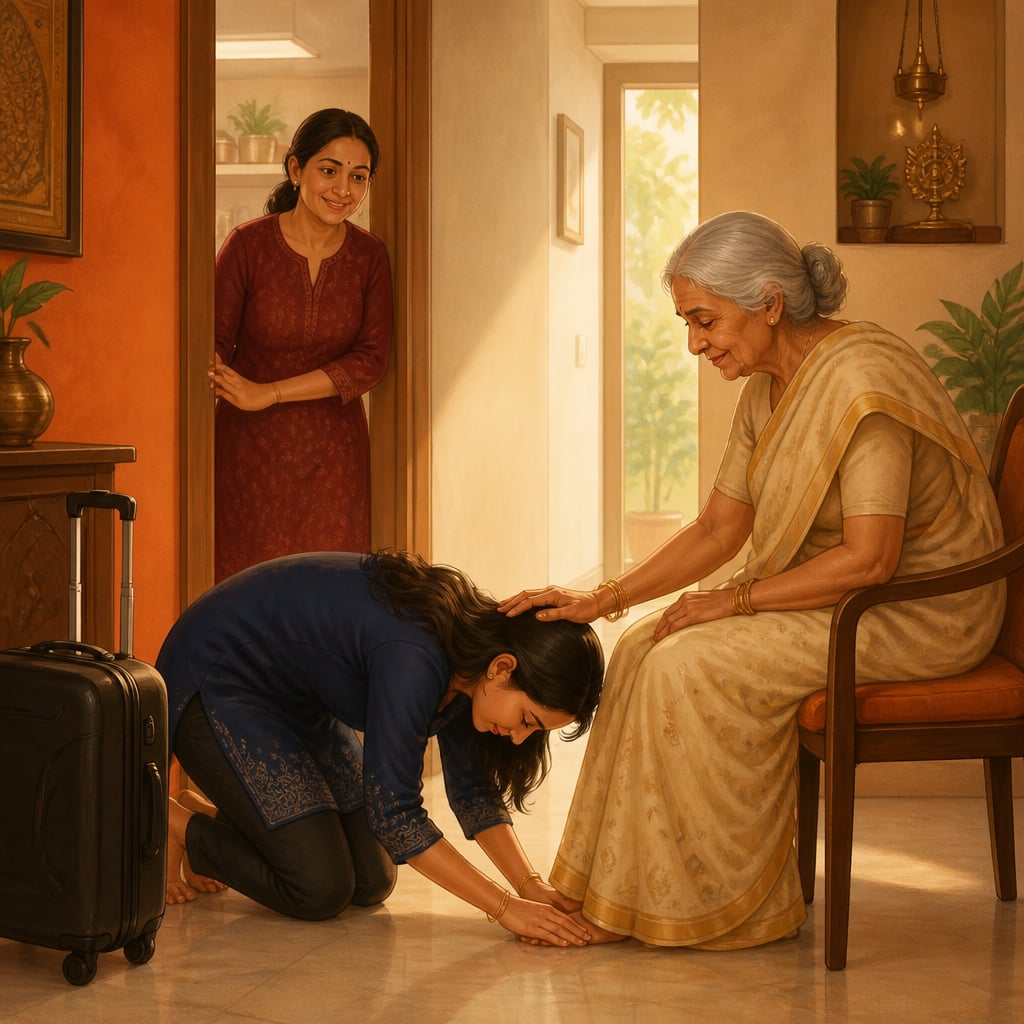
A young woman of twenty-eight is standing in the hallway of her parents' flat in Hyderabad with a wheeled suitcase. Her flight to San Francisco is at eight in the morning. Her mother, her amma, has been awake since four. The driver is downstairs. The young woman is checking her passport for the third time. Her nanamma, her father's mother, who lives in the room at the end of the hallway, has come out in her white cotton sari with a small steel plate of kumkum, a spoon of curd, and a single tulsi leaf. The nanamma does not say much. She places the kumkum tilak on the young woman's forehead. She holds the spoon of curd to the young woman's lips. She steps back and waits.
The young woman knows what comes next. She places her wheeled suitcase against the wall. She walks the three steps to her nanamma. She bends from the waist, folds her body forward, and brings the fingertips of both hands to her nanamma's feet. The nanamma's hand comes down lightly on the back of the young woman's head. The blessing is a single word in Telugu. "Sukhamga vellu." Go in well-being. The young woman touches her amma's feet next, and then her father's. She walks out of the flat.
This lesson is about that ten-second sequence. The dharmic tradition has, for at least three thousand years, encoded social greeting and elder-honouring as a structured sequence of bodily postures, with three principal gestures running the household's relational grammar. Namaste (or namaskar), the palms folded at the heart with the head inclined, is the ordinary daily greeting. Charan sparsh, the touching of the feet of elders with the fingertips, is the act of seeking blessing at the moments of arrival, departure, and consequential transitions. Sashtanga pranama, the full prostration with eight body parts touching the ground (forehead, chest, hands, knees, feet), is the deepest dharmic surrender, offered at the temple, before the guru, and on the most consequential occasions. Panini, in the Ashtadhyayi in the fourth century BCE, treated pranama and vandana as grammatically distinct categories sufficiently complex to require formal grammatical encoding. The household has been running these gestures for more than two and a half thousand years. The lesson is the explanation the nanamma did not stop to give the young woman at the door.
Namaste: The Palms at the Heart
The practice. The namaste begins with the bringing of the two palms together, fingers extended and pointing upward, with the joined palms placed against the centre of the chest at the level of the anahata, the heart chakra. The thumbs touch the sternum. The head inclines slightly forward. The eyes soften. The word namaste (Sanskrit, namah te, salutations to you) or namaskar (Sanskrit, namah karoti, I make salutation) is spoken or silent. The whole gesture takes approximately two seconds. It is the daily ordinary greeting, used on arrival, on departure, on meeting a stranger, on encountering a friend, and on every occasion of formal address. The regional variants run across the geography. In Tamil Nadu the greeting is vanakkam, in Karnataka namaskara, in Bengal nomoshkar, in Kerala namaskaram, in Maharashtra namaskar, in Punjab sat sri akal (with hands folded). The structural element, the joined palms at the heart with the inclined head, is preserved across the variants.
The namaste extends to a deeper form when the recipient is senior or the occasion is more consequential. The hands, still joined, may rise to the level of the forehead (the ajna chakra, the seat of buddhi), and at the deepest form the hands rise above the head (the sahasrara, the crown). The hierarchy is precise. Joined palms at the heart for an equal. Joined palms at the forehead for a senior. Joined palms above the head for a deity, a guru, or a great soul. The household teaches the hierarchy without naming it; the child learns by watching the elder calibrate the gesture.
The scripture. The textual anchors are layered. The Rig Veda preserves the verb namah (to bow, to salute) as the most frequent ritual verb in the entire Samhita; the formula namo namah (salutations, salutations) opens many of the canonical mantras. Panini, in his Ashtadhyayi (approximately fourth century BCE), treats pranama (the formal salutation) and vandana (the act of veneration) as grammatically distinct categories with specified case-endings, sufficient to require formal grammatical encoding. The Manusmriti chapter two, on the householder's daily duties, codifies the greeting forms with specified gestures for elders, equals, and juniors. The Mahabharata preserves the elaborated etiquette in the Vidura Niti and the Yaksha Prashna. The Bhagavad Gita uses the verb namah repeatedly in chapter eleven, the Vishvarupa Darshana, where Arjuna, having seen Krishna's cosmic form, repeats namah namah te as the verbal anchor of his surrender.
नमः ते।
namaḥ te
Salutations to you.
Standard Sanskrit greeting formula, preserved across the entire Vedic and post-Vedic corpus
The two-word formula is the structural core of the dharmic greeting. Namah (the bow, the salutation, the recognition) plus te (to you). The grammar is exact. The greeting is not an inquiry, not an exchange, not a transaction. It is the recognition of the other and the simultaneous recognition that the other contains the same divine principle the speaker contains. The two-word formula is the verbal compression of an entire theological position.
The symbolism. The folded palms encode the dharmic insight that the greeting is, at its root, the recognition of the atman in the other. The Sanskrit gloss namaste is sometimes elaborated as namo aham brahma asmi tad asi tvam, the bow that says I bow to the divine in you that is the same divine in me. The folded palms place the hands at the heart, the seat of the bhakti tradition's emotional centre, and bring the energy of the meeting inward rather than outward. The slight inclination of the head adds the modesty of the bow without requiring the full body to descend. The eyes-soft is the deactivation of the predatory eye-contact pattern that the modern psychology has documented as cortisol-elevating; the namaste is one of the few documented daily greetings in any continuous tradition that explicitly de-emphasises the direct eye-lock.
The absence of touch is a structural element, not an oversight. The namaste recognises the other without requiring physical contact, without requiring the hierarchical handshake (in which the firmer grip signals dominance), and without requiring the kiss-on-cheek negotiation (which encodes degrees of intimacy that vary by region and age). The greeting is offered at distance, with the body's sovereign space intact, and with the recognition of the other complete in the gesture itself.
Charan Sparsh: The Touching of the Feet
The practice. Charan sparsh is the act of touching the feet of an elder, a guru, or a deity's murti with the fingertips of both hands as a gesture of seeking blessing. The classical sequence is precise. The body bends from the waist, folds forward, the right hand reaches for the right foot of the elder and the left hand for the left foot, the fingertips touch the feet briefly, and the hands then rise back to the chest in a folded namaste position. The elder's response is to place the right hand lightly on the back of the head of the one bowing, and to speak a brief blessing: "Khush raho" (be happy), "Aayushman bhava" (may you live long), "Sukhamga vellu" (Telugu, go in well-being), "Vazhga" (Tamil, may you flourish), or the regional equivalent.
The occasions for charan sparsh are calibrated. The household runs the charan sparsh at moments of arrival and departure (the daughter-in-law touches the feet of her in-laws when she arrives at the marital home for the first time and at every visit thereafter; the grandchild touches the feet of the grandparents on every visit; the family touches the feet of the family priest at the start of every consequential ceremony). The charan sparsh is also offered at moments of consequential transition (before a journey, before an examination, before a wedding, before a major decision, on a birthday, on the death anniversary of a parent). The charan sparsh is offered to the family priest after a ceremony, to the guru at the start and end of every encounter, and to the murti at the temple. The frequency of the practice across a year, in a household that keeps the tradition, is in the hundreds.
The scripture. The principal anchors are the Manusmriti chapter two (on the householder's daily duties, including the elder-honouring protocols), the Mahabharata's Vidura Niti (which elaborates the social grammar of charan sparsh in considerable detail), the Ramayana (which preserves the canonical instances: Rama touching the feet of Vasishtha, Bharata touching the feet of Kausalya and the absent Rama's sandals, Hanuman touching the feet of Rama at every meeting), and the Bhagavad Gita chapter eleven (where Arjuna, after the Vishvarupa Darshana, prostrates with the gesture of full charan sparsh and asks Krishna's forgiveness for any prior familiarity).
अभिवादनशीलस्य नित्यं वृद्धोपसेविनः।
चत्वारि तस्य वर्धन्ते आयुर्विद्या यशो बलम्॥
abhivādanaśīlasya nityaṃ vṛddhopasevinaḥ
catvāri tasya vardhante āyur vidyā yaśo balam
For the one who is habitual in salutation and constant in the service of elders, four things increase: lifespan, knowledge, fame, and strength.
Manusmriti 2.121
The verse is the canonical statement of the charan sparsh's structural function. The grammar is direct. The habit of salutation and the service of elders produces four measurable outcomes: lifespan, knowledge, fame, and strength. The Manusmriti is not making a metaphysical claim. It is making a structural claim about social architecture. The household that runs the elder-honouring protocol produces children who live longer, learn more, are better regarded, and are more capable. The modern social-network and gerontology research, two thousand years later, has begun to measure the same effect.
The symbolism. The charan sparsh encodes the dharmic insight that the elder is the structural source of the household's continuity, and that the act of bending the body before the elder is the embodied recognition of the line. The feet are the part of the body most in contact with the earth, with the household's accumulated dharma, and with the elder's lifetime of effort. The act of touching the feet with the fingertips is the act of receiving the elder's accumulated dharmic charge through the most grounded part of the elder's body. The blessing that the elder gives in return, with the right hand on the back of the head of the one bowing, is the structural reciprocation: the elder transmits, the junior receives. The transaction is generational.
The deeper symbolism is the deactivation of the egoic shell. The body, when it bends fully from the waist before another, is structurally incapable of holding the egoic posture upright. The bending is the moment at which the ahamkara (the I-maker, the egoic principle) is structurally lowered. The Cialdini commitment-and-consistency principle, applied at the embodied level, suggests that the body's posture leads the mind's orientation; bending the body before the elder bends the mind into the receptive orientation in which the elder's blessing can land.
Sashtanga Pranama: The Eight-Limbed Prostration

The practice. Sashtanga pranama, literally the eight-limbed prostration, is the deepest form of the dharmic bow. The body lies fully forward on the ground with eight points of contact with the earth: the forehead (one point), the chest (one point, the heart pressed to the ground), the two hands (two points), the two knees (two points), and the two feet (two points). The arms are extended forward overhead, palms joined, fingertips touching the ground above the head. The breath is calmed. The position is held for several seconds. The practitioner then rises, brings the joined palms back to the heart, and stands.
The occasions for sashtanga pranama are reserved. The household offers sashtanga at the temple before the principal deity, before the guru on first meeting and at the moment of receiving formal initiation (diksha), before the family priest at the close of a major ceremony (the wedding, the upanayana, the antyeshti), and on the most consequential household occasions (the moment of accepting a major life-direction, the moment of seeking forgiveness for a serious breach, the moment of dedicating a major effort). The practice is most institutionally visible in the temple traditions, where the sashtanga is part of the canonical pradakshina-pranama-darshan sequence: walk around the deity, prostrate fully, rise, take darshan.
The female-coded variant, panchanga pranama, brings the body to the ground with five points of contact (the chest does not touch the ground), preserving the modesty conventions of the female devotee in mixed-gender temple settings. The functional and structural equivalence is preserved. The depth of the surrender is the same.
The scripture. The principal anchors are the Vishnu Purana (which codifies the sashtanga as the canonical pre-darshan posture at the Vishnu temple), the Shiva Purana (which preserves the same for the Shiva temple), the Skanda Purana (which elaborates the regional variants), and the Bhagavad Gita chapter eleven (where Arjuna's response to the Vishvarupa Darshana is the canonical literary instance of sashtanga). The Ramayana preserves Hanuman's sashtanga before Rama at multiple meetings, and the Mahabharata preserves Yudhishthira's sashtanga before Krishna at the close of the Rajasuya yajna.
साष्टाङ्गं प्रणिपातेन प्रसादो जायते गुरोः।
sāṣṭāṅgaṃ praṇipātena prasādo jāyate guroḥ
By the eight-limbed prostration, the grace of the guru arises.
Skanda Purana, Guru Gita section
The verse names the structural quality of the sashtanga. The full prostration is the embodied condition for the descent of grace. The grammar is causal: the prostration produces the grace, not in a transactional sense but in the sense that the body's full surrender opens the channel through which the guru's transmission can occur. The Skanda Purana is one of the principal classical anchors of the guru-disciple grammar that runs across the entire dharmic tradition.
The symbolism. The eight points of contact are not arbitrary. They are the structural inventory of the body's principal contact-points with the world: the forehead (the seat of the buddhi), the chest (the seat of the bhakti), the hands (the instruments of action, karma indriyas), the knees (the instruments of locomotion), and the feet (the instruments of grounding). The full prostration brings each of these into contact with the earth simultaneously, surrendering each of the body's faculties of self-direction to the receiving consciousness. The body that has been moving, acting, thinking, and feeling all morning lies fully still on the ground for the duration of the sashtanga. The pause is structural.
Why the Body Responds
The Habit Architecture of the three-gesture greeting system is one of the most carefully engineered relational instruments in any continuous tradition. The cue is the moment of meeting another (the daily encounter, the household visit, the ceremonial occasion). The routine is calibrated by relationship: namaste for equals, charan sparsh for elders, sashtanga for the deity and the guru. The reward is the felt-sense of relational order: the body has performed the gesture appropriate to the relationship, the elder has reciprocated with the blessing, and the household's relational architecture is, for that moment, fully aligned. The household does not need to remember whether to bow. The relationship determines the gesture; the gesture is automatic.
Charles Duhigg, in The Power of Habit, identifies the cue-routine-reward structure of habit formation; the three-gesture system runs this structure across an entire civilisation. Wendy Wood, in Good Habits Bad Habits (2019), documents that embodied habits with explicit physical components produce more durable behavioural patterns than purely cognitive habits; the bowed body is the physical component that anchors the relational orientation. George Lakoff and Mark Johnson, in Metaphors We Live By, document the embodied-cognition principle that the body's posture leads the mind's orientation; bowing the body produces the receptive mind, just as the upright body produces the assertive mind.
What the Labs Found
The modern research on greeting posture, bowing, and social hormonal effects has, in the last twenty years, slowly approached what the dharmic three-gesture system has held continuously. Vanessa Bohns and Scott Wiltermuth, at Cornell, in their 2012 paper in the Journal of Experimental Social Psychology, documented that submission-gestures in greeting (the bow, the inclined head, the lowered eye) measurably reduce defensive posturing in the greeted party and increase reported social trust. Kim et al (2009), in the Journal of Psychosomatic Research, measured cortisol and serotonin responses to bowed posture and documented significant cortisol reduction and serotonin elevation, with the effect proportional to the depth of the bow. Amy Cuddy and colleagues, at Harvard Business School, in their 2012 Psychological Science paper on power posing, documented the inverse: expansive posture elevates testosterone and lowers cortisol in the doer. The two findings together, the bowed posture's effect on the greeted and the expansive posture's effect on the doer, frame the embodied-cognition architecture that the dharmic gesture system has run continuously: the bowing body and the receiving body together form a hormonal-and-postural exchange that the modern instruments can now measure.
Paul Zak, at Claremont, in his work on oxytocin and social bonding (The Moral Molecule, 2012), documented that ritual greeting gestures with mutual sustained engagement produce measurable oxytocin elevation in both parties, with the effect strongest when the gesture is reciprocated (the namaste reciprocated by the namaste, the charan sparsh reciprocated by the head-blessing) rather than one-sided. The dharmic three-gesture system is structurally a reciprocated-greeting architecture: every namaste is met by a namaste, every charan sparsh by a head-blessing, every sashtanga by the deity's or guru's prasada. The hormonal architecture is engineered.

The COVID-19 finding is the most documented modern instance. In March 2020, with the SARS-CoV-2 pandemic spreading globally and the medical advice converging on the avoidance of contact-greetings (handshakes, hugs, cheek-kisses), the World Health Organization officially recommended namaste as the safest greeting protocol for the global population. Heads of state performed namaste at international meetings. The British royal family, the Israeli prime minister, the German chancellor, and the leaders of many other nations adopted the gesture publicly. The Western media covered the finding as an Indian gesture now going global, framing the phenomenon as a geographical export rather than as the validation of a three-thousand-year-old documented greeting protocol that had been engineered with infectious-disease prevention as one of its structural advantages.
What the World Calls It Now
The principal modern echo is the namaste-gone-global phenomenon. The WHO recommendation in March 2020 is the most documented case, but the underlying trend predates the pandemic. The yoga industry, valued at approximately eighty-seven billion dollars globally as of 2023, opens and closes every class with namaste, with the instructor placing the joined palms at the heart and inclining the head. The Lululemon brand printed Namaste on its yoga mats and apparel for years and faced public controversy over the appropriation in 2014 (Selena Gomez wore the brand's Namaste tank in promotional material; the resulting debate covered the gesture's dharmic origins for a brief news cycle and then faded). The wellness-greeting category, with namaste as its flagship phrase, runs across the full geography of yoga studios, meditation retreats, wellness conferences, and corporate-mindfulness programmes. None of the principal yoga curricula reference the Manusmriti's chapter two, the Panini Ashtadhyayi, or the Rig Vedic namo namah corpus. The greeting is taught as a yoga-adjacent vocabulary item rather than as the canonical dharmic greeting protocol it has been for three thousand years.
The deeper modern echo is the broader greeting-posture wellness industry. The bow-as-greeting category in the Japanese ritual and the Korean traditions has been preserved and exported with full institutional attribution; the Japanese ojigi and the Korean jeol are taught in cultural-competency curricula and business-etiquette programmes globally with explicit cultural attribution. The dharmic charan sparsh and sashtanga, with their three-thousand-year textual record and their institutional density across India, are, by contrast, rarely taught in the same curricula. The geographical attribution of the bow is calibrated by which civilisation is presenting the gesture; the dharmic tradition's institutional gesture has been less successfully exported with attribution intact.
Power posing and the broader embodied-cognition wellness market (Amy Cuddy's TED talk at sixty-eight million views, the broader self-help literature on posture-and-confidence, the corporate-coaching industry's posture-and-presence modules) are the inverse-direction echo of the dharmic gesture-system insight. The Cuddy research and the broader literature treat the body's posture as the leading edge of the mind's orientation; the dharmic tradition has run this insight in both directions (bow to receive, stand erect to lead) for three millennia.
What to Call It Yourself
Namaste in Sanskrit. Namaskar in the regional inflection. Charan sparsh for the touching of the feet. Sashtanga pranama for the eight-limbed prostration. The Western bowing greeting loses the hierarchy and the embodied-blessing reciprocation. The yoga studio's namaste preserves the word but loses the grammar (the studio's namaste is closing-of-class punctuation; the household's namaste is the structural opening of every encounter). When the conversation reaches for the WHO's pandemic-era greeting recommendation, for the yoga-class namaste, or for the broader wellness-greeting market, the response is one calm sentence. That is the namaste. Panini grammatically encoded it in the fourth century BCE. The Manusmriti chapter two codifies the household greeting protocol. The household has been running it for three thousand years. The naming is the lineage. The lineage is the receipt.
Key figures
Panini
4th century BCE (traditional dates approximately 520 to 460 BCE)
Manu
Manusmriti composed approximately 200 BCE to 200 CE
Case studies
Panini's Ashtadhyayi: Greeting as Grammar (4th century BCE)
Panini, the principal architect of the Sanskrit grammatical tradition, composed the Ashtadhyayi (literally Eight Chapters) in approximately the fourth century BCE. The text formalises Sanskrit in approximately four thousand sutras across eight chapters, with rules covering phonology, morphology, syntax, and semantics. Panini's treatment of greeting and salutation forms gives each its own grammatical category. Pranama (the formal salutation), vandana (the act of veneration), and abhivadana (the formal verbal greeting that names the greeter's lineage) are treated as grammatically distinct, with specified case-endings, verbal forms, and sandhi rules for each. The very fact that fourth-century-BCE Sanskrit grammar required separate categories for these greeting forms is the strongest single piece of evidence that the dharmic greeting system was sufficiently complex, codified, and stable to need formal grammatical treatment by 400 BCE. The Ashtadhyayi's precision is such that twentieth-century formal-language theorists, including Noam Chomsky, have explicitly identified Panini as the precursor of modern formal-language theory.
The Western framing of the dharmic greeting as folk practice, recent wellness import, or culturally curious gesture is structurally inconsistent with the Panini evidence. The Ashtadhyayi is a fourth-century-BCE technical grammar, not a cultural-anthropology treatise; its inclusion of pranama, vandana, and abhivadana as grammatical categories establishes that these were already formal social protocols sufficiently mature to require linguistic codification. The household greeting that the Western media of 2020 covered as an Indian gesture going global was a documented technical category in Indian grammar 2,400 years earlier. The receipts for the system's antiquity and formalisation are in Panini's surviving sutras, in the continuous grammatical tradition that has preserved the text since the fourth century BCE, and in the household practice that continues to perform the same gestures today.
The Ashtadhyayi has been preserved continuously since the fourth century BCE, with the grammatical tradition extended by Patanjali's Mahabhashya (second century BCE), Bhartrihari's Vakyapadiya (fifth century CE), and the broader commentarial corpus across subsequent centuries. The dharmic greeting system that Panini grammatically encoded has been preserved in continuous household and priestly transmission across the same period, with regional verbal inflections but structural identity across the geography. The 2020 WHO recommendation of namaste, the eighty-seven-billion-dollar yoga industry's adoption of namaste as its flagship phrase, and the broader Western rediscovery of the gesture are the modern global validation of a system that had been grammatically formalised twenty-four hundred years earlier.
Namaste and charan sparsh were grammatically encoded social protocols 2,400 years ago. The dharmic greeting system is not folk practice, not a wellness import, not a recent cultural emergence; it is one of the most formally codified relational protocols in any continuous tradition. The receipts for this status are in Panini's Ashtadhyayi, in the Manusmriti chapter two, and in the household practice that continues to run the integrated three-gesture system today.
When the conversation reaches for the namaste as a recent wellness phrase or as a 2020 pandemic-era cultural emergence, the dharmic response is one calm sentence: Panini grammatically encoded the dharmic greeting protocols in the Ashtadhyayi in the fourth century BCE. The Manusmriti chapter two codifies the household practice. The greeting is a 2,400-year-old formalised social protocol, not a recent cultural emergence.
Panini composed the Ashtadhyayi in approximately the fourth century BCE, with separate grammatical categories for pranama, vandana, and abhivadana, demonstrating the formalisation of the dharmic greeting system by 400 BCE. The text has been preserved continuously across approximately twenty-four hundred years of grammatical and commentarial tradition. Twentieth-century formal-language theorists (Chomsky and others) have explicitly identified Panini as the precursor of modern formal-language theory, making the Ashtadhyayi's grammatical encoding of the greeting system one of the oldest documented formal-language treatments of social protocol in any civilisation.
COVID-19 and the Global Namaste Moment (March 2020 to present)
In March 2020, with the SARS-CoV-2 pandemic spreading globally and the medical advice converging on the avoidance of contact-greetings (handshakes, hugs, cheek-kisses), the World Health Organization officially recommended namaste as the safest greeting protocol for the global population. Heads of state performed namaste at international meetings. The British royal family, the Israeli prime minister Benjamin Netanyahu, the German chancellor Angela Merkel, the French president Emmanuel Macron, the Australian prime minister Scott Morrison, and the leaders of many other nations adopted the gesture publicly. The US president Donald Trump performed the namaste at the Motera Stadium event in Ahmedabad in February 2020 just before the pandemic spread globally. Prince Charles, in March 2020, was photographed using namaste at multiple official greetings and was widely reported as having adopted the gesture as his pandemic-era greeting protocol. The Western media covered the phenomenon as 'an Indian gesture now going global,' framing it as a geographical export rather than as the validation of a three-thousand-year-old documented greeting protocol that had been engineered with infectious-disease prevention as one of its structural advantages. The yoga industry, valued at approximately eighty-seven billion dollars globally as of 2023, opens and closes every class with namaste, with the instructor placing the joined palms at the heart and inclining the head; the Lululemon brand, valued at approximately eight and a half billion dollars in 2023, printed Namaste on its yoga mats and apparel for years and faced public controversy over the appropriation in 2014 when Selena Gomez wore the brand's Namaste tank in promotional material. None of the principal yoga, wellness, or pandemic-era greeting curricula reference the Manusmriti's chapter two, the Panini Ashtadhyayi, or the Rig Vedic namo namah corpus.
The global namaste moment of March 2020 is the cleanest documented modern case of the dharmic greeting protocol being globally validated by the highest international medical authority while the dharmic lineage was simultaneously surgically removed. The structural insight, that the contact-free greeting is the safest population-level protocol during contagion-risk periods, is intact. The lineage is gone: no Manusmriti, no Panini, no Rig Veda, no household greeting system. The WHO recommendation framed namaste as a contemporary best-practice, not as a three-thousand-year documented protocol. The dharmic household's job is not to argue with the WHO; the structural advice is correct and aligned with the tradition. The job is to use the original word, with attribution. Namaste, with the recognition that the gesture's structural advantages (contact-free, hierarchically calibrated, hormonally optimised, oxytocin-elevating) were engineered three millennia ago, not improvised in March 2020.
The namaste's global adoption during the pandemic produced the broadest single international validation of any dharmic gesture in the modern period. The yoga industry's eighty-seven-billion-dollar annual market, the Lululemon brand's eight-and-a-half-billion-dollar valuation, the Calm and Headspace meditation apps' two-billion-dollar combined annual revenue, and the broader wellness-greeting category have, since approximately 2014 and intensifying since 2020, each expanded the namaste's presence in Western daily and corporate vocabulary. The Indian household that has always preserved the integrated three-gesture system was not made worse by Lululemon or by the WHO; it was, indirectly, validated by the global appetite for the structural insight. The Manusmriti, Panini, and the Rig Veda's namo namah corpus, however, remain almost entirely absent from the Western institutional treatment of the gesture.
The market and the international institutions reward the rebrander, not the source. The dharmic household's job is not to sue the WHO. The job is to use the original word with attribution. Namaste, with the Manusmriti grammar. Charan sparsh, with the Vedic Sanskrit elder-honouring lineage. Sashtanga pranama, with the Skanda Purana's Guru Gita section. When the conversation reaches for the WHO's pandemic-era greeting recommendation, for the yoga-class namaste, or for the broader wellness-greeting market, the response is one calm sentence: That is the namaste. Panini grammatically encoded it in the fourth century BCE. The Manusmriti chapter two codifies the household greeting protocol. The household has been running it for three thousand years. Talapatram's Sanatan Operating System course, in this lesson, is filing the receipt.
Use the original word in conversation. When the friend says she is doing the WHO's recommended namaste, you say she is doing the household namaste with three thousand years of textual codification behind it. When the magazine cover names the yoga-class namaste, you name the Manusmriti chapter two. The market and the international institutions are running the structural insight; the dharmic tradition is the source. The naming completes the loop.
The World Health Organization officially recommended namaste as the safest greeting protocol for the global population in March 2020. Heads of state of the UK, Germany, France, Israel, and Australia adopted the gesture publicly during the pandemic. The global yoga industry, with namaste as its flagship phrase, exceeded eighty-seven billion dollars in annual market value in 2023. The Lululemon brand, valued at approximately eight and a half billion dollars in 2023, printed Namaste on its yoga apparel for years. The Manusmriti specified the underlying greeting protocol approximately two thousand years earlier; Panini grammatically encoded it approximately twenty-four hundred years earlier. None of the principal yoga, wellness, or pandemic-era greeting curricula reference the Manusmriti's chapter two, the Panini Ashtadhyayi, or the Rig Vedic namo namah corpus.
Bohns-Wiltermuth 2012 and Kim 2009: The Hormonal Vindication of the Dharmic Bow
The modern research on greeting posture, bowing, and social hormonal effects has, in the last fifteen years, produced converging instrumented confirmation of the dharmic three-gesture system's underlying mechanisms. Vanessa Bohns and Scott Wiltermuth, at Cornell University, in their 2012 paper in the Journal of Experimental Social Psychology, documented that submission-gestures in greeting (the bow, the inclined head, the lowered eye) measurably reduce defensive posturing in the greeted party and increase reported social trust. Kim et al, in their 2009 paper in the Journal of Psychosomatic Research, measured cortisol and serotonin responses to bowed posture and documented significant cortisol reduction and serotonin elevation, with the effect proportional to the depth of the bow. Amy Cuddy and colleagues, at Harvard Business School, in their 2012 Psychological Science paper on power posing, documented the inverse-direction effect: expansive posture elevates testosterone and lowers cortisol in the doer. Paul Zak, at Claremont, in his 2012 work The Moral Molecule, documented that ritual greeting gestures with mutual sustained engagement produce measurable oxytocin elevation in both parties, with the effect strongest when the gesture is reciprocated. The Bohns-Wiltermuth, Kim, Cuddy, and Zak findings together frame an embodied-cognition architecture that the dharmic gesture system has run continuously: the bowing body and the receiving body together form a hormonal-and-postural exchange that the modern instruments can now measure. The depth of the bow (the namaste's slight inclination, the charan sparsh's full waist-bend, the sashtanga's complete prostration) is calibrated to the depth of the relational orientation, with each level producing a calibrated hormonal signature in both parties.
The Manusmriti 2.121 promise of four outcomes (lifespan, knowledge, fame, strength) for the abhivadana-shila (the one habitual in salutation) is, in the language of modern psychoneuroendocrinology, the hormonal architecture that the Bohns, Kim, Cuddy, and Zak research base has begun to instrument. The lifespan claim is consistent with the long-term cortisol-reduction effect of habitual bowed-greeting practice (chronic cortisol elevation is a documented predictor of accelerated biological ageing); the knowledge claim is consistent with the elder's structural transmission to the bowed receiver (the head-blessing gesture's neurological and bonding signatures); the fame claim is consistent with the Bohns-Wiltermuth social-trust findings; the strength claim is consistent with the Cuddy power-posing inverse-direction research applied at the household-aggregate level. The research vindication is total: the substance is correct, the structure is correct, the timing is correct, the hormonal architecture is correct. The Manusmriti specified each of these by experience two thousand years before the experimental methods could measure them.
The embodied-cognition research base, the greeting-posture research, the power-posing literature, and the broader oxytocin-and-ritual-greeting literature have grown into a substantial cross-disciplinary research field across psychology, neuroscience, endocrinology, and behavioural economics. The Cuddy 2012 TED talk on power posing has reached approximately sixty-eight million views, making it one of the most-watched TED talks in the platform's history. The corporate-coaching industry's posture-and-presence modules, the executive-coaching frameworks built on Cuddy and related research, and the broader wellness-greeting market are each downstream of the same recognition the dharmic three-gesture system has held continuously: the body's posture leads the mind's orientation, the bowed body produces the receptive mind, and the reciprocated greeting produces measurable hormonal alignment in both parties.
The case for the tradition does not need to wait for the lab. The lab, when it arrives, will confirm what the tradition recorded. The Rig Veda preserved the namo namah corpus three thousand years ago. Panini grammatically encoded the greeting protocols in the fourth century BCE. The Manusmriti codified the four-outcome promise (lifespan, knowledge, fame, strength) in the second century BCE. The Bhagavad Gita's chapter eleven articulated the namaste-as-cosmic-recognition. The Skanda Purana's Guru Gita named the sashtanga as the embodied condition for guru-prasada. Bohns and Wiltermuth published the social-trust paper in 2012. Kim et al published the cortisol-and-serotonin paper in 2009. Cuddy published the power-posing paper in 2012. The WHO recommended namaste in March 2020. Three independent research records, two thousand years apart, point to the same hormonal-and-relational architecture.
Three thousand years of household practice, twenty-four hundred years of formal grammatical codification, two thousand years of textual specification of outcomes, and over fifteen years of modern psychoneuroendocrinology research all point to the same embodied-cognition architecture for the dharmic greeting system. The grandmother does not need to read Bohns or Cuddy. She has put her grandson's hands on her feet before he left for the airport. The hormonal-greeting research and the dharmic three-gesture system are not in competition. They are the same insight, two thousand years apart, with one of them carrying the integrated whole the other is reassembling, piece by piece.
Bohns and Wiltermuth (2012, Journal of Experimental Social Psychology) documented that submission-gestures in greeting measurably reduce defensive posturing in the greeted party and increase reported social trust. Kim et al (2009, Journal of Psychosomatic Research) measured significant cortisol reduction and serotonin elevation in bowed posture, proportional to the depth of the bow. Cuddy et al (2012, Psychological Science) documented inverse-direction power-posing effects on testosterone and cortisol. Zak (2012, The Moral Molecule) documented oxytocin elevation in mutual ritual greeting. Manusmriti 2.121 specified the underlying four-outcome promise (lifespan, knowledge, fame, strength) approximately two thousand years earlier; Panini grammatically encoded the greeting protocols approximately twenty-four hundred years earlier; the Rig Veda's namo namah corpus is approximately three thousand years older than the modern psychoneuroendocrinology research.
Historical context
Vedic to present (the dharmic greeting system continuously documented from the Rig Veda's namo namah corpus, c. 1500 BCE; grammatical formalisation in Panini's Ashtadhyayi, 4th century BCE; codification in the Manusmriti chapter two, c. 200 BCE to 200 CE; modern instrumented confirmation in the embodied-cognition and greeting-posture research, 2009 to present; institutional global validation by the WHO in March 2020)
The three-gesture greeting system is one of the most stable institutions in Indian civilisation. Across three thousand years, through Vedic, Mauryan, Gupta, Pala, Chola, Vijayanagara, Mughal, Maratha, and colonial periods, the household has run the namaste as the daily greeting, the charan sparsh as the moment-of-transition gesture, and the sashtanga pranama as the temple and guru posture. The practice was preserved across regions, varnas, and economic classes through household and priestly transmission, with regional verbal inflections (vanakkam in Tamil, namaskara in Kannada, nomoshkar in Bengali, namaskaram in Malayalam, namaskar in Marathi and Hindi) but with structural identity across the geography. The colonial period imposed the handshake as the official greeting through schools, government, and military but did not displace the household namaste, which continued in parallel use throughout the colonial period and remains in active use across India in the twenty-first century. The 2020 WHO recommendation, the broader namaste-gone-global phenomenon, and the eighty-seven-billion-dollar yoga industry's adoption of namaste as its flagship phrase are the documented modern case of an integrated indigenous relational protocol being globally validated, with the structural insight imported and the dharmic lineage left behind. The dharmic household's job is small and clear: keep running the integrated three-gesture system, every namaste, every charan sparsh, every sashtanga, in every house that still keeps the protocol.
Living traditions
The dharmic three-gesture greeting system is no longer a Hindu tradition that the modern world is unaware of. The eighty-seven-billion-dollar yoga industry's namaste, the WHO's March 2020 official recommendation of namaste as the safest greeting protocol, the British royal family's pandemic-era adoption, the Lululemon brand's apparel-print, and the broader wellness-greeting category are the namaste with the dharmic lineage and the Manusmriti grammar surgically removed. The Bohns-Wiltermuth 2012 social-trust research, the Kim 2009 cortisol-and-serotonin measurements, the Cuddy 2012 power-posing inverse-direction research, and the Zak 2012 oxytocin-and-ritual-greeting research are the modern instrumented confirmations of what the dharmic three-gesture system has held continuously. The Indian household that has always preserved the integrated namaste, charan sparsh, and sashtanga pranama was not made worse by Lululemon or by the WHO; it was, indirectly, validated by the global appetite for the structural insight. The dharmic tradition's job is small and clear. When the conversation reaches for the WHO's pandemic-era recommendation, you say the namaste. When the conversation reaches for the yoga-class greeting, you say Panini grammatically encoded the namaste in the fourth century BCE. When the conversation reaches for the corporate power-posing module, you say Manusmriti 2.121 named the four outcomes (lifespan, knowledge, fame, strength) two thousand years ago. The Rig Veda's namo namah corpus, the Panini Ashtadhyayi, the Manusmriti chapter two, the Bhagavad Gita's chapter eleven, the Skanda Purana's Guru Gita, and the Apastamba Grihya Sutra are the textual anchors; the household practice is the daily instrument; the grandmother at the doorway placing her grandson's hands on her feet before he leaves for the airport is the institutional continuity. Use the names. The labs have arrived. Talapatram's Sanatan Operating System course, in this lesson and in the broader Gurukul, is the manual for the household and the relational-grammar tradition the integrated three-gesture system belongs to. Every namaste, every charan sparsh, every sashtanga, every receipt.
- Daily Household Namaste and the Reciprocated Greeting: The household practice of opening and closing every encounter with the namaste: the joined palms at the heart, the slight inclination of the head, the soft eyes, the verbal namaste or namaskar or the regional equivalent. The practice runs across the full day: at the morning meeting of the household, at the arrival of any visitor, at the meeting of any colleague or friend, at the departure of any family member, at the closing of any phone or video call. The hierarchy is calibrated by the height at which the joined palms are held: at the heart for an equal, at the forehead for a senior, above the head for a deity, a guru, or a great soul. The reciprocation is structural: the namaste is met by the namaste, completing the relational exchange. The verbal layer carries the regional inflection (vanakkam in Tamil, namaskara in Kannada, nomoshkar in Bengali, namaskaram in Malayalam, namaskar in Marathi and Hindi) but the structural gesture is preserved across the geography.
- Charan Sparsh at Moments of Transition: The household practice of running the charan sparsh at moments of arrival, departure, and consequential transition. The classical sequence is precise. The body bends from the waist, folds forward, the right hand reaches for the right foot of the elder and the left hand for the left foot, the fingertips touch the feet briefly, and the hands then rise back to the chest in a folded namaste position. The elder's response is to place the right hand lightly on the back of the head of the one bowing and to speak a brief blessing. The occasions are calibrated. The daughter-in-law touches the feet of her in-laws when she arrives at the marital home for the first time and at every visit thereafter. The grandchild touches the feet of the grandparents on every visit. The family touches the feet of the family priest at the start of every consequential ceremony. The household runs the charan sparsh at the beginning of the new year (Ugadi, Gudi Padwa, Vishu, Puthandu), on each parent's birthday, on the death anniversary of grandparents, before any consequential journey or examination, and on consequential life-transition occasions (the wedding, the new job, the new house, the major decision).
- Sashtanga Pranama at the Temple and Before the Guru: The household and temple practice of running the sashtanga pranama (the eight-limbed prostration) at the temple before the principal deity, before the guru on first meeting and at the moment of receiving formal initiation (diksha), and on the most consequential household occasions. The body lies fully forward on the ground with eight points of contact (forehead, chest, two hands, two knees, two feet); the arms are extended forward overhead, palms joined, fingertips touching the ground above the head; the breath is calmed; the position is held for several seconds; the practitioner then rises, brings the joined palms back to the heart, and stands. The female-coded variant, panchanga pranama, brings the body to the ground with five points of contact (the chest does not touch the ground), preserving the modesty conventions of the female devotee in mixed-gender temple settings. The practice is part of the canonical pradakshina-pranama-darshan sequence: walk around the deity, prostrate fully, rise, take darshan.
- Sringeri Sharada Peetham (the principal Adi Shankaracharya matha for the Guru Purnima sashtanga): One of the four principal mathas (monastic centres) established by Adi Shankaracharya in the eighth century, with the unbroken succession of Shankaracharyas across more than twelve hundred years. The Sringeri Sharada Peetham is the southern matha, dedicated to the goddess Sharada (Saraswati) and anchored at the confluence of the Tunga river. The Guru Purnima observance at Sringeri, with the disciple sashtanga pranama before the current Shankaracharya and the recitation of the Guru Gita, is one of the most institutionally significant Guru Purnima observances in the dharmic geography. The matha's unbroken acharya-succession (the parampara) provides the canonical institutional model for the guru-disciple lineage that the sashtanga pranama embodies.
- Tirumala Sri Venkateswara Swamy Temple (the principal pilgrimage destination for the household's annual sashtanga and abhishekam): One of the most institutionally significant Vaishnava temples in the dharmic geography, dedicated to Vishnu in his Venkateswara form. The temple is built on the seventh of the seven hills (the Saptagiri) at Tirumala and is regarded as one of the wealthiest temples in the world by annual donation receipts and by daily pilgrim flow. The Vaikuntha Ekadashi observance, the annual Brahmotsavam in September, and the household-scale annual yatra to Tirumala for the principal sashtanga before the deity are the major institutional occasions. The principal pilgrim flow is approximately seventy-five thousand per day on ordinary days and several lakhs per day on Vaikuntha Ekadashi and the Brahmotsavam window. The standard household pilgrimage involves the queue (the darshan line), the principal sashtanga before the moolavar (the principal deity), the laddu prasada distribution, and the descent down the Tirumala hill on the seven-hundred-step canonical descent route (or the modern motorable road).
- Belur Math (the principal Ramakrishna-Vivekananda monastic centre and the institutional anchor of the modern dharmic guru-tradition export): The headquarters of the Ramakrishna Math and Mission, founded by Swami Vivekananda in 1898 as the institutional embodiment of Sri Ramakrishna Paramahamsa's teaching and as the centre from which the modern global presentation of the dharmic guru-tradition would emerge. The campus, on the western bank of the Hooghly river, includes the Ramakrishna temple (with the murti of Sri Ramakrishna), the Vivekananda temple (built at the site of Vivekananda's cremation), the Holy Mother Sarada Devi's temple, the Brahmananda temple, and the principal monastic complex. The Guru Purnima observance at Belur Math, with the sashtanga pranama before the principal sannyasins of the order, is one of the most institutionally significant modern observances. The matha is the institutional successor to Vivekananda's 1893 Parliament of the World's Religions appearance in Chicago, where the namaste was performed at the global stage for the first time and the modern arc of the dharmic greeting's international presence began.
Reflection
- Look at your own week's relational rhythm. Do you open and close every consequential encounter with namaste? Do you perform charan sparsh before your parents, grandparents, and the family priest at moments of arrival, departure, and transition? Do you offer sashtanga pranama at the temple and before the guru on Guru Purnima? If the answer to any of these is no, what would change in your relational architecture if you installed the integrated three-gesture system as the household's default greeting protocol?
- Panini grammatically encoded the namaste, the pranama, and the abhivadana as distinct categories in the fourth century BCE. The World Health Organization recommended namaste as the safest greeting protocol in March 2020. What does it mean that two institutions, separated by twenty-four hundred years, arrived at the same conclusion that the contact-free reciprocated greeting is the most carefully engineered, hormonally optimised, and infectious-disease-safe greeting protocol available to a civilisation?
- The Western greeting protocol is the handshake: a gesture of equality, transactional, bilateral, with the firmer grip signalling dominance. The dharmic greeting is the namaste, the charan sparsh, and the sashtanga pranama: a hierarchically calibrated three-gesture system that names the relational tier of every encounter. What does it mean to live in a relational architecture where the gesture itself encodes the hierarchy and the calibrated reciprocation, rather than presenting every encounter as an equal transaction? What does the handshake-only frame lose, and what does the integrated three-gesture system offer?