Guru Is Not a Teacher

The Guru-Shishya bond, the Taxila gurukul, the dakshina contract, and why one-on-one transmission is structurally older than the lecture hall

The English word teacher names a person paid to deliver a syllabus. The Sanskrit word guru names something else entirely. The guru is the person who holds the lineage, who has been transmitted by his own guru, who carries the parampara, and to whom the shishya offers not tuition but dakshina at the close of the discipline. Taxila ran the world's oldest documented university on the guru-shishya model and the dakshina contract for one thousand years before tuition existed as a category. Panini, Chandragupta, Chanakya, and Jivaka the physician all studied at Taxila's guru-shishya chains. The modern executive-coaching industry is a twenty-billion-dollar global market that has rediscovered the structural relationship under the names mentorship and one-on-one coaching, with zero attribution to the original. The Ericsson ten-thousand-hours research and the Collins and Greeno cognitive apprenticeship model are the modern instrumented confirmation that situated learning under a master is neurologically superior to classroom instruction. The grandmother who touches the guru's feet on Guru Purnima knows the contract. The lesson is the explanation.

A Music Lesson in Pune, the Year the Boy Turned Eight
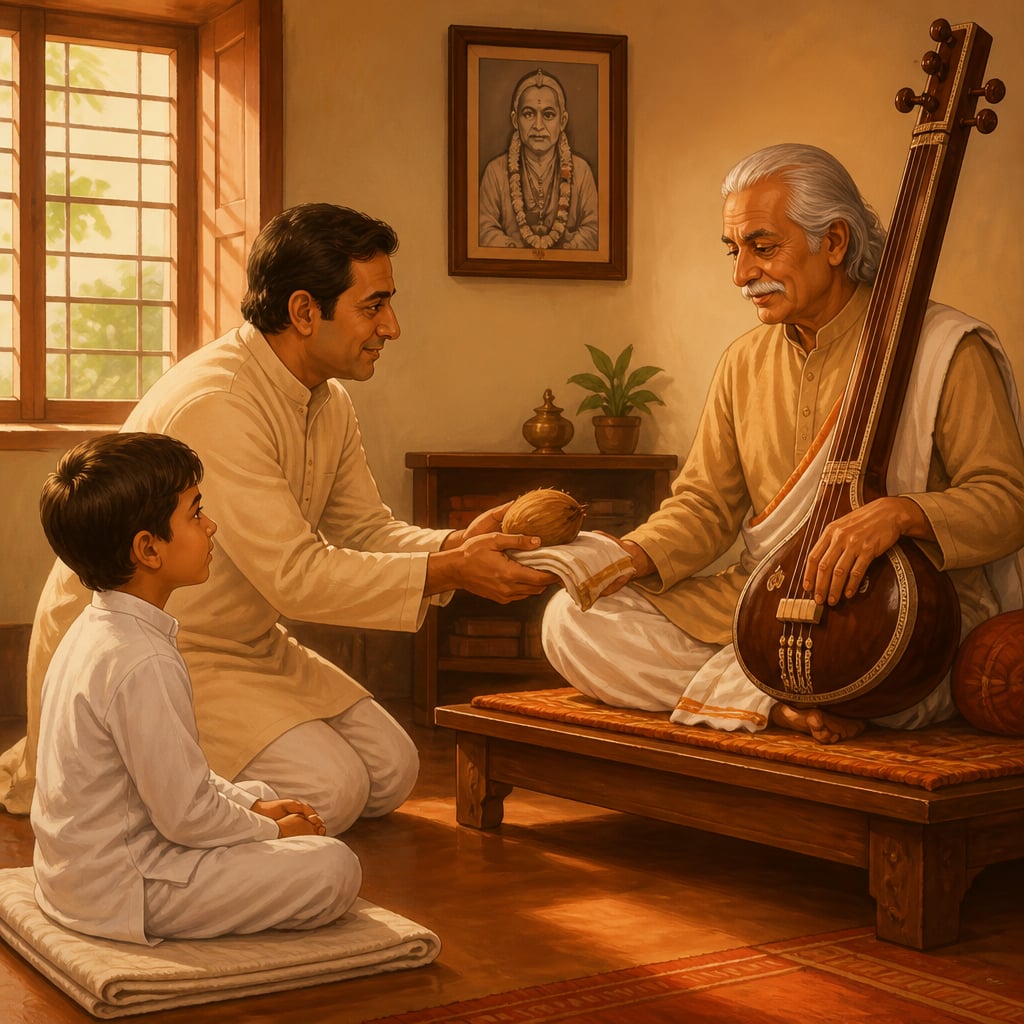
Boy with father at a music gurudev's house in Sadashiv Peth Pune

The boy is eight years old and has been brought to the gurudev's house in a small lane in Sadashiv Peth in Pune. The boy's father is carrying a small brass plate with five things on it: a coconut, a packet of betel leaves, a small mound of rice, a banana, and a folded one-rupee note. The gurudev is a thin man in his sixties, sitting cross-legged on a thin cotton mattress with a tanpura propped behind him and a brass spittoon beside him. He says nothing for a long time. The boy's father places the brass plate at the gurudev's feet, joins his palms, and says, "Maharaj, mulala swikar kara." Master, accept the boy.

The gurudev looks at the boy for a long time. Then he says, in Marathi, "Tu ka aalas?" Why have you come. The boy, who has been told only that he is going to learn singing from the gurudev, does not know what to say. The gurudev waits. Eventually the boy says the truth, that his father has brought him. The gurudev nods. He says, "Hi tujhi pratham guru-bhet aahe. Maza shishya banlas tar maza ghar ha tujha ghar aahe. Maza guru ha tujha guru aahe. Maza parampara hi tujhi parampara aahe. Tu ekun shabd aikla ka?" This is your first guru-meeting. If you become my shishya, my house is your house. My guru is your guru. My lineage is your lineage. Did you hear every word.

The boy did not. The boy understood only the word parampara. The boy understood that something larger than a music lesson was being offered, that the gurudev was not asking the boy if he wanted to learn songs but if he wanted to enter a line that ran backward through the gurudev's own gurudev and the gurudev's own gurudev's gurudev across centuries he had no way to count. The boy nodded. The father bowed. The gurudev took a single grain of rice from the brass plate, placed it on the boy's tongue, and said, "Maza shishya. Aata pratham raag shikhuya." My shishya. Now we will learn the first raga.

This lesson is about that scene. The dharmic tradition does not have a category called teacher in the modern Western sense of the person paid to deliver a syllabus across a semester to a room full of strangers. The dharmic tradition has the guru, who is something else entirely. The guru is the person who holds the parampara, the unbroken line of transmission. The guru is the person who has himself been transmitted by his own guru. The guru is the person to whom the shishya offers not tuition but dakshina at the close of the discipline, in whatever amount and whatever kind the shishya feels appropriate, with no contract, no fee schedule, no invoice. The guru-shishya relationship is the oldest continuously documented educational institution in human history, and the modern world, having spent a century rediscovering fragments of it under the names mentorship, coaching, apprenticeship, and one-on-one tuition, is paying retail for what the Taxila gurukul ran for a thousand years on dakshina alone.

Guru and Shishya: The Relationship the English Words Cannot Carry

The practice. The guru-shishya parampara (the lineage of master-and-disciple) is the institutional structure of dharmic learning. The relationship is not a transaction; it is a bond. The shishya does not enrol in a course; he is accepted by the guru. The guru does not teach a curriculum; he transmits a lineage. The relationship lasts not for a semester but for the shishya's life, and often beyond, with the shishya in time becoming the guru of his own shishyas and so transmitting forward what was transmitted to him.

The principal classical formats of the guru-shishya relationship include the gurukul (the residential format in which the shishya lives in the guru's household for the duration of the discipline, typically twelve years for the Vedic studies, with no tuition but with the shishya performing household service in lieu); the acharya kula (the temple-based or sectarian-headquarters format in which the acharya teaches a defined sampradaya's philosophical and ritual corpus); the gharana (the household-based format in classical music, dance, and the performing arts, with the gharana name carrying the lineage's distinctive style across generations); and the parampara (the broad term for any unbroken line of guru-to-shishya transmission across multiple generations).

The principal classical disciplines preserved through the guru-shishya format include the Vedic disciplines (the four Vedas with their associated sciences: jyotisha, kalpa, shiksha, vyakarana, chhanda, and nirukta); the darshana disciplines (the six classical philosophical schools: Nyaya, Vaisheshika, Samkhya, Yoga, Mimamsa, and Vedanta, with their respective acharya-kulas); the agama disciplines (the Vaishnava Pancharatra, the Shaiva Agama, the Shakta Tantra, with their temple-based priestly traditions); the shastra disciplines (Ayurveda, Arthashastra, Dharmashastra, Natyashastra, and the various technical sciences); the kala disciplines (the sixty-four classical arts, including classical music, dance, sculpture, painting, and the performing arts); and the martial disciplines (Kalaripayattu in Kerala, Mardani Khel in Maharashtra, Silambam in Tamil Nadu, Gatka in Punjab, and the broader subcontinental martial traditions).

The relationship's procedural opening is the Upanayana for Vedic studies (treated in Chapter Six's lesson on the sixteen samskaras) or the guru-bhet ceremony for the non-Vedic disciplines, in which the shishya is formally accepted by the guru with the offering of the brass-plate items (coconut, betel, rice, banana, and the symbolic dakshina), the placing of a single grain of rice on the shishya's tongue, and the recitation of the appropriate sampradayic mantras. The relationship's procedural closing, after the discipline is complete, is the samavartana (the graduation, also treated in Chapter Six) in which the shishya offers the final dakshina to the guru and is formally released into the world to apply the discipline.

The dakshina contract. The dakshina is the heart of the dharmic learning economy and the structural feature that distinguishes guru-shishya transmission from the modern fee-paying tuition model. The dakshina is the gift the shishya offers the guru at the close of the discipline (or at intervals during the discipline, depending on the sampradaya's convention), in whatever amount and whatever kind the shishya feels appropriate. The dakshina is voluntary, not contractual; the dakshina is given out of gratitude, not out of obligation; the dakshina is named at the close, not at the beginning; the dakshina has no fee schedule, no invoice, and no enforcement mechanism beyond the shishya's own dharma. The Taxila gurukul ran on dakshina for one thousand years and educated tens of thousands of shishyas without any tuition fee whatsoever.

The Eklavya frame and the Dronacharya frame. The Mahabharata's Eklavya episode is the canonical scriptural treatment of the dakshina question's edge case. Eklavya, the tribal-born archer, was refused acceptance by Drona on caste grounds, fashioned a clay murti of Drona, practised under the murti, and surpassed Arjuna in skill. When Drona discovered the situation, he asked for the dakshina that Eklavya owed him as the inwardly-acknowledged guru: Eklavya's right thumb, which would render him unable to draw a bow. Eklavya offered it without hesitation. The episode is read in different ways across the dharmic tradition, with the canonical reading naming Drona's request as a dharmic failure and Eklavya's adherence as a dharmic triumph. The episode is preserved precisely because it stresses the dakshina contract to its breaking point and asks the reader to weigh the shishya's loyalty against the guru's misuse of authority. The Eklavya question is one of the most-debated ethical questions in the dharmic learning tradition.

The Drona-Arjuna relationship is the canonical positive frame: the guru who tests the shishya, who recognises the shishya's gift, who pushes the shishya past the shishya's own self-imposed limits, and who, at the close, releases the shishya with a complete training. Drona's transmission to Arjuna is the canonical instance of the full guru-shishya cycle: the acceptance, the discipline, the testing, the training, the closing dakshina, and the release.

Taxila: The World's Oldest Documented University

Acharya teaching shishyas under a banyan at ancient Taxila

The Takshashila gurukul (Taxila in modern Pakistan, near present-day Rawalpindi) is the world's oldest documented institution of higher learning, with documented operations from approximately the sixth century BCE to the fifth century CE. The Taxila record is exceptional in the documentary tradition: the names of the teachers, the names of the students, the disciplines taught, the duration of the residence, and the dakshina norms are preserved in the Jataka tales, the Buddhist Vinaya literature, the Greek records of Alexander's contact with Taxila in 326 BCE (Strabo and Arrian preserved the Greek accounts), and the Chinese pilgrim records of Faxian (4th-5th century CE) and Xuanzang (7th century CE).

The graduates of Taxila are themselves a history. Panini, the foundational classical Sanskrit grammarian whose Ashtadhyayi is the world's oldest surviving generative grammar, studied at Taxila in approximately the fifth or fourth century BCE. Chanakya (Kautilya), the architect of the Mauryan empire and author of the Arthashastra, was both a student and a teacher at Taxila in the fourth century BCE. Chandragupta Maurya, the founder of the Mauryan dynasty, was Chanakya's shishya at Taxila before becoming emperor. Jivaka, the personal physician to the Buddha and one of the foundational figures in the Ayurveda tradition, completed his seven-year medical training at Taxila under his Ayurvedic acharya. Kumarajiva, the Buddhist scholar whose Chinese translations of the Sanskrit sutras shaped East Asian Buddhism, had Taxila-tradition predecessors in his lineage.

The disciplines at Taxila included the four Vedas, the six classical philosophical schools, Ayurveda (Atreya was the foundational Ayurvedic teacher at Taxila), Sanskrit grammar (Panini's contributions), Arthashastra and political science (Chanakya's), military science, archery (Drona's lineage at Taxila), the eighteen classical arts, and the various specialist disciplines. The duration of residence varied from seven years (the Ayurveda discipline) to twelve years (the Vedic disciplines) and longer for the comprehensive scholar. The financing was entirely dakshina-based: students brought what their families could afford, performed household service in lieu, and offered the closing dakshina at the discipline's completion in whatever amount and kind they felt appropriate. The Taxila gurukul ran on this model for approximately one thousand years.

The Scripture Behind the Guru

The principal scriptural anchors. The Upanishads are the foundational classical texts of the guru-shishya relationship. The Mundaka Upanishad opens with Shaunaka approaching Angiras as the shishya approaches the guru: "tasmai sa hovacha" (to him, that one spoke). The Katha Upanishad records the dialogue of the boy Nachiketa and the death-deity Yama, in which Yama becomes the guru who answers Nachiketa's three boons. The Chandogya Upanishad records the dialogue of Shvetaketu and his father Uddalaka Aruni, with the "tat tvam asi" teaching delivered in the guru-shishya format. The Bhagavad Gita is itself a guru-shishya dialogue, with Krishna as the guru and Arjuna as the shishya, with the entire text framed as the guru's transmission to the shishya in the moment of the shishya's crisis.

The Manusmriti chapter two prescribes the duties of the shishya toward the guru in the Vedic gurukul: the morning service, the firewood gathering, the food preparation, the household assistance, and the disciplined attention to the guru's instruction. The Apastamba Dharma Sutra and the Ashvalayana Grihya Sutra preserve the procedural details of the Upanayana and the gurukul residence. The Yajnavalkya Smriti codifies the post-gurukul dharma of the householder who has graduated.

गुरुर्ब्रह्मा गुरुर्विष्णुः गुरुर्देवो महेश्वरः।

गुरुः साक्षात् परब्रह्म तस्मै श्रीगुरवे नमः॥

gurur brahmā gurur viṣṇuḥ gurur devo maheśvaraḥ

guruḥ sākṣāt para-brahma tasmai śrī-gurave namaḥ

The guru is Brahma, the guru is Vishnu, the guru is Maheshvara. The guru is verily the Supreme Brahman. To that guru, salutation.

Guru Stotram, traditionally attributed to the Skanda Purana's Guru Gita

The verse encodes the dharmic tradition's theological elevation of the guru: the guru is identified with the trimurti (the three principal aspects of the divine: creation, preservation, dissolution) and with the para-brahman (the supreme reality itself). The elevation is not metaphorical in the dharmic frame; the guru is, in the moment of transmission, the channel through which the para-brahman becomes available to the shishya, and the shishya's salutation at the threshold of every learning session is the salutation to that channel.

Why the Body Responds: The Habit Architecture of Guru-Shishya Transmission

The Habit Architecture of the guru-shishya relationship is unusually well-engineered for the modern question of mastery and skill acquisition. The cue is the daily threshold of the guru's house, the morning's first salutation, the moment the shishya touches the guru's feet and is permitted to begin the day's work. The routine is the disciplined daily practice under the guru's watchful correction, the immediate feedback loop between the shishya's attempt and the guru's adjustment, the iterative refinement that no classroom format can deliver. The reward is the felt-sense of progress measured against the lineage's standard, the gradual approach to the mastery the parampara has carried across generations, and the eventual transmission of the shishya into the line as a guru in his own right.

The behavioural science is exact. The guru-shishya relationship is what the modern cognitive science literature calls cognitive apprenticeship, the structural format in which a novice learns from a master through situated practice with continuous feedback rather than through abstracted classroom instruction. Anders Ericsson's decades of research on expert performance, summarised in Peak (2016) and the foundational 1993 Psychological Review paper, established that deliberate practice under an expert coach is the non-negotiable structural feature of every documented case of expert mastery, across domains from chess to music to athletics to surgery. The famous "ten thousand hours" finding is, in Ericsson's actual formulation, ten thousand hours specifically of deliberate practice under expert guidance, not ten thousand hours of unsupervised activity. Without the guide, the practice does not produce mastery.

Collins, Brown, and Newman's (1989) Cognitive Apprenticeship paper in the cognitive science literature established the four structural features of the format: modelling (the master demonstrates the skill), scaffolding (the master provides graded support that is gradually withdrawn), articulation (the master makes explicit the implicit reasoning behind expert moves), and fading (the master gradually transfers responsibility to the apprentice). The four features map almost exactly onto the guru-shishya format the Taxila gurukul codified two and a half thousand years ago: the guru's daily demonstration of the discipline, the guru's graded correction across the years, the guru's articulation of the parampara's reasoning, and the guru's eventual release of the shishya at the samavartana.

What the Labs Found

Anders Ericsson, K, Krampe, R, and Tesch-Romer, C (1993), The Role of Deliberate Practice in the Acquisition of Expert Performance, in Psychological Review, established the foundational research on expert performance: deliberate practice under an expert coach is the non-negotiable structural feature of every documented case of expert mastery, across domains.

Collins, Brown, and Newman (1989), Cognitive Apprenticeship: Teaching the Crafts of Reading, Writing, and Mathematics, in Knowing, Learning, and Instruction, established the four-feature model of cognitive apprenticeship (modelling, scaffolding, articulation, fading) and demonstrated through controlled comparisons that situated learning under a master produces measurably better outcomes than equivalent classroom instruction.

Daniel Coyle (2009), The Talent Code, synthesised the Ericsson research with neuroscience findings on myelination (the insulating sheath that develops around frequently-used neural pathways) and established that deliberate practice under expert guidance produces measurable neural-architectural changes that classroom instruction does not produce. The book popularised the term "talent hotbeds" for institutional environments (the Spartak Tennis Club in Moscow, the Suzuki music method, the Brazilian futsal academies) that institutionally embody the cognitive-apprenticeship structure.

Robert Bjork's research at UCLA on desirable difficulties in learning, summarised across multiple papers and synthesised in his foundational work on the "new theory of disuse", established that learning is most durable when the learner is required to retrieve and apply knowledge under graduated challenge, precisely the structural feature of the guru's testing of the shishya across the years of the gurukul residence.

Each of these papers is the modern instrumented confirmation of what the Taxila gurukul institutionally delivered for a thousand years: that mastery requires situated practice under an expert master, with continuous feedback, graduated challenge, articulated reasoning, and the eventual release of the apprentice into the discipline as a practitioner in his own right.

What the World Calls It Now

Modern executive coaching session in a glass meeting room

The modern executive coaching and mentorship industry is the principal institutional rediscovery of the guru-shishya relationship. The industry, estimated at over twenty billion dollars globally as of 2023, includes executive coaches (working with C-suite executives at hourly rates from three hundred to three thousand dollars), career coaches (working with mid-career professionals at lower rates), performance coaches (in athletics, music, and the performing arts), wellness coaches (in fitness, nutrition, and lifestyle), and the mentorship programmes of the major corporations. The International Coach Federation (ICF) certifies over fifty thousand coaches globally and has become the principal credentialing body of the industry. Each of these institutional formats is a structural cousin of the guru-shishya relationship; none of them acknowledges the source.

The Y Combinator model of the start-up accelerator, in which a small cohort of founders works with experienced mentors over three months, is a structural cousin of the gurukul format compressed into a quarter. The artist residency at the Yaddo, the MacDowell, and the various international writing and visual-art residencies (typically four to twelve weeks) is a structural cousin of the gharana format. The medical residency in the Western teaching-hospital tradition, in which the resident apprentices under attending physicians for three to seven years, is the closest direct institutional parallel to the dharmic shastra-discipline gurukul.

The Suzuki method in classical music education, the Montessori method in early childhood education, the Reggio Emilia approach, the apprenticeship-based vocational training of the German manufacturing tradition, and the various craft-guild apprenticeship traditions of medieval Europe are all institutional formats in which the dharmic guru-shishya structure is preserved or rediscovered under different names.

The MOOC revolution (Coursera, edX, Khan Academy, the various online lecture platforms) and the modern American university lecture-hall format are the structural opposites of the guru-shishya relationship: scalable, cheap, and decoupled from the master-apprentice bond. The MOOC industry, despite the hundreds of millions of enrolments, has produced almost no documented cases of mastery; the completion rates remain in the single digits, and the few completers who achieve mastery typically supplement the MOOC with mentor-led practice on the side. The structural insight has been confirmed at scale: classroom-style instruction without the master-apprentice bond does not produce mastery, no matter how scalable the format.

What to Call It Yourself

Guru in Sanskrit. Shishya in Sanskrit. Parampara for the lineage. Gurukul for the residential format. Acharya kula for the temple-based format. Gharana for the household-based artistic format. Dakshina for the closing gift. The English word teacher is too thin; mentor is closer but still incomplete; master in the master-apprentice sense is closer still but lacks the lineage dimension.

When the friend describes her new executive coach, the response is one calm sentence. "That is your guru. The relationship you are describing is the guru-shishya parampara. The Taxila gurukul ran on this model for a thousand years and educated Panini and Chanakya and Chandragupta. The dakshina you offer at the end is older than the invoice your coach will send you."

When the colleague describes a Y Combinator cohort experience, the response names the source. "That is a compressed gurukul. The mentor-cohort structure is the structural format the dharmic tradition has run for two and a half thousand years. The Ericsson ten-thousand-hours research is the modern measurement of why the format works."

The boy in the gurudev's house in Sadashiv Peth in Pune does not know any of this. The boy knows only that the gurudev placed a grain of rice on his tongue, that the parampara has been opened to him, and that the line of music he is about to enter runs backward through the gurudev and the gurudev's gurudev across centuries he cannot count. Twenty years later, when the boy has become a performing musician and is asked by the wellness magazine about the secret of his mastery, the boy will say one word. Guruji. The wellness magazine will translate it as teacher. The boy will say nothing. The translation cannot carry the bond. The bond is not under translation's authority. The bond is the receipt, and the receipt has been at the threshold of the gurudev's house since long before the wellness magazine had a category.

Key figures

Chanakya (Vishnugupta, also called Kautilya)

c. 375 - 283 BCE

Panini

c. 6th-4th century BCE (the dating is debated; the Ashtadhyayi internal evidence suggests approximately the fifth or fourth century BCE)

Anders Ericsson (with Krampe and Tesch-Romer)

1947 - 2020

Case studies

Taxila and the Thousand-Year Dakshina Economy (6th c BCE - 5th c CE)

The Taxila (Takshashila) gurukul, established in the Gandhara region of the northwestern subcontinent in approximately the sixth century BCE and operating continuously until the fifth century CE, is the world's oldest documented institution of higher learning with verified guru-shishya transmissions. The institution's thousand-year operation is preserved in the documentary record across multiple independent sources: the Jataka tales (the Buddhist birth-story collection that includes detailed accounts of Taxila's institutional life), the Buddhist Vinaya literature (the monastic disciplinary code that includes references to the Taxila-trained monks), the Greek records of Alexander's 326 BCE contact (preserved in Strabo, Arrian, and the lost Macedonian historians), and the Chinese pilgrim records of Faxian (4th-5th c CE) and Xuanzang (7th c CE, recording the period of decline). The graduates of Taxila include Panini (the foundational classical Sanskrit grammarian whose Ashtadhyayi shaped the next two and a half millennia of Sanskrit grammar), Chanakya (the architect of the Mauryan empire and author of the Arthashastra), Chandragupta Maurya (Chanakya's shishya, founder of the Mauryan dynasty), Jivaka (the personal physician to the Buddha, foundational figure in the Ayurveda tradition), and Kumarajiva (the Buddhist scholar whose translations shaped East Asian Buddhism). The disciplines taught included the four Vedas, the six classical philosophical schools, Ayurveda (with Atreya as the foundational teacher), Sanskrit grammar, Arthashastra and political science, military science, archery (with Drona's lineage at Taxila), the eighteen classical arts, and various specialist disciplines. The duration of residence varied from seven years (Ayurveda) to twelve years (Vedic studies) and longer for the comprehensive scholar. The financing was entirely dakshina-based: students brought what their families could afford, performed household service in lieu, and offered the closing dakshina at the discipline's completion in whatever amount and kind they felt appropriate. The institution operated on this model for approximately one thousand years, educating tens of thousands of shishyas across the period.

The Taxila gurukul is the institutional flagship of the dharmic guru-shishya parampara at the highest scholarly scale and across the longest institutional duration. The dakshina-based financing model is the foundational economic feature: the institution did not charge tuition; the institution ran on the voluntary post-discipline gifts that the shishyas offered to their gurus, on the household service the shishyas performed during residence, and on the patronage of the local rulers and merchant families. The model presupposes a high-trust society in which the dakshina contract is taken seriously by the shishya, the patronage is taken seriously by the rulers, and the institution's reputation is taken seriously by the surrounding community. The model produced one thousand years of continuous operation and educated some of the most influential figures in classical Indian civilisation. The Panini Ashtadhyayi, the Chanakya Arthashastra, the Mauryan empire, the Jivaka medical tradition, and the broader Taxila intellectual output are the documented receipts of the dakshina-based gurukul model.

The Taxila gurukul operated for approximately one thousand years (c. 6th c BCE to 5th c CE) until the institutional decline coincident with the Hephthalite (White Hun) invasions of the fifth and sixth centuries CE that destroyed the broader Gandhara civilisational complex. The Taxila precedent was extended by the Nalanda mahavihara (5th c CE to 1193 CE) at substantially greater scale (up to ten thousand resident students, approximately two thousand teachers at peak) and by the medieval acharya-kulas, gharanas, and sampradaya-paramparas across the subsequent millennium. The dharmic guru-shishya tradition has been preserved continuously across the entire period from Taxila to the present, through the gurukul format, the acharya-kula format, the gharana format, and the various sectarian-paramparic formats.

The world's oldest documented university ran on voluntary gifts, not tuition fees, for one thousand years. The institutional achievement is documented across multiple independent textual traditions and through the documented intellectual output of the graduates. The framing of higher education as a commercial transaction with fee-paying students and salaried teachers is a recent innovation; the dharmic tradition has the prior and longer-running model. The receipts for the dakshina-based gurukul model are the Ashtadhyayi, the Arthashastra, the Mauryan empire, the Ayurveda tradition, and the foundational Sanskrit grammatical and philosophical corpus.

Every modern claim that high-quality higher education requires fee-paying tuition or government-funded subsidy can be answered with one citation. The Taxila gurukul ran for one thousand years on voluntary post-discipline gifts and produced foundational intellectual contributions (Sanskrit grammar, political theory, medicine) that have shaped human civilisation for two and a half millennia. The modern higher-education debt crisis (one point seven trillion dollars in US student debt as of 2023) and the global tuition-cost spiral are downstream of an institutional model the dharmic tradition discarded as inadequate two and a half thousand years ago.

The Taxila gurukul operated continuously from approximately the sixth century BCE to the fifth century CE, a duration of approximately one thousand years. The institution educated tens of thousands of shishyas across the period, with documented graduates including Panini (Ashtadhyayi), Chanakya (Arthashastra), Chandragupta Maurya (Mauryan empire founder), Jivaka (Ayurvedic physician to the Buddha), and Kumarajiva's predecessors. The institution ran entirely on dakshina-based financing with no tuition fees whatsoever for the entire thousand-year duration.

The $20B Executive Coaching Industry: Mentorship Without the Lineage

The modern executive coaching and mentorship industry, emerging in the 1980s and expanding rapidly across the subsequent decades, has reached approximately twenty billion dollars in global annual revenue as of 2023. The industry includes executive coaches working with C-suite executives at hourly rates from three hundred to three thousand dollars; career coaches working with mid-career professionals at lower rates; performance coaches in athletics, music, and the performing arts; wellness coaches in fitness, nutrition, and lifestyle; and the formal mentorship programmes of the major corporations (Google, Microsoft, the various consulting and finance industry mentorship structures). The International Coach Federation (ICF), founded in 1995, certifies over fifty thousand coaches globally and has become the principal credentialing body of the industry. The Y Combinator model of the start-up accelerator (founded 2005), in which a small cohort of founders works with experienced mentors over three months, is the most documented compressed-gurukul format in the modern technology industry; YC has produced approximately three thousand alumni companies with a combined valuation of over six hundred billion dollars. The artist residency at the MacDowell, Yaddo, and the various international writing and visual-art residencies preserves the gharana format in compressed form. The medical residency in the Western teaching-hospital tradition is the closest direct institutional parallel to the dharmic shastra-discipline gurukul, with three to seven years of master-apprentice training under attending physicians. The relational structure across all of these institutional formats is identical to the guru-shishya relationship: master-apprentice transmission, situated practice with continuous feedback, the gradual release of the apprentice into the discipline. None of these institutional formats acknowledges the dharmic tradition as the structural source. The Taxila gurukul model, which ran on the same relational structure for one thousand years on dakshina-based financing, is mentioned in approximately zero of the principal English-language coaching curricula, mentorship-programme materials, or executive-development textbooks.

The modern executive coaching industry is a clean documented case of the dharmic guru-shishya relationship reaching mainstream Western audiences with the dharmic lineage surgically removed. The structural insight is intact: master-apprentice transmission produces mastery in a way that classroom instruction cannot. The lineage is gone: no parampara, no acharya-kula, no Taxila precedent, no dakshina contract. The dharmic learner's job is not to argue with the executive coaching industry; the industry's structural advice is broadly aligned with the tradition. The job is to use the original word. Guru, not executive coach. Shishya, not coachee. Parampara, not professional development. Dakshina, not the invoice the coach will send. The naming is the lineage. The lineage is the receipt.

The executive coaching industry has helped a generation of Western professionals experience a structural format for skill acquisition and professional development that the post-Reformation Western education system had largely abandoned in favour of the lecture-hall classroom model. The Indian sampradaya-tradition that has always preserved the guru-shishya parampara was not made worse by the executive coaching industry; it was, indirectly, validated by the global appetite for the structural insight. The MOOC industry's failure (single-digit completion rates, near-zero documented mastery outcomes despite hundreds of millions of enrolments) is the obverse documentation: classroom-style instruction without the master-apprentice bond does not produce mastery, no matter how scalable the format.

The market rewards the rebrander, not the source. The dharmic learner's job is not to sue the International Coach Federation. The job is to use the original word. Guru, not executive coach. Parampara, not mentorship lineage. Dakshina, not coaching invoice. When the friend describes her new executive coach, the response is one calm sentence: 'That is your guru. The relationship you are describing is the guru-shishya parampara. The Taxila gurukul ran on this model for a thousand years and educated Panini and Chanakya and Chandragupta.' Talapatram's Sanatan Operating System course, in this lesson, is filing the receipt.

Use the original word in conversation. When the friend says she is meeting her executive coach, you say she is meeting her guru. When the magazine cover names mentorship as the secret to career mastery, you name the Taxila gurukul. When the conscious-development workshop charges five thousand dollars for the introductory weekend, you note that the local gurukul's parampara has been delivering the structural format for two thousand five hundred years on dakshina-based financing. The naming completes the loop.

The modern executive coaching and mentorship industry exceeds twenty billion dollars in global annual revenue as of 2023. The International Coach Federation certifies over fifty thousand coaches globally. The Y Combinator alumni cohort represents over six hundred billion dollars in combined company valuation. The Taxila gurukul-and-dakshina model specified the underlying relational architecture approximately two thousand five hundred years earlier. The Taxila precedent is mentioned in zero of the principal English-language coaching curricula, mentorship-programme materials, or executive-development textbooks.

Ericsson 1993 and Collins-Brown-Newman 1989: The Cognitive-Apprenticeship Vindication of Guru-Shishya

In 1989, Allan Collins, John Seely Brown, and Susan Newman published 'Cognitive Apprenticeship: Teaching the Crafts of Reading, Writing, and Mathematics' in Knowing, Learning, and Instruction, establishing the four-feature model of cognitive apprenticeship: modelling (the master demonstrates the skill), scaffolding (the master provides graded support that is gradually withdrawn), articulation (the master makes explicit the implicit reasoning behind expert moves), and fading (the master gradually transfers responsibility to the apprentice). The paper demonstrated through controlled comparisons that situated learning under a master produces measurably better outcomes than equivalent classroom instruction. In 1993, Anders Ericsson, Ralf Krampe, and Clemens Tesch-Romer published 'The Role of Deliberate Practice in the Acquisition of Expert Performance' in Psychological Review, drawing on detailed analyses of the practice histories of expert performers (the Berlin Music Academy violinists, the Polgar chess prodigies, the elite surgeons, the world-record athletes) and demonstrating that the common factor across all documented cases of expert mastery is structured engagement with deliberate practice (specifically targeted drills, immediate feedback, gradual extension of difficulty) under the guidance of an expert coach. The famous 'ten thousand hours' finding popularised by Malcolm Gladwell's Outliers (2008) is, in Ericsson's actual formulation, ten thousand hours specifically of deliberate practice under expert guidance, not ten thousand hours of unsupervised activity. Daniel Coyle's The Talent Code (2009) extended the framework with neuroscience findings on myelination and established the institutional category of 'talent hotbeds' for environments (the Spartak Tennis Club in Moscow, the Suzuki music method, the Brazilian futsal academies) that institutionally embody the cognitive-apprenticeship structure. Robert Bjork's UCLA research on 'desirable difficulties' established that learning is most durable when the learner is required to retrieve and apply knowledge under graduated challenge. Together, this body of work is the modern instrumented confirmation of what the Taxila gurukul institutionally delivered for one thousand years and what the broader dharmic guru-shishya parampara has institutionalised continuously for two and a half thousand years: that mastery requires situated practice under an expert master, with continuous feedback, graduated challenge, articulated reasoning, and the eventual release of the apprentice into the discipline.

The Collins-Brown-Newman 1989 four-feature model of cognitive apprenticeship maps almost exactly onto the dharmic guru-shishya format the Taxila gurukul codified two and a half thousand years ago. Modelling: the guru demonstrates the discipline daily. Scaffolding: the guru provides graded correction across the years of residence, gradually withdrawing the support as the shishya develops mastery. Articulation: the guru makes explicit the parampara's reasoning, the implicit logic behind the expert moves of the discipline. Fading: the guru gradually transfers responsibility to the shishya across the discipline's duration, releasing the shishya at the samavartana into the world as a practitioner. The Ericsson 1993 deliberate-practice framework is the same insight expressed in measurable terms: the ten thousand hours under expert guidance, the structured drills, the immediate feedback. The Bjork 'desirable difficulties' research is the same insight as the guru's testing of the shishya across the years. The wellness-industry myelination literature (Coyle 2009) is the same insight as the dharmic 'gurumukha' tradition of the realised teaching's living presence in the body of the shishya. The receipts for the cognitive-apprenticeship architecture are the Mundaka Upanishad's 'samit-pani' verse, the Bhagavad Gita's 'pranipata, pariprashna, seva' verse, the Manusmriti's chapter two on the gurukul, and the Apastamba Dharma Sutra's procedural codifications. The modern instrumented confirmation is the Collins-Brown-Newman paper, the Ericsson paper, the Coyle book, and the Bjork research.

The cognitive apprenticeship and deliberate practice literature has, in the last three to four decades, broadly confirmed the structural insight the dharmic guru-shishya parampara institutionalised two and a half thousand years earlier. The modern executive coaching industry, the Y Combinator and accelerator model, the medical residency tradition, the artist residency format, the Suzuki and Montessori educational methods, and the broader apprenticeship-revival movement (the resurgence of trade-apprenticeship programmes in the United States and the United Kingdom, the German manufacturing tradition's continued institutional preservation of the apprentice format) are each downstream of the same structural insight: that situated practice under an expert master produces mastery in a way that classroom instruction cannot. The MOOC industry's failure at scale (single-digit completion rates, near-zero documented mastery outcomes despite hundreds of millions of enrolments) is the obverse documentation.

The case for the tradition does not need to wait for the lab. The lab, when it arrives, will confirm what the tradition recorded. The Mundaka Upanishad specified the proper approach to the guru in approximately the sixth or fifth century BCE. The Bhagavad Gita's verse on pranipata, pariprashna, and seva is approximately the same age. The Taxila gurukul institutionally embodied the cognitive-apprenticeship structure across one thousand years of continuous operation. Collins, Brown, and Newman published the four-feature model in 1989. Anders Ericsson published the deliberate-practice framework in 1993. Three independent records, two and a half millennia apart, point to the same structural feature of human mastery: situated practice under an expert master, with continuous feedback, graduated challenge, articulated reasoning, and the eventual release of the apprentice into the discipline. The cognitive science literature is doing serious good work. The dharmic guru-shishya parampara is the structural source.

Two and a half thousand years of guru-shishya practice, two thousand years of textual codification, and over thirty-five years of modern cognitive-apprenticeship and deliberate-practice research all point to the same architecture. The shishya in the Pune gurudev's house does not need to read Anders Ericsson. The shishya has touched the gurudev's feet at the threshold of every learning session and has received the continuous correction that the deliberate-practice framework now measures. The cognitive science literature and the dharmic guru-shishya parampara are not in competition. They are the same insight, two and a half thousand years apart, with one of them carrying the integrated architecture the other is reassembling, paper by paper. The bond is the structure. The structure is the receipt.

Allan Collins, John Seely Brown, and Susan Newman published 'Cognitive Apprenticeship' in 1989. Anders Ericsson, Krampe, and Tesch-Romer published the deliberate-practice paper in Psychological Review in 1993. Daniel Coyle published The Talent Code in 2009. The Mundaka Upanishad, the Bhagavad Gita's chapter four verse 34, and the Taxila gurukul's institutional embodiment of the cognitive-apprenticeship structure all predate the modern research by approximately two and a half thousand years. The dharmic textual sources and the Taxila institutional record are mentioned in zero of the principal English-language cognitive-apprenticeship, deliberate-practice, or executive-coaching curricula.

Historical context

Vedic gurukul foundations (c. 1500-500 BCE) through the Taxila and Nalanda institutional periods (6th c BCE - 12th c CE), the medieval gharana and acharya-kula traditions (8th-18th c CE), the colonial disruption of the gurukul system (19th c CE), the post-independence revival, and the modern cognitive apprenticeship and executive-coaching research (1989-present)

The integrated guru-shishya parampara is the institutional core of dharmic learning and has been preserved continuously across two and a half thousand years through the late-Vedic, Mauryan, Gupta, Pala, Chola, Vijayanagara, Maratha, and modern periods. The Taxila gurukul's thousand-year continuous operation is the foundational documented case; the Nalanda mahavihara's seven-hundred-year operation extended the Taxila precedent at substantially greater scale. The medieval Vedanta acharya-kulas (the Adi Shankara lineage of the four mathas at Sringeri, Dwarka, Puri, and Jyotirmath; the Ramanuja lineage at Srirangam; the Madhva lineage at Udupi) preserved the philosophical and ritual transmission across the post-classical period. The classical music gharanas of northern India (Gwalior, Agra, Kirana, Patiala, Jaipur-Atrauli, Mewati) and the Carnatic guru-shishya paramparas of southern India preserved the artistic transmission across the medieval and modern periods. The colonial-period disruption of the formal gurukul system through the imposition of the Macaulay-system schooling and the Western university format displaced the gurukul from institutional dominance in higher education but preserved it in the rural and sectarian sphere; the post-independence revival movements (the Arya Samaj's Gurukul Kangri, the various sectarian acharya-kulas, the contemporary residential gurukul institutions) have continued the tradition into the present. The 1989-present Western rediscovery of the underlying cognitive-apprenticeship structure under the names mentorship, executive coaching, deliberate practice, and one-on-one tuition is the most documented modern case of an integrated indigenous learning architecture being reassembled, paper by paper, with the Sanskrit names removed and the integrated whole unrecognised. The dharmic learner's job is small and clear: keep approaching the guru with samit-pani in hand, keep offering the dakshina at the close, keep transmitting the parampara forward when the time comes.

Living traditions

The integrated guru-shishya parampara is no longer a Hindu tradition that the modern world is unaware of. The modern executive coaching and mentorship industry is the principal institutional rediscovery, with twenty billion dollars in annual revenue, fifty thousand-plus ICF-certified coaches, and the institutional formats of executive coaching, career coaching, performance coaching, wellness coaching, and corporate mentorship programmes. The Y Combinator and the broader accelerator-cohort model is the start-up-industry rediscovery in compressed gurukul format. The medical residency, the artist residency, the Suzuki and Montessori educational methods, the German manufacturing apprenticeship tradition, and the various craft-guild apprenticeship structures of the modern global economy are each downstream of the same structural insight. The cognitive-apprenticeship literature (Collins, Brown, and Newman 1989), the deliberate-practice research (Ericsson 1993), the talent-hotbeds framework (Coyle 2009), and the broader expert-performance research literature is the modern instrumented confirmation. The dharmic tradition's job is small and clear. When the conversation reaches for executive coaching, you say guru. When the conversation reaches for mentorship, you say guru-shishya parampara. When the conversation reaches for the start-up accelerator's mentor cohort, you say compressed gurukul. The Mundaka Upanishad, the Bhagavad Gita's chapter four, the Manusmriti's chapter two, and the Apastamba Dharma Sutra are the textual anchors; the Taxila gurukul's thousand-year operation, the Nalanda mahavihara's seven-hundred-year operation, the medieval acharya-kulas, and the gharana traditions are the institutional lineage; the daily practice in the gurudev's house in Sadashiv Peth in Pune is the living embodiment. Use the names. The labs have arrived. The Taxila gurukul ran for one thousand years on dakshina before tuition existed as a category. The Mundaka Upanishad specified the proper approach to the guru in approximately the sixth or fifth century BCE, two and a half thousand years before Anders Ericsson published his deliberate-practice research. Talapatram's Sanatan Operating System course, in this lesson and in the broader Gurukul, is the manual for the integrated guru-shishya parampara the dharmic tradition has always run. Every guru-bhet, every dakshina, every Guru Purnima, every receipt.

Reflection

More in Samaja: Social, Ethical, Relational

All lessons in Samaja: Social, Ethical, Relational · Samskaras: The Sanatan Operating System course