The Queue Is Sacred
Why Cutting Lines Is Theft
A queue is society in miniature. Every person in line has somewhere to be, someone waiting for them. Every line-cutter steals TIME - the one resource that cannot be replaced. This lesson explores the dharmic principle of krama (order) and why respecting queues is fundamental to civic righteousness.
Two Scenes, One Truth
Scene 1: The City Hospital
It's 6 AM at the government hospital's registration counter. Ramesh, a daily-wage laborer from a nearby slum, has been waiting since 4 AM. His six-year-old daughter has had a fever for three days. He couldn't afford to miss work earlier, but now she's getting worse.
The line stretches fifty people deep. Ramesh is number twelve.
At 7:30 AM, a well-dressed man arrives in an SUV. He walks past the line, straight to the counter. "I know Dr. Sharma," he announces. "Just need a quick registration." His child has a mild cough - nothing urgent.
The clerk hesitates, then processes his form. The well-dressed man is gone in three minutes.
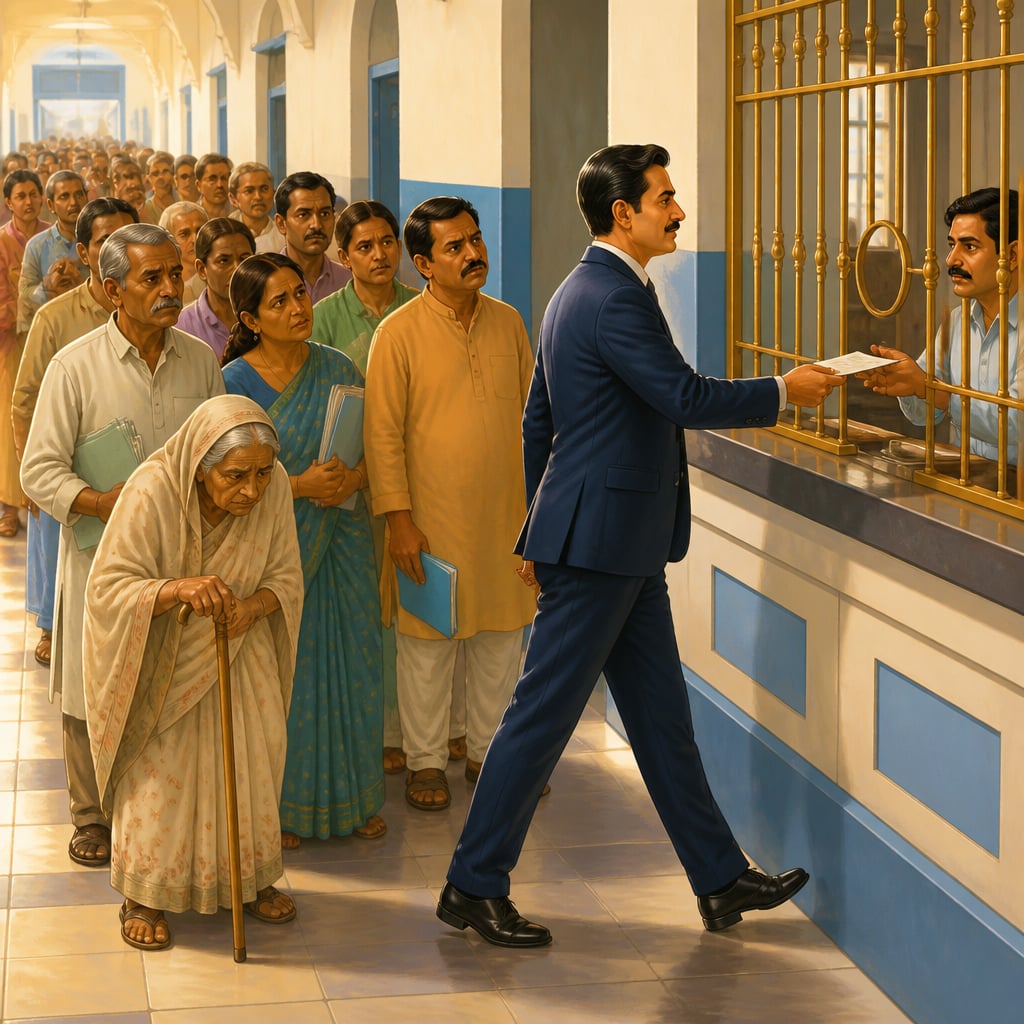
Ramesh watches. He says nothing. What can he say? By the time he reaches the counter, the pediatric OPD has a two-hour wait. His daughter's fever spikes. He'll miss another day of work tomorrow.
Scene 2: The Village Ration Shop
Distribution day in Karimnagar district. Twenty families have queued since 5 AM. Lakshmi, a widow with three children, is fourteenth in line. She needs her month's rice ration - it's all her family will eat for the next week.
At 9 AM, the Sarpanch's nephew arrives on his motorcycle. He walks straight to the front. "Mama knows the shopkeeper," he says casually. No one protests.
He gets his ration - the good quality rice from the top of the sack. By the time Lakshmi reaches the counter at noon, only the broken rice remains. Her children will eat what the powerful left behind.
Why It Matters
A queue is not just a line of bodies. It is a social contract made visible.
When you join a queue, you are saying: "I acknowledge that these people arrived before me. Their time matters. I will wait my turn."
When you cut a queue, you are saying: "My time is more valuable than everyone else's. My needs matter more. Rules are for others."
This is not a small thing. This is stealing.
What do you steal when you cut a line?
- Time: The one resource no one can make more of
- Dignity: The message that some people matter less
- Trust: The social contract that makes civilization possible
- Justice: The principle that rules apply equally to all
The well-dressed man at the hospital didn't just steal ten minutes. He stole Ramesh's daughter's chance at early treatment. He stole Ramesh's wages for tomorrow. He stole his faith that the system treats everyone fairly.
What the Scriptures Say
The Principle of Krama (Order)
यावदर्थं प्रसिध्यर्थं स्वं स्वं भागमुपाश्नुयात् Yāvadarthaṁ prasidhyarthaṁ svaṁ svaṁ bhāgam upāśnuyāt "One should take only one's rightful share, in proper order." , Shanti Parva 259.21
The Mahabharata is explicit: taking more than your share, or taking it out of turn, disturbs the cosmic order itself.
The Excess Principle
अति सर्वत्र वर्जयेत् Ati sarvatra varjayet "Excess in anything should be avoided." , Vidura Niti
When you take your turn AND someone else's, you are taking in excess. Even if you "only need two minutes."
The Order Mandate
क्रमेण सर्वे कुर्वीरन् Krameṇa sarve kurvīran "All should proceed in proper order." , Manusmriti 7.139
This isn't just about efficiency. Krama - order - is a dharmic principle. The universe itself operates in order. The seasons follow sequence. The planets maintain their orbits. When humans break order, they break with the natural law.
The Clear Position
QUEUE-CUTTING IS THEFT OF TIME, AND TIME CANNOT BE REPAID.
There are no exceptions:
- "I just have one quick question" - So does everyone else.
- "I know someone here" - Connections don't erase other people's wait.
- "I'm in a hurry" - So is the woman with the sick child who arrived before you.
- "My work is important" - Every person's work matters to them.
The only legitimate reasons to move ahead in a queue:
- Medical emergency (genuine, not convenience)
- Disability that makes standing difficult
- Extreme old age
- Advanced pregnancy
And even then - you ask those in line. You don't assume the right.
Dharmic Guidelines
✅ DO
| Action | Why It Matters |
|---|---|
| Wait your turn regardless of your status | Dharma applies equally to all - the CEO and the clerk |
| Arrive on time rather than expecting shortcuts | Planning ahead is your responsibility, not others' burden |
| Offer your place to elderly, pregnant, or disabled | Seva (service) earns merit; entitlement destroys it |
| Call out line-cutting - politely but firmly | Silence makes you complicit in adharma |
| Thank others when they let you ahead | Gratitude acknowledges their sacrifice |
❌ DON'T
| Action | The Karma You Create |
|---|---|
| Cut lines "for just one question" | You teach your children that rules are optional |
| Use connections to bypass queues | You create a world where only the connected matter |
| Accept "VIP" treatment that harms others | You enjoy stolen time; the debt remains |
| Stay silent when witnessing queue-cutting | Your silence is consent; you share the karma |
| Blame "the system" while gaming it | Hypocrisy compounds the original wrong |
The Karma Angle
Cut 10 queues → Wait in 100 slow lines.
This isn't superstition. It's how social trust works.
When enough people cut queues, the queue system breaks down. Everyone arrives earlier. Everyone pushes harder. The orderly line becomes a mob. The mob becomes chaos.
You think you're saving time by cutting. You're actually destroying the system that saves everyone time.
And your children are watching.
Every time you walk to the front of a line, your child learns:
- Rules don't apply to us
- Other people's time doesn't matter
- Connections matter more than fairness
- Getting ahead is more important than being good
They will carry these lessons into their schools, their workplaces, their own families. Your two minutes of impatience echoes for generations.
Lessons by Age
For Children (8-12 years)
Imagine someone pushed ahead of you in the lunch line every single day.
How would that feel? Would you think it was fair?
Now imagine you're the one pushing. Yes, you get your food faster. But everyone else gets theirs slower. And they all remember what you did.
When you wait your turn, you're being brave. You're saying: "I can be patient. I don't need to cheat." That's something to be proud of.
For Teenagers (13-17 years)
Your time isn't more valuable than anyone else's.
You might think you have more important things to do than wait. Homework. Practice. Friends. But the person ahead of you also has important things. You just don't know what they are.
Waiting in line is actually practice for life. Jobs, relationships, opportunities - they all require patience. The person who can't wait their turn at 16 becomes the adult who can't wait for promotions, can't wait for relationships to develop, can't wait for anything worth having.
Patience isn't weakness. It's power over yourself.
For Adults (18+ years)
You are modeling citizenship every time you stand in a queue.
Your children see everything. They see when you wait patiently. They see when you try to cut. They see when you stay silent while others cut. They see when you speak up.
You can give them lectures about fairness and honesty. But they'll remember what you did in the queue at the temple, the airport, the government office.
What do you want them to remember?
The Transformation
Not all stories end badly.
Suresh was a senior manager at a tech company. For years, he'd used his status to skip lines - at restaurants, hospitals, even his children's school. "Time is money," he'd say. "I have responsibilities."
One day, his driver's wife needed emergency surgery. Suresh went to the hospital to help. He saw his driver, Raju, standing in a queue that wrapped around the building. Raju had been there since dawn.
"I'll handle this," Suresh said, walking toward the counter.

Raju stopped him. "Sir, please. These people have been waiting. If I go ahead, they'll have to wait longer. My wife would not want that."
Suresh was stunned. This man, whose wife was in surgery, had more dharma than he did.
He went back to the line. He waited three hours with Raju. And something changed in him that day.
Now Suresh waits in every queue. When his colleagues ask why, he tells them about Raju. "That man taught me what I should have learned decades ago," he says. "The queue is where we prove we're human."
Living Traditions
Queues are not a modern invention. Ancient India developed sophisticated systems for managing shared access.

| Tradition | Location | What It Teaches |
|---|---|---|
| Tirumala Darshan System | Tirupati, Andhra Pradesh | Millions of pilgrims managed through an ancient queue system. Rich and poor wait together. The Lord sees all equally. |
| Kumbh Mela Akhada Order | Prayagraj | 13 akharas (monastic orders) maintain a fixed bathing sequence that has remained unchanged for centuries. Even holy men wait their turn. |
| Temple Prasad Lines | All Hindu temples | In the prasad line, the CEO stands behind the sweeper. The prasad is the same for all. |
| Gurudwara Langar | All Sikh gurudwaras | Everyone sits in the same line, on the same floor, eating the same food. Kings have sat beside beggars. |
These traditions encode a profound truth: before the divine, before the community, all status dissolves. We are all just people, waiting our turn.
Practical Steps
This week, try these:
Arrive 10 minutes early to any appointment. You won't need shortcuts if you plan ahead.
Stand in a long queue once - deliberately. Practice patience as a skill.
Speak up once when you see someone cut a line. Politely. "Excuse me, the line starts back there."
Thank the person behind you if you need to step out of line briefly. Acknowledge their patience.
Talk to your children about waiting. Ask them: "Why do we wait our turn?"
The Final Word
"पंक्ति में खड़ा व्यक्ति सभ्यता की रीढ़ है।" "The person standing in line is the backbone of civilization."
Every queue you join, you're making a choice. Not just about where to stand, but about who you are.
You can be the person who waits - who acknowledges that others matter, that rules apply to everyone, that civilization requires patience.
Or you can be the person who cuts - who believes their time is special, their needs are urgent, their status exempts them from ordinary rules.
The queue will forget you either way. But you won't forget what you chose. And neither will the people watching.
Especially the small ones.
Every queue you join is an opportunity to align with cosmic order rather than against it. The discipline of waiting is not just social convenience - it's a small act of dharmic practice, a way of affirming that you are part of a larger order, not above it.
Next time you're in a long queue, instead of frustration, try seeing it as a few minutes of tapas. Practice presence. Observe your impatience without acting on it. You're not just waiting - you're training your mind in the same discipline that the great ones practiced.
Case studies
The Emergency Room Lesson
Dr. Anand was a successful cardiologist with VIP connections at City Hospital. One evening, his wife developed a mild headache. Rather than wait in the ER queue like everyone else, Dr. Anand called his friend, the hospital administrator, and got her seen immediately. In the queue that night was Mrs. Sharma, a retired school teacher with chest pain. She'd been waiting two hours. While Dr. Anand's wife was being examined for her headache, Mrs. Sharma collapsed. By the time doctors reached her, she'd had a massive heart attack. She survived, but with permanent damage. The hospital's review found that the queue-jumping had delayed her care by twenty crucial minutes.
The Mahabharata warns: 'यावदर्थं प्रसिध्यर्थं स्वं स्वं भागमुपाश्नुयात्' - take only your rightful share. Dr. Anand took time that wasn't his to take. His wife's minor discomfort was prioritized over Mrs. Sharma's life-threatening emergency. In dharmic terms, he stole - not money, but something more precious: time that could not be repaid.
Dr. Anand learned of Mrs. Sharma's case a week later. Haunted by guilt, he began volunteering at the ER every Sunday, personally ensuring the queue system was respected. He now tells his story to medical residents: 'I saved thousands of hearts in my career. But I may have damaged one through my arrogance. The queue exists for a reason.'
Status and connections can break queues, but they cannot break karma. The time we steal from others has real consequences - sometimes consequences we never see. Dr. Anand was lucky; he learned his lesson and transformed. Mrs. Sharma paid the price for his education.
VIP queue-jumping persists in Indian hospitals, government offices, and airports. Every time someone uses connections to skip the line, the cost falls on those without connections. In a society striving for equal access to healthcare and justice, respecting the queue is one of the simplest tests of civic integrity.
A 2019 study across Indian hospitals found that VIP queue-jumping delays treatment for other patients by an average of 23 minutes per incident, with emergency departments reporting up to 40% longer wait times during peak hours.
The Temple That Taught Equality
In 1965, the Tirumala Tirupati Devasthanam faced a crisis. Wealthy donors were demanding separate, faster darshan lines. Politicians wanted VIP access. The temple was becoming a place where money bought proximity to God. The temple board made a radical decision: they would create a single darshan system where everyone - regardless of wealth, status, or political power - would wait their turn. Special darshan would be available, but at fixed times and with clear rules. No cutting. No exceptions. Even the President of India would follow the same process.
The board invoked the principle that before Venkateswara, all devotees are equal. The queue system embodies the verse: 'क्रमेण सर्वे कुर्वीरन्' - all should proceed in order. The temple's genius was making this spiritual principle into administrative reality.
Today, Tirumala manages over 100,000 pilgrims daily through one of the world's most sophisticated queue management systems. The waiting time can be long, but it is the same for everyone. Billionaires have waited alongside farmers. Cabinet ministers have stood behind auto-rickshaw drivers. The queue has become a spiritual teaching in itself.
When institutions enforce the queue principle, equality becomes real. The Tirumala system proves that even in India - with all its hierarchy and status consciousness - the queue can work. It requires leadership, systems, and the courage to say 'no' to the powerful.
Modern venue management, from airports to theme parks, increasingly uses technology-driven queuing systems. Tirumala's model shows that fair systems can scale to millions when leadership refuses to bend rules for the powerful. Organizations designing ticketing, reservations, or service queues can draw directly from this principle.
Tirumala Tirupati Devasthanam manages over 100,000 pilgrims daily using a queue system with 12 compartments. In 2023, the temple received approximately 24.5 million visitors, making it one of the most visited religious sites in the world.
Living traditions
- Annadanam: The tradition of feeding all who come, in order of arrival.
Reflection
- Think of a time when someone cut ahead of you in a queue. How did you feel? Now think of a time when you were tempted to cut a line yourself. What made you want to? What did you ultimately do?
- The lesson says 'your children are watching.' Even if you don't have children, who might be learning from your behavior in queues? Colleagues? Younger relatives? Strangers who form impressions?
- When you see someone cut a line, do you speak up or stay silent? What stops you from speaking? What would make it easier?
- Consider the phrase: 'The queue is where we prove we're human.' What does this mean to you? What other everyday situations test our humanity in similar ways?