Shuddhi Dharma: Cleanliness
Your Trash Is Your Karma
What you discard reveals who you are. Every wrapper tossed, every stain left on public walls, every piece of garbage thrown from a moving vehicle tells the world: 'I matter, you don't.' This lesson explores shuddhi dharma - the dharmic duty of cleanliness - where purity of space reflects purity of mind.
The Window Test
A moving car. A busy highway. A split-second decision.
Rajiv is driving home from a road trip with his family. His 8-year-old son Arjun finishes a packet of chips in the backseat.
"Papa, what do I do with this?" Arjun holds up the empty wrapper.
Rajiv is tired. There's no dustbin in sight. The window is right there.
"Just throw it out," he says. And the wrapper flies into the wind.
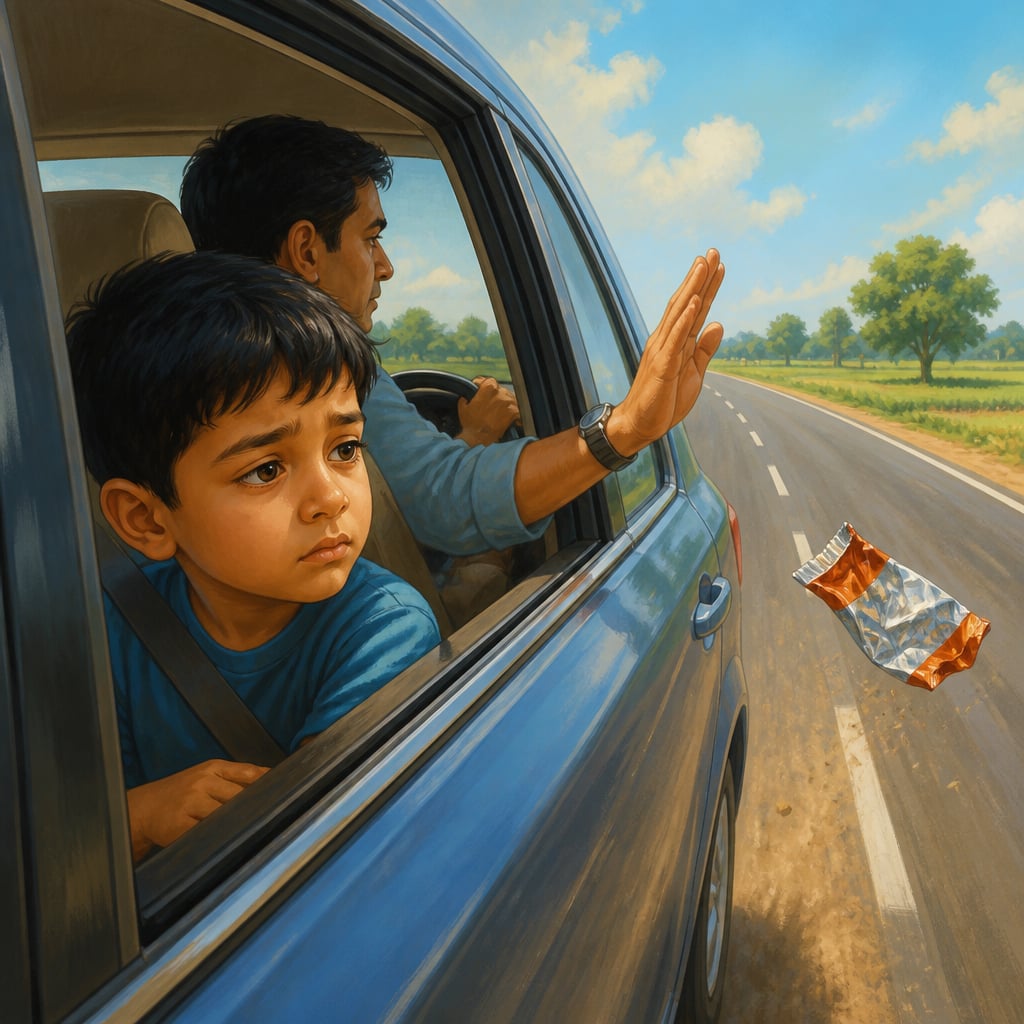
Arjun watches it flutter away. He doesn't say anything. But something is learned.
Three things happened in that moment:
A piece of trash joined millions of others clogging India's drainage systems, polluting its roadsides, poisoning its cattle.
A lesson was taught. Arjun learned that inconvenience justifies pollution. That public space is a dumping ground. That 'someone else' will clean up.
Karma was created. Not mystical, invisible karma - real, tangible karma. That wrapper will be eaten by a cow, will clog a drain, will add to the mountain of plastic choking Indian cities. The chain of consequence began with a lazy hand.
The wrapper was 5 grams. The karma weighs much more.
The Red Stain Test
A heritage building. A freshly painted wall. A mouth full of paan.
Mr. Verma has been chewing paan for forty years. It's his right, he'd say. His tradition. His pleasure.
He's walking past the newly renovated railway station - a beautiful colonial structure restored at public expense. The walls gleam white.
Mr. Verma needs to spit. The red juice is building up. There's no designated spitting area. There rarely is.
He aims for the base of the wall. The red spray hits the fresh paint. One stain among the thousand that will follow.
"What's one spit?" he might argue. "The wall was going to get dirty anyway."
But here's what actually happened:
A public space was degraded. Thousands of people will now look at that wall and see not heritage, but disgust.
A social permission was granted. Every subsequent spitter will see Mr. Verma's stain and think: "If he did it, why can't I?"
A message was sent. To every foreign visitor, to every child, to every citizen who hoped for a cleaner India: "We don't care enough to try."
Mr. Verma's spit took two seconds. The stain will last until the next repainting. The message lasts longer.
The Numbers Don't Lie
62 million tonnes. That's how much solid waste India generates annually.
70%. That's how much of it goes untreated, ending up in open dumps, waterways, and public spaces.
11.9 billion. That's the estimated number of paan spit stains on Indian walls and streets.
3.3 million tonnes. That's the annual plastic waste, much of it from single-use wrappers tossed from moving vehicles.
These aren't abstract statistics. They're the cumulative result of billions of individual decisions:
- "Just this once."
- "It's just one wrapper."
- "Someone will clean it."
- "What difference does my one spit make?"
Each person thinks they're the exception. Together, they are the rule.
Why It Matters
The External Truth
Cleanliness is health.
- Waterborne diseases kill hundreds of thousands annually in India. Many are directly linked to contaminated water from garbage dumping.
- The cattle who eat discarded plastic develop stomach blockages. Their milk production drops. Farmers lose income. Families go hungry.
- The drains clogged with wrappers flood during monsoons. Homes are destroyed. Lives are lost.
Your tossed wrapper is connected to all of this. The chain is invisible, but it's real.
The Internal Truth
External cleanliness reflects internal state.
Ask yourself honestly: Would you throw that wrapper on your own bedroom floor? Would you spit on your own living room wall?
No? Then why is it acceptable in public space?
The answer reveals something uncomfortable: we treat public space as inferior because we don't truly see it as ours.
But it IS ours. The street in front of your house is as much yours as your bedroom. The public wall is as much yours as your home's interior. When we pollute it, we pollute our own extended home.
The person who throws a wrapper from a car window and the person who keeps their home spotless are not practicing different standards. They're practicing a split personality - clean self, dirty citizenship.
What the Scriptures Say
Cleanliness as Conduct
शौचं चाचार एव च Śaucaṁ cācāra eva ca "Cleanliness is conduct itself." , Taittiriya Aranyaka 10.1
The ancients didn't separate cleanliness from morality. How you maintain your space IS your achara (conduct). A person who litters is displaying their achara for all to see.
Purity as Achievement
शौचं सर्वार्थसाधनम् Śaucaṁ sarvārthasādhanam "Purity is the means to all achievements." , Manusmriti 5.135
This isn't metaphor. In practical terms, clean environments enable everything: health, productivity, dignity, prosperity. Dirty environments undermine all of these.
The Threefold Purity
शौचं स्थैर्यमात्मविनिग्रहः Śaucaṁ sthairyam ātmavinigrahaḥ "Purity, steadiness, self-control." , Bhagavad Gita 13.8
The Gita lists saucha (purity/cleanliness) as a divine quality, connected to self-control. Littering is a failure of self-control - the inability to hold a wrapper for five more minutes until you find a bin.
The Yoga of Cleanliness
शौचात् स्वाङ्गजुगुप्सा Śaucāt svāṅgajugupsā "From cleanliness comes protection of one's own being." , Yoga Sutras 2.40
Patanjali teaches that external cleanliness (bahya saucha) leads to internal purification. The discipline of keeping your surroundings clean trains the mind toward higher purities.
The Clear Position
LITTERING AND SPITTING ARE NOT SMALL THINGS. THEY ARE VISIBLE DECLARATIONS OF DISREGARD FOR OTHERS.
| Action | What You're Really Saying |
|---|---|
| Throwing wrapper from car | "This is someone else's problem" |
| Spitting on public walls | "My convenience > your environment" |
| Dumping garbage in vacant lots | "What I can't see doesn't matter" |
| Urinating in public | "My body's needs override everyone's dignity" |
| Leaving food waste in public spaces | "I've eaten; let the flies have theirs" |
No excuse justifies these:
- "There's no dustbin" → Carry it until there is
- "Everyone does it" → Be the one who doesn't
- "One wrapper doesn't matter" → Multiply by 1.4 billion
- "I pay taxes for cleaning" → So does everyone who has to look at your mess
Dharmic Guidelines
✅ DO
| Action | Why It Matters |
|---|---|
| Keep a small bag in your vehicle for trash | Preparation prevents pollution |
| Hold your wrapper until you find a bin | Self-control is a trainable skill |
| Use designated spitting areas (or avoid spitting in public) | Your habit doesn't override public dignity |
| Pick up one piece of litter a day | Net positive: leave spaces cleaner than you found them |
| Teach children by example | Your habits become their habits for life |
❌ DON'T
| Action | The Karma You Create |
|---|---|
| Throw anything from a moving vehicle | You're literally driving away from your karma - but it follows |
| Spit on walls, stairs, public surfaces | You mark public space with disgust |
| Leave garbage "near" but not "in" dustbins | The extra two steps you saved create hours of cleanup |
| Assume "someone will clean it" | That someone is paid poverty wages to clean your laziness |
| Burn garbage (especially plastic) | You're converting solid waste into poison air |
The Karma Angle
The Chain You Start
The wrapper you throw today:
- Flies into a field
- A cow eats it
- The plastic blocks the cow's digestive system
- The cow stops producing milk
- The farmer loses income
- His child drops out of school
- The cycle of poverty continues
You'll never meet that child. You'll never know the connection. But the chain is there, link by link, from your hand to their future.
The stain you leave:
- Others see the stain and add theirs
- The wall becomes disgusting within days
- The building looks neglected
- Property values in the area drop
- Businesses move away
- Jobs disappear
- Crime increases in neglected areas
One spit didn't cause all this. But one spit started the chain. Yours wasn't the only link - but it was a link.
The Generational Karma
What you do in front of your children, they will do in front of theirs.
Rajiv threw that wrapper casually, thinking Arjun wouldn't remember. But Arjun remembers everything. He'll remember that "just throw it out" when he's driving with his own children.
Mr. Verma has been spitting for forty years. His son spits. His grandson will spit. The stain is passed down like a family tradition - but it's not tradition. It's karma pretending to be normal.
Breaking the chain requires one generation to say: "It stops with me."
Will it be you?
Lessons by Age
For Children (8-12 years)
Would you throw garbage on your friend's floor?
Imagine your friend invites you to their home. Would you drop your candy wrapper on their carpet? Would you spit on their wall? Of course not! That would be rude and disrespectful.
Now imagine India is a friend's home - because it is. It's our shared home. When we throw trash on the street, we're being rude to 1.4 billion roommates.
Next time you have a wrapper, imagine you're in a friend's home. Would you throw it here? No? Then hold it until you find a dustbin. That's what a good guest does.
For Teenagers (13-17 years)
The 'cool' kid who litters isn't cool - they're lazy.
Throwing trash from a car or bike might feel casual, careless, even rebellious. But what you're really showing is:
- You can't be bothered to wait two minutes
- You expect someone else to clean up after you
- You don't see public space as worth protecting
That's not cool. That's the behavior of a child who never learned responsibility.
Real independence isn't doing whatever you want. It's taking responsibility for your impact. The truly independent person carries their trash because they understand they're part of something larger.
For Adults (18+ years)
Your standard for home cleanliness should extend to public spaces.
Many Indians keep homes spotlessly clean while treating public spaces as dumping grounds. This split personality reveals something troubling: we care about what's 'ours' but not what's 'everyone's.'
But public space IS ours. The road in front of your house is as much your space as your bedroom. The park your children play in is as much your responsibility as your living room.
Extend your standards. What you wouldn't tolerate at home, don't create outside. The same hand that keeps your kitchen clean can keep the street clean.
The Transformation
From Red to Clean: Mr. Sharma's Story
For thirty-five years, Mr. Sharma chewed paan and spit wherever convenient.
Walls, stairs, streets, railway platforms - all bore his red mark. He never thought about it. It was just what you did.
Then his granddaughter started school. Walking her to class one morning, she pointed at a stained wall.

"Dadaji, that's so disgusting. Who does that?"
Mr. Sharma froze. He had done exactly that, hundreds of times. Maybe even on that same wall.
He saw the stain through her eyes: ugly, inconsiderate, embarrassing. He imagined her discovering that her grandfather was one of those people.
The next day, he quit paan cold turkey. It wasn't easy - thirty-five years of habit don't disappear overnight. But every time he craved it, he remembered his granddaughter's face.
"She'll grow up in whatever India we create," he realized. "I want to create one that doesn't disgust her."
Now Mr. Sharma carries a small garbage bag when he walks. He picks up at least one piece of litter daily. Not to make up for decades of stains - those are permanent. But to start a different chain, a cleaner karma.
"I can't unpaint those walls," he says. "But I can make sure no new stains come from me. And maybe, just maybe, my granddaughter will never know what her Dadaji used to be."
Living Traditions
India has rich traditions of cleanliness that predate modern sanitation. We're not learning something new - we're remembering something old.
| Tradition | What It Teaches |
|---|---|
| Temple Gopuram Cleaning (South India) | Before major festivals, entire communities come together to clean temple towers. Cleanliness is collective seva, not just personal preference. |
| Diwali Deep Cleaning | The tradition of cleaning every corner of the home before Diwali connects physical cleanliness to spiritual renewal. Lakshmi visits clean homes. |
| Pongal House Cleaning (Tamil Nadu) | The thorough cleaning before harvest festival - throwing out old, making space for new. Cleanliness enables abundance. |
| Onam Pookalam (Kerala) | The flower rangoli requires a swept, clean entrance. You cannot create beauty on filth. |
| Sandhya Vandana Achamana | The ritual sipping of water before prayers - external purification preceding internal worship. |
Shabari's Example

Shabari swept the forest paths daily for decades, awaiting Rama's visit. Her ashram was spotless. When Rama finally came, he didn't arrive in a dirty space - he arrived in a space prepared with love and discipline.
This is the model: maintain cleanliness as a practice of devotion, not as a response to inspection.
The Psychology of Littering
Why do people who keep clean homes pollute public spaces?
Ownership Gap: We don't feel public space is "ours" - so we don't protect it.
Diffusion of Responsibility: "Someone else will clean it" - but if everyone thinks this, no one cleans.
Normalization: When spaces are already dirty, adding more feels acceptable. The first wrapper is the hardest; after that, everyone follows.
Anonymity: No one knows who threw that wrapper. The shame that would prevent us at home is absent in public.
Immediate vs. Delayed: The convenience of throwing now is immediate; the consequences are diffuse and delayed.
Breaking these patterns:
- Claim public space as yours: The street is your front yard extended
- Be the first to keep it clean: Don't wait for others
- Act as if you're watched: Imagine your child or mother is always watching
- Connect action to consequence: That wrapper → that clogged drain → that flooded home
Practical Steps
This week, try these:
The Vehicle Bag: Put a small bag in your car, bike basket, or bag. All trash goes there until you find a proper bin. Zero tolerance for throwing.
The Daily Pickup: Pick up one piece of litter per day that isn't yours. Net positive contribution to public space.
The Wrapper Challenge: For one week, keep every wrapper, tissue, and disposable you use. At week's end, see the pile you would have scattered across public spaces.
The Child Conversation: If you have children, explain why you don't throw trash outside. Ask them to remind you if you forget. Make them partners in cleanliness.
The Compliment: When you see someone picking up litter, disposing properly, or keeping public space clean - thank them. Positive reinforcement works.
The Broken Window Theory
In 1982, criminologists James Wilson and George Kelling proposed the "Broken Window Theory": if a building has one broken window left unrepaired, soon all windows will be broken. Visible signs of disorder invite more disorder.
The same applies to cleanliness:
- One stain invites more stains. The first spitter makes it acceptable for the second, third, hundredth.
- One wrapper signals permission. A clean space stays cleaner; a littered space gets worse.
- One act of cleanliness also spreads. When someone picks up litter, others are less likely to add more.
You are always casting a vote for what kind of space this will be.
Every wrapper you throw votes for dirtier. Every wrapper you carry votes for cleaner. Every spit stain votes for degradation. Every clean choice votes for dignity.
The space you're in is the accumulated result of thousands of individual votes. Make yours count.
The Final Word
"बाह्यशौचं तथान्तः शौचं" "External cleanliness reflects internal purity."
The wrapper test is a character test. What you do with that wrapper when no one is watching reveals who you truly are.
The spitting test is a respect test. How you treat public walls reveals how much you respect the shared home of 1.4 billion people.
You cannot worship Ganga Maiyya and dump plastic in her waters. You cannot celebrate Diwali in a spotless home and throw garbage in the street outside. You cannot teach your children about respect while demonstrating contempt for public space.
The split between private cleanliness and public filth is the split in our national character. Healing it begins with each of us deciding: "From now on, my standards follow me everywhere."
The home you clean every day is practice. The real test is outside your door.
Every piece of litter is a small betrayal of the shared space. Every clean choice is a small act of citizenship.
Choose carefully. Your trash is your karma. And karma follows you home.
Treat every space as if you're preparing it for a sacred visit. The street you walk on, the park your children play in, the railway platform you wait on - maintain them with Shabari's devotion. Not for inspection, not for praise, but as practice.
Use cleanliness as meditation. When you pick up a piece of litter, you're not just cleaning the environment - you're practicing mindfulness, discipline, care for others. When you resist throwing that wrapper, you're training your mind in self-control. External action, internal transformation.
Case studies
The Wrapper That Killed the Cow
In 2022, veterinarians in Gujarat operated on a cow suffering from severe digestive problems. When they opened the stomach, they found 52 kilograms of plastic - mostly food wrappers, bags, and packaging. The cow had been eating garbage because her grazing land had become a dumping ground. She was one of hundreds of cattle operated on that year. Across India, an estimated 1 million cattle die annually from ingesting plastic waste. Each of those deaths traces back to someone throwing 'just one wrapper.'
Hindu tradition reveres the cow as Gau Mata - mother. The irony is tragic: the same people who would never harm a cow directly are killing them indirectly through careless waste disposal. The wrapper tossed from a car becomes the plastic blocking a sacred animal's stomach. The karma of 'just one wrapper' connects directly to Gau Mata's suffering.
Some municipalities have started 'Plastic-Free Grazing Zones' around cattle areas. Volunteers patrol to remove wrappers before cattle can eat them. But the fundamental problem remains: every wrapper thrown is a potential death sentence for a cow. The only real solution is stopping the throwing.
The chain from your hand to a cow's stomach is invisible but real. What seems like a minor act of laziness can end in death. 'Just one wrapper' multiplied by millions creates a graveyard.
Plastic pollution remains India's most visible environmental crisis. With single-use plastic bans partially enforced, the real change must come from individual choices: carrying reusable bags, refusing unnecessary packaging, and properly disposing of waste. The chain from a carelessly dropped wrapper to an animal's stomach is shorter than most people realize.
The Centre for Science and Environment found that over 60% of stray cattle autopsied in Indian cities had plastic in their stomachs. A single cow in Lucknow was found with 71 kg of plastic waste in 2023.
Indore: The Cleanest City
In 2017, Indore ranked among India's dirtiest cities. By 2022, it had won the 'Cleanest City' award for six consecutive years. The transformation wasn't magic - it was methodology and mindset change. The city implemented door-to-door garbage collection. But more importantly, it ran massive awareness campaigns. Citizens were shown the chain of consequences - where their garbage went, what happened when drains clogged, why cleanliness mattered for health and property values. Social pressure shifted. Littering became shameful. Neighbors called out neighbors. Children reminded parents. The culture changed from 'someone else's problem' to 'our collective responsibility.'
Indore demonstrates the power of collective saucha - cleanliness as a shared value, not just individual preference. The city essentially rebuilt the traditional village culture where cleanliness was a community practice, where everyone maintained shared spaces, where filth was shameful. The Taittiriya Aranyaka's teaching - 'शौचं चाचार एव च' (cleanliness is conduct) - became a lived reality: your cleanliness behavior became your public character.
Property values in Indore rose significantly. Health indicators improved. Tourism increased. Civic pride created a positive cycle - the cleaner the city got, the more citizens wanted to keep it clean. The economic benefits proved that cleanliness isn't just moral - it's practical. 'शौचं सर्वार्थसाधनम्' - cleanliness as the means to all achievements - became demonstrably true.
Culture change is possible. A city with the same infrastructure, same population, same challenges transformed in five years. The difference was collective will and consistent effort. What Indore did, any city can do. What any city can do, each individual must start.
Indore's model is now being replicated in cities like Surat, Bhopal, and Visakhapatnam. The core insight applies to any community, from apartment complexes to corporate campuses: cleanliness is not about resources but about consistent collective commitment enforced through simple, repeatable systems.
Indore won the Swachh Survekshan 'Cleanest City' award for seven consecutive years from 2017 to 2023. The city achieved 100% door-to-door waste collection and processes over 1,100 tonnes of waste daily.
Living traditions
- Achamana: The ritual sipping of water before prayers, accompanied by mantras, as an act of purification.
- Tulsi Vrindavan Maintenance: The daily care of the Tulsi plant in Hindu households - watering, cleaning the altar, maintaining the sacred space.
Reflection
- Be honest: when was the last time you threw something out of a vehicle window, left garbage near (but not in) a dustbin, or spit in a public space? What was going through your mind at that moment?
- Your home is spotless but the street outside is filthy. What explains this gap? What would need to change for you to treat public space with the same care as private space?
- The lesson says 'your trash is your karma.' Do you believe that the wrapper you throw has real consequences beyond the immediate? How far does the chain of consequence extend?
- If every person in India kept their public space as clean as their home, what would the country look like? What's stopping this from happening? What role can you play?