Marga Dharma: Traffic Rules
The Road as Shared Sacred Space
The road belongs to no one person. It is a shared space where our true character reveals itself - not through what we say, but through how we drive. This lesson explores marga dharma: the dharmic duty of responsible road use, where every red light, every lane, every pedestrian crossing becomes a test of our civic soul.
Four Roads to Adharma
The Ambulance That Couldn't Pass
Mumbai, Rush Hour. The Western Express Highway.
An ambulance screams through traffic, lights flashing. Inside, 8-year-old Priya struggles to breathe. Acute asthma attack. Every minute matters.
The traffic is heavy but moving. Vehicles ahead begin to part, making way. Then, at the Andheri junction, a white SUV refuses to move. The driver is on his phone. The ambulance honks. The SUV stays put. "Where can I go?" the driver gestures. "Traffic is traffic."
He could move six inches left. He doesn't.
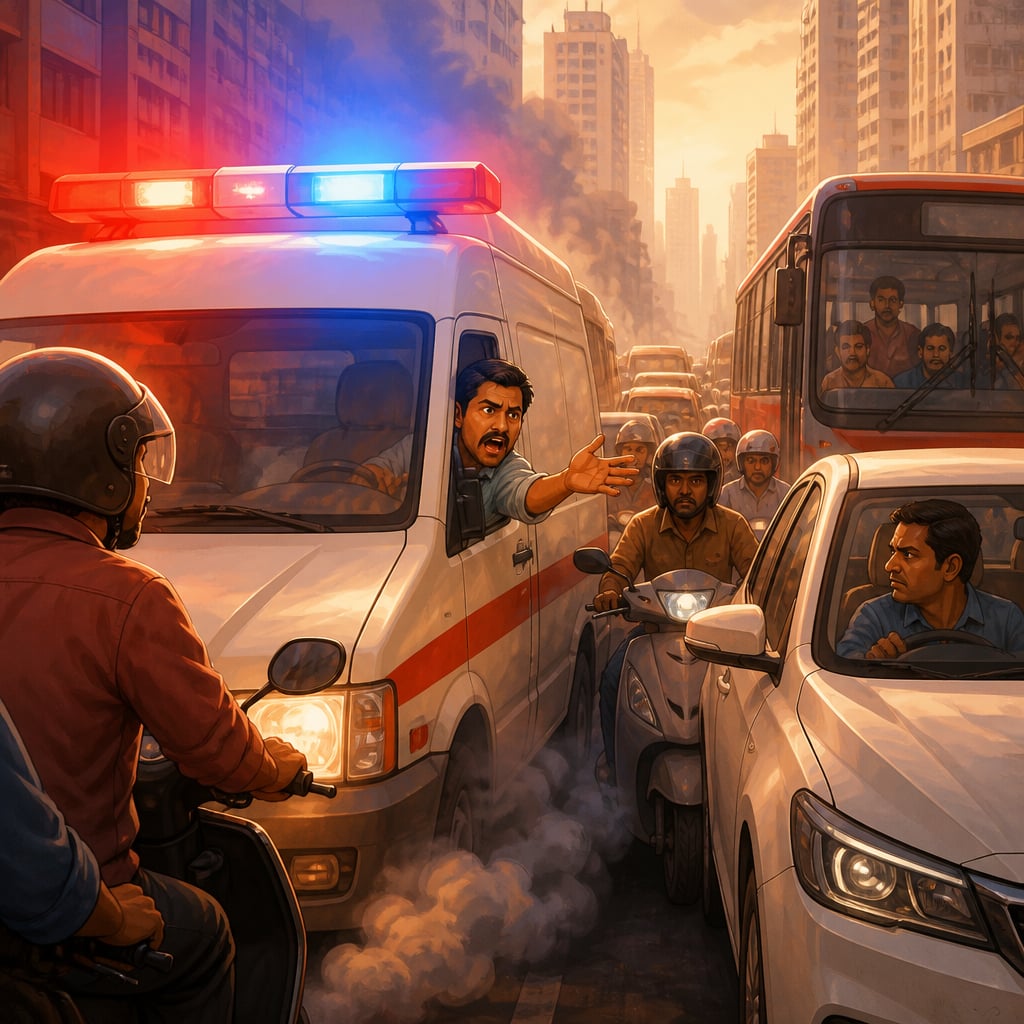
The ambulance loses four minutes. Four minutes that Priya's lungs didn't have.
She survived - barely. She now lives with permanent lung damage. The SUV driver will never know. He went home, had dinner, forgot the ambulance by morning.
He stole four minutes. They cost Priya a lifetime of breathing easy.
The Wrong-Side Shortcut
Jaipur, Tonk Road. 7:30 AM.
Vikram is running late for an important presentation. The traffic light ahead will take three minutes. He spots an opening - a quick zip down the wrong side, then a U-turn. "Just 200 meters," he tells himself. "Everyone does it."
He doesn't see Sunita, the college student on her scooter, coming the other way. She's on her correct lane, distracted by adjusting her helmet strap.
The collision breaks her leg in three places. Her engineering entrance exam is in two weeks. She misses it.
Vikram saved two minutes. Sunita lost a year of her life.
At the hospital, Vikram cries. "I didn't mean to," he says. But intentions don't set bones. Sunita's parents don't care about his meeting. They care about their daughter who may never walk without a limp.
The Red Light at 2 AM
Bengaluru, Outer Ring Road. Saturday night.
Rohit has dropped his friends home after a party. He's not drunk - just one beer hours ago. The roads are empty. The traffic light at the deserted junction turns red.
"Why wait?" he thinks. "No one's coming."
He checks left. Checks right. Accelerates.
What he doesn't see is the delivery boy Imran, on his motorcycle, coming from behind a parked truck on the cross road. Imran had the green light. He had the right of way.
Rohit's car hits Imran's motorcycle at 60 km/hr.
Imran, 22, was working night shifts to pay for his mother's dialysis. He died at 2:17 AM.
Rohit waited zero seconds. Imran's mother waits forever for a son who won't come home.
The red light wasn't inconvenient. It was the only thing standing between Imran and death. Rohit removed it.
The Footpath Rider
Delhi, Connaught Place. Evening.
The traffic is jammed. Arvind is on his motorcycle, already late. He spots the footpath - a clear strip of space while cars sit stuck.
"Just for a bit," he tells himself. He weaves onto the pavement.
Mrs. Gupta, 67, is walking to the Metro station. She's hard of hearing. She doesn't hear the motorcycle behind her. When Arvind honks, she panics, turns the wrong way, and falls.
Her hip fractures. At 67, a hip fracture isn't just an injury. It's often the beginning of the end. She never fully recovers. She dies of complications eight months later.
Her family will never connect her death to the motorcycle on the footpath. But the chain is there. Arvind's impatience → Mrs. Gupta's fall → the hip fracture → the decline → the death.
The footpath is for feet. Arvind's wheels set in motion something he'll never know he caused.
Why It Matters
The road reveals who you are when no one you know is watching.
At home, with family, at work with colleagues - you're performing. You know the expectations. You meet them. But alone in your vehicle, anonymous in the traffic, the real you emerges.
- Do you yield, or push?
- Do you wait, or jump?
- Do you see pedestrians as obstacles, or as people?
- Do you treat the ambulance siren as your problem, or dismiss it as someone else's emergency?
Your driving is your character made visible.
And the road doesn't forgive.
A harsh word can be apologized for. A broken promise can be mended. But a life taken at a red light stays taken. A spine shattered on the wrong side doesn't unshatter. The road keeps score in ways that cannot be undone.
What the Scriptures Say
The Right Path
असतो मा सद्गमय Asato mā sadgamaya "Lead me from the wrong path to the right path." , Brihadaranyaka Upanishad 1.3.28
This famous prayer is usually interpreted spiritually. But it applies literally too. The "wrong path" includes driving on the wrong side of the road. The "right path" includes respecting traffic lanes. Dharma operates in the physical world as much as the spiritual.
The King's Highway
राजमार्गे न रोद्धव्यं Rājamārge na roddhavyaṁ "The king's highway must not be obstructed." , Arthashastra 2.4
Kautilya's ancient traffic law: blocking the main road was a punishable offense. The road belongs to the collective. Obstructing it - whether by illegal parking, by blocking ambulances, or by creating chaos through wrong-side driving - is an offense against everyone.
Give Way
पन्थानं देहि Panthānaṁ dehi "Give way on the path." , Manusmriti 4.38

This verse established a hierarchy of right-of-way: a loaded cart yields to an unloaded one, a pedestrian yields to a vehicle, but all yield to the aged, the infirm, and women. Today's version: yield to ambulances, yield to pedestrians on crossings, yield to basic humanity.
The Clear Position
TRAFFIC RULES ARE NOT SUGGESTIONS. THEY ARE DHARMIC DUTIES.
Every violation has a victim - sometimes visible, sometimes invisible, sometimes delayed.
| Violation | The Victim You Create |
|---|---|
| Blocking ambulance | Patient inside who needed those minutes |
| Wrong-side driving | The person coming correctly who trusted the system |
| Red light jumping | The one who had the green light and expected safety |
| Footpath riding | The pedestrian who had nowhere else to walk |
| Illegal parking | Ambulances delayed, traffic blocked, accidents caused |
| Honking excessively | The child startled, the elderly stressed, everyone's peace stolen |
| Speeding in residential areas | The child who runs into the road without warning |
No excuse justifies these:
- "I'm late" → Leave earlier.
- "Traffic is too slow" → That's not a license to endanger others.
- "Nobody was coming" → You didn't know that. You assumed.
- "Everyone does it" → And everyone creates karma doing it.
Dharmic Guidelines
✅ DO
| Action | Why It Matters |
|---|---|
| Give way to ambulances immediately | That patient could be your parent tomorrow |
| Stop at red lights even at 3 AM on empty roads | Rules exist because our judgment fails; the rule doesn't |
| Stay in your lane, drive on the correct side | The system only works if everyone trusts it |
| Respect pedestrian crossings | The footpath is their only space; the road has alternatives for you |
| Use indicators before turning | Communication prevents collisions |
| Follow speed limits in residential areas | Children don't check for speeders before chasing a ball |
❌ DON'T
| Action | The Karma You Create |
|---|---|
| Block ambulances | You may be the next patient in one |
| Drive on the wrong side for shortcuts | You're betting someone else's life on your schedule |
| Jump red lights because "no one's coming" | Someone's always coming; you just didn't see them |
| Ride on footpaths | You're using a weapon in a space meant for the defenseless |
| Honk continuously in jams | You add suffering to everyone while solving nothing |
| Park illegally "for just two minutes" | Those two minutes cause hours of cascade delays |
The Karma Angle
The Chain Reaction
Traffic violations create karma chains that extend far beyond the visible.
Consider the wrong-side driver:
- He startles an oncoming motorcyclist
- The motorcyclist swerves to avoid him
- The swerve takes the motorcycle into a cyclist's path
- The cyclist falls into a pedestrian
- The pedestrian drops her phone; the screen cracks
- She can't call her diabetic mother to remind her about insulin
- The mother forgets her dose; her sugar spikes
- A hospitalization follows
The wrong-side driver never knows. He's home by then, congratulating himself on the two minutes he saved. But the karma chain connects him to a hospital bed he'll never see.
The road is a web. Pull one thread, and you never know what unravels.
Your Children Are in Traffic Too
Today, you jump the red light. Your child in the backseat learns that rules are optional when they're inconvenient.
In ten years, that child will be driving. They'll remember not your lectures about safety, but your behavior at that 2 AM junction.
The karma of bad driving is generational. You teach by doing. What are you teaching?
Lessons by Age
For Children (8-12 years)
Imagine the road is a playground with rules.
In your playground, there are rules: don't push, take turns, share equipment. What happens when someone breaks the rules? People get hurt. Fights start. The game stops being fun.
The road is a much bigger playground. The rules are traffic lights, lanes, crossings. When adults break the rules, people get hurt much worse than on a playground.
When you're in a car, watch how the driver behaves. Are they following the rules? Do they stop at red lights even when no one's watching? That tells you a lot about them.
For Teenagers (13-17 years)
You'll be driving soon. What kind of driver will you be?
Right now, you're watching adults drive. Some follow rules. Some don't. Some make you feel safe. Some terrify you.
You're learning. Not from driving lessons - from watching. When your father jumps a light, when your mother honks endlessly, when the family driver takes the footpath - you're learning that this is acceptable.
It isn't. When you drive, you'll have a choice. The habits you form in the first year of driving stay with you for life. Choose to be the driver who makes passengers feel safe, not the one who scares them.
Skill isn't about going fast. It's about keeping everyone alive.
For Adults (18+ years)
Your driving creates the traffic culture your children inherit.
Every city has a traffic culture. In some, people stop for pedestrians. In others, pedestrians run for their lives. In some, ambulances move freely. In others, they crawl while patients die.
You create that culture. You are that culture.
When you yield, others learn to yield. When you stop, others learn to stop. When you give way to the ambulance, you teach everyone behind you that this is what we do.
Or you teach them the opposite.
There is no neutral. You're either building the traffic culture you want, or destroying it.
The Transformation
Sunil's Story: From Violator to Volunteer
For twenty years, Sunil drove like most people in Delhi - aggressively, impatiently, treating traffic rules as suggestions. He'd jumped hundreds of red lights. He'd driven on the wrong side countless times. He'd never faced consequences.
Then his son got a motorcycle.
On the third day, a car coming from the wrong side hit his son at a junction. His son survived with a broken arm and a shattered sense of safety. At the hospital, Sunil realized: that wrong-side driver was him. Not that specific driver - but someone just like him. Someone who thought two minutes mattered more than someone's life.
Sunil changed.
He now volunteers with a traffic awareness NGO. He stands at junctions during rush hour, helping pedestrians cross. He talks to auto drivers about lane discipline. He hasn't jumped a red light in four years.
"I can't undo my past violations," he says. "But I can try to cancel them out. For every light I jumped, maybe I can help one ambulance pass. For every pedestrian I scared, maybe I can help one cross safely."
His son still rides his motorcycle. But now Sunil trusts the road a little more - because he's trying to make it trustworthy.
Living Traditions
Ancient India developed its own traffic principles, remarkably relevant today.

| Tradition | What It Teaches |
|---|---|
| Ratha Yatra Protocols (Puri) | Millions of devotees pull the chariot without chaos because there are clear lanes, clear signals, and shared respect. The Jagannath Rath moves smoothly because everyone knows their place. |
| Char Dham Yatra Routes | For centuries, pilgrims on narrow mountain paths followed a protocol: those going uphill have right of way over those coming down. Loaded pack animals yield to unloaded ones. This ancient "traffic rule" still works. |
| Village Bullock Cart Paths | Traditional villages had understood traffic protocols: pedestrians had priority, animals next, then carts. Fast traffic yielded to slow. No one "owned" the path. |
| Kautilya's Traffic Laws | The Arthashastra prescribed fines for blocking roads, for running people down, for creating road hazards. Traffic law isn't a British import - it's an ancient dharmic concern. |
The Psychology of Traffic Violations
Why do good people drive badly?
Research shows that being inside a vehicle creates psychological distance:
Anonymity: In a car, you're not a person with a name - you're a vehicle. This makes it easier to behave badly.
Dehumanization: Other vehicles become obstacles, not people. That "idiot who won't move" is someone's parent, someone's child.
Urgency Bias: In a car, destinations feel urgent. Walking, you'd wait at lights. Driving, the same wait feels intolerable.
Diffusion of Responsibility: "Everyone does it" - when violations are common, personal responsibility dissolves.
Dharmic driving means fighting these psychological traps:
- See the person, not the vehicle
- Remember that your urgency doesn't create others' obligations
- Act as if you're visible, even when you're anonymous
- "Everyone does it" is never dharmic justification
Practical Steps
This week, try these:
The Red Light Meditation: At every red light, instead of frustration, take three conscious breaths. Arrive calmer, even if marginally later.
The Ambulance Promise: Commit to moving instantly when you hear a siren. Pre-plan: "When I hear an ambulance, I move left immediately." Preparation beats reaction.
The Pedestrian Acknowledgment: When you stop for a pedestrian at a crossing, make eye contact and gesture them across. Humanize the interaction.
The Lane Discipline Day: For one full day, refuse to change lanes erratically. Stay in your lane. Observe how it changes your stress levels.
The Honking Fast: For one week, honk only for genuine emergencies. Notice how rarely that is. Notice how traffic moves the same anyway.
The Final Word
"मार्गस्य स्वामी नास्ति।" "The road belongs to no one person."
You share the road with the ambulance carrying someone's father to the hospital. With the scooter carrying a student to her exam. With the bicycle carrying a daily wage earner to his job. With the child crossing to her school.
None of them are obstacles. All of them are people.
Your vehicle is not an extension of your ego. The road is not a race to win. Traffic rules are not burdens to evade. They are the thin line between civilization and chaos, between safe arrival and tragedy.
Every time you drive, you choose: add to the chaos, or hold the line.
The person you injure, the ambulance you block, the pedestrian you terrify - they'll never know your name. But karma knows no anonymity. The road keeps score.
Drive as if your own child is the pedestrian. Because someday, somewhere, they will be.
Next time you're tempted to claim the road - by blocking a junction, by refusing to yield, by taking 'just a shortcut' on the wrong side - remember: you are a guest on this road, sharing it with thousands of others. Act like a guest, not an owner.
If you drive a large vehicle, use your visibility to yield to smaller ones. If you have a powerful engine, use it for acceleration into safety, not for intimidation. True strength is restraint, not domination.
Case studies
The Golden Hour Lost
In 2019, a Bengaluru tech worker named Kiran collapsed at work with a cardiac arrest. His colleagues called an ambulance immediately. The hospital was 6 kilometers away. The ambulance took 47 minutes to cover that distance. At junction after junction, vehicles refused to yield. Some were physically unable to move in the traffic. But many simply didn't try. Drivers looked away, stayed on their phones, waited for the ambulance to somehow find its own way. Kiran was dead on arrival. The doctors estimated he had survived the initial arrest. He died during the transport. In the 'golden hour' where cardiac patients can be saved, Kiran waited in traffic while people checked their WhatsApp. A security camera compilation later went viral, showing vehicle after vehicle refusing to yield.
The Manusmriti commands: 'पन्थानं देहि' - give way on the path. Every driver who refused to yield violated this ancient dharmic principle. They didn't commit murder by law. But in karmic terms, they collectively contributed to a death.
Kiran's death sparked Bengaluru's 'Make Way for Ambulance' campaign. Traffic police began strictly enforcing ambulance right-of-way. The city now has one of the better ambulance response systems in India. Kiran's family did not sue - instead, they funded ambulance drones to overcome traffic. 'No lawsuit will bring him back,' his wife said. 'But maybe his death can save others.'
The collective refusal to yield killed one man. The collective decision to change, inspired by that death, may save thousands. Traffic culture is created by each individual choice - for better or worse.
In cities like Bangalore, Hyderabad, and Delhi, ambulances still struggle to reach patients because drivers refuse to yield. The "golden hour" problem is not a resource problem but a behavior problem. Every driver who moves aside is practicing a form of life-saving civic duty.
India's average emergency response time in urban areas is 20 to 30 minutes, compared to 8 minutes in the US and 7 minutes in the UK. A 2018 study found that 30% of trauma deaths in Indian cities were preventable with faster ambulance access.
Chandigarh: The City That Stopped
In 2018, Chandigarh conducted an experiment. For one month, traffic police strictly enforced red light stops - no exceptions, no bribes, no 'let it go this time.' The results were dramatic: accidents dropped 23%. Average commute times actually decreased - the smooth flow of disciplined traffic moved faster than the chaos of everyone trying to jump ahead. Drivers initially complained. But by week three, compliance became habit. By week four, drivers were policing each other - honking at red-light jumpers, creating social pressure for compliance.
This experiment proved Kautilya's insight: 'राजमार्गे न रोद्धव्यं' - when the road system works, everyone benefits. The temporary inconvenience of waiting at lights created lasting benefits of faster, safer travel. Dharmic discipline creates collective prosperity.
Chandigarh now has some of India's lowest traffic fatality rates. The experiment expanded - automated cameras replaced human enforcement. The 'culture of compliance' that started as external enforcement became internalized habit. Other cities have struggled to replicate this - because culture change requires consistent enforcement that most cities can't maintain.
Dharmic driving isn't just moral - it's practical. The city that follows rules moves faster and safer than the city where everyone cheats. Individual discipline creates collective benefit; individual chaos creates collective suffering.
Cities worldwide are finding that strict, consistent traffic enforcement saves more lives than any road-widening project. Chandigarh's results mirror findings from Stockholm, Bogota, and Singapore: when rule-following becomes the norm rather than the exception, everyone moves faster and safer.
Chandigarh's traffic fatality rate dropped by 35% between 2018 and 2021 after strict red-light enforcement. The city's accident rate fell from 18.4 per 100,000 people to 11.9 during the same period.
Living traditions
- Arthashastra Traffic Enforcement: Kautilya prescribed specific fines for road obstruction, for injuring pedestrians, for damaging property on public roads.
Reflection
- Think about your own driving (or that of people who drive you). What is your most common traffic violation? Why do you do it? What would it take to stop?
- Have you ever been affected by someone else's traffic violation - delayed by an illegally parked car, scared by a wrong-side driver, stuck behind someone blocking an ambulance? How did it feel to be on the receiving end?
- The lesson says 'your driving is your character made visible.' Do you agree? What does your driving reveal about you?
- If everyone drove exactly the way you drive, what would traffic in your city look like? Would it be better or worse than now?