Vayu Dharma: Air Pollution
The Breath We Share
Water you can bottle and store. Land you can fence and claim. But air belongs to no one because it belongs to everyone. Every breath you take was just in someone else's lungs. Every pollutant you release enters the lungs of children, elders, and strangers. This lesson explores vayu dharma - our sacred duty to the breath we share.
Two Scenes, One Truth
Scene 1: The Construction Site Next Door
It's October in Noida. Priya teaches at the government school across from a massive construction project. For two years now, there have been no dust barriers. No water sprinklers. Just clouds of silica and cement dust billowing across the road every time a truck moves.
Her students cough. Many have started using inhalers. The school has no air conditioning, no air purifiers - the windows stay open because otherwise it's too hot. So the dust comes in.
She's complained to the builder. "We'll put up sheets," they say. The sheets appear for a day before an inspection, then vanish. She's filed complaints with the pollution board. Nothing changes.
Yesterday, a six-year-old in her class was taken to the hospital. The doctor said his lungs look like a forty-year-old smoker's. He's never touched a cigarette. He just breathed the air.
Scene 2: The Season of Smoke
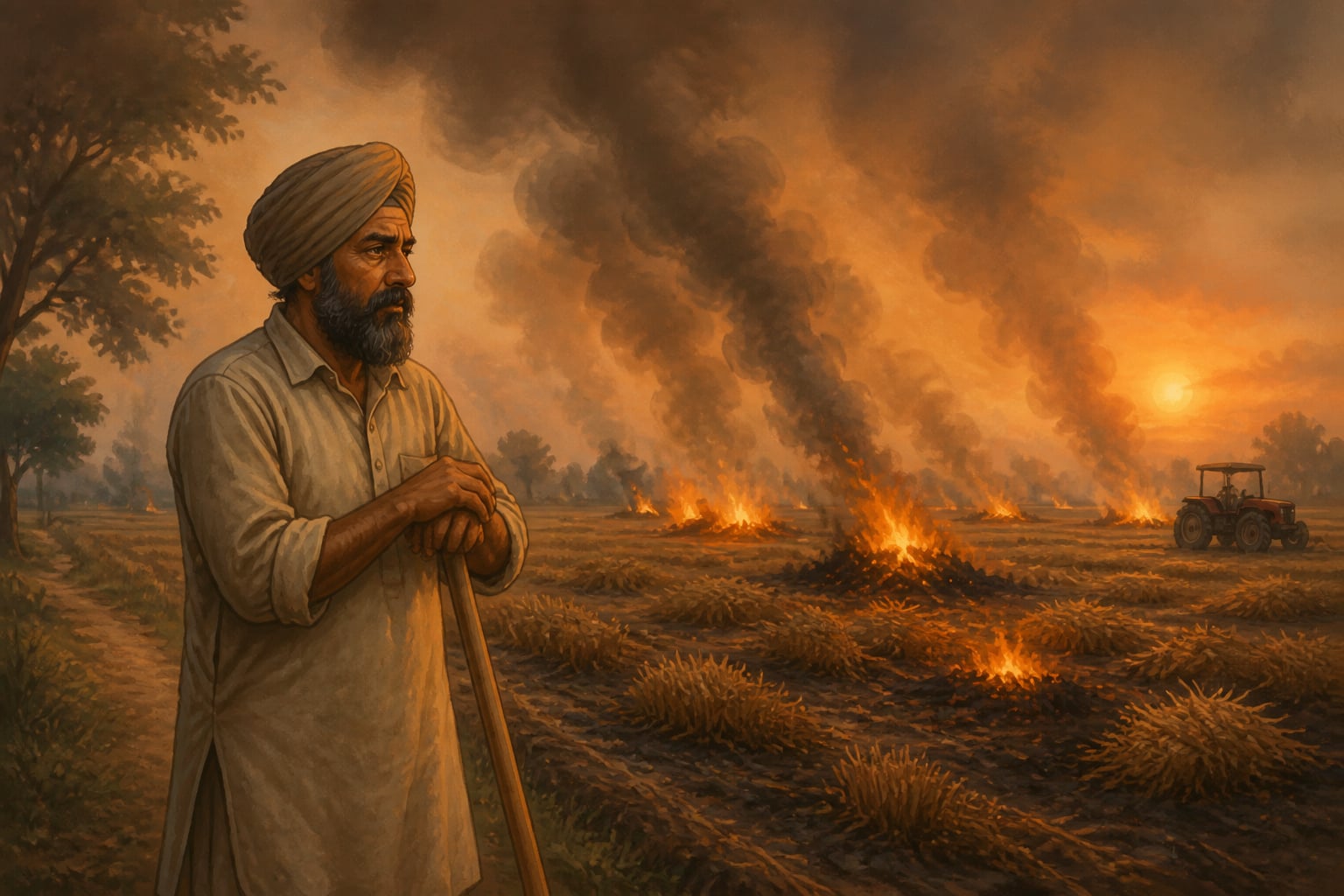
Harjinder Singh is a wheat farmer in Sangrur, Punjab. Harvest is over. The stubble stands in his fields - the leftover stalks after the combine harvester has taken the grain. He has three weeks before he must plant the next crop.
His grandfather used to let cattle graze the stubble, then plough it under. But Harjinder doesn't have cattle. His neighbor has a machine that can clear the stubble, but it costs money he doesn't have. The government promised subsidies for stubble management, but the paperwork takes longer than his planting window.
So he does what his neighbors do. He lights a match.
The smoke rises. It joins the smoke from a thousand other fields. It drifts east, toward Delhi, 250 kilometers away. In Delhi, a grandmother with asthma struggles to breathe. An office worker's eyes water. Schools close. Hospitals fill.
Harjinder knows this. But what can he do? He has a crop to plant. A family to feed. A loan to repay.
"I'm sorry," he says to no one in particular, watching the smoke rise. "I don't know what else to do."
Why It Matters
Air is the one resource we cannot choose to share. We already share it.
Think about what happens when you exhale. The air leaves your lungs. It mixes with the atmosphere. Within minutes, molecules from your breath are entering the lungs of people around you - family, neighbors, strangers.
You didn't choose this. Neither did they. It simply happens, constantly, as long as we all breathe.
Now think about what happens when a factory releases smoke. Or a construction site generates dust. Or a field is set on fire. That pollution doesn't stay in one place. It travels - sometimes hundreds of kilometers - and enters the lungs of people who had no say in its creation.
This is why air pollution is different from other civic issues:
- You cannot opt out. You can choose not to drink polluted water. You cannot choose not to breathe polluted air.
- Victims are invisible. The person whose pollution gives you asthma may never see you, never know you exist.
- Distance is no protection. The stubble burning in Punjab affects lungs in Delhi. The factory in the industrial area affects the school two kilometers away.
- The most vulnerable suffer most. Children, elderly, those with respiratory conditions - they pay the highest price for pollution they didn't create.
When you pollute the air, you are not just releasing particles. You are forcing strangers to breathe what you wouldn't want in your own lungs.
What the Scriptures Say
Air as Life Itself
प्राणो वायुः Prāṇo vāyuḥ "Life-breath is air." , Prashna Upanishad 2.3
In Vedic understanding, prana - the life force - is carried by vayu, air. Breath is not just respiration; it's the vehicle of life itself. When you pollute air, you pollute the very carrier of life.
The Source of Breath
वायोः प्राणः Vāyoḥ prāṇaḥ "From air comes breath." , Taittiriya Upanishad 2.1
This verse places air in the cosmological sequence of creation. Air is not a resource we extract; it's a fundamental element from which life emerges. Treating it carelessly is treating existence carelessly.
The Five Great Elements
In Hindu philosophy, vayu (air) is one of the Pancha Mahabhutas - the five great elements from which all matter is composed. Earth, water, fire, air, space - these are not just substances but sacred principles. Polluting air is polluting one-fifth of creation's foundation.
The Clear Position
POLLUTING AIR IS FORCING OTHERS TO BREATHE YOUR WASTE. THAT IS ADHARMA.
Let's be clear about what air pollution does:
- It kills. Over 1.6 million Indians die annually from air pollution-related causes. That's more than road accidents, more than many diseases.
- It harms children most. Young lungs are still developing. Pollution doesn't just make them sick today; it damages their capacity to breathe for life.
- It costs money. Lost workdays, hospital bills, reduced productivity - air pollution costs the Indian economy billions.
- It's often preventable. Construction dust can be controlled with barriers and water. Vehicle emissions can be reduced with maintenance. Stubble can be managed without burning.
The argument "I have no choice" doesn't hold when alternatives exist. The argument "everyone does it" doesn't hold when the result is millions of damaged lungs.
If you wouldn't blow cigarette smoke in a child's face, don't release pollution into the air they breathe.
Dharmic Guidelines
✅ DO
| Action | Why It Matters |
|---|---|
| Maintain your vehicles properly | A well-tuned engine produces less pollution. Regular PUC isn't bureaucracy; it's dharma. |
| Use public transport, carpool, or cycle when possible | Every car off the road is cleaner air for everyone. |
| Demand dust control at construction sites | Those barriers and water sprinklers are legally required. Insist on them. |
| Plant and protect trees | Trees are natural air purifiers. One mature tree can absorb 20+ kg of CO2 per year. |
| Support clean air policies | Vote, speak up, engage with pollution control authorities. Clean air needs civic action. |
❌ DON'T
| Action | The Karma You Create |
|---|---|
| Burn garbage, leaves, or waste in the open | Every fire releases toxins that enter lungs throughout your neighborhood. |
| Ignore vehicle emissions | That black smoke from your auto or truck isn't just ugly; it's assault on every lung nearby. |
| Accept "everyone does it" as justification | Everyone doing adharma doesn't make it dharma. |
| Stay silent about visible pollution | Construction dust, factory smoke, illegal burning - report what you see. |
| Believe distance protects you | Your children breathe the same air polluted by sources you think are "far away." |
The Karma Angle
The air you pollute today enters the lungs of children you'll never meet.
Karma is not magic. It's consequence. Consider:
The construction company that skips dust barriers saves money. The children in the nearby school develop asthma. The company never sees those children. But the consequence exists.
The farmer who burns stubble clears his field quickly. The smoke drifts 300 kilometers. Somewhere, an elderly person dies weeks earlier than they would have. The farmer never knows. But the consequence exists.
The factory that releases untreated emissions profits this quarter. The workers in the surrounding area breathe those emissions for years. The factory sees no connection. But the consequence exists.
This is modern karma: actions whose consequences we never see but which exist nonetheless.
The inverse is also true:
- The business that installs proper emission controls protects lungs it will never count.
- The person who maintains their vehicle well gives cleaner air to strangers.
- The community that restores green cover improves air for generations they'll never meet.
You can be the source of harm or the source of healing. The air doesn't forget. It just carries.
Lessons by Age
For Children (8-12 years)
Have you ever been in a room with someone coughing? Did you try to move away?
You couldn't stop breathing, could you? You had to breathe whatever was in that room.
That's what air pollution is like, except you can't leave the room. The room is everywhere outside. When someone burns garbage or drives a smoky vehicle, that smoke goes into your lungs whether you want it or not.
This is why we don't burn things carelessly. This is why we take care of trees. Because everyone has to breathe the same air - and we want that air to be clean.
For Teenagers (13-17 years)
You will inherit the air your parents' generation creates.
The decisions being made now about factories, vehicles, construction, and farming will determine whether you breathe clean air or wear masks for the rest of your life.
You have a voice. Social media has made pollution visible in new ways - satellite images of stubble burning, air quality maps, viral videos of dust-choked neighborhoods. Use these tools. Make noise. The air is yours too.
For Adults (18+ years)
You are both victim and contributor. Act on both fronts.
Yes, you suffer from pollution you didn't create. But you also create pollution others suffer from. The question is: what's the net effect of your existence on the air?
Maintain your vehicle. Demand compliance from construction sites. Support clean energy. Plant trees. Vote for leaders who take air quality seriously. These aren't just personal choices; they're civic duties.
The Transformation
When a Village Chose to Stop Burning

Patauda is a small village in Haryana, part of the stubble-burning belt that chokes Delhi every winter. For years, farmers here burned their rice stubble like everyone else.
In 2019, a group of young farmers led by Sunil Kumar decided to try something different. They pooled resources to rent a Happy Seeder - a machine that plants wheat directly through the stubble without burning. The first season was experimental.
What they found surprised them. The stubble, left in the field, decomposed into organic matter. The soil retained more moisture. They used less water, less fertilizer. Their yields were actually better.
Word spread. The next year, more farmers joined. By 2022, Patauda had become a "zero burning" village. The Haryana government began using it as a model.
"We were burning money," Sunil says now. "The stubble we burned for free could have improved our soil for years. We just didn't know."
The irony: what they thought was necessity was actually waste. What they thought saved time actually cost them fertility. And what they thought affected only distant cities was damaging their own fields.
The Dust That Settled
A Builder Who Learned to Build Right
Rakesh Agarwal ran a construction company in Gurugram. For years, he operated like everyone else: minimal dust control, no green barriers, complaints ignored. Profits were good.
Then his daughter developed asthma. The doctor's question haunted him: "Does she live near a construction site?" She didn't. But she lived with someone who created them.
Rakesh began reading about construction dust - the silica, the cement particles, the PM2.5 that buries itself in lungs. He learned that the dust from his sites traveled kilometers. His workers, the neighbors, the schoolchildren down the road - they were all breathing what he was too cheap to control.
He changed. His company now uses dust barriers, water sprinklers, wheel-washing stations. Yes, it costs more. Yes, he's lost some contracts to cheaper competitors. But his sites are known now - the ones you can breathe near.
"My daughter still has asthma," Rakesh says. "I can't undo the years before. But I can stop creating more patients for other fathers."
Living Traditions
Our ancestors understood air's sacredness, even if they couldn't measure PM2.5.
| Tradition | Location | What It Teaches |
|---|---|---|
| Havan/Yajna with Specified Materials | Pan-India | Traditional havans use specific woods and herbs that purify rather than pollute. The practice recognizes that what you burn matters - not all smoke is equal. |
| Tulsi in Every Courtyard | Pan-India | The tradition of keeping tulsi (holy basil) wasn't just religious - tulsi releases ozone-friendly oxygen and has antimicrobial properties. Sacred and practical combined. |
| Neem Tree Planting | Pan-India | Neem is considered sacred partly because of its air-purifying properties. The tradition of planting neem created green cover with purpose. |
| Morning Pranayama | Yogic tradition | The practice of breath exercises at dawn, when air is cleanest, shows awareness that air quality varies and the best air should be consciously used. |
| Temple Groves | Throughout India | Many temples were surrounded by preserved forests. These served as carbon sinks and air purifiers for surrounding communities. |
Modern Collective Efforts
The ancient wisdom now has institutional support:
National Clean Air Programme (NCAP) targets 20-30% reduction in particulate matter in 122 cities by 2024. It focuses on vehicular emissions, industrial pollution, construction dust, and road dust.
Pollution Under Control (PUC) Certificates are legally required for all vehicles. While enforcement varies, the framework exists - citizens can demand it be taken seriously.
Air Quality Monitoring has expanded dramatically. Real-time AQI readings are available for most cities via apps and websites. Information that was once invisible is now visible.
Stubble Management Programs offer subsidies and equipment for alternatives to burning. The uptake is slow, but the options exist and are expanding.
Policy creates possibility. Individual action creates change.
Practical Steps
This week, try these:
Check your vehicle's emissions. When did you last get PUC? Is your vehicle producing visible smoke? Get it serviced.
Download an air quality app. Track your local AQI. Notice when it spikes. Learn what causes those spikes in your area.
Look for pollution sources. Is there open burning nearby? Dusty construction without barriers? Smoky factories? Document what you see.
File one complaint. Whether to the pollution board, the municipal corporation, or the local police - report one visible pollution source. Follow up.
Plant something. A tulsi, a neem sapling, anything green. One plant won't change the air. But it will change your relationship to it.
The Science of Shared Air
Understanding how air pollution works helps us understand why it's a shared problem:
PM2.5 - Particulate matter smaller than 2.5 micrometers. Small enough to penetrate deep into lungs, even into the bloodstream. From vehicles, fires, construction, industry.
PM10 - Larger particles from dust, pollen, construction. Still harmful, especially with prolonged exposure.
Nitrogen Dioxide (NO2) - From vehicles and industry. Causes respiratory inflammation.
Ozone (O3) - Created when pollutants react with sunlight. Beneficial in the upper atmosphere, harmful at ground level.
These don't stay where they're created. Wind carries them. Kilometers traveled, new lungs affected. Your pollution becomes someone else's health crisis.
The Final Word
"प्राणायामेन युक्तेन सर्वरोगक्षयो भवेत्" "Through proper pranayama, all diseases can be overcome." , Hatha Yoga Pradipika
Our ancestors knew that breath was sacred. They developed elaborate practices for controlling and purifying breath. Pranayama wasn't just exercise - it was spiritual discipline.
But pranayama assumes clean air to breathe. What good is perfect breath control if the air itself is poison?
The ancient rishis performed their practices in forests, on mountains, by unpolluted rivers. They breathed air that was clean because the world was treated with reverence.
We have lost that reverence. We treat air as a garbage dump - somewhere to throw smoke, dust, and exhaust. We act as if the air can absorb infinite abuse.
It cannot.
Vayu is a god in our traditions. The father of Bhima. The father of Hanuman. The carrier of prana. The element without which life ends in minutes.

We don't worship Vayu with temples. We worship him with clean air.
Every breath you take was in someone else's lungs. Every breath you exhale will be in someone else's lungs. This is the intimacy we share with strangers, the connection we cannot break.
Breathe clean. Let others breathe clean. This is vayu dharma.
Consider your own breathing. Each breath is an exchange - you take from the common air, you return to it. What quality of air do you take? What quality do you return? If your vehicle emits black smoke, your return is poison. If you plant trees, your return is oxygen. The exchange continues with every breath.
The stubble burning in Punjab reaches Delhi. The construction dust in your neighborhood reaches your neighbor's child. The vehicle emissions on the highway enter the school nearby. These connections are invisible but real. Recognizing them is the first step to acting on them.
Case studies
The School That Fought Back
Ryan International School in Gurugram was surrounded by construction. Dust levels inside classrooms exceeded safe limits by 300%. Children were falling sick. Parents were withdrawing students. Instead of relocating, the school decided to fight. They documented dust levels daily. They photographed missing barriers and dry construction sites. They filed complaints with the Haryana State Pollution Control Board - not once, but weekly. They got media involved. The construction companies resisted. They had connections, lawyers, the usual defenses. But the school was relentless. Parents formed a group. They attended every hearing. They made the issue visible. Within six months, the surrounding sites had proper dust barriers, water sprinklers, and covered material storage. Not because the builders wanted to - because they couldn't operate without doing so.
This is modern sakshi dharma - the duty to witness and act. The school didn't just suffer silently. They documented, reported, and persisted. The Mahabharata warns that those who witness adharma and stay silent share the karma. The school chose not to be silent.
The Ryan International case became a template for other schools facing similar issues. The Pollution Control Board created expedited processes for complaints near schools. The construction industry learned that schools are no longer easy victims.
Pollution continues when victims accept it. When communities organize, document, and persist, even powerful polluters must comply. The law exists - it needs citizens to enforce it.
Construction dust remains one of Delhi NCR's largest pollution sources, yet enforcement of dust control norms is inconsistent. Citizen-led monitoring using low-cost sensors and documentation through apps like SAFAR and AirVisual is creating the evidence base that forces compliance. Communities near construction sites have legal tools available if they organize to use them.
A 2020 study by IIT Delhi found that PM2.5 levels near active construction sites exceeded safe limits by 200-400%. The Central Pollution Control Board reported that construction dust contributes 30% of particulate pollution in Indian cities.
The Village That Stopped Burning
Karnal district in Haryana was among the worst stubble-burning areas in India. Every October-November, the sky would turn orange with smoke. Farmers saw no alternative. **Ram Avtar** was a progressive farmer who attended a training on Happy Seeder technology - a machine that plants wheat through standing stubble. He tried it on one acre. The results were good. He tried it on more. But the real change came when Ram Avtar started talking to his neighbors. Not lecturing - listening. He understood their constraints: the cost of equipment, the tight planting window, the fear of new methods. He helped form a cooperative. They pooled resources to buy a Happy Seeder. They shared it across farms. They supported each other through the learning curve. In 2021, over 40 farmers in his area used the seeder. In 2022, it was over 100. Stubble burning in the area dropped by 80%.
Ram Avtar's approach embodies the principle of 'sahakara' - cooperation. He didn't judge or shame his neighbors. He understood their constraints and helped create solutions. Change came not through preaching but through practical demonstration and community support.
The cooperative model has spread. Multiple villages in Karnal now operate as 'zero burning zones.' Farmers report improved soil health, reduced water usage, and equivalent or better yields. The switch that seemed impossible became a movement.
Farmers don't burn stubble because they enjoy pollution. They do it because they see no alternative. When alternatives are made accessible - not just available - behavior changes. Judgment doesn't work. Solutions do.
Stubble burning continues to choke North India every winter despite alternatives being available. The gap is not technology but adoption, which requires making alternatives as easy and cheap as burning. Government subsidies for crop residue management machinery and the growing market for bio-decomposers are slowly closing this gap.
NASA satellite data showed that stubble burning in Punjab and Haryana contributed 25-45% of Delhi's PM2.5 pollution during October-November. In 2022, over 49,000 farm fires were recorded by satellite in Punjab alone, though this was a 30% decline from 2021.
The City That Made Air Visible
In 2015, Beijing was infamous for air pollution - images of people in masks, buildings invisible through smog. But something changed. The Chinese government started publishing real-time air quality data. Citizens could see, on their phones, exactly how bad the air was. This visibility changed everything. People started demanding action because they could see the problem with numbers, not just symptoms. Businesses that claimed to be clean were exposed by monitors near their facilities. The government faced public pressure it couldn't ignore. By 2020, Beijing's air quality had improved by over 50%. Not to safe levels yet, but dramatically better. The pollution hadn't been invisible before - but the data made it undeniable.
This is the power of 'pratyaksha' - direct perception. When pollution was just 'hazy days,' it could be ignored. When it became numbers - PM2.5: 300, 400, 500 - it became a crisis that demanded response. Making the invisible visible is itself a dharmic act.
India has followed suit with air quality monitoring. Apps like SAFAR and IQAir show real-time AQI. This visibility has driven policy changes, school closures during severe pollution, and citizen activism.
What gets measured gets managed. Air pollution thrived in invisibility. Data and monitoring make it visible, and visibility creates accountability. Check your local AQI - making pollution visible is the first step to fixing it.
Real-time air quality monitoring through apps, government dashboards, and low-cost personal sensors has made pollution visible in ways that were impossible a decade ago. Cities that publish AQI data and enforce action plans based on pollution levels, as Delhi does with its Graded Response Action Plan, demonstrate that measurement is the first step toward management.
Beijing reduced PM2.5 levels by 53% between 2013 and 2022, from 89.5 to 42 micrograms per cubic meter. India launched the National Clean Air Programme in 2019 targeting a 40% reduction in particulate pollution by 2026 across 131 cities.
Living traditions
- Havan with Traditional Materials: Fire rituals using specific woods (mango, palash) and herbs (ghee, camphor, herbs) believed to purify air.
- Tulsi in Every Courtyard: The tradition of keeping a tulsi (holy basil) plant in the courtyard, worshipped daily.
Reflection
- Take a deep breath right now. What are you actually inhaling? Do you know the air quality where you are? Have you ever checked?
- Think about the pollution sources in your daily life - your vehicle, your cooking, any burning you do. Where does that pollution go? Whose lungs receive it?
- Have you ever seen open burning, construction dust without control, or heavy vehicle emissions and thought 'someone should do something'? What stopped you from being that someone?
- If a stranger's choices gave your child asthma, how would you feel? If your choices gave a stranger's child asthma, would you know? Does not knowing make it better?