Jala Dharma: Water Conservation

Every Drop Is Sacred

Water is not ours to waste - it is loaned to us by future generations. Our ancestors worshipped rivers as goddesses and built elaborate systems to harvest every drop. This lesson explores the dharmic principle of jala dharma and why water conservation is not just environmental sense but spiritual duty.

Two Scenes, One Truth

Scene 1: The Apartment Complex

It's May in Hyderabad. The water tanker arrives at Lakshmi Apartments at 6 AM. Venkat, a software engineer on the fifth floor, is already awake. He's been tracking the building's water usage on the RWA WhatsApp group.

The problem isn't the swimming pool - that's filled once a month and properly maintained. The problem is the leaks.

Sixteen taps dripping across the building. Three flush valves that don't close properly. A broken pipe in the parking area that's been "scheduled for repair" for two months. The building loses 2,000 liters daily to leaks alone.

Venkat has calculated this: that's enough water for 40 families in the bastis behind their complex - families who get water for two hours every alternate day.

He's raised this at three RWA meetings. Each time, someone says, "We'll get to it." Each time, nothing changes. The tanker bills keep rising. The leaks keep dripping. And 2,000 liters flow into the drains every single day.

Scene 2: The Parched Village
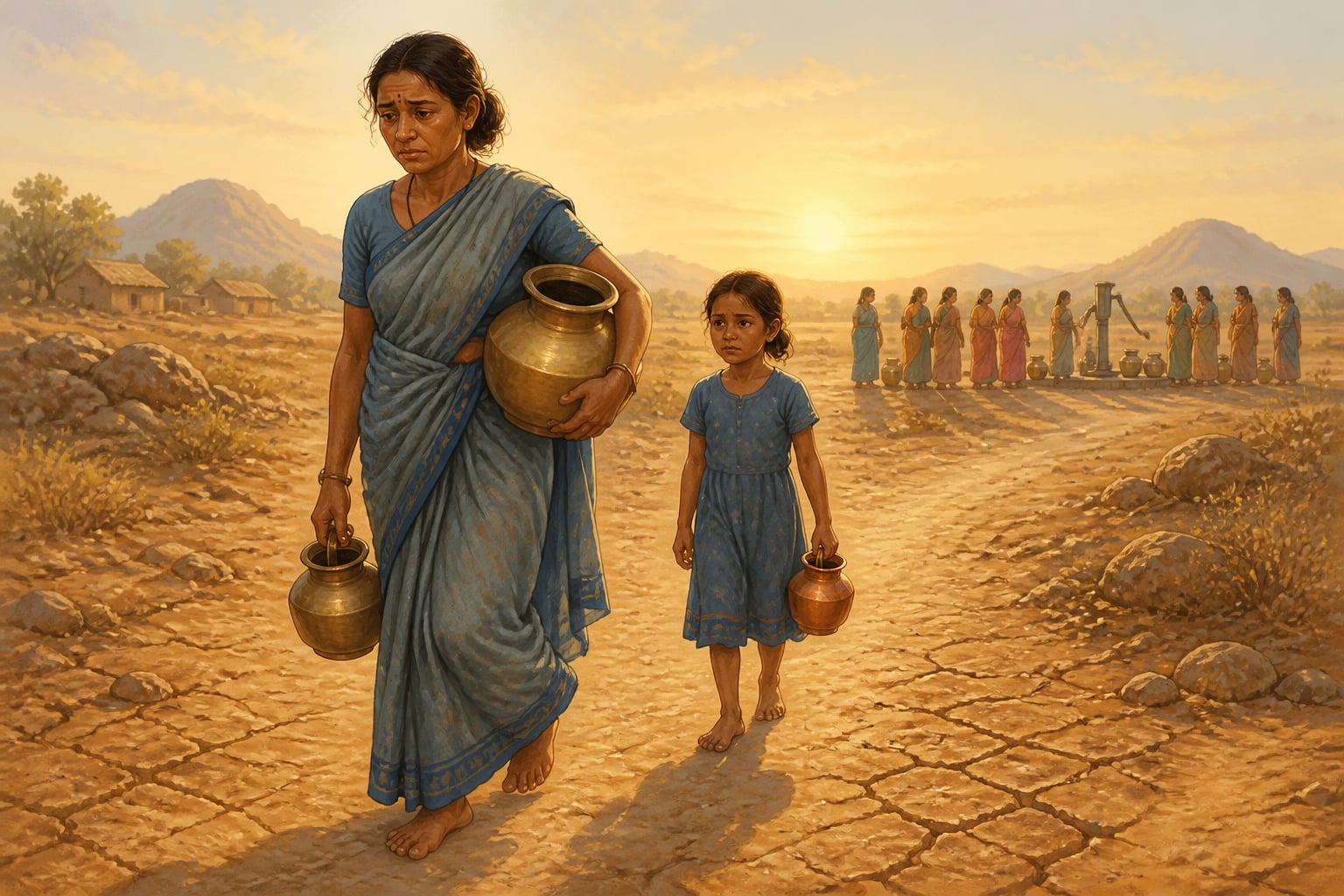
Mallamma walking with a brass pot to a distant hand pump at dawn

Mallamma walks three kilometers every morning to the hand pump in Anantapur district, Andhra Pradesh. She carries two plastic pots - one on her head, one on her hip. This is her family's water for the day.

The village bore well dried up two years ago. The big farmers upstream installed powerful motors that drew the water table down 400 feet. Now only they have water - for their tomato fields, their bore wells, their homes.

Mallamma doesn't blame them. They need water for their crops. But she remembers when the village tank was full, when her grandmother used to bathe at the temple steps, when water wasn't something you walked kilometers to find.

"The water went somewhere," she tells her daughter. "It didn't disappear. Someone has it. We just don't know who."


Why It Matters

Water is not ours. It is borrowed from those who come after us.

Think about this: the water you drink today is the same water that filled rivers when Rama walked the earth. The same water that Ganga brought from heaven. The same water your great-grandchildren will need to survive.

We don't own water. We are custodians. Trustees. Temporary holders of something that must be passed on.

When you waste water, you are not just using a resource carelessly. You are:

The tap dripping in your bathroom isn't just losing water. It's leaking dharma.


What the Scriptures Say

Water as Divine

आपो देवीः Āpo devīḥ "Waters are goddesses." , Rig Veda 7.49.2

This isn't metaphor. Our ancestors experienced water as divine presence. Every river is a goddess. Every drop carries divine energy. When you waste water, you're discarding the sacred.

The Blessing Prayer

शं नो देवीरभिष्टय आपो भवन्तु Śaṁ no devīr abhiṣṭaya āpo bhavantu "May divine waters be auspicious for us." , Atharva Veda 1.6.1

This prayer acknowledges that water's blessings are not guaranteed. They must be earned through respect. Polluted, wasted water cannot be auspicious.

The Prohibition

नाप्सु मूत्रं पुरीषं वा Nāpsu mūtraṁ purīṣaṁ vā "Never defile water." , Manusmriti 4.56

This injunction extends beyond the obvious. Wasting water is a form of defilement - treating the sacred as ordinary, the precious as disposable.


The Clear Position

WATER IS LOANED TO US BY FUTURE GENERATIONS. WASTING IT IS BETRAYING THEIR TRUST.

The water crisis in India is not about scarcity. India receives more rainfall than most countries. The crisis is about:

Conservation doesn't mean deprivation. It means:

Your grandchildren will either thank you for the water you saved or curse the wells you emptied. The choice is made daily, drop by drop.


Dharmic Guidelines

✅ DO

Action Why It Matters
Fix leaking taps immediately A dripping tap wastes 15-20 liters daily - 7,000 liters yearly
Harvest rainwater at home Your roof collects thousands of liters yearly - don't let it drain away
Reuse water thoughtfully Kitchen wash water can nurture your garden; bath water can flush toilets
Protect local water bodies That "dirty pond" near you was once someone's lifeline - it can be again
Support community water initiatives Join your RWA's water conservation efforts; attend gram sabha discussions on water

❌ DON'T

Action The Karma You Create
Leave taps running while brushing, soaping, or chatting Every wasted minute is 10-15 liters gone forever
Delay fixing leaks "until convenient" That convenience costs 20+ liters daily
Wash vehicles with running hose A bucket uses 20 liters; a hose uses 200
Destroy or encroach upon ponds, tanks, or lakes You steal from the community and from future generations
Draw groundwater unsustainably Bore wells that drain aquifers steal from neighbors and descendants alike

The Karma Angle

Waste water today → Watch your children walk for it tomorrow.

This isn't mysticism. It's hydrology.

Every bore well drains from a shared aquifer. When enough people draw without replenishing, the water table drops. When it drops far enough, pumps fail. When pumps fail, tankers come. When tankers become unaffordable, people walk.

The generation that drains the aquifer isn't the generation that walks for water. That karma lands on their children and grandchildren.

But karma also works in reverse.

The family that installs rainwater harvesting adds to the aquifer. The community that restores their tank creates water security. The person who fixes leaks and reuses water creates abundance.

You can be the ancestor who left wells full or the ancestor who left them empty. Both are remembered. Differently.


Lessons by Age

For Children (8-12 years)

Imagine you have a water bottle that has to last the whole day.

Would you pour it on the ground for fun? Would you leave the cap loose so it leaks? Of course not - you'd be thirsty later.

The Earth is like that water bottle. All the water we'll ever have is already here. When we waste it, we're pouring out what we'll need later.

Every time you turn off the tap while brushing, you're being a water hero. Every time you tell someone about a leaking tap, you're protecting the future.

For Teenagers (13-17 years)

Your generation will inherit the water crisis or the water solutions.

The aquifers being drained today will be empty in your lifetime. The tanks being destroyed for malls will be missed in your lifetime. The choices being made now will become your reality.

You have more power than you think. Social media campaigns have saved lakes. Youth movements have restored rivers. The engineers, administrators, and decision-makers of tomorrow are in school today.

What will you do with that power?

For Adults (18+ years)

Your home is a water system. How efficiently does it run?

Most households can reduce water usage by 30-40% with simple changes: fixing leaks, installing aerators, harvesting rain, reusing grey water. The technology exists. The methods are known. The only question is will.

And beyond your home: What water bodies exist in your community? What shape are they in? Who's responsible for them? These are civic dharma questions that need engaged citizens, not bystanders.


The Transformation

The Village That Remembered How to Save Water

Hiware Bazar villagers building a stone check-dam on a hillside

Hiware Bazar in Maharashtra was dying. By 1989, it was one of the poorest villages in Ahmednagar district. Water was scarce. Young people were leaving. The village had lost hope.

Then something changed. A young man named Popatrao Pawar became sarpanch. He didn't bring government money or NGO programs first. He brought an old idea: watershed management.

The village decided to stop running after water and start catching it where it fell. They built check dams on streams. They dug percolation pits. They stopped bore wells entirely - only open wells, recharged by rain, were permitted.

The results took time. But within a decade, the water table that had been at 100 feet rose to 15 feet. Dry streams began flowing. Agriculture revived. Young people came back.

Today, Hiware Bazar is one of India's model villages. The average income has multiplied tenfold. And it started with one decision: to respect water.

"We didn't create water," Pawar says. "We just stopped wasting what the sky gives us."


Living Traditions

Water conservation is not a modern concept. It's a forgotten inheritance.

Tradition Location What It Teaches
Pushkaram Festivals All major rivers Every 12 years, each of India's major rivers has a festival. Millions come to worship. The tradition encodes the principle: rivers are not resources but relations.
Stepwell Architecture (Vav) Gujarat & Rajasthan These aren't just wells - they're temples to water. Rani ki Vav in Patan has 500 sculptures. Our ancestors built places of worship to collect water.
Temple Tanks (Kalyani) South India Every temple has a tank. These served practical and spiritual purposes - bathing before worship, groundwater recharge, community water source. Many are now filled and built over.
Chhath Puja Bihar & Eastern UP The only festival where worshippers stand IN the river to offer prayers. You can only worship in water you haven't polluted.
Johad Revival Movement Rajasthan Rajendra Singh and Tarun Bharat Sangh have revived over 10,000 traditional water harvesting structures. Ancient wisdom, modern application.

Modern Collective Efforts

The ancient wisdom now has institutional support:

Jal Jeevan Mission aims to provide tap water to every rural household by 2024. But infrastructure alone can't solve the crisis - household conservation must match government provision.

Jal Shakti Abhiyan focuses on rainwater harvesting and water body restoration. Many states now mandate rainwater harvesting in new buildings.

Namami Gange works to clean and rejuvenate the Ganga. Thousands of crores invested, but the river's health ultimately depends on millions of individual choices.

These programs create opportunity. You create the outcome.


Practical Steps

This week, try these:

  1. Audit your home for leaks. Check every tap, every flush, every pipe joint. Fix what you find. One leak fixed saves thousands of liters yearly.

  2. Time your morning routine. How long does water run while you brush, shave, bathe? Can you reduce by even one minute? That's 10-15 liters saved daily.

  3. Research rainwater harvesting for your home. Even apartment dwellers can do terrace harvesting. Many states offer subsidies.

  4. Find your nearest water body. Lake, tank, pond, stream - what condition is it in? Who maintains it? What could you do to help?

  5. Talk about water. In your family, your RWA, your workplace. Make water a topic of conversation, not just consumption.


The Final Word

"नदीनां सागरो गतिः" "Rivers flow to the ocean." , Panchatantra

Water must flow. That is its nature. From cloud to rain, from rain to river, from river to sea, from sea to cloud again. The cycle has continued since Earth was born.

We are part of this cycle, not masters of it. The water we use today will return - to the aquifer, to the river, to the sky. The question is: what condition will it be in? Will it be clean enough to use again? Will there be enough left for those who come after?

Bhagirath's family performed tapas for generations to bring Ganga to earth. Countless ancestors built tanks, dug wells, preserved forests that caught the rain.

Bhagirath in tapas as Ganga descends through his matted hair

They passed water to us. We must pass it to our children. Not polluted. Not depleted. Not privatized behind bore wells and tankers.

Water is sacred. Every drop is a drop of Ganga. Every tap is a tirtha.

Treat it so.

Think of the infrastructure that brings water to your tap: dams, pipes, pumps, treatment plants, workers who maintain them. Think of the rain and rivers and aquifers. Think of all the effort - human and natural - behind every drop. Now: does it deserve to drain away unused while you brush your teeth?

When your bore well draws from a shared aquifer, you're drawing from a common pool. When your drain wastes water that could have recharged that aquifer, you're taking from the common wealth. Water conservation isn't just personal virtue - it's civic duty to the shared resource.

Case studies

The Stepwell That Wouldn't Die

In Jodhpur, Rajasthan, the 500-year-old Toorji Ka Jhalra stepwell had become a garbage dump. Locals used it as a trash pit. The ancient water harvesting structure that once sustained thousands was buried under decades of waste. In 2008, a small group led by architect **Karan Grover** decided to restore it. They faced skepticism: 'Why bother? We have taps now.' The work was backbreaking - over 30,000 loads of garbage removed by hand. When they finally reached the water, it was clear. The aquifer had survived. The 500-year-old engineering still worked. Within months, the water table in surrounding areas began rising. Wells that had gone dry started producing again.

Our ancestors built the stepwell not just for themselves but for generations they would never meet. For 500 years, it worked. In just 50 years of neglect, it was nearly lost. The restoration proved that traditional water wisdom remains valid - we had simply forgotten to honor it.

Today, Toorji Ka Jhalra is a heritage site and working water body. It has inspired stepwell restoration across Rajasthan. The lesson: beneath our garbage, the ancient solutions still work. We just have to unbury them.

Modernity didn't make traditional water harvesting obsolete - it made us forget why it mattered. The engineering of our ancestors was sound. Our duty is to preserve it, not pave over it.

India's water crisis is projected to affect 600 million people by 2030. Traditional water harvesting structures like stepwells, tanks, and johads offer proven, low-cost solutions that modern engineering is now rediscovering. Cities like Bangalore and Chennai are reviving lake systems that were paved over during rapid urbanization.

India once had over 3,000 stepwells. By 2010, fewer than 900 remained functional. Toorji Ka Jhalra in Jodhpur, dating to the 1740s, was restored in 2009 after decades of being buried under 20 feet of garbage and sediment.

The Chennai Crisis of 2019

In June 2019, Chennai's four major reservoirs ran dry. A city of 10 million faced 'Day Zero.' Water trains were brought from 200 kilometers away. Offices closed. IT companies asked employees to work from home. Hotels turned away guests. But here's what the headlines missed: Chennai receives adequate rainfall. The crisis wasn't about rain - it was about what happened to the rain. Over decades, the city had destroyed over 1,000 water bodies for development. Lakes became tech parks. Ponds became apartment complexes. Channels that fed the reservoirs were encroached upon. The rain still fell. It just had nowhere to go.

Chennai's traditional name is 'Chennapattinam' - 'the place with many tanks.' The city was designed around water bodies. The IT hub celebrated as India's future was built by destroying the water infrastructure that made the city possible.

Post-crisis, Chennai began restoring lakes and mandating rainwater harvesting. But the lesson came too late for many - families that left, businesses that moved, summers spent in water queues. The city learned that you cannot develop away from water; you can only develop with it.

Every tank we fill and every pond we pave creates the next crisis. Development that ignores water is not development - it's just borrowing against a future that will demand repayment.

Bangalore, Hyderabad, and Mumbai face Chennai-like water crises as lakes are encroached, groundwater is over-extracted, and rainwater runs off paved surfaces. The pattern is predictable and preventable. Cities that invest in water recycling, rainwater harvesting, and lake restoration before the crisis are the ones that avoid it.

Chennai's four major reservoirs, with a combined capacity of 11,257 million cubic feet, held just 0.1% of capacity in June 2019. The city's daily water deficit reached 550 million liters, forcing 12,000 tanker loads daily to meet basic needs.

The Farmer Who Recharged His Village

**Ramanbhai Patel** was a prosperous farmer in Saurashtra, Gujarat. Like his neighbors, he had deep bore wells that let him grow water-intensive crops. Unlike his neighbors, he noticed that every year, he had to drill deeper. In 2005, his main bore well went dry. He could drill deeper - 1,000 feet, 1,500 feet, like others were doing. Instead, he stopped. Ramanbhai converted his farm to rainwater harvesting. He dug percolation pits, built check dams on the stream through his land, and switched to less water-intensive crops. Neighbors thought he was mad. Within five years, his original bore well had water again - at 200 feet. His water-guzzling neighbors were now drilling at 800 feet and still chasing the water table down.

Ramanbhai rediscovered what his grandfather knew: you cannot extract more than the sky gives. The aquifer is a bank account. You can withdraw, but only if someone is depositing. His rainwater harvesting was simply making deposits.

Today, over 50 farms in Ramanbhai's area have adopted his methods. The water table across the local aquifer has risen by nearly 100 feet. He didn't just save his farm - by recharging the shared aquifer, he saved his neighbors too.

The race to the bottom - ever-deeper bore wells - is a race everyone loses. The only winning strategy is to replenish, not just extract. What Ramanbhai discovered is what the Vedas always taught: water must flow, be shared, be returned.

Groundwater depletion across India's agricultural belts, particularly in Punjab, Haryana, and western UP, threatens food security for hundreds of millions. The competitive bore-well race, where each farmer drills deeper to compensate for falling water tables, is a classic tragedy of the commons. Community-level recharge solutions are the only sustainable path.

Saurashtra's groundwater table dropped by an average of 3 meters per decade between 1990 and 2010. Communities that adopted check dams and recharge wells saw water tables rise by 5 to 30 meters within 5 years, according to Gujarat Water Resources Development Corporation data.

Living traditions

Reflection

More in Prakruti Dharma - Environment

All lessons in Prakruti Dharma - Environment · Samaj Dharma: The Dharmic Citizen's Handbook course