Prithvi Dharma: Earth and Waste

What You Discard Defines You

Earth is our mother - माता भूमिः. She carries us, feeds us, receives our dead. And now she is choking on our waste. This lesson explores prithvi dharma - our sacred duty to the ground beneath our feet. What we discard reveals who we are. What we bury, our children will inherit.

Two Scenes, One Truth

Scene 1: The Temple Tank That Suffocated
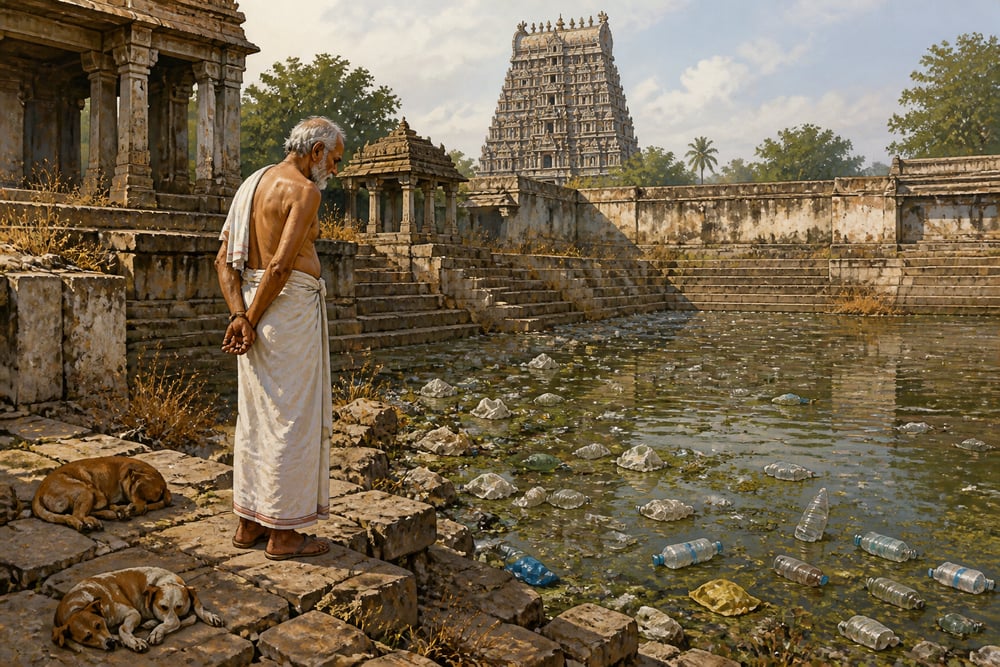
Rajan at the suffocated Varadaraja temple tank choked with plastic

The Varadaraja Perumal Temple in Kanchipuram has a tank that once covered several acres. For over a thousand years, devotees bathed there before worship. The water was clean. Fish swam. Lotuses bloomed.

Rajan grew up swimming in that tank. His grandfather told him stories of a time when the water was so clear you could count the temple's reflection stone by stone.

Now Rajan is sixty. The tank is still there - technically. But the water is a soupy green. Plastic bags float like ghost fish. Bottles and wrappers form a permanent scum along the edges. The smell in summer is unbearable.

"We did this," Rajan says, standing at the edge. "My generation. Our parents told us to respect this place. We nodded, and then we threw our plastic into it anyway. We thought it would just... disappear."

It didn't disappear. It accumulated. A thousand years of sanctity buried under fifty years of carelessness.

Scene 2: The Field That Stopped Growing

Lakshmi farms two acres in Karimnagar district, Telangana. Her family has worked this land for generations. Her grandmother grew cotton here. Her mother grew cotton and groundnut. The soil was rich.

Now Lakshmi struggles to grow anything. The soil is tired, she says. But that's not quite right.

For twenty years, her family used plastic mulch to suppress weeds. Convenient. Effective. When the plastic tore, they didn't remove it - just added more on top. When the seasons changed, fragments mixed into the soil with each tilling.

Now that soil is 30% plastic by some measures. The fragments block water absorption. They prevent root growth. They don't decompose - they just break into smaller pieces, contaminating the groundwater.

"The land that fed four generations cannot feed the fifth," Lakshmi says. "We put something in that can never come out."


Why It Matters

Earth is not a dumping ground. Earth is our mother.

In Vedic tradition, the relationship with earth is familial:

माता भूमिः पुत्रोऽहं पृथिव्याः "Earth is my mother, I am her son." , Atharva Veda 12.1.12

When you dump waste on the ground, you are not just littering. You are burying filth in your mother's body. When you add plastic to soil, you are poisoning the womb that feeds you.

This is not metaphor. It is how our civilization understood itself for thousands of years.

Consider what happens to your waste:

Plastic is different. Plastic is permanent. Plastic in earth is adharma.


What the Scriptures Say

Earth as Mother

माता भूमिः पुत्रोऽहं पृथिव्याः Mātā bhūmiḥ putro'haṁ pṛthivyāḥ "Earth is my mother, I am her son." , Atharva Veda 12.1.12

This is not poetry. It is a statement of relationship. The earth that grows our food, receives our dead, and carries our homes is not a resource to be exploited but a mother to be honored.

Earth as Treasure-Giver

विश्वम्भरा वसुधानी Viśvambharā vasudhānī "She who bears all, giver of treasure." , Prithvi Sukta

Vasudha - the one who gives wealth. The earth's fertility is a gift. But gifts can be exhausted when treated with contempt.

Trees as Sons

दशकूपसमा वापी, दशवापीसमो ह्रदः। दशह्रदसमः पुत्रो, दशपुत्रसमो द्रुमः॥ "Ten wells equal one pond, ten ponds equal one lake, ten lakes equal one son, ten sons equal one tree." , Matsya Purana 154.512

Planting and protecting a tree gives merit equal to ten sons. This verse encodes the extreme value of vegetation. Destroying green cover is destroying what our ancestors valued above family lineage.


The Clear Position

PLASTIC IN EARTH IS ADHARMA. PERIOD.

Let us be direct about what plastic does:

This is not an environmental issue. It is a dharmic crisis.

When you use single-use plastic carelessly, you are:

Reduce plastic. Refuse when possible. Recycle what you must use. Dispose properly what cannot be recycled.

But most importantly: recognize that what you discard does not disappear. It accumulates. On your mother's body.


Dharmic Guidelines

✅ DO

Action Why It Matters
Segregate waste at source Wet waste can compost. Dry waste can recycle. Mixed waste goes to landfills - permanently.
Carry your own bags and bottles Every plastic bag refused is one less in the system. This is the simplest dharma.
Compost organic waste Food scraps become soil. This completes the cycle - what earth gives, you return.
Support proper disposal systems Pay for waste collection. Participate in community clean-ups. Make proper disposal possible.
Choose products with less packaging Your purchasing choices shape what companies produce. Vote with your wallet.

❌ DON'T

Action The Karma You Create
Throw waste on streets, drains, or open land Every piece joins the permanent burden on Bhumi Devi.
Use single-use plastic when alternatives exist That convenience lasts five minutes. The plastic lasts five centuries.
Burn plastic This releases toxins into air AND leaves residue in earth - double adharma.
Mix wet and dry waste You make both unusable. Recyclables become landfill. Compostables become garbage.
Assume "someone will clean it" That someone is usually a marginalized person, underpaid to handle waste you were too lazy to manage.

The Karma Angle

What you bury, your children will inherit.

Karma is not mysticism when it comes to earth. It is simple physics:

In Tamil Nadu, the Perungudi dump is now a small mountain - visible for kilometers. People live in its shadow. They breathe its methane. They drink water from wells contaminated by its leachate. The garbage of one generation became the geography of the next.

But karma also works positively:

You are writing on the earth. Your handwriting will be read for generations.


Lessons by Age

For Children (8-12 years)

Would you throw garbage on your mother's lap?

That sounds silly, right? You'd never do that. But the earth is called "Mother Earth" because she takes care of us like a mother - giving us food, water, and a place to live.

When we throw plastic on the ground, it's like throwing it on our mother. The earth can't clean it up - plastic stays there for hundreds of years, longer than you, your children, and even your grandchildren will live.

Every time you put garbage in the right bin, you're being kind to Mother Earth. That's a superhero move.

For Teenagers (13-17 years)

Your generation will live with the consequences of this one.

The adults around you created a world of single-use plastic. They didn't know - or didn't want to know - what would happen. Now we know. Microplastics are in your blood. Literally.

You have every right to be angry. But anger alone changes nothing. What changes things: refusing plastic when you can, pushing for better systems, calling out carelessness, and making sustainability normal.

Your generation has the information. The question is: will you act on it?

For Adults (18+ years)

You are the transitional generation.

You grew up when plastic was celebrated. You're living when its consequences are undeniable. The habits you build, the systems you support, the example you set - these determine whether the transition happens.

Segregation at source. Composting. Reducing single-use plastic. Supporting proper waste management. These aren't just personal choices - they're civilizational choices made one household at a time.


The Transformation: Three Stories

1. The Temple Pond Revival

Thiruvaiyaru in Tamil Nadu was once famous for its temple tank - the Ayyarappan Kovil tank, centuries old, maintained by generations. By 2010, it was a garbage dump. Choked with plastic. Encroached upon by buildings. The water was toxic.

A group of local citizens decided to act. They formed the Thiruvaiyaru Heritage Foundation. They didn't wait for government. They started with their hands - pulling plastic, clearing debris, removing encroachments through community pressure.

It took three years. They removed over 10,000 cubic meters of garbage. They restored the water channels that once fed the tank. They revived the traditional maintenance practices - the very rituals that had kept the tank clean for centuries.

Today, the tank holds water again. Fish have returned. Migratory birds visit. Children swim. The temple rituals that require clean water can happen again.

"Our ancestors built this," says Raghavan, one of the founders. "They maintained it for a thousand years. We destroyed it in fifty. We've only begun to repair what we broke."

2. The Factory Owner's Reckoning

Murthy ran a dyeing unit in Tirupur, Tamil Nadu - the textile capital of South India. For years, his factory released untreated effluents into the ground. Everyone did it. The land was cheap. Enforcement was lax.

Then his daughter developed a rare kidney condition. The doctors asked about drinking water sources. Tests showed heavy metals - the same chemicals his factory released - in their home's borewell.

The contamination had traveled. What he pumped into the ground two kilometers away had reached his family's water supply. He was poisoning his own children.

Murthy sold the dyeing unit. He couldn't run it cleanly at the margins the market demanded. But he didn't walk away from the problem.

He now runs an NGO that helps textile units install effluent treatment. He funds soil remediation in contaminated areas. He speaks at industry conferences about what he did and what it cost.

"I was the villain," he says. "Now I try to be part of the solution. It doesn't undo what I did. But it might prevent someone else from making the same mistake."

3. The Village That Became Zero-Waste

A Vellore household segregating waste into wet, dry, and recyclable bins

Vellore Panchayat in Kerala was like any other Indian village - garbage dumped in the open, plastic burning in corners, a growing waste crisis. The panchayat tried fining people. It didn't work.

Then they tried something different: they made it easy.

They provided three bins to every household - wet, dry, recyclable. They trained residents in segregation. They set up a composting unit for organic waste. They established a Material Recovery Facility for recyclables. They created jobs - waste collection, composting, recycling - from within the village.

Within two years, Vellore sent zero waste to landfills. The compost was sold back to farmers. The recyclables generated revenue. The village actually made money from its waste.

More importantly, they changed behavior. Children grew up seeing segregation as normal. Adults took pride in their clean village. What started as a panchayat program became community culture.

"The secret," says the sarpanch, "is not punishment. It's making the right thing easy. When you give people the infrastructure to do right, most people will."


Living Traditions

Our ancestors didn't have plastic, but they understood earth's sanctity.

Tradition Location What It Teaches
Bhoomi Puja Pan-India Before any construction, earth is worshipped and asked permission. This ritual encodes the principle: you don't own land, you're asking to use it.
Sacred Groves (Devvans) Western Ghats, Northeast Forest patches preserved because they're home to deities. No cutting, no dumping. Religious prohibition created environmental protection.
Sthal Vruksha Temple tradition Every temple has a protected tree - neem, peepal, banyan. Cutting it is sacrilege. This preserved trees across the landscape.
Nag Panchami Pan-India Worship of snakes. Beyond religion, this protected snakes that control pests and maintain soil health. The ecosystem was encoded in the calendar.
Vruksha Puja Pan-India Tree worship during festivals. Marriages to trees. This made tree-cutting emotionally and spiritually difficult.

Modern Collective Efforts

The ancient wisdom now has institutional support:

Swachh Bharat Mission aims to make India clean, with emphasis on waste management, sanitation, and behavior change. It has built millions of toilets and supported waste processing infrastructure.

Extended Producer Responsibility (EPR) makes companies responsible for the plastic they produce, even after consumers discard it. This creates incentives for recyclable packaging.

Plastic Waste Management Rules ban certain single-use plastics and mandate proper disposal and recycling. Enforcement varies, but the legal framework exists.

Legacy Waste Remediation programs are cleaning up old dump sites and converting them into usable spaces.

Policy creates frameworks. Citizens create change.


Practical Steps

This week, try these:

  1. Audit your garbage. For one week, actually look at what you throw away. How much is plastic? How much could be composted? How much could be recycled? Knowledge is the first step.

  2. Start segregating at source. Even if your city doesn't have good systems, separate wet and dry waste. It makes everything that follows easier.

  3. Carry a cloth bag. Keep one in your vehicle, your purse, your office. The twenty seconds it takes to remember is worth the plastic bag you won't need.

  4. Refuse one thing. This week, consciously refuse one single-use plastic item you normally accept - a straw, a bag, a cup. Make it a habit.

  5. Find your local waste heroes. Who are the kabaadiwalas, waste collectors, recyclers in your area? Know them. Respect them. Make their job easier with proper segregation.


The Science of Waste

Understanding what happens to different materials helps us make choices:

Organic Waste

Recyclables

Plastic

Hazardous Waste


The Final Word

"धरणी धारयते विश्वम्" "Earth sustains the universe." , Various Puranas

The earth sustains everything. Every being, every plant, every river, every mountain - all rest on her. She has carried us for millions of years.

And now she is struggling.

The landfills grow into mountains. The plastic accumulates in soil. The chemicals seep into groundwater. The earth that nourished us is becoming a repository for our carelessness.

This is not an environmental problem. This is a filial problem - a failure to honor our mother.

Bhumi Devi once complained to Vishnu that she was overburdened by adharma. He incarnated to relieve her. But we cannot wait for avatars. The burden we're placing on earth now is something we must lift ourselves.

Bhumi Devi seated on a lotus, cradling a green sapling

Every piece of plastic you refuse is a kindness to her. Every bit of waste you segregate properly is respect. Every tree you plant is gratitude. Every cleanup you participate in is seva.

You are not just managing waste. You are practicing prithvi dharma - the duty to the mother who carries us all.

What you discard defines you. What you protect, protects your children. What you bury, you bequeath.

Choose carefully. The earth remembers everything.

Consider your relationship with earth through this lens. Are you taking sustainably or extracting destructively? Are you protecting or polluting? Are you in a relationship of mutual benefit or one-sided exploitation? Prithu's covenant is still in effect - the question is whether we're honoring our side.

Have you planted a tree? By this ancient measure, planting and nurturing one tree gives you merit equal to ten sons. The flip side: every tree destroyed - for development, convenience, profit - destroys merit that took generations to create. Consider this when you see deforestation or consider your own planting.

Case studies

The Temple Tank That Rose Again

The **Kapaleeshwarar Temple** in Chennai has a tank (teppakulam) that was once the heart of the neighborhood. For ritual bathing, for the float festival, for community gathering. By 2015, it was a cesspool - raw sewage, plastic waste, chemical runoff. The **Chennai Corporation** partnered with **Environmentalist Foundation of India** and local citizens. They didn't just clean the tank - they fixed the sewage systems feeding into it, restored the inlet channels, removed decades of silt, and established regular maintenance. The work took two years. Volunteers removed over 5,000 truckloads of waste. The ancient brick lining was exposed for the first time in decades. In 2017, the teppakulam held its first float festival in years - the temple deity carried on a decorated raft across clean water. Elderly residents wept. They remembered the tank from their childhood.

The teppakulam wasn't just a pond - it was sacred infrastructure, part of the temple complex. Its pollution was desecration. Its restoration was an act of worship as much as environmentalism. The project showed that faith and ecology can align.

The Kapaleeshwarar tank is now a model for temple tank restoration across Tamil Nadu. The state government has launched programs to restore hundreds of temple tanks. What was abandoned is being recognized as heritage.

We built these water bodies with sacred purpose. We polluted them through carelessness. We can restore them through commitment. The infrastructure of our ancestors was sound - our duty is to undo our neglect.

Tamil Nadu's temple tank restoration movement has revived hundreds of water bodies, improving groundwater recharge, flood resilience, and community gathering spaces. The model is being adopted across Karnataka and Andhra Pradesh, proving that heritage conservation and practical water management can reinforce each other.

Tamil Nadu has over 39,000 temple tanks, of which fewer than 10,000 remain functional. The Kapaleeshwarar Temple tank in Mylapore, Chennai, restored in 2017, can hold approximately 2 million liters of rainwater, recharging the local water table.

The Factory Owner's Reckoning

**Prakash Chemicals** operated in an industrial area near Vapi, Gujarat - one of India's most polluted zones. The company released untreated effluents for years. Everyone did. Enforcement was minimal. **Jayesh**, the owner's son, returned from studying abroad in 2010. He was appalled at what he saw - rivers running colors, soil that wouldn't grow anything, villages with cancer clusters. His father resisted change - treatment plants were expensive, competitors didn't have them, margins were thin. But Jayesh kept pushing. Then his father was diagnosed with a rare liver disease. The doctors said environmental toxins were a likely factor. The man who had polluted for profit was now paying with his body. After his father's death, Jayesh transformed the company. Full effluent treatment. Soil remediation on company land. Funding for health clinics in affected villages. The company's costs went up. Some products became uncompetitive. They dropped those products. Today, Prakash Chemicals is certified as a zero-discharge facility. It's smaller but sustainable. Jayesh speaks at industry forums about the real cost of pollution - the cost his father paid.

This is karma made visible. The pollution released didn't disappear - it accumulated in bodies, including the body of the man who released it. The transformation came too late for the father but may prevent others from learning the same lesson the hard way.

Jayesh's story is used in business schools as a case study on industrial responsibility. Several other factory owners in the Vapi area have followed suit - not from regulation but from seeing what pollution really costs.

What you dump doesn't disappear. It enters the system. It may enter your system. The karma of pollution is not abstract - it's medical. The question is whether you realize this before or after the diagnosis.

Industrial pollution of waterways continues across India despite tightening regulations. The Namami Gange program, real-time effluent monitoring systems, and zero liquid discharge mandates are creating accountability. Factory owners who invest in treatment infrastructure early avoid the regulatory and health costs that inevitably catch up.

Vapi in Gujarat was listed among the world's top 10 most polluted places by the Blacksmith Institute in 2007. Groundwater mercury levels were 96 times above WHO safety limits, and cancer rates in the surrounding area were 5 times the national average.

The Village That Turned Waste to Wealth

**Panaji Municipal Corporation** in Goa was drowning in waste. Open dumps. Burning. The tourist paradise was becoming a garbage town. In 2016, they decided to try something radical: decentralized waste processing. Instead of trucking all waste to one dump, they set up small processing units across the city. Each neighborhood handled its own waste. Households were given three bins. Wet waste went to local composting units. Dry waste went to material recovery facilities. Only non-recyclable, non-compostable waste went to the landfill. The transition was difficult. People complained. Habits were hard to change. But the Corporation persisted with education, enforcement, and making the right thing easy. Within three years, Panaji went from 100% landfill to nearly zero waste to landfill. The compost is sold to farmers. The recyclables generate revenue. The city makes money from what used to cost money to dump.

This is the completion of the cycle that our ancestors understood. Organic waste returns to soil. Materials are reused. Nothing is truly 'thrown away' because there is no 'away.' The city operationalized ancient wisdom at scale.

Panaji is now a model city for waste management. Dozens of municipalities have visited to learn. The model is being replicated across India. What seemed impossible became proof of concept.

Waste is not inevitable - it's a system design problem. When you make the right thing easy (segregation, composting, recycling), people do the right thing. Panaji didn't change human nature; they changed the system humans navigate.

India generates over 150,000 tonnes of municipal solid waste daily, with less than 30% processed scientifically. Panaji's decentralized model is being studied by cities across India as an alternative to the mega-landfill approach. The core insight, that waste management works when systems make the right choice the easy choice, applies at every scale from apartments to municipalities.

Panaji achieved 100% source segregation of waste by 2020, diverting over 85% of its waste from landfills. The city processes 50 tonnes of waste daily through decentralized composting and recycling, reducing landfill dependence by 80% since 2016.

Living traditions

Reflection

More in Prakruti Dharma - Environment

All lessons in Prakruti Dharma - Environment · Samaj Dharma: The Dharmic Citizen's Handbook course