Vīrya: Strength as Inner Capacity
Why the Rishis Measured Strength from the Inside Out
Exploring the Vedic concept of vīrya, not as physical might, but as the inner capacity to act, endure, and transform. The Rishis saw true strength as a quality of consciousness, not muscle.
The young Rishi had trained for seven years. He could hold his breath underwater until the other students gave up watching. He could run from dawn to midday without rest. He could lift stones that made grown men struggle. Yet his guru refused to call him strong.
"You have bala," the old teacher said one evening, watching the Saraswati flow past their āśrama. "But vīrya? That I have not seen in you."
The student was confused. Was he not the strongest in the āśrama? Had he not proven himself in every test of endurance?
The guru pointed to a much older student, frail and thin, who sat quietly in meditation nearby. "He has vīrya. When his village was flooded and his family lost, he did not break. When his body failed him three winters ago, his practice deepened. When doubts arise, he does not flee them, he faces them like a warrior faces an army."
That night, the young Rishi understood something that would take him years to fully grasp: the Vedic tradition measured strength from the inside out.
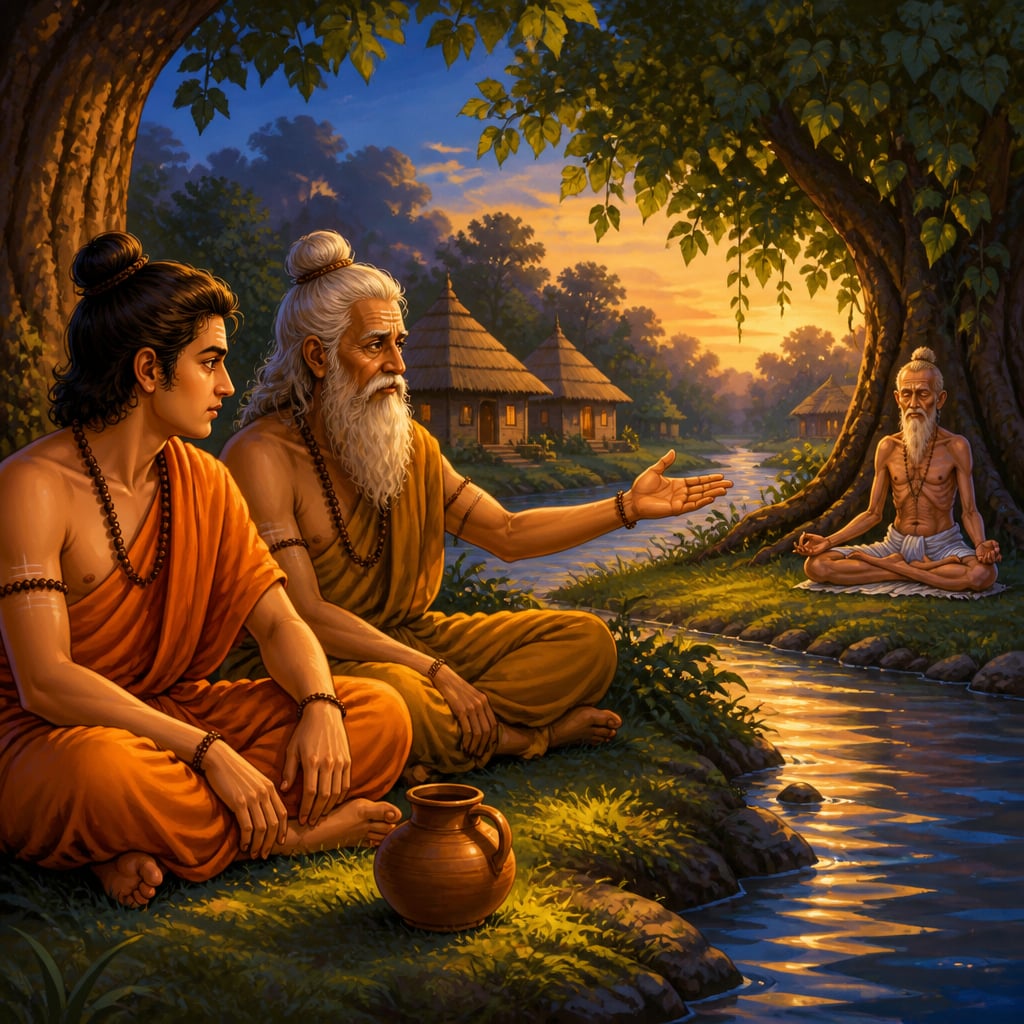
The Vedic Distinction: Bala and Vīrya
Understanding vīrya as inner capacity rather than external power shifts how we think about strength entirely. The Rishis weren't naively celebrating physical force, they were developing a sophisticated psychology of resilience and capacity that modern research is only beginning to rediscover. When we invoke vīrya, we're not asking for magical external help but awakening capacities that already exist within.
The Rishis made a distinction that modern languages struggle to capture. Bala referred to physical power, the ability to lift, strike, or endure bodily strain. Vīrya, however, pointed to something deeper: the inner capacity to act with vigor, to persevere through psychological darkness, to maintain one's center when everything around collapses.
This wasn't mere philosophy. The Vedic seers lived in a world of genuine danger, droughts that lasted years, wild animals, tribal conflicts, diseases without cures. They observed that some people with great bala crumbled under pressure, while others with modest physical strength displayed extraordinary resilience. The difference was vīrya.
As one hymn declares:
"vīryàṃ hi mā marutaḥ sakrá ādaduḥ" "The Maruts have given me heroic vigor."
The Maruts, storm deities associated with Indra, didn't grant physical muscle. They granted the psychological force that allows someone to face the storm within.
What the Rishis Saw: Strength as Capacity
When the Rishis invoked Indra for vīrya, they weren't asking for bigger biceps. Indra's greatest battle, against Vritra, the demon who withholds cosmic waters, was understood by commentators like Sri Aurobindo as a psychological allegory. Vritra represents the forces of obstruction, inertia, and constriction within the mind. Indra's vīrya is the power to break through.
Sayana, the great 14th-century commentator, interprets vīrya as sāmarthya, capacity or potency. Not raw force, but the potential to accomplish what needs to be accomplished. This aligns with Sri Aurobindo's reading in The Secret of the Veda: the Vedic deities represent psychological and spiritual forces, and invoking them means awakening those capacities within oneself.
The Rig Veda asks:
"kó adyá yuṅkte dhurí gā́ṛtasya vājínaḥ" "Who today yokes the horses of inspired speech?"
The "yoking" imagery is significant. Vīrya is about harnessing, directing energy toward purpose, not merely possessing it.
Traditional Interpretations: Inner Heroism
Traditional commentaries consistently emphasize vīrya as an internal quality. Yaska's Nirukta traces the word to the root vī, "to go, to pervade", suggesting that true strength pervades one's entire being, not just the body.
The Shatapatha Brahmana connects vīrya explicitly to mental fortitude during sacrifice, the ability to maintain concentration and resolve when the ritual demands it. A priest who lost his inner composure, no matter how physically capable, was considered to lack vīrya.
This interpretation persists in later traditions. The Bhagavad Gita's call to "stand and fight" (yudhyasva) is not primarily about military combat but about facing the inner battle, the Kurukshetra that exists in every human heart.
Living This Today
Consider the difference between two people facing job loss. Both may have identical physical health, similar savings, comparable external circumstances. Yet one spirals into despair while the other treats it as an opportunity for transformation. The difference isn't luck or optimism, it's vīrya, the inner capacity to act when action feels impossible.

Mary Kom, the six-time world boxing champion, demonstrated this distinction vividly. After childbirth and multiple injuries, experts wrote her off. She lacked the bala of her younger competitors. But her vīrya, the inner force that allowed her to train when her body resisted, to compete when critics dismissed her, to persist when medals seemed impossible, carried her to championship after championship well into her late thirties.
Modern psychology has terms for aspects of this: resilience, grit, psychological flexibility. But vīrya encompasses something broader, not just bouncing back, but the fundamental capacity to engage with life's challenges as a warrior engages with battle. Not seeking conflict, but not fleeing from it.
Your Inner Measure
The Rishis left us with a question worth sitting with: How do you measure your own strength?
If you measure by external achievements, possessions acquired, opponents defeated, goals checked off, you're measuring bala. This isn't worthless, but it's incomplete.
Vīrya is measured differently. It shows in how you face uncertainty. In whether you can hold your center when emotions storm. In your capacity to act from choice rather than compulsion. In the quality of presence you bring to difficulty.
The young Rishi from our opening eventually understood this. Years later, when famine struck and his āśrama was reduced to a handful of survivors, he was not the strongest physically. But he was the one who maintained the rituals, encouraged the others, and kept the sacred fires burning through the darkest months.
His guru, by then long passed, would have finally called him strong.
Research by Angela Duckworth on 'grit' shows that perseverance and passion for long-term goals predict success better than talent or IQ. However, vīrya adds a dimension Duckworth doesn't emphasize, the inner quality that makes grit possible.
Leaders who cultivate inner capacity before crisis are able to remain centered when others panic. Satya Nadella's emphasis on 'growth mindset' at Microsoft reflects this, building organizational vīrya before market challenges hit.
Systems that build resilience in calm times survive disruption. The Vedic principle of cultivating vīrya is essentially building antifragility, Nassim Taleb's term for systems that grow stronger under stress.
ACT (Acceptance and Commitment Therapy) identifies 'psychological inflexibility', avoidance, fusion with thoughts, disconnection from values, as the core of suffering. This maps remarkably to Vritra: the force that constricts and blocks flow.
Every organization has its Vritra, bureaucratic inertia, fear of change, 'we've always done it this way.' Leaders with vīrya don't ignore these forces but face them directly with patient, persistent effort.
Blocked systems, whether rivers, organizations, or psyches, become stagnant. The Vedic insight is that obstruction isn't just a problem but a necessary context for the emergence of breakthrough energy.
Case studies
Mary Kom: Six Championships Built on Vīrya
In 2008, after winning her third consecutive world championship, Mary Kom became pregnant with twin boys. Most expected her career to end. She was 25, old for boxing, and motherhood would mean years away from competition. When she returned in 2010, critics noted her diminished speed and power. Her bala had decreased. Yet from 2010-2018, she won three more world championships, an Olympic bronze, and became the only woman boxer to win eight world medals. In 2018, at age 35, she won her sixth world title, a record that still stands.
Mary Kom's story is a study in vīrya versus bala. Her physical power (bala) peaked in her early twenties. But her inner capacity (vīrya), the ability to train through exhaustion, compete through doubt, persist through repeated setbacks, only grew stronger. When asked about her longevity, she speaks not of physical training but of mental strength: 'My body says stop, but my mind says continue.' This is vīrya: the inner force that transcends physical limitation.
At 41, Mary Kom was still competing at the highest levels, though she announced retirement in 2024. Her record of six world championships remains unmatched. More significantly, she demonstrated that strength measured from within follows different rules than strength measured from without.
When bala diminishes, through age, injury, circumstance, vīrya can still grow. True capacity is not bound by physical limits but by the willingness to engage fully with whatever challenge arises.
The pressure to 'bounce back' quickly after setbacks, whether postpartum, post-injury, or post-failure, ignores that genuine recovery often requires a longer, more patient rebuilding. Mary Kom's story validates the slow return. For anyone feeling the gap between their current capacity and their previous peak, the lesson is that inner resolve can outlast physical setbacks.
Mary Kom won more world championship medals (8) after becoming a mother than before (2), despite being older and facing competitors at their physical peak.
Bhishma's Vow: Vīrya as Chosen Restraint
When Prince Devavrata learned that his father Shantanu had fallen in love with Satyavati but couldn't marry her (because her father demanded her children inherit the throne), he made an unprecedented vow. He renounced not only his claim to the throne but all claims to marriage and progeny, forever. This wasn't demanded of him; he chose it. The vow was so extraordinary that the heavens showered flowers and he was renamed Bhishma ('the terrible,' acknowledging the terrifying strength of such renunciation). He kept this vow for over 70 years through wars, temptations, and moments when breaking it would have been easily justified.
Bhishma's story redefines strength. His vīrya was not displayed in what he did but in what he chose not to do. His restraint required more inner capacity than any battle. The Rishis understood that vīrya includes the power to hold back, to maintain a chosen position against the pull of desire, convenience, and circumstance. This is why Bhishma, lying on his bed of arrows, is treated as a teacher of dharma: his life demonstrated that true strength is a quality of will, not muscle.
Bhishma became the greatest warrior of his age, but his true greatness was his unbroken vow. When he finally allowed himself to die (on the auspicious day of his choosing, having waited on his arrow-bed for weeks), he demonstrated that even death was subject to his inner capacity.
Vīrya includes the strength to restrain, not just to act. Sometimes the greatest display of inner capacity is the choice not to use one's power, and to maintain that choice across decades.
In a culture that celebrates assertiveness and action, choosing restraint is often misread as weakness. Bhishma's vow speaks to anyone who has made a costly personal sacrifice for someone else's well-being, whether caring for aging parents, supporting a partner's career, or stepping back so a colleague can lead. Restraint that comes from strength, not helplessness, is its own form of power.
Bhishma maintained his vow of celibacy for an estimated 72 years until his death on the battlefield, making it one of the longest documented acts of sustained willpower in Indian literature.
Reflection
- In what area of your life do you currently have bala (external resources) but lack vīrya (inner capacity)? What would developing that inner capacity look like?
- Why might the Rishis have distinguished between bala and vīrya? What does it reveal about their understanding of human nature?
- If vīrya can be cultivated, is it more like a skill or more like a muscle? What are the implications of each view?