Śauryam: Courage Without Aggression

The Vedic Art of Fearless Action Without Violence

Exploring śauryam, Vedic heroic courage, as strength that acts decisively without requiring aggression. The Rishis distinguished between the courage to act rightly and the violence of domination.

Indra had issued a clear warning: anyone who revealed the secret of the Madhu-vidyā, the honey-knowledge, would lose their head.

The Rishi Dadhyanc knew the secret. The Ashvin twins, divine physicians excluded from the Soma ritual, desperately needed it. They came to Dadhyanc with their request, and he faced a choice that defines courage: speak the truth and face certain death, or stay silent and stay safe.

Dadhyanc chose to speak.

But here is where the story becomes instructive. He didn't challenge Indra to combat. He didn't organize a rebellion against divine authority. He didn't even make a dramatic speech about truth and justice. He simply found a way to do what was right despite the consequences.

The Ashvins, knowing Indra's threat, replaced Dadhyanc's human head with a horse's head before he taught them. When Indra inevitably severed it, they restored his original head. The knowledge was transmitted. The threat was neutralized. And Dadhyanc never raised a weapon.
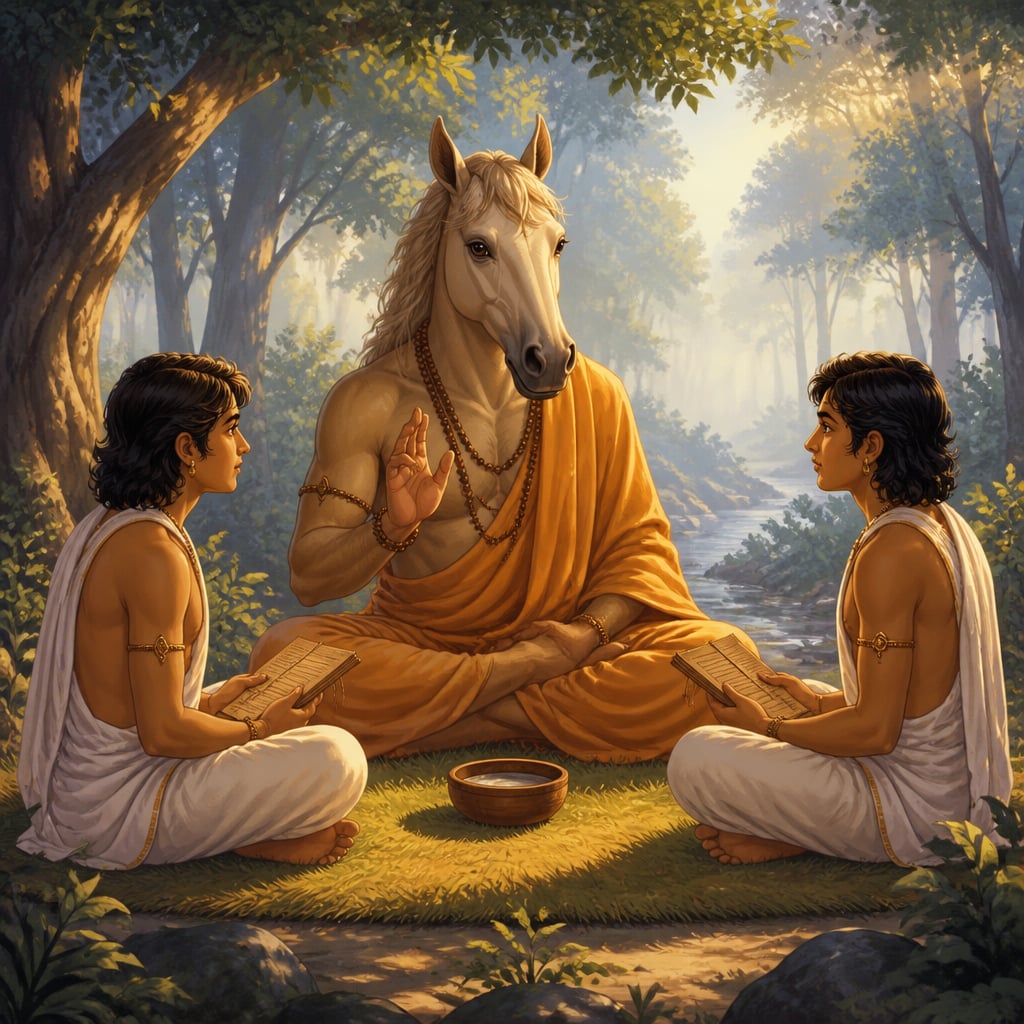
Rishi Dadhyanc teaching the Ashvin twins

This is śauryam, the courage that acts without aggression, that confronts without combat, that persists without violence.

Śauryam: The Courage Distinction

In a world that often conflates strength with aggression and courage with violence, the Vedic understanding of śauryam offers an alternative. Dadhyanc and Gargi demonstrate that courage can be generative rather than destructive, that heroism can be measured in truths spoken rather than enemies defeated. This reframing is as relevant now as it was four thousand years ago.

The Sanskrit tradition makes distinctions that English blurs. Śauryam (from śūra, hero) is heroic courage, the quality of a true hero. But the Vedic hero is not defined by how many enemies they defeat. The hero is defined by what they have the courage to do.

Śauryam differs from:

Term Meaning Quality
Krodha Anger Reactive, hot, often destructive
Āgression Attack-impulse Initiated violence, domination-seeking
Bala Physical force Capacity for violence
Śauryam Heroic courage Capacity for right action despite fear

The Rig Veda celebrates Indra's śauryam in slaying Vritra, but this isn't glorification of violence. It's celebration of the courage to break through obstruction. When the same hymns describe śauryam in other contexts, the emphasis shifts to moral courage, truth-speaking, and steadfast action.

"satyáṃ bṛhád ṛtám ugrám" "Truth, vastness, cosmic order, and fierce courage..."

Here ugra (fierce, formidable) describes a quality of truth itself, not the violence of the truth-speaker but the power of truth to transform.

The Dadhyanc Teaching: Courage as Transmission

Dadhyanc's story reveals a specific form of śauryam: the courage to transmit what matters despite personal cost.

The Madhu-vidyā he shared wasn't trivial knowledge. According to the Brihadaranyaka Upanishad, it's the understanding that all beings are interconnected like honey in a honeycomb, each cell containing the essence of the whole. This knowledge was transformative and, apparently, dangerous to those who hoarded power.

Dadhyanc's courage wasn't displayed in battle but in teaching. He risked his head, literally, to ensure wisdom reached those who needed it. The Rig Veda honors him:

"dadhyáṅṅ ha me jánuṣaṃ vet́tha" "Dadhyanc knows my origin..."

This is spoken by the Ashvins, acknowledging that through Dadhyanc's courage, they gained knowledge of their own deepest nature. His śauryam was generative, not destructive.

Traditional Readings: Courage and Dharma

Sayana's commentary links śauryam explicitly to dharmic action, courage is the capacity to do what is right regardless of consequences. This isn't blind fearlessness but reasoned commitment to righteousness.

The distinction matters. Foolhardy courage, rushing into danger for its own sake, is not śauryam but sāhasa (recklessness). True śauryam involves:

  1. Discernment (viveka): Knowing what action is right
  2. Steadiness (dhairya): Maintaining resolve despite fear
  3. Non-attachment (vairāgya): Acting without grasping at outcomes

Sri Aurobindo's psychological reading adds another dimension. For him, śauryam is the courage to face inner truth, the willingness to see ourselves clearly, to confront our own Vritras, to pursue self-knowledge despite the ego's resistance. This is perhaps the most demanding courage of all.

Rahul Dravid: The Wall's Quiet Courage

Rahul Dravid defending a delivery at the crease

In Indian cricket, aggression is celebrated. Batsmen who dominate bowlers, who hit sixes, who sledge opponents, these receive the most attention. Against this backdrop, Rahul Dravid presented a different model of courage.

Known as "The Wall," Dravid's strength was patience. He faced the fastest bowlers in the world not by attacking them but by simply not getting out. His courage manifested as presence, being there, ball after ball, session after session, refusing to yield.

This required a different kind of bravery:

When Dravid became India's coach, the same śauryam manifested. He didn't revolutionize with aggressive tactics. He built foundations, developed players patiently, and created a culture where young cricketers could grow without fear of failure.

India's historic Test series wins in Australia (2021) and victories across conditions emerged from this patient courage. No chest-thumping, no aggressive posturing, just steady, skillful persistence.

The Aggression Trap

Modern culture often conflates courage with aggression. We celebrate "crushing it," "destroying the competition," "dominating the market." But the Vedic understanding suggests this conflation has costs.

Aggression requires an enemy. When courage is defined as fighting, we need something to fight. This creates adversarial relationships where none need exist and escalates conflicts that could be resolved.

Aggression depletes. The physiology of aggression, cortisol, adrenaline, sympathetic nervous system activation, cannot be sustained. Aggressive courage burns out; steady courage endures.

Aggression narrows. When we're in aggressive mode, we see fewer options, consider fewer perspectives, make more mistakes. Śauryam, by contrast, maintains clarity even under pressure.

The Rishis understood that true strength doesn't require defeating others. Dadhyanc didn't defeat Indra; he found a way to act rightly despite Indra's threat. Dravid didn't dominate bowlers; he outlasted them. The courage to endure, persist, and act rightly often accomplishes more than the courage to attack.

Śauryam in Daily Life

Heroic courage sounds grand, but śauryam manifests in ordinary moments:

None of these require aggression. All require courage. The Vedic insight is that these daily acts of śauryam, quiet, unflashy, persistent, may be more heroic than any battlefield victory.

The Practice of Non-Aggressive Courage

Developing śauryam is a practice, not a personality trait:

Notice the aggression impulse: When fear arises, notice if your first response is to attack, to argue, to dominate, to prove someone wrong. This impulse is natural but not necessary.

Find the action beneath the reaction: What actually needs to be done? Often the aggressive response is a detour around the real action required.

Act from center, not from fear: Śauryam arises from groundedness, not from the frantic energy of threatened ego. Pause. Breathe. Then act.

Measure success differently: Not "Did I win?" but "Did I act rightly? Did I maintain my integrity? Did I contribute to resolution rather than escalation?"

Dadhyanc's head was restored. But even if it hadn't been, his śauryam would stand. The courage was in the action, not the outcome.

Courage and the Next Challenge

Śauryam prepares us for perhaps the greatest psychological challenge: recovering after failure.

The courage to act without aggression often means the courage to act without certainty of success. Sometimes we speak truth and are punished for it. Sometimes we persist and still lose. Sometimes we do everything right and the outcome is still painful.

The next lesson explores what happens then, how the Rishis understood setback, failure, and the strength to rise again.

Research by psychologist Albert Bandura distinguishes 'proactive aggression' (initiated violence) from 'reactive aggression' (defensive response). Neither is the same as courage. Many aggressive acts are actually expressions of fear wearing a dominant mask. True courage often requires inhibiting the aggressive impulse.

Jim Collins's research on 'Level 5 Leaders' found that the most effective leaders combine 'professional will' (fierce resolve) with 'personal humility' (absence of ego-aggression). This is śauryam in organizational context, strength without domination.

Systems tend toward equilibrium. Aggressive intervention often triggers counter-reactions that neutralize the change. Patient, persistent influence, śauryam rather than attack, often produces more durable transformation.

Angela Duckworth's research on 'grit' shows that passion and perseverance for long-term goals predicts success better than talent. But grit requires a specific kind of courage, the dhairya to continue when feedback is slow and recognition absent.

Rahul Dravid's coaching philosophy centers on 'process over outcome', focus on doing the right things consistently rather than chasing results. This requires courage because results-focus feels more concrete. Trusting the process is an act of dhairya.

Complex systems change slowly. Donella Meadows noted that the most powerful leverage points are the hardest to change and require the longest commitment. System change requires endurance courage, dhairya sustained over years.

Case studies

Rahul Dravid: The Wall's Philosophy of Courage

In a cricket culture that celebrated aggressive batsmen, Sachin's drives, Sehwag's attacks, Dhoni's finishes, Rahul Dravid chose a different path. His Test batting average of 52.31 came not from dominance but from defense. His 36 Test centuries came not from attacking spells but from patient accumulation. He faced over 31,000 balls in Test cricket, more than anyone in history, not through aggression but through what he called 'the courage to be boring.'

Dravid exemplifies śauryam as endurance rather than attack. His courage was in facing Brett Lee at 150 kmph and simply... surviving. Not counter-attacking. Not dominating. Just being there, ball after ball. When he became India's head coach (2021-2024), he brought the same philosophy: build foundations, trust process, develop players without pressure for immediate results. His śauryam was patience elevated to heroism.

Under Dravid's coaching, India won historic Test series in Australia (2021), reached the World Test Championship Final twice, and developed a generation of players who could win in any conditions. His 'Wall' approach, courage through presence rather than aggression, became India's dominant cricketing philosophy.

Courage doesn't require flash. Sometimes the most heroic thing is to simply not yield, to stay present when others would react, to maintain steadiness when aggression seems easier. Dravid proved that dhairya can be as powerful as any attack.

In fast-paced industries that reward flashy moves and bold pivots, the quiet consistency of someone who simply refuses to make unforced errors is often undervalued. Dravid's 'Wall' philosophy maps onto the reliable team member, the steady investor, or the parent who shows up every day without drama. Endurance is a form of courage that compounds over time.

Dravid faced 31,258 deliveries in Test cricket, if laid end to end, that's over 8 hours of facing bowling at the highest level. His career was built not on moments of brilliance but on sustained presence. That's śauryam measured in hours.

Gargi Vachaknavi: The Courage to Question

In the court of King Janaka, a philosophical debate was announced with a thousand cows as prize. The great sage Yajnavalkya claimed victory. But before he could leave, the woman philosopher Gargi Vachaknavi rose to question him. In a society where women rarely participated in such debates, and where challenging the greatest sage of the age was itself audacious, Gargi asked question after penetrating question about the nature of reality. She pushed until Yajnavalkya finally said, 'Gargi, do not question too much, lest your head fall off.'

Gargi's courage was not aggressive but persistent. She didn't attack Yajnavalkya; she questioned him. Her śauryam was intellectual, the courage to pursue truth through dialogue rather than combat. When Yajnavalkya warned her about her head, she stopped, not from fear but from recognizing that she had reached the limits of what dialogue could reveal. Her courage was in the questioning; her wisdom was in knowing when to stop.

Gargi is remembered as one of the great Vedic philosophers. Her questions, about what weaves the universe, about the foundation beneath all foundations, became central to Upanishadic inquiry. Her courage in the debate established that philosophical inquiry transcends gender and that truth-seeking is itself a form of heroism.

The courage to question can be as profound as the courage to fight. Gargi faced the greatest sage of her age not with weapons but with inquiry. Her śauryam was in refusing to accept easy answers, in pushing past social constraints, in treating truth as worth whatever discomfort its pursuit required.

Gargi's willingness to challenge the most respected authority in the room is directly relevant in workplaces where junior employees hesitate to question senior leaders. Psychological safety research by Google's Project Aristotle found that teams where people feel safe to ask hard questions outperform teams where they do not. Intellectual courage is a measurable competitive advantage.

Gargi is one of only two women recorded as debating in a royal philosophical assembly in Upanishadic literature, and the only one who challenged the sage Yajnavalkya to the point where he warned her to stop.

Reflection

More in Vīrya: Strength Beyond the Body

All lessons in Vīrya: Strength Beyond the Body · Rig Vedic Psychology course