Indra-tattva: The Breakthrough Force Within
How the Rishis Understood Psychological Energy
Exploring Indra not as an external deity but as the psychological force of breakthrough, illumination, and decisive action, the inner energy that shatters obstacles and releases blocked potential.
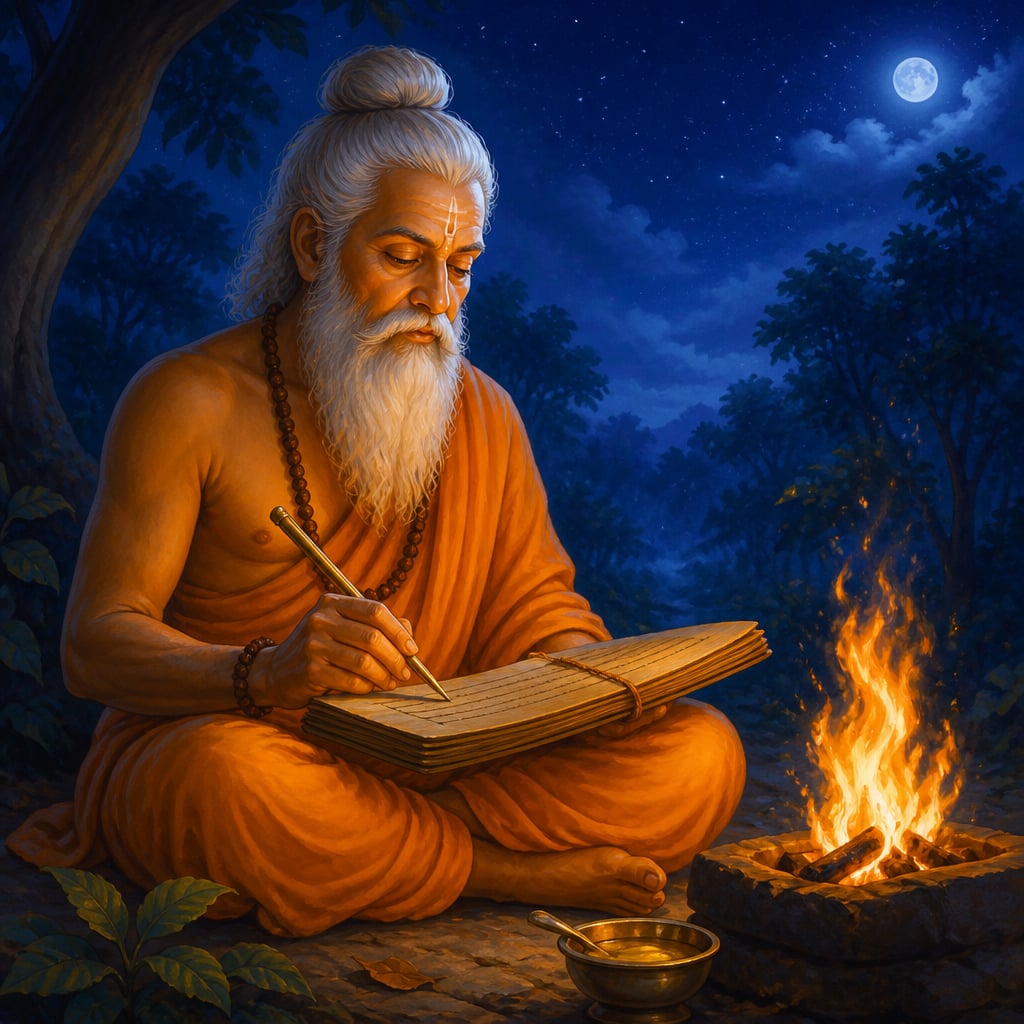
Vasishtha sat alone before the fire, composing a hymn that would echo through millennia. Other Rishis sang to Indra for victory in battle, for rain, for protection from enemies. Vasishtha was asking something different.
"When will Indra come to me?" he wrote. But as the words formed, he understood the question differently. Not when will Indra arrive from some celestial realm, but when will I awaken the Indra-force within myself? When will the breakthrough come, not from outside, but from the depths of my own being?
This was Vasishtha's revolutionary insight: Indra is not merely a god to be propitiated. Indra is a tattva, a principle, a psychological reality that exists within every person. The question isn't whether Indra exists "out there." The question is whether you can access the Indra that exists within.
The Indra Principle: Beyond Mythology
Understanding Indra as a psychological principle transforms how we approach obstacles. Instead of passive hoping or mere effort, we gain access to technologies of breakthrough developed over millennia. The Rishis weren't naive worshippers of storm gods, they were practical psychologists who developed methods for invoking peak states. These methods remain available today.
Indra receives more hymns in the Rig Veda than any other deity, over 250 suktas celebrate his power. Western scholars long dismissed this as primitive nature worship: Indra as the storm god, bringer of rain. But this reading misses the psychological depth that traditional commentators have always seen.
Sri Aurobindo, in The Secret of the Veda, reads Indra as the illumined Mind, the force within us capable of breakthrough perception and decisive action. When the Rishis invoke Indra, they're not praying for external intervention. They're calling forth a capacity that lies dormant within.
"indraṃ mitráṃ váruṇam agním āhur" "They call him Indra, Mitra, Varuna, Agni..."
The Rig Veda itself acknowledges that the Devas are aspects of a single reality called by different names. Indra is the name for that reality when it manifests as breakthrough force, the energy that shatters obstacles, releases what is blocked, illuminates what was dark.
What Makes Indra Unique: The Slayer of Vritra
Indra's defining act is the slaying of Vritra, the serpent demon who coils around the cosmic waters, withholding them from the world. This isn't just mythology. Read psychologically, Vritra represents everything that constricts, blocks, and withholds our vitality.
We all know Vritra. It's the procrastination that keeps us from starting. The fear that freezes us before action. The inertia that whispers "not today, not now, not you." Vritra is the inner obstruction that holds our waters hostage.
Indra is the force that breaks through.
As the Rig Veda declares:

"áhan vṛtráṃ vṛtratáraṃ vyàṃsam índro vájreṇa mahatā́ vadhéna" "Indra slew Vritra, the greater Vritra, the shoulderless one, with his great weapon, the vajra."
The vajra, Indra's thunderbolt, is described as irresistible. Once thrown, it cannot fail. In psychological terms, the vajra is the focused intention that cuts through hesitation. It's the moment when accumulated energy finally breaks free.
Sayana and Aurobindo: Two Lenses
Sayana's traditional commentary emphasizes Indra's role in maintaining cosmic order. When Vritra blocks the waters, drought ensues, both literal and metaphorical. Indra's intervention restores flow. This aligns with the Rig Vedic worldview where ritual invocation participates in cosmic maintenance.
Sri Aurobindo deepens this reading. In his interpretation, the waters Vritra withholds are not merely rain but āpaḥ, the flowing energies of consciousness, inspiration, and creative force. Vritra represents the fundamental resistance to evolution that exists in matter, mind, and spirit. Indra is the divine force that enables upward breakthrough.
Both readings converge on a practical point: you can invoke Indra. Whether you understand this as prayer to an external deity or awakening an internal capacity, the technology remains the same. Through focused intention, mantra, and tapas, the breakthrough force can be called forth.
The Breakthrough Moment: Neeraj Chopra at Tokyo

On August 7, 2021, Neeraj Chopra stood on the javelin runway in Tokyo's Olympic Stadium. India had never won an Olympic gold in athletics. Not in 100 years of trying. The pressure was immense, over a billion people watching, decades of near-misses weighing on the moment.
His first throw: 87.03 meters. Good, but not decisive.
His second throw: 87.58 meters. Still anyone's competition.
Something shifted. In interviews, Neeraj describes entering a state of complete focus, not trying harder, but becoming somehow more present. His body knew what to do. His mind wasn't interfering. The Vritra of self-doubt and overthinking had been temporarily slain.
Throw after throw, he maintained that zone. 87.58 meters held for gold.
What happened? The Rishis would recognize it immediately: the Indra-tattva manifested. Not as external help, but as a breakthrough state where accumulated preparation meets focused presence. The waters that had been blocked, India's athletic potential, Neeraj's own capability, finally flowed free.
Invoking Indra: The Practice
The Rishis didn't wait for breakthrough to happen accidentally. They developed technologies for invoking Indra, for deliberately calling forth the breakthrough force.
Soma was central to this practice. Whether Soma was a plant, a preparation, or a metaphor for inner experience remains debated. What's clear is that Soma rituals were designed to shift consciousness, to create the conditions where Indra could manifest.
Mantras served as invocations. The sounds themselves were believed to awaken corresponding forces. Chanting Indra hymns wasn't just devotion; it was psychological technology.
Tapas, disciplined practice, built the capacity for breakthrough. Indra doesn't manifest in an unprepared vessel. The Rishis understood that breakthrough requires accumulated pressure, like steam building until the whistle blows.
Your Indra Capacity
Every person has experienced moments of breakthrough, when effort suddenly becomes effortless, when obstacles that seemed insurmountable simply give way. These aren't random. They follow patterns.
Psychologist Mihaly Csikszentmihalyi calls it "flow", the state where challenge meets skill perfectly, and action seems to arise spontaneously. Athletes call it "the zone." The Rishis called it Indra-possession, not being taken over by an external force, but having your inner Indra fully activated.
The question isn't whether you have this capacity. Everyone does. The question is whether you've learned to invoke it, or whether you wait passively, hoping breakthrough will find you.
Vasishtha's insight stands: Indra is not far away. Indra is not a matter of luck or divine favor. Indra is a force within you, coiled and waiting, ready to be invoked. The waters of your vitality are held back by your own Vritra. The vajra that will shatter that obstruction is already in your hand.
The only question is: when will you throw it?
Peak performance research shows that visualizing past successes activates the same neural pathways as the original success. When stuck, recalling times you broke through obstacles literally primes your nervous system for breakthrough.
Great leaders invoke organizational 'Indra moments', the times the company overcame impossible odds. These stories aren't just inspiration; they're psychological technology for creating new breakthroughs.
Complex systems often remain stuck until a threshold is crossed, then change rapidly (phase transitions). The Vedic model of sudden breakthrough maps to how real systems actually transform.
Psychologist Peter Gollwitzer's research on 'implementation intentions' shows that specific if-then plans ('If X happens, I will do Y') dramatically increase follow-through. This is vajra-forging: making intention concrete and irresistible.
Jeff Bezos's 'disagree and commit' principle reflects the vajra: once a decision is made, implement with full force. Hedged intention accomplishes nothing. The vajra cannot be 'sort of' thrown.
System leverage points require focused intervention. Spreading effort across many points dilutes impact. The vajra principle says: find the right point and strike with complete force.
Case studies
Neeraj Chopra: The Vajra Throw at Tokyo
On August 7, 2021, Neeraj Chopra entered the javelin final at the Tokyo Olympics carrying the weight of India's 100-year athletics drought. No Indian had ever won Olympic gold in athletics. The pressure was immense, his throws were being watched by over a billion people. In the final, after two throws that put him in medal position but not decisively ahead, something shifted. Neeraj entered what athletes call 'the zone', a state of complete presence where overthinking stopped and his body simply executed years of preparation. His 87.58-meter throw held for gold.
Neeraj's gold medal throw exemplifies the Indra-tattva manifesting. The Vritra he faced wasn't just other competitors but the accumulated weight of India's athletic history, his own self-doubt, and the paralysis that pressure can bring. His breakthrough came not from trying harder but from entering a state where the inner Indra could act, preparation, focus, and presence converging in a single decisive moment. The javelin became his vajra.
Neeraj won India's first Olympic athletics gold, then went on to win the 2023 World Championship and 2024 Paris Olympics silver. More significantly, his victory broke a psychological barrier for Indian athletics, proving breakthrough was possible opened the way for others.
Breakthrough often looks like effortlessness because the inner Indra has taken over. Years of preparation create the conditions; focused presence throws the vajra. The moment itself is sudden, decisive, and transforms everything that follows.
Flow states, where action becomes effortless and performance peaks, are now studied across sports, surgery, music, and software engineering. These states share a common pattern: extensive preparation followed by complete present-moment focus. Neeraj Chopra's gold-medal throw is a textbook example of what psychologist Mihaly Csikszentmihalyi called 'optimal experience.'
Neeraj's 87.58m gold-winning throw was only his second-best of the competition, but it was the throw where pressure, preparation, and presence aligned. The Indra-tattva doesn't guarantee the technically best performance; it produces the performance that achieves breakthrough.
Vasishtha's Triumph Over Vishvamitra: Inner Power Over Outer Force
The legendary rivalry between Rishis Vasishtha and Vishvamitra illustrates the Indra principle perfectly. Vishvamitra was a powerful Kshatriya king who tried to take Vasishtha's divine cow Kamadhenu by force. Despite bringing his entire army, every attack failed, Vasishtha's inner power (brahmatejas) simply neutralized military might. Frustrated, Vishvamitra realized that outer force (bala) could never overcome inner spiritual power. He renounced his kingdom and undertook severe tapas for thousands of years to become a Brahmarishi, to develop his own inner Indra.
This story demonstrates that the true Indra-tattva is not about external power but inner capacity. Vasishtha didn't fight Vishvamitra's army, he simply stood in his power, and the army couldn't touch him. His breakthrough was already complete; Vishvamitra's Vritra was trying to achieve through external force what only inner development could provide. Vishvamitra's eventual success came not from more armies but from cultivating his own inner Indra through tapas.
Vishvamitra eventually became one of the greatest Rishis, perceiving the Gayatri Mantra through his deep tapas. His story shows that the Indra-tattva can be developed by anyone, even a warrior king who initially relied only on external power. The path is through tapas, not conquest.
External force cannot overcome established inner power. The true breakthrough is internal. Vishvamitra's real victory wasn't over Vasishtha, it was over his own Vritra: the assumption that outer power was sufficient.
Many workplace conflicts pit positional authority against genuine expertise. The manager who demands compliance through title alone often loses to the colleague whose competence commands natural respect. Vasishtha's calm power over Vishvamitra's brute force is a template for navigating office politics with integrity rather than aggression.
Vishvamitra's transformation from Kshatriya king to Brahmarishi took multiple lifetimes of effort according to tradition, representing the only such category-crossing transformation recorded in Vedic literature.
Reflection
- What is the Vritra in your life right now, the obstruction that's withholding your 'waters' of vitality and potential? What would it take to slay it?
- Have you ever experienced a breakthrough moment, where obstacles suddenly collapsed and action became effortless? What conditions preceded that breakthrough?
- If Indra is a principle within rather than an external deity, what does 'invocation' actually mean? How does one invoke a psychological capacity?