Tṛṣṇā: When Desire Becomes Excess

Understanding When Healthy Wanting Becomes Consuming Craving

The Rig Veda recognized that desire, like fire, can either illuminate life or consume it. This lesson explores tṛṣṇā, the thirst that cannot be quenched, examining how healthy longing can transform into compulsive craving, and what the Vedic seers observed about the psychology of excess.

A disciple once approached his guru with a strange complaint. 'I have achieved everything I wanted,' he said. 'I have wealth, family, position. Yet I feel emptier than when I had nothing. The more I acquire, the more I want. What illness is this?'

The guru smiled. 'You have discovered tṛṣṇā, the thirst that drinking cannot satisfy. The Rig Veda describes it as water poured onto sand. No matter how much you pour, the sand remains thirsty. Your achievements have fed the sand, not the root.'
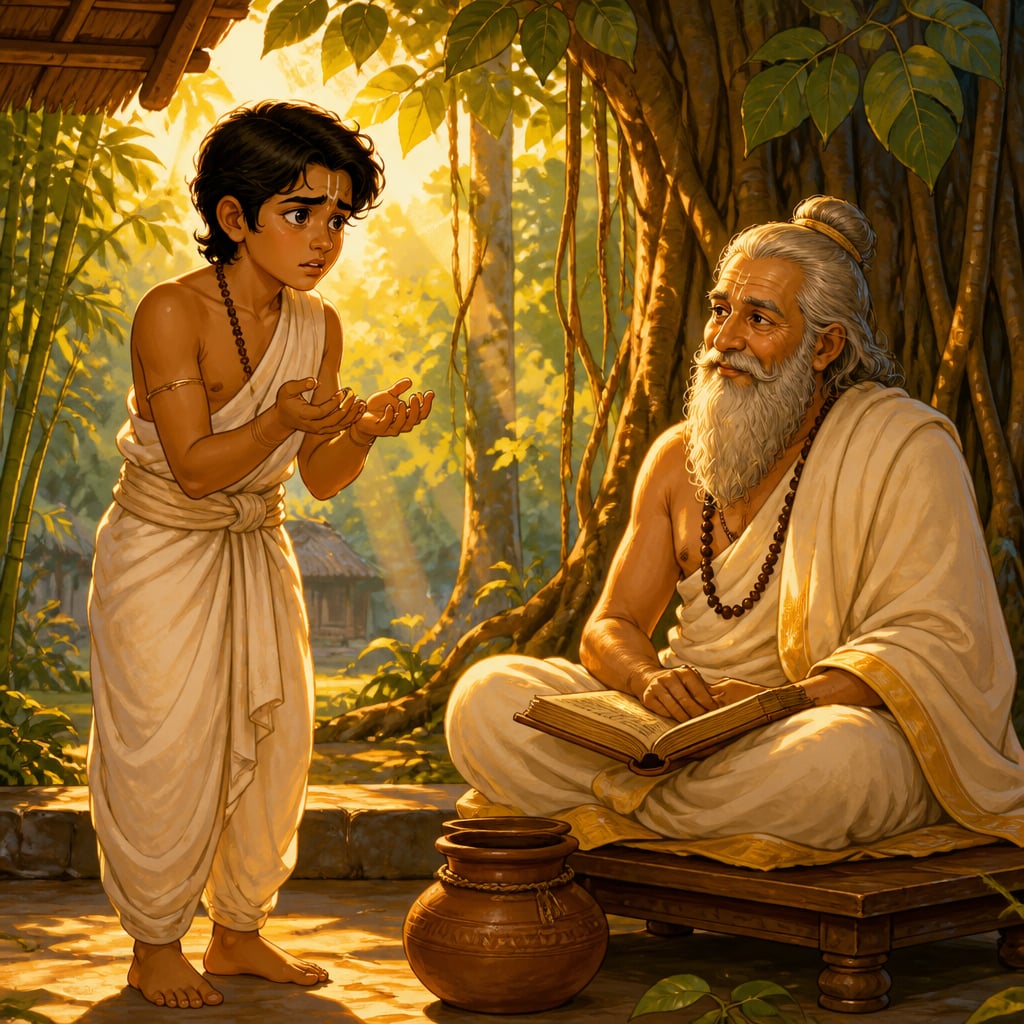
Disciple bringing complaint to forest guru

This distinction, between kāma (natural desire) and tṛṣṇā (compulsive craving), represents one of the Vedic seers' most profound psychological insights, later developed extensively in Buddhist and Jain traditions. It offers a non-moralistic understanding of excessive desire, not as sin but as misdirected seeking. This psychological precision allows for intervention without shame: understanding the mechanism of craving opens paths to freedom without requiring self-condemnation.

They understood that desire itself is not the problem. Desire moves us toward food when hungry, toward warmth when cold, toward connection when lonely. It is the intelligence of life seeking its needs.
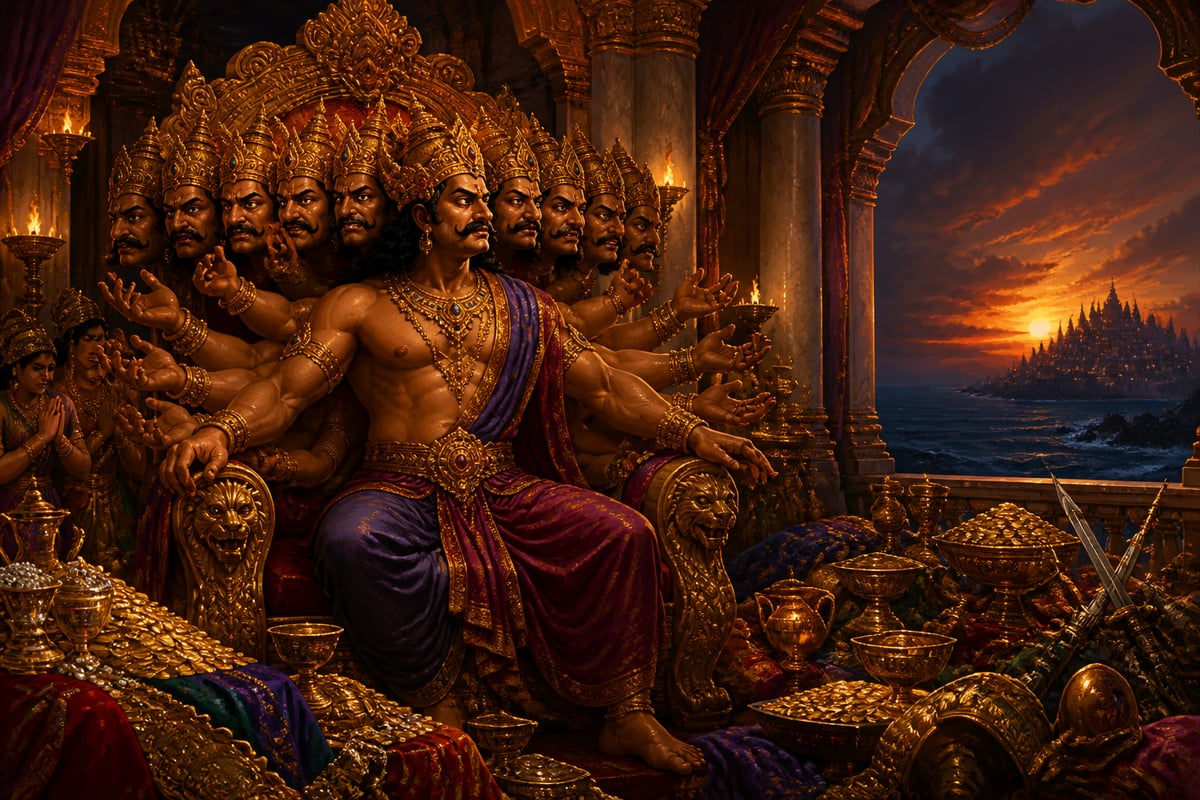
Ten-headed Ravana on golden Lanka throne

But tṛṣṇā is different. The word literally means 'thirst', but not ordinary thirst that water satisfies. Tṛṣṇā is the thirst that increases with every drink. It is desire disconnected from need, want divorced from wisdom. The Rig Veda observes this phenomenon with remarkable precision: 'Like flames fed by wind, craving grows stronger by being fed.'

How does healthy kāma become destructive tṛṣṇā? The seers identified several mechanisms. First is disconnection, when we lose touch with the original need that sparked the desire. A person begins wanting security and ends wanting unlimited wealth. The original purpose is forgotten; only the wanting remains. Second is substitution, using one form of fulfillment to address a different kind of emptiness. Seeking recognition to fill a need for love. Seeking possessions to fill a need for meaning. The desire can never be satisfied because it's addressing the wrong hunger.

Third, and perhaps most subtle, is the phenomenon the seers called 'the hunger of the fed.' This occurs when satisfaction itself becomes unsatisfying. The moment of acquisition is followed immediately by a new want. Vedic psychology suggests this happens when we mistake the excitement of wanting for the fulfillment of having. We become addicted to desire itself, not to its object.

The Ṛṣis distinguished between two directions of desire. Pravṛtti is desire that moves outward, seeking more, expanding, acquiring. Nivṛtti is desire that turns inward, seeking depth, consolidating, understanding. Neither is inherently superior, but tṛṣṇā develops when pravṛtti loses all connection to nivṛtti, when expansion has no corresponding deepening.

Woman scrolling phone in bed at 1 AM

Consider how this manifests. A person wants a comfortable home. This is natural kāma. They acquire one, but immediately want a larger one. Then a second home. Then a collection of properties. Each acquisition brings brief satisfaction followed by expanded want. They have forgotten what 'home' was originally meant to provide, shelter, belonging, rest. They are now collecting homes while remaining homeless in their hearts.

The Rig Veda offers a diagnostic question: 'Does fulfillment bring peace or does it bring new restlessness?' If achieving what you wanted creates relief and gratitude, the desire was aligned with genuine need. If achievement immediately generates new wanting, tṛṣṇā is present.

This is not a call to desirelessness. The seers were clear that kāma is essential to life. Without desire, there is no growth, no creation, no participation in existence. The goal is viveka, discrimination between wants that serve life and wants that consume it. Between fires that warm and fires that burn.

The transformation from kāma to tṛṣṇā often happens unconsciously. We don't decide to become insatiable; we drift there through small steps. Each step seems reasonable. Each expansion feels necessary. Only in retrospect do we see how far we've traveled from our original shores.

The Vedic remedy begins with attention. Simply noticing: 'I am wanting again. Has the previous want been fulfilled? Did that fulfillment bring the peace I expected?' This pause breaks the automatic cycle. It creates space between stimulus and response, between want and pursuit.

The seers also prescribed santosh, contentment not as passive resignation but as active appreciation. Dwelling in what has been received rather than rushing toward what hasn't. This is not complacency; it is allowing fulfillment to complete its work before moving to the next desire.

Most radically, Vedic psychology suggests that behind all tṛṣṇā lies a single unfulfilled desire, the desire for wholeness, for connection to our deepest nature. When this primary desire remains unaddressed, we try to satisfy it through secondary objects. We seek in multiplicity what can only be found in depth.

As one Vedic verse states: 'The one who knows the Self is satisfied. Having found the infinite, what finite thing could they lack?' This is not suppression of desire but its ultimate fulfillment, wanting the one thing that, once obtained, transforms all other wanting.

Case studies

India's Endless Scroll: The Smartphone Tṛṣṇā Epidemic

India now has over 750 million smartphone users, with average daily screen time exceeding 4.5 hours. A 2024 study found that 67% of Indian users check their phones within 5 minutes of waking, and 54% report anxiety when separated from their devices. The 'infinite scroll' design of social media apps perfectly exemplifies tṛṣṇā, each video or post provides momentary satisfaction while creating desire for the next. Like the Vedic image of fire fed with ghee, engagement grows rather than diminishes with use. Users report feeling empty after hours of scrolling, having consumed much but retained nothing. The design explicitly exploits tṛṣṇā psychology: variable rewards, social comparison, and fear of missing out create compulsive use patterns. What began as tools for connection have become engines of disconnection, from present experience, from deep work, from meaningful relationship. The pattern mirrors ancient descriptions of tṛṛṇā: the more we consume, the hungrier we become; the more connected we are, the lonelier we feel.

The infinite scroll is the digital equivalent of 'desire fed by ghee', each consumption strengthens rather than satisfies the craving. The Vedic seers would recognize the fundamental problem: seeking in quantity what can only be found in quality, pursuing connection through mechanisms designed to prevent the depth connection requires.

The smartphone addiction cycle demonstrates trishna in digital form: each scroll provides momentary satisfaction while deepening the craving. Users report feeling emptier after hours of consumption, having consumed much but retained nothing meaningful.

Awareness of the tṛṣṇā mechanism is the first step toward freedom. When we understand that the design deliberately feeds craving without satisfying it, we can choose to step outside the loop. Practices like phone-free mornings, app time limits, and intentional digital use apply Vedic viveka (discrimination) to modern technology.

App designers openly describe their goal as maximizing 'time on device,' using variable reward schedules identical to slot machines. Understanding that your phone is engineered to exploit the craving-without-satisfaction cycle gives you the awareness to set boundaries. Screen time limits, grayscale mode, and notification batching are practical modern equivalents of the Vedic discipline of samyama.

A 2024 study found that 67% of Indian smartphone users check their phones within 5 minutes of waking, and average daily screen time exceeds 4.5 hours across 750 million users.

Ravana's Consuming Desire: The King Who Had Everything

Ravana, king of Lanka, possessed everything a being could desire. His kingdom was made of gold. He had conquered the gods themselves. His knowledge of the Vedas was unparalleled; he was such an accomplished musician that his veena playing could move the cosmos. He had wives, wealth, power, knowledge, artistic mastery, yet he could not rest. His desire for Sita, the wife of Rama, despite having everything else, perfectly illustrates tṛṣṇā. He did not need another wife; he had thousands. He did not lack for beauty around him; Lanka was filled with celestial beings. His desire for Sita was pure tṛṣṇā, wanting disconnected from need, craving that completion could never address because the emptiness was internal. His advisors, his brother Vibhishana, even Sita herself warned him. But tṛṣṇā cannot hear reason. The more obstacles to his desire, the more intensely he wanted. His kingdom's destruction, his sons' deaths, his own demise, all stemmed from a desire that was never really about its object. Ravana was seeking in Sita what no external acquisition could provide: a sense of completeness that his mountains of achievement had failed to create.

Ravana embodies the Vedic teaching that external acquisition cannot address internal emptiness. His story demonstrates that tṛṣṇā is not about the object desired but about the desirer's inner state. No amount of having can satisfy a being who has not addressed the fundamental question of being.

Ravana's uncontrolled desire led to the destruction of Lanka, the death of his sons and warriors, and his own demise at Rama's hands. His entire kingdom fell because the void within could not be filled by any external acquisition.

Ravana's story appears daily in modern form: successful people whose achievements bring no peace, whose acquisitions only reveal new lacks. The lesson is not that desire is wrong but that desire disconnected from self-understanding becomes self-destructive. The question is not 'What do I want?' but 'What in me is wanting, and what does it truly seek?'

The pattern of acquisition without satisfaction appears in every domain: collectors who cannot stop acquiring, executives who cannot stop expanding, influencers who cannot stop posting. Ravana's story is a diagnostic tool. When you notice that getting what you wanted only revealed a new want, you are seeing the mechanism clearly for the first time.

Ravana possessed mastery of all four Vedas, command over the three worlds, and a golden kingdom, yet his unfulfilled desire for Sita led to the destruction of Lanka and the death of his entire dynasty.

Reflection

More in Kāma-Bhaya: Fear, Desire & What Drives Us

All lessons in Kāma-Bhaya: Fear, Desire & What Drives Us · Rig Vedic Psychology course