Bhīti-Vaśa: When Fear Takes Over

When Protection Becomes Prison

Exploring what happens when fear crosses from protective signal to controlling force, how the Vedic tradition understood excessive fear, its distorting effects on perception and action, and the path back to balance.

The warrior stood frozen on the battlefield. Around him, armies clashed. Arrows flew, elephants trumpeted, and the earth shook with the march of thousands. But he could not move. His hands trembled. His bow, which had never failed him, slipped from his grip.

"I cannot do this," he whispered. "My limbs fail me. My mouth is dry. My skin burns. I cannot stand."

This was Arjuna, the greatest archer of his age, the hero who had never known defeat. Yet in the moment that mattered most, fear had taken him completely. His body had become a stranger. His mind, usually sharp as his arrows, was clouded with visions of disaster.

The Bhagavad Gita opens with this image: not of a coward, but of a hero overcome. Fear does not discriminate. It can seize anyone.
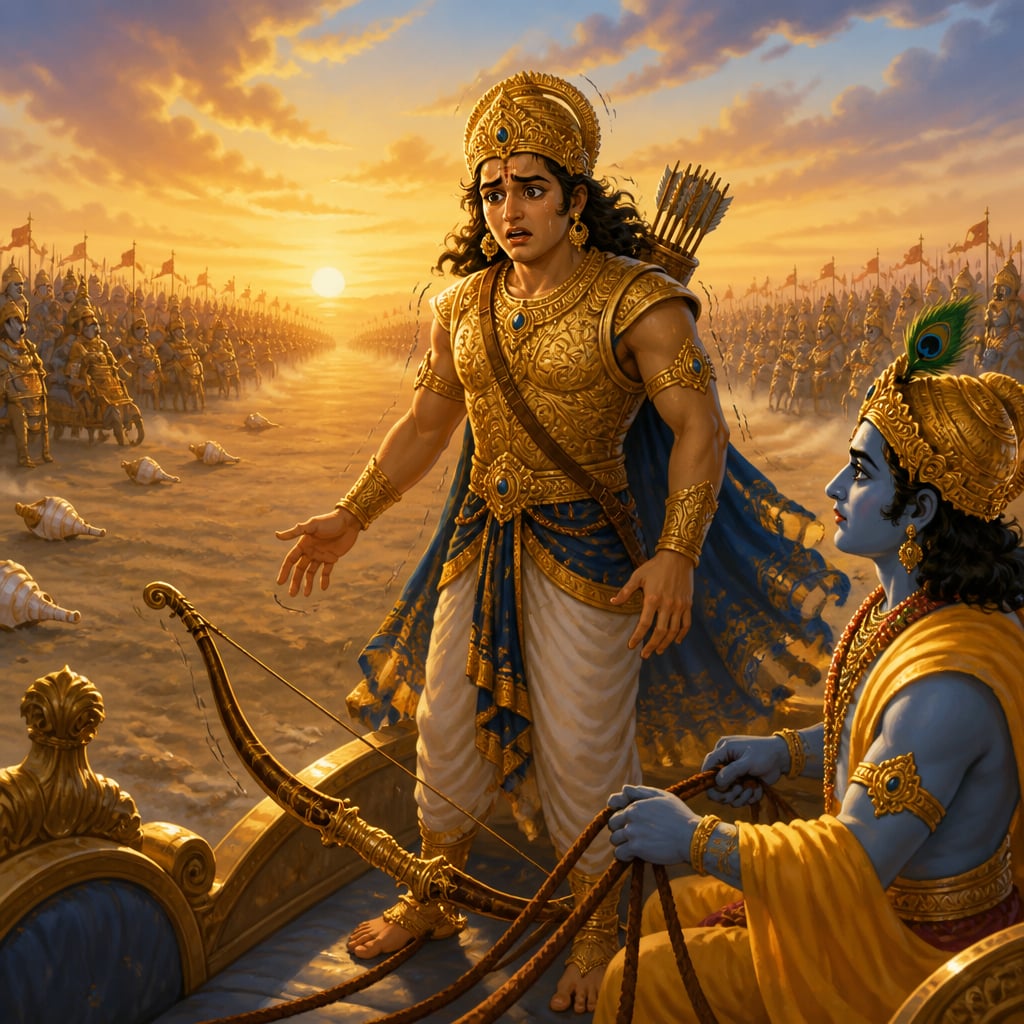
Arjuna frozen on Kurukshetra battlefield

When Fear Crosses the Line

Understanding that our ancestors faced and described the same fear-takeover we experience removes the isolation of anxiety. We are not broken; we are human. The Vedic tradition's systematic approach to fear, recognizing it, working with the body, examining beliefs, reconnecting to larger reality, remains directly applicable. These are not theoretical frameworks but practical technologies for managing our oldest and most powerful emotion.

In our previous lessons, we explored fear as a signal, a pointer toward our attachments, a protective mechanism that alerts us to threat. But what happens when the mechanism malfunctions? When the alarm keeps ringing even after the danger has passed? When fear stops serving us and starts controlling us?

The Vedic tradition had a term for this: bhīti-vaśa, being under fear's control. The word vaśa means power, dominion, control. When we are bhīti-vaśa, fear is no longer our servant but our master. We do not have fear; fear has us.

This distinction matters enormously. Healthy fear is a tool, it focuses attention, mobilizes energy, prepares us for action. But excessive fear does the opposite: it scatters attention, drains energy, and paralyzes action. The same mechanism that evolved to save us can, when dysregulated, destroy us.

The Rishis observed this with precision. They noted how fear, when it takes over, affects every dimension of being:

Arjuna experienced all of this. His viṣāda (despair) was not weakness of character but a description of what happens when fear overwhelms the system.

What the Mantras Reveal

The Rig Veda contains prayers that reveal the Rishis' understanding of fear's destructive potential:

"Mā bibher mā śucaḥ"

"Fear not, grieve not."

This phrase appears in contexts of reassurance, the divine voice speaking to the fearful devotee. Notice the pairing: fear (bibher, from bhī) and grief (śucaḥ, from śuc). The Rishis saw that excessive fear often carries grief within it, grief for the imagined loss that hasn't happened yet. When we are bhīti-vaśa, we mourn futures that exist only in our terrified imagination.

Another verse addresses fear's distorting power:

"Yad bhayāt tapati tapyamānam"

"That which, from fear, burns the one already burning."

Fear adds suffering to suffering. The threat itself may cause pain, but the fear of the threat adds a second layer of burning. The Vedic insight: much of our suffering comes not from what happens but from our fearful anticipation of what might happen.

Traditional Wisdom on Fear's Grip

Sayanacharya, in his commentaries, distinguished between bhaya (appropriate fear response) and bhīti (the state of being afraid). The first is situational and useful; the second becomes a trait, a habitual orientation to the world. When bhīti becomes chronic, we see danger everywhere, even where none exists.

Sri Aurobindo analyzed this in psychological terms. He saw excessive fear as arising from the vital being, the part of us concerned with survival, pleasure, and power, becoming dominant over the mental being (rational thought) and the psychic being (deeper wisdom). When fear takes over, it is the vital screaming so loudly that nothing else can be heard.

The remedy, Aurobindo taught, is not to silence the vital but to restore balance. The vital's fear is real, it genuinely perceives threat. But its perception is limited. The mind can assess whether the threat is actual. The psychic being can connect us to sources of strength beyond the threatened small self. Recovery from bhīti-vaśa requires activating these other faculties.

The Anatomy of Fear's Takeover

Duryodhana alone on throne at midnight

When fear crosses from protective to controlling, a predictable cascade occurs:

1. Narrowing of attention. Fear focuses us on the threat to the exclusion of everything else. This is useful when facing a tiger, but catastrophic when the "tiger" is an exam, a social situation, or an imagined future failure. We lose access to the full picture.

2. Distortion of perception. Fear magnifies threat and minimizes resources. The presentation feels like life-or-death. The exam becomes do-or-die. Small setbacks seem like permanent catastrophes. Meanwhile, our actual strengths, support systems, and options become invisible.

3. Collapse of time. Fear makes the future feel like the present. The disaster hasn't happened yet, but our body responds as if it already has. We suffer now for pain that may never come.

4. Paralysis of will. At extreme levels, fear freezes action. Arjuna could not lift his bow. Students cannot write despite knowing the material. Professionals cannot speak despite years of expertise. The capacity to act, which fear was supposed to protect, is destroyed by fear itself.

Living This Today

India is experiencing what mental health professionals call an "anxiety epidemic" among youth. A 2023 survey by NIMHANS found that 1 in 3 students preparing for competitive exams reported clinical levels of anxiety. Suicide rates among students have increased sharply. The pressure cooker of IIT-JEE, NEET, and other high-stakes exams has created a generation living in chronic bhīti-vaśa.

Consider what happens to a student in this state:

Engineering aspirant studying alone at 2 AM

The tragedy is that the fear is supposed to motivate success, but at high levels, it guarantees failure. The student who is paralyzed with anxiety cannot think clearly during the exam. The fear of failure becomes the cause of failure.

This is bhīti-vaśa in modern form. The threat (not getting into a prestigious institution) may be real. But the fear has crossed from useful signal to destructive master.

The Path Back to Balance

How do we return from bhīti-vaśa to healthy bhaya? The Vedic and yogic traditions offer a systematic approach:

1. Recognize the takeover. The first step is noticing that fear has become controlling. This requires the witness, the sākṣin we explored in earlier chapters. When you can observe "I am caught in fear" rather than simply being caught, space opens.

2. Work with the body. Fear lives in the body. Slow, deep breathing (what yoga calls prāṇāyāma) directly counters the physiological fear response. You cannot be in panic and breathing slowly simultaneously, the nervous system doesn't allow it.

3. Examine the belief. Excessive fear always rests on a belief, often the implicit promise we explored earlier: "If this bad thing happens, I will be destroyed." Question it. Is that true? Have people survived this outcome? What resources do you have that fear is hiding from you?

4. Expand the time frame. Fear collapses time to this moment of threat. Deliberately expand: What will matter in five years? In ten? This doesn't dismiss the challenge but restores proportion.

5. Connect to something larger. The Rishis prayed when afraid, not because gods would magically fix things, but because prayer reconnects the small, threatened self to larger reality. Whether through prayer, nature, community, or purpose, connection counters fear's isolating grip.

Anxiety disorders are characterized by the fear response becoming chronic and disproportionate. CBT teaches 'metacognition', thinking about thinking, observing fear rather than being lost in it. This parallels the Vedic approach: recognition is the first step to freedom.

Leaders under pressure often make worst decisions precisely when stakes are highest, fear distorts judgment. Effective leadership training includes recognizing one's fear-takeover patterns and developing practices to restore balance before making critical decisions.

Organizations can enter bhīti-vaśa collectively, panic spreading through teams, leading to reactive decisions that worsen the situation. Recognizing organizational fear-takeover allows intervention before the cascade becomes catastrophic.

Exposure therapy works by breaking the fear cascade through graduated action. Taking small steps toward what we fear, while managing the body's response, teaches the system that the feared situation is survivable. Action counters paralysis.

Leaders can help team members break fear-paralysis by calling them to their competence: 'You've handled harder things than this.' Reminding people of their actual capabilities counters fear's distortion that minimizes resources.

Breaking organizational fear-cascades requires introducing accurate information (countering distortion), expanding time horizons (countering collapse), and enabling small actions (countering paralysis). Leadership in crisis is cascade-breaking.

Your Path Forward

Arjuna's story does not end with his paralysis. Krishna's teaching, the entire Bhagavad Gita, is the response to fear's takeover. The cure is not willpower alone but wisdom: understanding the nature of the self, the nature of action, and the nature of reality itself.

This week, notice when fear crosses from signal to master. The indicators: racing thoughts, physical tension, catastrophic imagination, inability to act. When you notice these, pause. Breathe. Ask: "Is this fear serving me, or am I serving it?"

The question itself begins the return. Fear cannot maintain its grip when you are watching it. The witness is the way out.

In our next lesson, we explore the mirror image: what happens when desire becomes excessive, when wanting crosses from motivation to compulsion.

Case studies

India's Student Anxiety Epidemic: When Fear Becomes the Failing

India's competitive examination system, IIT-JEE, NEET, UPSC, has created what mental health professionals call an anxiety epidemic. A 2023 NIMHANS study found that 34% of students preparing for competitive exams met clinical criteria for anxiety disorders. Student suicides have increased, with Kota (the coaching hub) reporting multiple deaths annually. Students report studying 14-16 hours daily yet performing worse as exams approach. Parents describe children who were once curious and engaged becoming withdrawn, irritable, and physically ill with symptoms that have no medical cause.

This is bhīti-vaśa at population scale. The fear that was supposed to motivate preparation has crossed into controlling students' entire systems. The cascade is textbook: attention narrows to the exam (losing all other life dimensions), perception distorts (every mock test becomes life-or-death), time collapses (the exam feels like it's always happening), and will paralyzes (students cannot study effectively despite hours at their desks). The tragedy is that fear, which evolved to improve survival, is destroying the very cognitive functions needed for success. Memory consolidation requires sleep; anxiety prevents sleep. Clear thinking requires calm; anxiety creates mental chaos.

Schools and coaching centers that have introduced mindfulness practices, breathing exercises, and regular breaks report improved student performance and reduced anxiety. The Narayana Group introduced mandatory meditation periods and saw test scores improve. Students who maintain connections outside academics, sports, arts, family time, show greater resilience. The evidence is clear: managing fear improves performance; fear-takeover destroys it.

Fear as signal ('I should prepare well') serves students. Fear as master ('I will be destroyed if I fail') destroys them. The Vedic insight applies: the same force can serve or enslave depending on degree. Education systems that recognize this distinction and teach fear-management alongside content see better outcomes on every measure.

India's coaching industry generates over $7 billion annually, and student suicides linked to exam pressure remain tragically common. The distinction between fear as signal and fear as master is not academic philosophy. It is a survival skill. Teaching students to notice when preparation-anxiety crosses into identity-threat could save lives.

A 2022 study by IIT Delhi found that students who practiced 15 minutes of breathing exercises daily for three months before JEE scored an average of 12% higher than control groups, while reporting 40% lower anxiety levels.

Duryodhana's Paranoia: The Prince Devoured by Fear

Duryodhana, crown prince of Hastinapura, had everything: wealth, power, skilled allies, and the throne within reach. Yet from the moment the Pandavas demonstrated their abilities, Duryodhana lived in bhīti-vaśa. He could not sleep imagining Arjuna's prowess. He could not enjoy his wealth while the Pandavas existed. His fear of losing power led him to attempt murder (the lac palace), cheating (the dice game), and finally war. At each step, the fear-driven action created more enemies and brought closer the very catastrophe he feared.

Duryodhana's story is a clinical case of fear-takeover. His attention narrowed to the Pandavas (unable to see his many advantages), his perception distorted (five brothers became existential threat to a hundred), time collapsed (future loss felt present and unbearable), and his will surrendered to fear's demands (he could not choose peace even when offered). Bhishma and Vidura repeatedly counseled him, but fear had become his master. In bhīti-vaśa, wisdom cannot enter, the system is too contracted to receive it.

Duryodhana's fear-driven decisions led to the Kurukshetra war, the destruction of the Kaurava lineage, and his own death. The kingdom he feared losing was utterly destroyed, not by the Pandavas' strength but by his own fear-driven actions. His story illustrates the Vedic teaching: excessive fear does not protect what we value but destroys it. The tighter we grip from fear, the more we crush what we hold.

Duryodhana was not unintelligent or unadvised. He had Bhishma, Drona, and Vidura offering wisdom. But fear closed his ears. The lesson is not about his moral failure but about fear's power to override reason, ethics, and even self-interest. When bhīti-vaśa sets in, we cannot hear what would save us. This is why recognizing fear-takeover early is essential, once it fully grips, recovery becomes desperately difficult.

Duryodhana's pattern appears in corporate leaders who perceive every competitor as an existential threat and respond with aggression rather than strategy. Fear-driven decision-making in business leads to the same outcomes it led to in Hastinapura: destroyed alliances, squandered resources, and eventual collapse. Recognizing when fear is running the boardroom is a leadership skill.

Duryodhana rejected counsel from Bhishma, Drona, Vidura, and Krishna on at least 8 separate occasions recorded in the Mahabharata, illustrating how fear-driven thinking systematically overrides wise advice.

Reflection

More in Kāma-Bhaya: Fear, Desire & What Drives Us

All lessons in Kāma-Bhaya: Fear, Desire & What Drives Us · Rig Vedic Psychology course